Long before smartphones told people the date, entire cultures tracked time by watching animals. The Chinese zodiac is one of the oldest and most recognized systems of its kind, giving every year a face: a Rat, a Dragon, a Rabbit, a Pig. Millions of people still use it today to describe personality, plan important life events, and choose gifts and jewelry connected to the animal a person was born under. Its meaning has stayed relevant for thousands of years, which is exactly what makes the system worth understanding in more detail.
What Is the Chinese Zodiac?
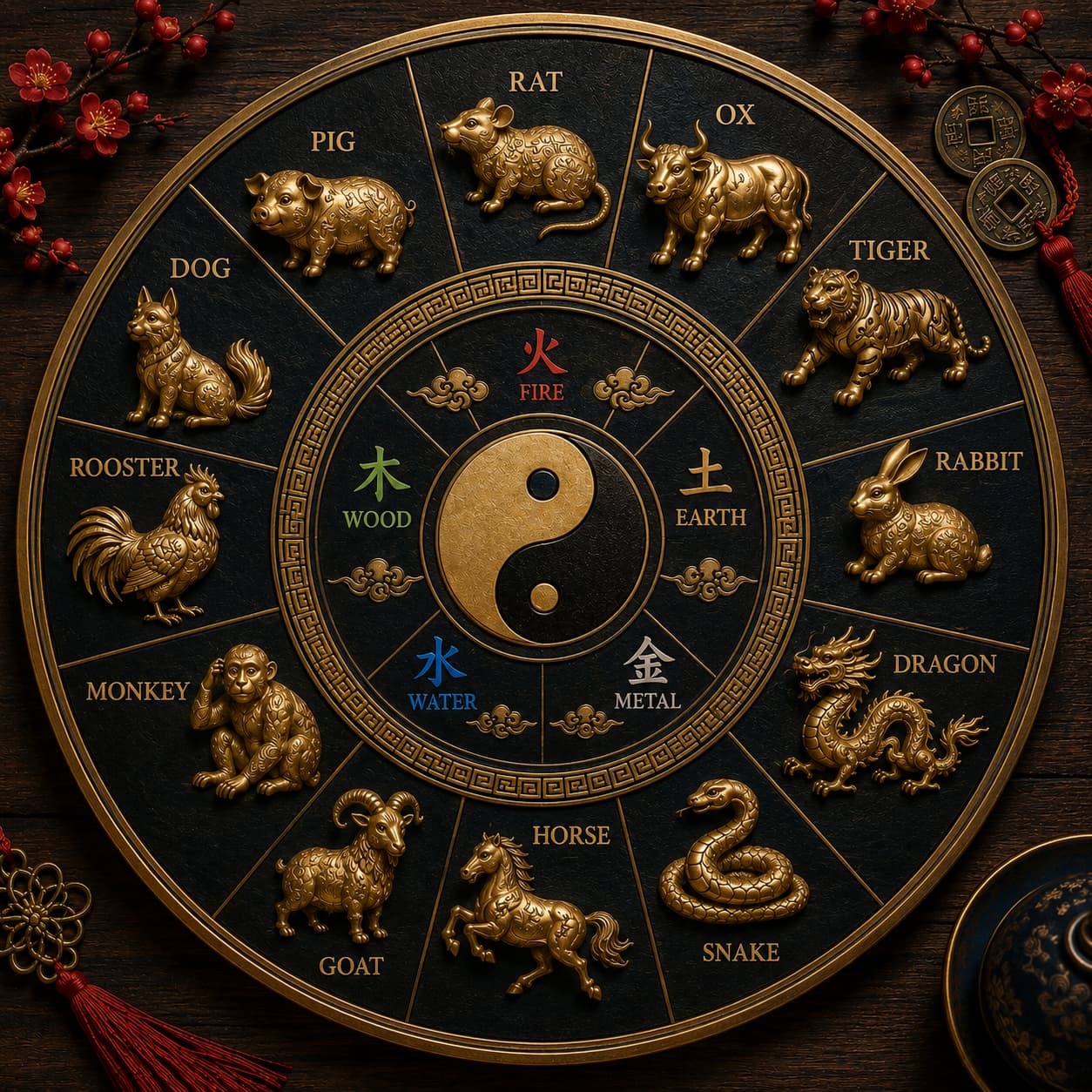
The Chinese zodiac is a 12-year cycle in which every year is represented by a different animal, and each animal is believed to shape the personality of people born during it. In order, the animals are the Rat, Ox, Tiger, Rabbit, Dragon, Snake, Horse, Goat, Monkey, Rooster, Dog, and Pig. Once the twelfth animal has had its turn, the cycle starts over again with the Rat, repeating endlessly.
Unlike Western astrology, which sorts people by birth month and constellation, Chinese astrology is built around the lunar calendar and combines the 12 animals with five elements and the balance of yin and yang. This means a person’s zodiac animal depends on the year they were born rather than the month. Each animal also carries its own personality traits, lucky elements, and compatibility patterns said to influence people born under it. A system this old has also picked up regional differences over time, with some East Asian countries adjusting the animal lineup slightly while keeping the same basic 12-year structure.
Because the new year in this calendar doesn’t fall on January 1st, people born in January or early February sometimes belong to a different zodiac year than their Gregorian birth year would suggest. The cycle changes to a new animal every year at Chinese New Year, which falls somewhere between January 21st and February 20th on the regular calendar. Historians generally agree the system has something to do with early animal worship, and a version of it has existed in Chinese culture since the Qin dynasty, more than 2,000 years ago.
The Legend Behind the 12 Animals
The most famous explanation for the order of the animals is a story about a race. According to legend, the emperor held a great race to decide which animals would earn a spot in the calendar, and whichever animal finished first would claim the very first year of the 12-year cycle. The tale has been passed down for generations and remains the most commonly cited origin story across Chinese culture today.
The most well-known version of this story explains why the small Rat ended up in first place ahead of much larger animals. As the tale goes, the clever Rat hitched a ride on the Ox’s back while crossing a river, then jumped off right at the finish line to win first place, which is why the Rat leads the zodiac even though it is one of the smallest animals in it. The Ox came in second, followed by the Tiger, Rabbit, Dragon, Snake, Horse, Goat, Monkey, Rooster, and Dog, with the Pig finishing last. Other tellings add extra drama to the middle of the race: in one version, the Rabbit challenged the Dragon to a separate race and won, moving up the line, which angered the Dog enough to bite the Rabbit and get sent to the back as punishment, while the Pig simply arrived late after everyone else had already settled their positions.
There is also a more technical explanation tied to older Chinese timekeeping methods that predate the animal legend entirely. Long before the animals were attached to the cycle, years were tracked using a set of labels called the Earthly Branches, which were also used to mark the hours of the day. The animals were added later as a memory aid, and each one was linked to a certain time of day based on its typical behavior, which is another explanation historians offer for why the order ended up the way it did. Both explanations, the folk tale and the timekeeping system, are usually presented side by side rather than treated as competing theories, since the legend likely grew up around a structure that already existed.
Yin and Yang in the Zodiac
Every animal in the cycle is also assigned an energy: either yin or yang. Yang is linked with activity, light, movement, and the expression of power, while yin embodies softness, receptivity, inner energy, and tranquility. Together the two forces are meant to represent balance rather than opposition, with neither one considered better or stronger than the other.
Of the 12 zodiac animals in order, all the odd-numbered animals are Yang and the even-numbered animals are Yin, meaning the Rat, Tiger, Dragon, Horse, Monkey, and Dog fall on the Yang side, while the Ox, Rabbit, Snake, Goat, Rooster, and Pig fall on the Yin side. Yang signs tend to be described as more active, bold, and extroverted, while Yin signs are generally framed as more introspective, nurturing, and calm. The balance between the two is also considered important in relationships, and pairs with complementary energies, meaning one yin sign paired with one yang sign, are often described as finding a natural balance and mutual support.
The Five Elements of the Chinese Zodiac
Chinese astrology does not stop at just 12 animals. Five elements, wood, fire, earth, metal, and water, cycle through the years in order, with each element appearing twice across a full 60-year cycle before the exact same animal-element combination repeats. This is why a year is sometimes described as the “Fire Horse” or “Wood Dragon” instead of simply “Horse” or “Dragon.”
The element adds another layer of meaning on top of the animal itself, which is one reason two people born in the same animal year but a different element cycle can be described as having noticeably different personalities. The system pairs one of ten stems, which come in yin and yang versions of each element, with one of the twelve animal branches in sequence, and because ten does not divide evenly into twelve, the stem and animal combinations shift slightly with each pass through the cycle until the full 60-year pattern completes. A grandparent and a grandchild born in the same animal year could easily fall under different elements entirely, since the full combination only repeats once every 60 years.
Wood
Wood governs the spring portion of the cycle and is tied to growth, flexibility, and new beginnings. People born under a Wood year are often described as expansive and generous, with a natural pull toward building things up rather than tearing them down.
| Trait | Detail |
|---|---|
| Season | Spring |
| Direction | East |
| Color | Green |
| Associated with | Growth, flexibility, new beginnings |
Fire
Fire governs the summer portion of the cycle and is tied to passion, energy, and transformation. Years carrying this element are generally associated with boldness and quick action, giving whichever animal they’re paired with an extra dose of intensity.
| Trait | Detail |
|---|---|
| Season | Summer |
| Direction | South |
| Color | Red |
| Associated with | Passion, energy, transformation |
Earth
Earth sits at the center of the cycle rather than lining up with a single season, and it’s tied to stability, nourishment, and balance. People born under an Earth year are often described as grounded and dependable, valued for keeping a steady footing when things around them shift.
| Trait | Detail |
|---|---|
| Season | Transition between seasons |
| Direction | Center |
| Color | Yellow |
| Associated with | Stability, nourishment, balance |
Metal
Metal governs the autumn portion of the cycle and is tied to strength, precision, and discipline. Years carrying this element tend to be linked with sharp focus and a strong sense of structure, echoing the way metal itself is shaped through careful, deliberate work.
| Trait | Detail |
|---|---|
| Season | Autumn |
| Direction | West |
| Color | White |
| Associated with | Strength, precision, discipline |
Water
Water governs the winter portion of the cycle and is tied to wisdom, adaptability, and calm. People born under a Water year are often described as reflective and flexible, more likely to flow around an obstacle than push straight through it.
| Trait | Detail |
|---|---|
| Season | Winter |
| Direction | North |
| Color | Black or Blue |
| Associated with | Wisdom, adaptability, calm |
The 12 Animal Signs and Their Meanings
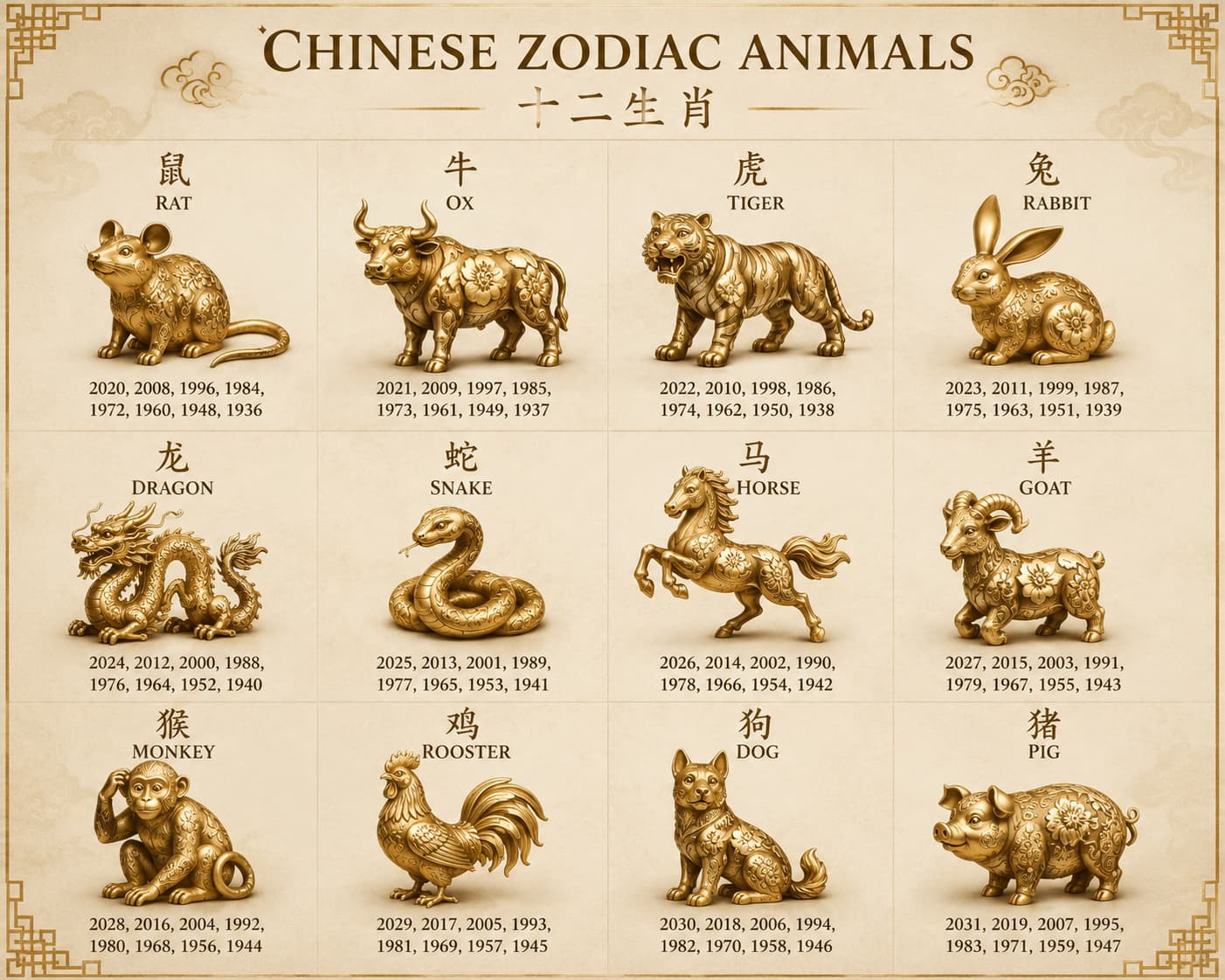
Twelve very different personalities make up the full cycle, ranging from the clever Rat to the generous Pig, and each one carries a reputation built over thousands of years of storytelling.
Rat
People born in Rat years are traditionally seen as sharp, observant, and skilled at spotting opportunities before others do. The Rat’s win in the legendary river race is often used as a symbol of this same quality: relying on wit rather than size or strength to get ahead, a reputation that has followed the animal through centuries of Chinese folklore without ever turning villainous.
In older farming communities, spotting rats near a grain store was sometimes taken as a sign that the harvest had been plentiful enough to draw them in, which gave the animal an unexpected tie to abundance rather than pure nuisance. The Rat also opens the twelve-year cycle, and in some regional traditions that first position has made it a small symbol of fresh starts and new opportunity at the beginning of a new zodiac round.
| Trait | Detail |
|---|---|
| Core symbol | Cleverness and resourcefulness |
| Energy | Yang |
| Known for | Quick thinking, adaptability, spotting opportunity |
Ox
The Ox has long been tied to farming and physical labor in Chinese culture, since real oxen were essential for plowing fields for centuries before machinery took over. A ritual known as whipping spring cattle was traditionally performed to mark the start of a new year of hard work and good harvests, and that same practical, dependable reputation carried straight into the zodiac, where people born in Ox years are described as steady and patient rather than flashy.
That reputation for strength shows up in everyday Chinese language as well. Common expressions like “strong as an ox” are used the same way in Chinese as they are in English, and the animal is frequently invoked in idioms about stubborn, unglamorous effort that eventually pays off. That everyday linguistic presence has helped keep the Ox’s zodiac meaning consistent and easy to recognize, even outside the context of astrology.
| Trait | Detail |
|---|---|
| Core symbol | Hard work and reliability |
| Energy | Yin |
| Known for | Patience, honesty, quiet determination |
Tiger
The Tiger is often described as the king of beasts within the zodiac and is associated with bravery, a reputation that shows up throughout Chinese art and mythology on temple carvings and household charms meant to ward off misfortune. People born in the year of the Tiger are traditionally described as independent, with high self-esteem and a strong drive to lead and protect others, though recklessness is often named as the sign’s biggest weakness.
The Tiger’s standing reaches beyond the 12-year cycle as well. In traditional Chinese astronomy, the White Tiger is one of the Four Symbols representing the western sky, standing alongside the Azure Dragon, Vermilion Bird, and Black Tortoise as one of four guardian creatures tied to the cardinal directions. That older, separate tradition is part of why tiger imagery carries such a strong protective meaning in Chinese design, independent of whether it’s shown in its zodiac context or not.
| Trait | Detail |
|---|---|
| Core symbol | Courage and leadership |
| Energy | Yang |
| Known for | Boldness, protectiveness, independence |
Rabbit
The Rabbit is described as intelligent and gentle, which makes it one of the more well-liked signs in the cycle. Its connection to the moon runs especially deep in Chinese folklore, most famously through the story of the Jade Rabbit said to live there, which has made Rabbit imagery a common feature during Mid-Autumn Festival celebrations well beyond its role in the zodiac.
According to the legend, the Jade Rabbit spends its time on the moon grinding herbs into an elixir of immortality using a mortar and pestle, often shown as a companion to the moon goddess Chang’e. That story has made the rabbit one of the more recognizable figures in Chinese folklore outside the zodiac entirely, appearing on lanterns, mooncakes, and decorations well before anyone connects it back to a specific birth year.
| Trait | Detail |
|---|---|
| Core symbol | Gentleness and good luck |
| Energy | Yin |
| Known for | Kindness, calm confidence, popularity |
Dragon
Among all 12 signs, the Dragon is by far the most popular, since it is considered the totem of the Chinese nation and stands for power, good fortune, and success. That popularity is strong enough that many couples specifically hope to have a baby during a Dragon year, which leads to noticeably higher birth rates in those years, and its long association with Chinese emperors gives it a layer of imperial symbolism no other sign shares.
The dragon’s reach into everyday celebration goes well beyond the zodiac chart itself. Dragon dances, where performers move a long, articulated dragon puppet through the streets during Lunar New Year parades, are one of the most recognizable customs in Chinese celebration and are meant to chase away bad luck and welcome a prosperous year ahead. That performance tradition has helped keep dragon imagery visible and celebrated well outside the years the zodiac specifically assigns to it.
| Trait | Detail |
|---|---|
| Core symbol | Power and success |
| Energy | Yang |
| Known for | Ambition, imperial history, being the only mythical animal in the cycle |
Snake
Snakes are often described as deep thinkers in Chinese folklore, patient and observant rather than quick to act on impulse. The animal has also long been associated with transformation in Chinese thought, tied partly to the way snakes shed their skin, a symbolism of renewal that shows up frequently in traditional art centered on the Snake.
The Snake is sometimes given the more flattering nickname “little dragon” in everyday conversation, a nod to how closely the two creatures are linked visually and symbolically despite the Snake sitting lower in the zodiac’s general prestige. One of China’s most famous folk tales, the Legend of the White Snake, follows a snake spirit who takes human form and falls in love with a mortal man, and the story remains one of the most widely retold pieces of Chinese folklore today, keeping the animal’s mystical reputation alive well outside the zodiac chart.
| Trait | Detail |
|---|---|
| Core symbol | Wisdom and intuition |
| Energy | Yin |
| Known for | Patience, reflection, transformation |
Horse
The year of the Horse is said to symbolize passion, drive, and vitality, and 2026 itself is a Horse year, running from February 17th, 2026 to February 5th, 2027. Horses have historically played an outsized role in Chinese history, from military campaigns to trade along the Silk Road, which helped cement the animal’s association with freedom and forward motion long before it was folded into the zodiac.
That connection to momentum and success shows up directly in Chinese language today. The phrase “ma dao cheng gong,” which translates roughly to instant success upon a horse’s arrival, is a common New Year greeting used to wish someone swift achievement in the year ahead. Its popularity as a well-wish is a good example of how deeply the Horse’s zodiac meaning has folded into everyday customs well beyond the animal’s actual birth years.
| Trait | Detail |
|---|---|
| Core symbol | Energy and freedom |
| Energy | Yang |
| Known for | Passion, drive, independence |
Goat
This sign is sometimes translated as “Sheep” or “Ram” depending on the source and region, but the underlying meaning stays consistent across all three versions: calm, artistic, and easygoing. People born under this sign are traditionally thought of as caring and imaginative, drawn toward beauty and harmony rather than conflict or competition.
The animal also carries a small linguistic bonus in Chinese, since the word for goat or sheep sounds close to the word for a positive, sunlit form of energy in Chinese philosophy. That near-match has made goat and ram imagery a popular feature in New Year blessings and decorations, where a trio of goats is sometimes used as a visual pun for a phrase wishing prosperity and good fortune in the year ahead.
| Trait | Detail |
|---|---|
| Core symbol | Gentleness and creativity |
| Energy | Yin |
| Known for | Calm, artistic, harmony-seeking |
Monkey
Monkeys are known throughout Chinese storytelling for their wit and mischief, most famously through the classic tale of the Monkey King, one of the central figures in the 16th-century novel Journey to the West. That same lively, quick-witted energy carries directly into the zodiac sign, associated with people who think on their feet and enjoy solving problems creatively, though the same cleverness can occasionally come across as mischievous.
The Monkey King character, known as Sun Wukong, has become one of the most widely adapted figures in Chinese storytelling, appearing in countless retellings across opera, television, and film well beyond the original novel. That enormous cultural footprint has helped keep Monkey imagery instantly recognizable across Chinese pop culture, giving the zodiac sign a level of visibility few of the other eleven animals can match.
| Trait | Detail |
|---|---|
| Core symbol | Cleverness and playfulness |
| Energy | Yang |
| Known for | Wit, curiosity, sociability |
Rooster
Roosters wake at the same time every single day without fail, and that reliability is central to why the sign is linked with punctuality and a strong work ethic. According to older folklore, roosters were believed to protect against evil spirits, and in ancient times sworn brothers would drip rooster blood into wine as part of a solemn oath sworn to the heavens, a protective symbolism that has stayed attached to the animal well beyond its zodiac role.
Older Chinese tradition also credits the rooster with five specific virtues, each tied to a physical feature of the bird itself: its comb represents civility, its spurs represent a martial spirit, its willingness to fight represents courage, its habit of calling other hens over to food represents benevolence, and its reliable crowing at dawn represents trustworthiness. That five-virtue framework is one of the more detailed character breakdowns given to any animal in the zodiac, and it lines up closely with the honest, hardworking reputation the sign carries today.
| Trait | Detail |
|---|---|
| Core symbol | Honesty and hard work |
| Energy | Yin |
| Known for | Punctuality, sharp perception, confidence |
Dog
Of all 12 animals, the Dog is arguably the easiest for most people to connect with personally, since real dogs are famous worldwide for their faithfulness to their owners. People born in Dog years are traditionally seen as trustworthy and fair-minded, often described as the friend who tells the truth even when it isn’t what someone wants to hear.
That bond between dogs and their owners runs deep in Chinese history as well. Archaeologists have found dog figurines and remains placed in tombs dating back thousands of years, reflecting a belief that a loyal companion could accompany its owner even after death. That long-standing role as a protector and companion, both in daily life and in burial customs, lines up closely with the sign’s zodiac reputation for guarding and standing by the people it cares about.
| Trait | Detail |
|---|---|
| Core symbol | Loyalty and protectiveness |
| Energy | Yang |
| Known for | Trustworthiness, fairness, honesty |
Pig
The Pig is described as honest and one that brings good fortune, making it another well-liked sign within the cycle, even though it finished last in the legendary race. The animal is instead associated with abundance and contentment, largely because pigs have historically represented wealth and a comfortable household in Chinese agricultural life.
That link between pigs and household security shows up in a popular explanation of the Chinese character for “home,” 家, which combines the symbol for a roof with a component many describe as a pig underneath it. The traditional story behind this reading holds that keeping a pig indoors once signified a settled, self-sufficient household, though some language scholars argue the original component may have depicted something else entirely before later script changes blurred the distinction. Either way, the popular pig-under-a-roof explanation has stuck for centuries and helps explain why the Pig, despite its last-place finish in the race legend, has kept such a warm and fortunate reputation across Chinese culture.
| Trait | Detail |
|---|---|
| Core symbol | Honesty and good fortune |
| Energy | Yin |
| Known for | Generosity, warmth, contentment |
Jewelry Traditions Tied to the Chinese Zodiac
Jade holds a place in Chinese jewelry that no other material has matched for thousands of years. Long before gold became a global standard for wealth, jade was already regarded as the more valuable material in China, prized as the “stone of heaven” and worn as a marker of rank, power, and wealth among kings, emperors, and nobles. Confucius is often credited with linking jade to human virtues such as durability, purity, serenity, and radiance, giving the stone a symbolic weight well beyond its appearance, and craftspeople have been carving it into jewelry for roughly five thousand years.
Gold carries its own strong association within Chinese culture, tied closely to prosperity and good fortune rather than rank or virtue. Zodiac jewelry made in gold leans on that same symbolism, pairing an animal’s individual meaning with the metal’s broader promise of luck and abundance. That combination is part of why gold zodiac pendants and coin-style jewelry have remained a steady gift choice for birthdays, weddings, and other milestone occasions.
Wearing jewelry that matches a person’s own zodiac animal carries extra weight during a ben ming nian, the year that matches someone’s own sign, which comes around once every twelve years. Traditional belief treats this year as a hurdle to get through rather than a stroke of luck, and wearing red, whether as clothing, a bracelet, or a pendant, has long been a way people try to protect themselves from bad fortune during it. Zodiac jewelry made specifically for a ben ming nian often leans on red accents or red string for that exact reason, setting it apart from the everyday version of the same animal design.
Gifting zodiac jewelry tied to a child’s birth year is another custom that has held steady across generations, chosen as a way to mark the animal a baby was born under and pass down a piece connected to family heritage. Because the meaning of each animal is treated as fixed rather than a matter of personal taste, jewelry like this tends to get kept as a family keepsake rather than worn as a passing trend.
Chinese Zodiac vs Western Zodiac
The two systems are often mentioned together, but they developed independently and work in fundamentally different ways. Western astrology is based on the sun and organizes people by birth month, while Chinese astrology follows the moon and is built around the year someone was born instead. That single difference explains why a person can have both a Western sun sign and a Chinese zodiac animal without the two systems ever overlapping in method.
Another distinction lies in the symbols themselves: the Chinese zodiac is represented entirely by animals, whereas the Western zodiac includes several signs, such as Libra or Gemini, that are not animals at all despite the word “zodiac” translating roughly to “cycle of animals.” The animals of the Chinese zodiac also are not tied to constellations the way Western zodiac signs are, since the Chinese system tracks years rather than the sun’s position against the backdrop of stars. Even with these differences, both systems share a broad structural similarity: both are based on time periods of birth and both use twelve symbols, each carrying associated personality traits and fortunes, which is likely part of why the two are so often compared despite developing on entirely different continents.
The Chinese Zodiac in Other Countries
While the system began in China, it did not stay contained within one country’s borders. The Chinese zodiac remains popular across other parts of East Asia, including Japan, Vietnam, and Thailand, with variations also found in South Korea, Singapore, Nepal, Bhutan, and Cambodia, each of which adapted the core system to fit local culture.
Some countries swapped out one or two animals to better match local wildlife and folklore. Japan uses the same lineup as China but replaces the Pig with the Boar, while Vietnam swaps the Ox for the Buffalo and replaces the Rabbit with the Cat entirely. Thailand keeps the same 12 animals as China but incorporates a mythical half-human, half-snake spirit called the Naga into certain regional versions of the cycle. These regional differences show how deeply the zodiac became woven into everyday life across Asia rather than staying a fixed export from a single source, and the underlying structure, a 12-year repeating cycle tied to personality and fortune, has stayed remarkably consistent across every version.
Frequently Asked Questions
How is a person’s Chinese zodiac animal determined?
A person’s zodiac animal is based on the lunar year they were born in, factoring in that the Chinese New Year usually falls in late January or February rather than on January 1st. Anyone born before that specific date in a given year technically belongs to the previous year’s animal sign rather than the one matching their Gregorian birth year.
Why does the Chinese zodiac use years instead of months like Western astrology?
Western astrology is based on the sun and sorts people by birth month, while the Chinese zodiac follows the moon and is organized around the year of birth instead. These are two separate systems that developed independently of each other, so it is entirely normal for someone to have both a Western sun sign and a Chinese zodiac animal at the same time.
Is the Chinese zodiac only used in China?
No. While the system originated in China, it remains popular across other parts of East Asia, including Japan, Vietnam, and Thailand. Each region has introduced its own small variations over the centuries, but the core 12-animal, 12-year structure has stayed largely the same everywhere it is used.
What year is 2026 in the Chinese zodiac?
2026 is the year of the Horse, a sign associated with passion, drive, and vitality. This particular year begins on February 17th, 2026.
Does a zodiac animal ever repeat for the same person?
Yes. Since the cycle is only 12 years long, a person’s animal returns every 12 years throughout their life. A simple way to check is to see whether someone’s current age is a multiple of 12, since that marks the return of their own zodiac year, sometimes called their “ben ming nian.”
Conclusion
Each of the 12 Chinese zodiac animals carries its own distinct personality, from the quick-witted Rat to the loyal Dog and the fortunate Pig, layered further by yin-yang energy and a five-element cycle that adds depth well beyond a simple animal chart. That combination of legend, timekeeping, and symbolism is exactly what has kept the system meaningful across thousands of years and multiple countries, each of which adapted it while keeping its core structure intact. Whether the appeal lies in the Dragon’s imperial power or the Rabbit’s quiet gentleness, the real meaning behind each sign carries far more history and nuance than a single animal name suggests on its own.