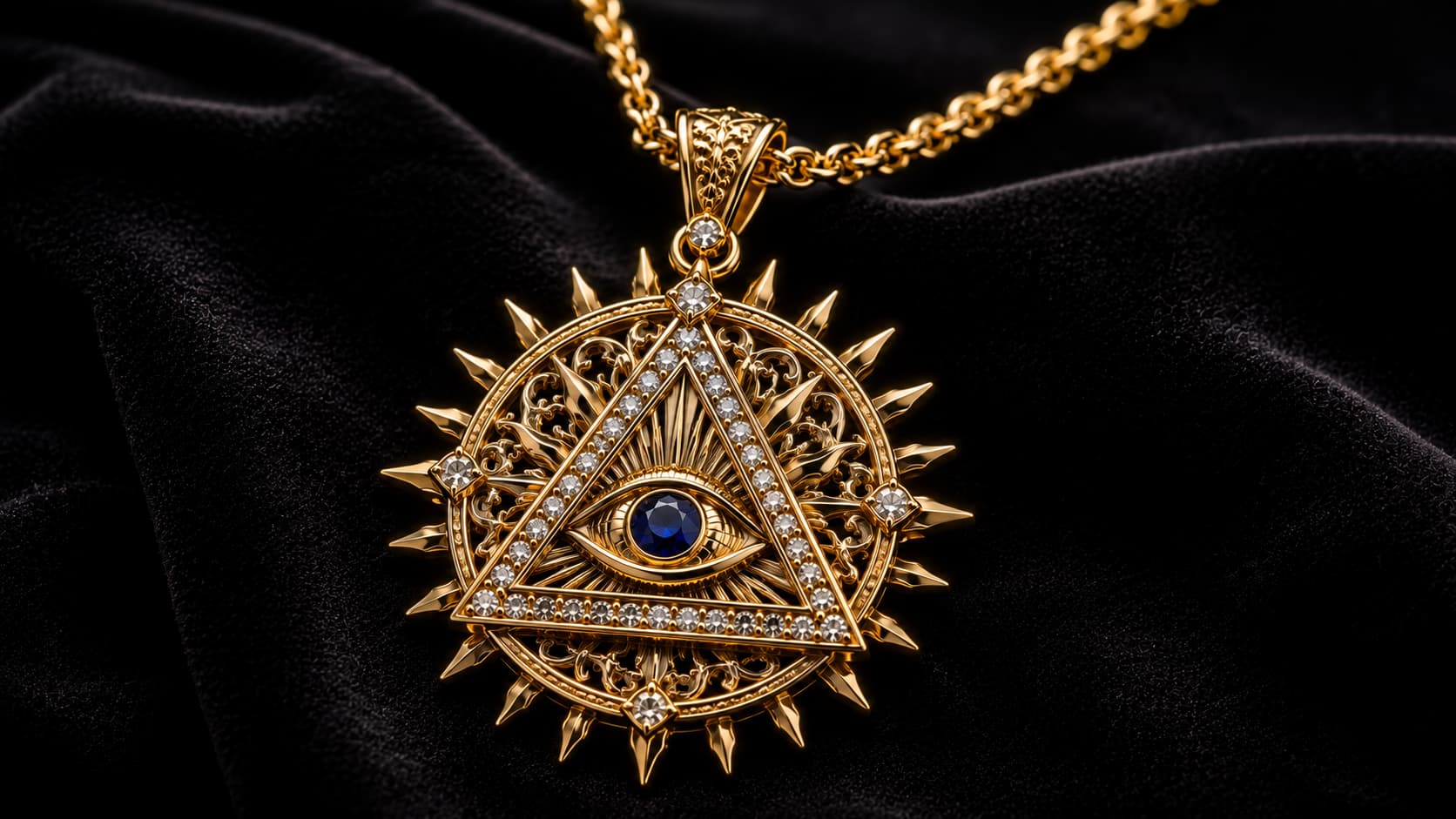
A single eye, glowing inside a triangle, has been showing up on rings, pendants, and coins for centuries — and it still catches people’s attention every time. Some wearers pick it because it looks striking, others because they connect it to watchfulness, protection, or a higher power keeping an eye on the world. Whatever the reason, the Eye of Providence is one of the most recognizable — and most misunderstood — symbols in jewelry today, carrying a history that stretches from Renaissance church paintings all the way to the back of a US one-dollar bill.
What Does the Eye of Providence Symbolize?
The Eye of Providence represents an all-knowing, watchful presence — traditionally understood as the eye of God looking over humanity. Artists typically draw a single realistic eye set inside a triangle, with light radiating outward from it, a visual shorthand for the idea that something greater is paying attention to human affairs.
In jewelry, that meaning carries over pretty directly. People wear it as a reminder that they’re being watched over, protected, or guided — sometimes in a religious sense, sometimes in a more general “the universe has my back” way. The triangle isn’t random either; it’s almost always drawn as an equilateral triangle, with all three sides equal, which many read as a sign of balance and stability.
History of the Eye of Providence
The exact eye-in-a-triangle version recognized today first showed up in Renaissance-era Christian art, not in ancient Egypt as many people assume. Despite that popular assumption, historians generally trace the specific image — the realistic eye framed by a triangle and rays of light — back only a few centuries, even though eye symbolism itself is far older.
One of the earliest known paintings to include it is Jacopo Pontormo’s Supper at Emmaus, painted in 1525, where the symbol hovers directly over Christ’s head. Its placement there was deliberate — a visual cue telling viewers that a divine presence was overseeing the whole scene, which is exactly why art historians point to this painting as an early anchor for the symbol’s Christian origins.
That doesn’t mean the idea of a watchful eye is new, though, since eyes carried symbolic weight in several cultures long before the Renaissance. Mesopotamia offers one of the earliest examples: Sumerian sculptors deliberately enlarged the eyes on statues to emphasize a sense of holiness and watchfulness, one of the oldest known uses of an oversized eye as a marker of the sacred. Ancient Egypt had its own version in the Eye of Horus, also called Wadjet, though it was a completely different symbol tied to healing and protection rather than the triangle design. Religious texts carried the concept forward as well — the Bible’s Book of Psalms, written roughly 800–600 BC, repeatedly describes God’s eyes watching over people, giving the idea deep religious roots long before the artwork existed. By the 17th century, Christian art kept building on the same theme, sometimes surrounding the eye with clouds or a burst of sunlight instead of a triangle.
The Eye of Providence’s roots as a concept — a god who sees everything — are ancient. The specific eye-in-a-triangle image we know today, however, is a Renaissance invention, only a few hundred years old.
The symbol didn’t stay confined to one painting, either. A big part of its spread came from published reference works — most notably a 1593 book by Italian writer Cesare Ripa, called Iconologia, which catalogued and illustrated ancient Egyptian, Greek, and Roman symbols for artists and thinkers across Europe. Books like that put a wide library of symbolic imagery, including eye motifs, into wide circulation, which helps explain why the Eye of Providence kept turning up in churches, prints, and public buildings well into the 1700s.
Why Is the Eye of Providence on the Dollar Bill?
The Eye of Providence appears on the back of the Great Seal of the United States, which is depicted on the reverse of the one-dollar bill, positioned above an unfinished pyramid.
Two men are credited with the seal’s final design: Charles Thomson, who served as Secretary of the Continental Congress, and artist William Barton. Congress approved their work on June 20, 1782, capping off a process that had already run through multiple earlier attempts. The eye itself is believed to have been suggested by artistic consultant Pierre Eugene du Simitiere, drawing on a long-standing tradition of the symbol representing God’s protective attention — an idea that had actually been floated for the seal back in 1776, years before the final design was locked in. On the seal, it sits above an unfinished pyramid, a detail many historians read as the young nation still under construction, with the eye watching over that ongoing work. The Latin phrase above it, Annuit Cœptis, translates roughly to “He approves our undertakings” — a nod to divine blessing, not a hidden message about secret societies, despite what internet rumors sometimes claim.
The symbol also appeared in Europe around the same era. It features prominently at the top of the original publication of France’s Declaration of the Rights of Man and of the Citizen, another example of it being used as a mainstream symbol of moral and divine oversight during the late 1700s, rather than anything secretive.
The Eye of Providence and Freemasonry
It’s associated with Freemasonry today, but it wasn’t originally created by Freemasons — they adopted an already-existing Christian symbol. Within Masonic tradition, the symbol serves as a personal reminder that a higher force — what Freemasons refer to as the Great Architect — keeps watch over their conduct. It ties directly into values the fraternity emphasizes internally, including moral discipline, ongoing self-development, and service to others.
The timeline of how it entered Freemasonry is a little fuzzy, but historians have traced it back fairly far. One of the earliest known examples tied to the fraternity dates back to a personal wax seal used by Robert Moray, a Scottish soldier who joined Freemasonry in 1641. Only a partial impression of that seal survives, but what remains shows an eye positioned at the middle of a circle, with lines extending outward toward the edge like beams of light. By the mid-1700s the symbol was firmly part of Masonic writing. Bro. Fifield D’Assigny referenced it in two of his published works, one in 1741 and another in 1744, showing it was already a recognized part of Masonic symbolism decades before it became widespread in America. The link became especially firm in the United States in 1797, when Thomas Smith Webb published The Freemason’s Monitor, a text that went on to influence how Masonic ritual was practiced across the country for generations afterward.
On jewelry, the symbol could reasonably represent a general spiritual meaning, a specifically Masonic one, or simply a design someone liked — context, like where a piece was bought or who is wearing it, usually points to which.
Is the All-Seeing Eye an Illuminati Symbol?
Historically, no — the Bavarian Illuminati, the real 18th-century secret society the myth traces back to, never actually used the Eye of Providence as its symbol. Adam Weishaupt, a legal scholar who taught church law at a Bavarian university, started the group in 1776, and Bavarian authorities forced it to disband less than a decade later, in 1785.
The popular idea of the eye as an “Illuminati symbol” came from a much later source: conservative writers in the 1790s, alarmed by the French Revolution, spread the idea that a shadowy Illuminati network had secretly engineered it, even though the real Bavarian group had already been dissolved. That conspiracy theory kept mutating over the following two centuries, and the Eye of Providence got pulled into it mainly because it already looked mysterious and had a long-standing connection to Freemasonry, which people mistakenly assumed overlapped with the Illuminati. By the time the symbol was placed on the Great Seal in 1782, the modern Illuminati myth had barely begun, and the two developed independently.
Today the name “Illuminati” is used more as a catch-all term for an imagined hidden elite than as a reference to the actual historical group, and the eye symbol gets attached to that broader myth in movies, music videos, and online forums. The documented history tells a much plainer story: a Christian symbol of divine watchfulness, adopted separately by Freemasonry and by the young United States government, with no verified historical link to the Bavarian secret society at all.
Eye of Providence vs. Evil Eye: Key Differences
The two symbols look nothing alike once the details are compared side by side, and they mean almost opposite things. The Eye of Providence is a single realistic-looking eye, usually inside a triangle, symbolizing watchful protection or divine awareness. The evil eye symbol, by contrast, is typically a stylized blue-and-white eye shape (often round, layered circles) meant to deflect envious or malicious stares directed at the wearer, rather than represent a watching god.
| Feature | Eye of Providence | Evil Eye |
|---|---|---|
| Shape | Realistic eye in a triangle | Stylized circular eye, often blue |
| Origin | Renaissance Christian art | Ancient Mediterranean & Middle Eastern folk belief |
| Meaning | Divine watchfulness, guidance | Protection from jealousy or curses |
| Alternate names | All-Seeing Eye | Nazar, Mati, Ayin Hara (depending on region) |
| Typical colors | No fixed color scheme | Almost always blue and white |
| Common use | Rings, pendants, coins, seals | Bracelets, charms, home décor |
Because they’re both “eye” symbols, people mix them up in casual conversation, but a jeweler or historian would never confuse the two designs.
Is the All-Seeing Eye a Negative Symbol?
No — despite its reputation online, the symbol’s actual, documented history is religious and civic, not sinister. Most of that reputation comes from its association with the Illuminati myth and its placement on US currency, both of which have made it a favorite target for conspiracy theorists looking for hidden meaning in everyday symbols.
Historically, the eye was simply shorthand for “someone, usually God, is watching over humanity,” used openly in churches, government seals, and public monuments — hardly the hallmarks of a hidden or secretive symbol. For anyone drawn to the design or to the idea of being watched over, there’s nothing inherently ominous about choosing it for a piece of jewelry.
How People Wear the Eye of Providence Today
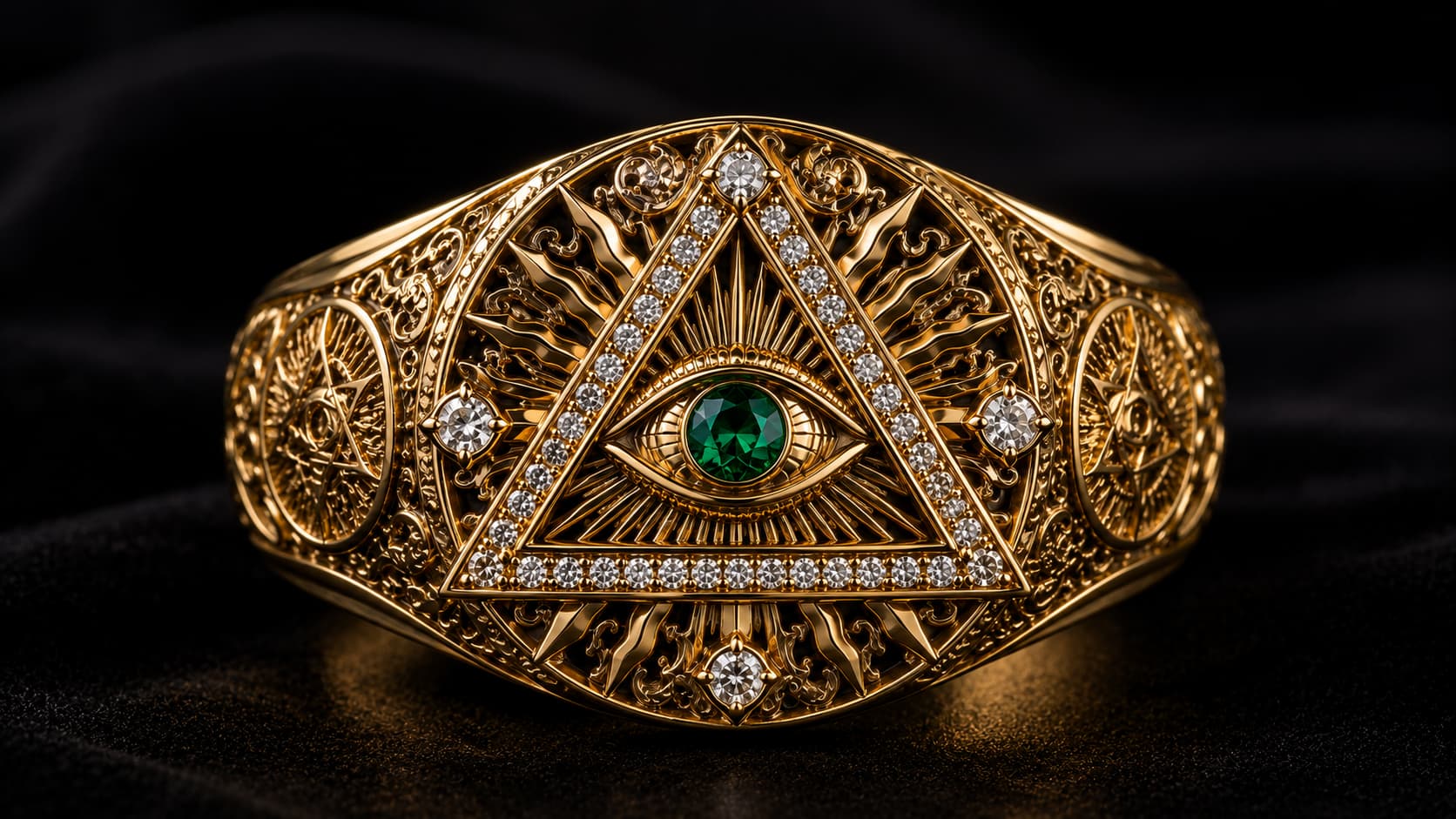
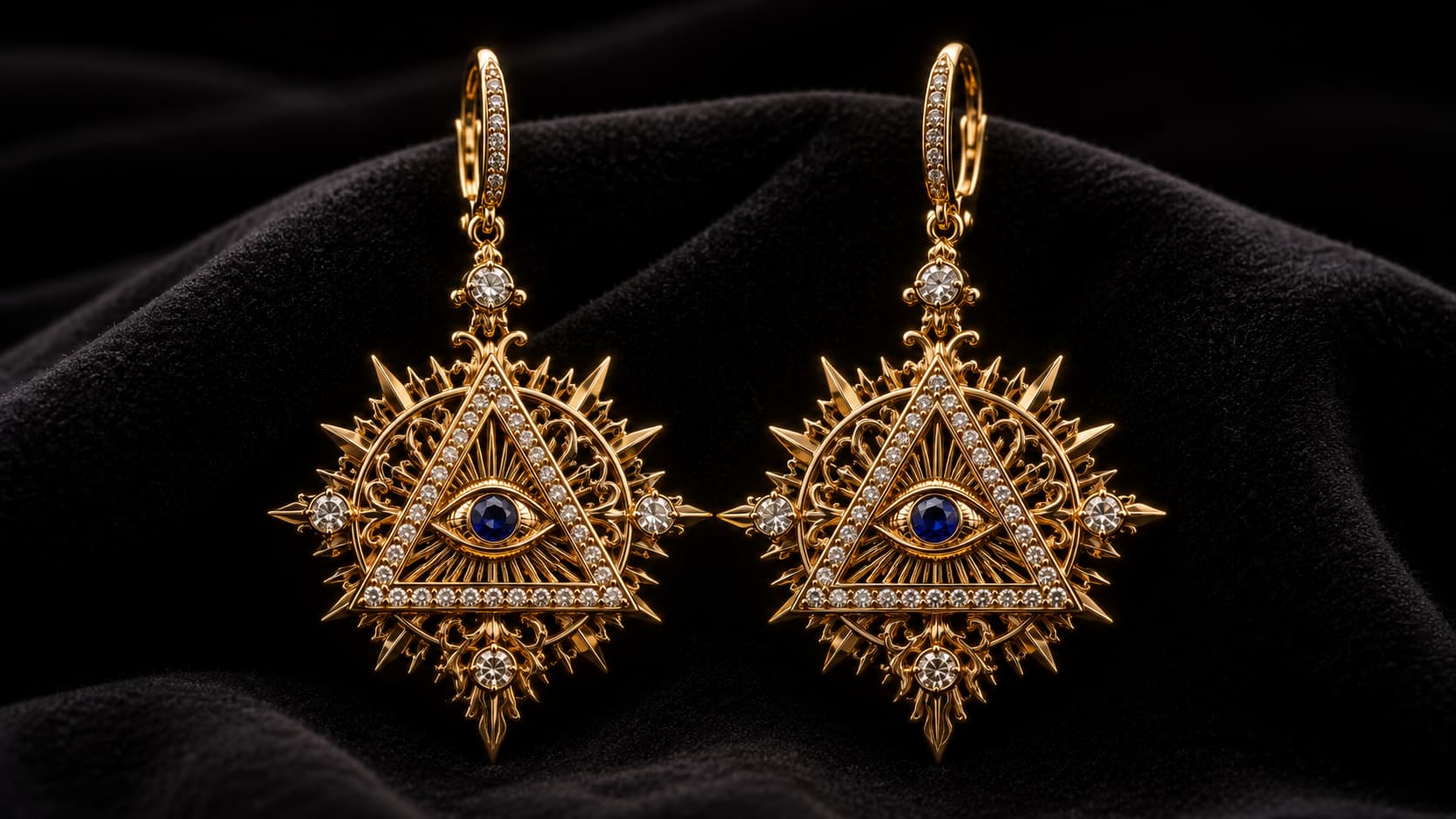
It shows up mainly as pendants, rings, and small charms, almost always keeping the classic eye-in-a-triangle layout even when the artistic style changes. Some designs stick closely to the traditional look, with radiating light around a realistic eye. Others simplify it into cleaner, more modern lines, or blend it with other symbols like stars or moons for a more decorative, less overtly religious piece.
People choose it for a range of reasons. For some, it carries spiritual or religious meaning, serving as a reminder of being watched over or guided. Others are drawn simply to the aesthetic — it’s a bold, detailed, conversation-starting design that stands out from more common motifs. Historical or cultural interest plays a role too, particularly for people who appreciate its Renaissance and Enlightenment-era roots. And for others, it functions much like other protective symbols, worn for a sense of personal protection even outside strict religious practice.
Because the design is centuries old and appears on public documents like currency, it’s considered a traditional symbol rather than anyone’s private property — which is part of why it keeps reappearing across so many different jewelry styles and eras.
Frequently Asked Questions
Is the Eye of Providence Egyptian?
Not directly — the eye-in-a-triangle design familiar today is Renaissance European, though the idea of a protective, all-seeing eye has older parallels, like the unrelated Eye of Horus from ancient Egypt.
What triangle shape is used with the Eye of Providence?
It’s almost always drawn as an equilateral triangle, which many people interpret as a symbol of balance, and in Christian art specifically as a representation of the Holy Trinity.
Can anyone wear Eye of Providence jewelry, or is it only for Freemasons?
Anyone can wear it. The symbol predates Freemasonry and has always been used more broadly in Christian art and civic symbolism, so wearing it doesn’t imply membership in any organization.
Why is the Eye of Providence linked to the Illuminati?
Mostly because of a myth that started in the 1790s, after the real Bavarian Illuminati had already been shut down — later conspiracy theorists attached the symbol to that myth because it already looked mysterious and had ties to Freemasonry, not because of any documented historical connection.
What’s a good way to describe the symbol’s meaning in one sentence?
It represents the idea that a higher power, or something greater than ourselves, is watching over and guiding human affairs.
Conclusion
The Eye of Providence has traveled a long way from a 1525 Italian church painting to a modern pendant, and along that journey it’s carried the same basic idea the whole time: something greater is watching, and that can be a source of comfort rather than fear. Its ties to the US dollar bill and to Freemasonry get most of the internet attention, but the deeper, better-documented story is simpler — a Renaissance symbol of divine care that Christians, governments, and eventually jewelry designers all found meaningful enough to keep alive for five centuries.