A mala is a string of beads that people have used for thousands of years to help them focus while praying or meditating. It might look like a beautiful necklace or bracelet at first glance, and today plenty of people do wear them that way, but a mala was never really designed to be jewelry. It was designed to be a tool, something a person holds in their hands to keep their mind steady while their thoughts drift toward chanting, breathing, or quiet reflection. Understanding where malas came from and what each part of them means makes it much easier to see why this simple string of beads has survived, almost unchanged, across so many centuries and so many different cultures.
What Is a Mala?
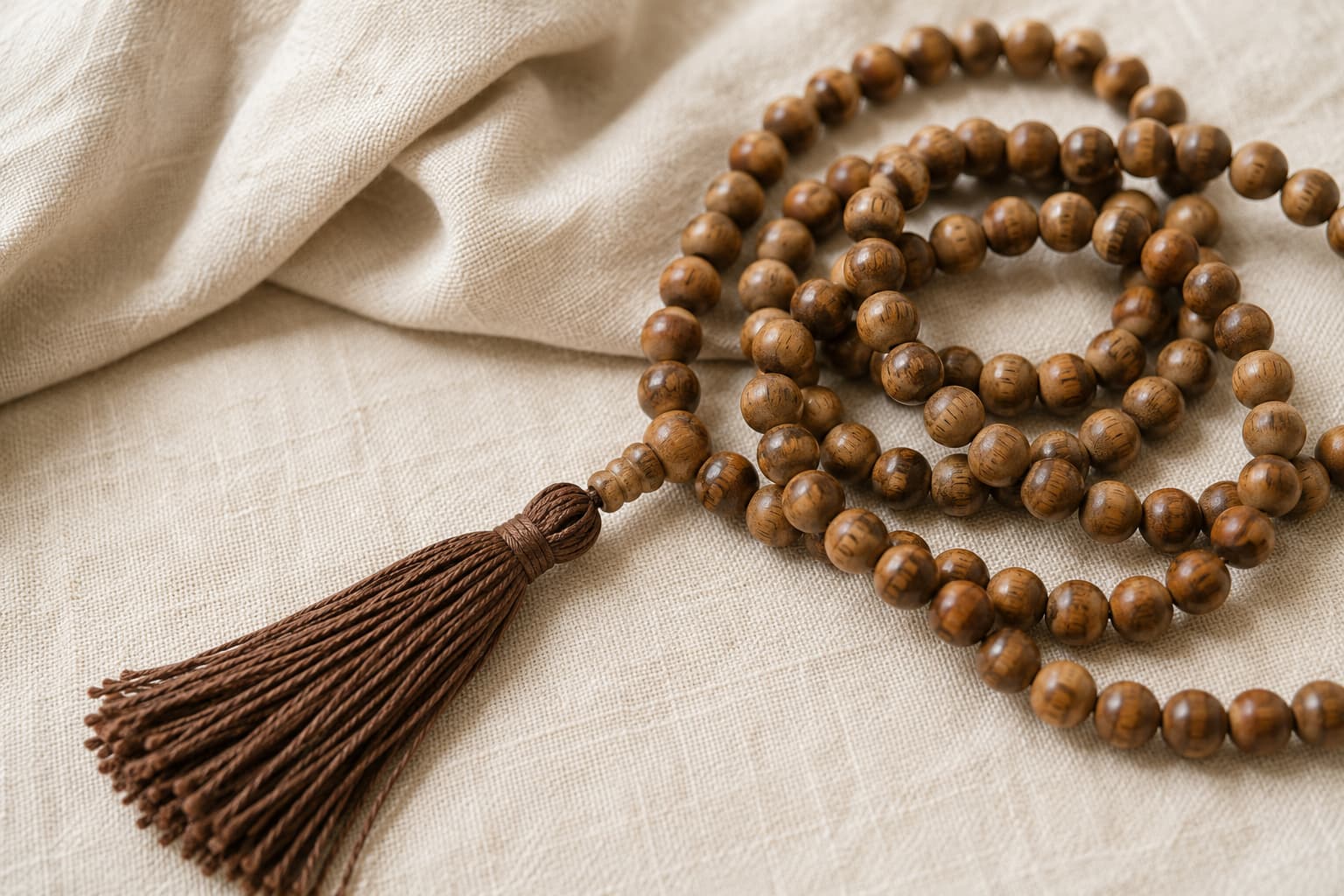
A mala is a string of beads, most often 108 of them, used to count prayers, mantras, or breaths during meditation. It can take the form of a long necklace-style strand or a shorter bracelet, and its other common name, japamala, points directly at its purpose: a garland built for repeated, focused prayer. The word “mala” itself comes from Sanskrit and simply means “garland,” which is a fitting way to think about it — a garland of small, repeated moments of focus, one bead at a time. Its closed, circular shape is also part of the design, echoing the idea of a practice with no fixed beginning or end.
Malas aren’t unique to one single religion. Hindu sages relied on them first, using the beads to keep count while repeating mantras during meditation, and Buddhist monks later adopted the same basic tool for the same purpose. Over the centuries the practice also found its way into Jain and Sikh traditions. Buddhist versions of the mala carry their own specific symbolism, which is what most people mean when they picture the classic wooden or seed-bead strand associated with monks and meditation halls.
At its core, a mala works like a physical counter. Instead of relying on memory to track whether a recitation was number 47 or 48, the practitioner simply moves a thumb to the next bead. That frees the mind to focus on the words or the breath rather than the arithmetic. This act of repeating something over and over, whether it’s a sacred phrase or a single word, has its own name in Sanskrit: japa. A mala used this way is sometimes called a “japa mala,” a more specific version of the same word.
Reaching for a mala doesn’t require belonging to a particular religion. Many people today use one the way someone else might use a fidget tool or a set of worry beads, something to hold and move through the fingers while the mind settles. That secular use isn’t a modern distortion of the tradition so much as an extension of what malas were always doing, giving restless hands and restless minds something steady to do together.
Where Do Malas Originate From?
Mala beads are believed to have originated in India roughly 3,000 years ago, long before Buddhism as it’s known today even existed. Hindu holy men, sometimes called sadhus, were using early versions of the beads to keep their attention steady while repeating sacred names and mantras during meditation.
Buddhism picked up the practice as it grew out of that same region. A well-known legend tells of a king, often named Vaidunya in accounts of the story, who ruled during a period of famine and disease and asked the Buddha for a simple practice his suffering people could follow. The Buddha is said to have told him to string together 108 bodhi seeds into a circle and recite a phrase of refuge while counting through them. Like most origin legends, the details vary by telling, but this is the version most often cited to explain how the practice took root specifically within Buddhism.
From there, mala beads didn’t stay in one place. Monks carried the practice along trade routes across Asia, and each region that adopted it added its own materials, styles, and small variations, which is why slightly different versions of the mala exist today across Tibetan, Chinese, and Southeast Asian traditions.
Why Do Malas Have 108 Beads?
Most malas have exactly 108 beads because that number is considered sacred across several Asian religious traditions, not just Buddhism. It shows up so consistently that it’s treated less like a coincidence and more like a rule, and it’s one of the clearer examples of how numbers carry meaning in jewelry well beyond mala practice.
There isn’t one single agreed-upon reason for the number, which is part of what makes the tradition interesting. In Buddhism, the 108 beads are often said to represent the 108 defilements, or kleshas, the mental states that block a person from reaching enlightenment. Other traditions point to astronomical patterns, noting that the number of houses in astrology (12) multiplied by the number of planets recognized in that system (9) equals 108. A separate Buddhist explanation traces the number back to a specific text, the Mokugenji Sutra, which is credited with the origin of the 108-bead tradition.
Whatever the exact origin, the effect is the same: 108 repetitions demand real focus and patience, but not so many that the practice becomes exhausting. That balance may be exactly why the number stuck.
There isn’t one official answer, and that isn’t a gap in the record so much as a reflection of how the tradition actually works. Different schools and teachers explain the number differently, and some don’t offer an explanation at all, treating it simply as the way it’s always been done. There’s also a small mathematical curiosity attached to the number: add together the digits of 108 and the result is 9, which divides evenly into 108. Numbers with that property are known as Harshad numbers, and some traditions treat this tidy bit of arithmetic as one more sign that 108 represents wholeness or completeness.
Not every mala has exactly 108 beads, though. Wrist versions, sometimes called “mala bracelets,” are commonly made with smaller counts like 21, 27, or 54, which are all divisors of 108. These shorter versions are easier to wear day to day and are popular with people who like the symbolism of a mala without carrying a full-length strand.
What Do the Guru Bead and Tassel Mean?
The guru bead is the one bead on a mala that stands apart from the other 108, marking the beginning and end of a full cycle around the strand. It’s usually larger, a different color, or made from a different material than the rest of the beads, so it can be found by touch without looking.
Its meaning is tied directly to its name. The guru bead represents the teacher or spiritual guide, and its position at the start and finish of the strand is meant to symbolize respect for those who share spiritual wisdom. When someone using a mala reaches this bead during meditation, tradition says they shouldn’t just keep going past it. Instead, they pause and reverse direction, which is a small physical gesture of acknowledging the teacher before starting the next round.
Many malas also have a tassel hanging from the guru bead, and this isn’t just decoration either. It draws on the same lotus flower symbolism found throughout other spiritual jewelry.
A lotus flower grows up through muddy water before it ever opens into bloom. The tassel is meant to carry that same image, a small reminder that clarity and awakening can grow out of confusion and struggle rather than in spite of them.
Some modern malas swap the tassel out for a small pendant or charm instead, which changes the look but keeps the same basic idea of marking that one special bead.
The guru bead actually goes by a second, older name that explains a lot about what it’s meant to represent: the meru bead. In Hindu, Jain, and Buddhist cosmology, Meru is a towering mountain with several peaks, imagined as the point around which the universe itself is organized, both in a physical and a spiritual sense. Naming the mala’s central bead after that mountain casts it as the axis everything else revolves around, which fits neatly with its job of marking the exact point where one cycle of practice ends and the next begins.
Many hand-knotted malas also carry a small knot in the cord between each bead. Practically, this keeps the beads evenly spaced and stops them from rubbing together and wearing down over time. Some practitioners and makers also read a quieter meaning into the knots, treating them as small stand-ins for life’s ordinary interruptions, with the unbroken strand around them a reminder that even those interruptions are part of one continuous thread.
What Are Mala Beads Made From?
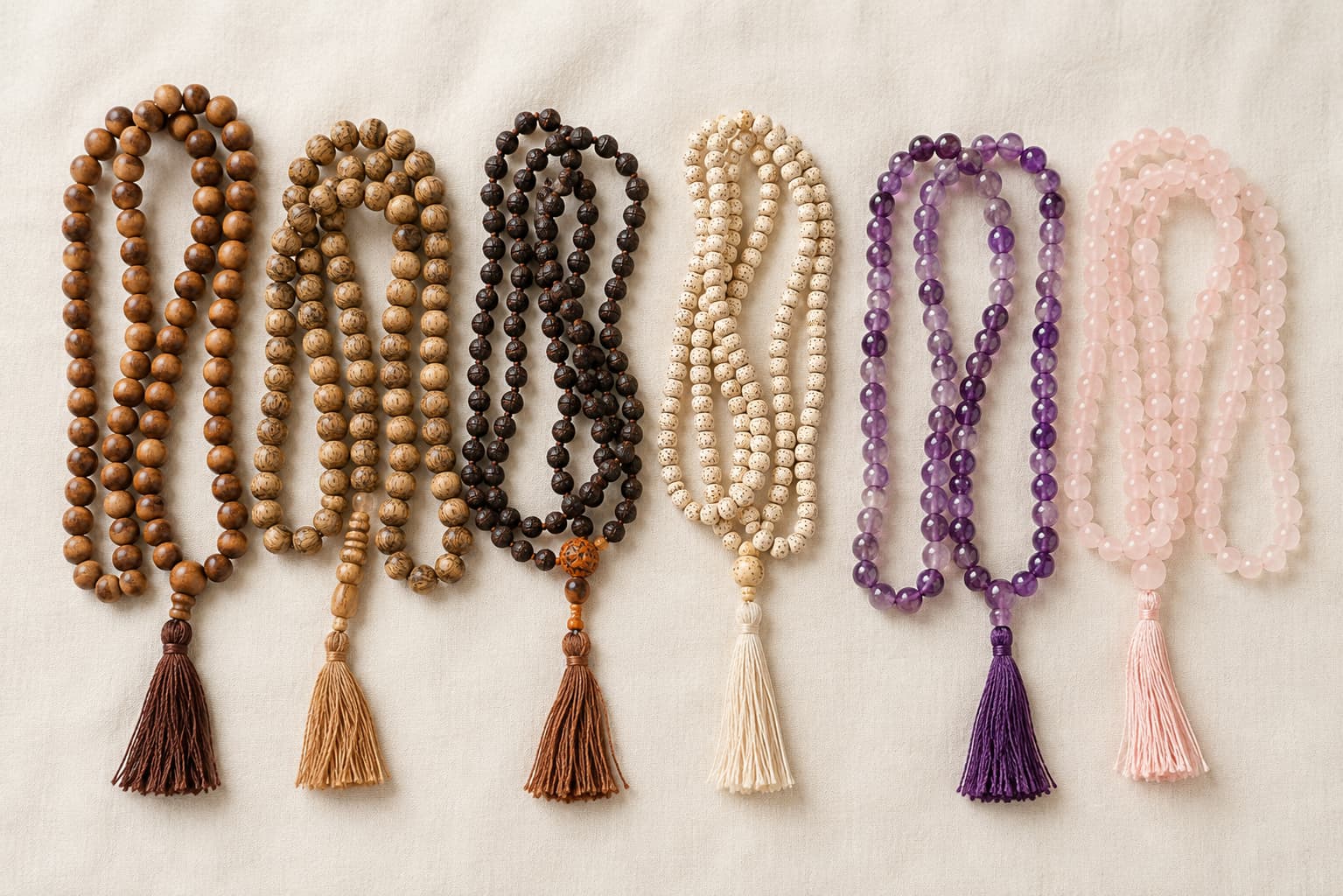
Mala beads are made from a wide range of natural materials, and the material itself often carries its own symbolic meaning within the practice. Wood, seeds, and gemstones are the three most common categories, each associated with different intentions, and wood in particular has been favored across many cultures for its warmth and durability.
| Material | Associated With |
|---|---|
| Sandalwood | Calm, purification, a soothing natural scent |
| Rudraksha seeds | Protection, grounding, traditional Hindu and Buddhist practice |
| Bodhi seeds | A direct link to the Buddha’s own enlightenment |
| Lotus seeds | Purity, compassion, spiritual blossoming |
| Rosewood | Traditionally linked to the heart, used in calming practice |
| Tulsi (holy basil) wood | Devotion and purity in Hindu tradition |
| Gemstones | Personal intention, often paired with modern crystal-healing beliefs |
Sandalwood is one of the most widely used choices, largely because of how it engages the senses during practice. Both Hindu and Buddhist traditions connect the wood to purification and mental calm, and it’s specifically linked to settling the three mental states of craving, aversion, and confusion that meditation practice aims to quiet. Part of its appeal is practical rather than symbolic: the natural oils in the wood release a warm, sweet fragrance that builds with body heat and handling, giving practitioners a scent they come to associate with settling into focus.
Rudraksha seeds are another long-favored option, especially within practices connected to Hindu devotion and yoga. Unlike the smooth finish of polished wood, rudraksha has a naturally bumpy, uneven surface, and that texture gives a distinctly different feel as each seed passes between the fingers, something many long-time users say helps keep attention anchored in the present moment.
Bodhi seed malas carry a more specific story than most other materials. They’re taken from the sacred fig tree, the very species under which the Buddha is said to have reached enlightenment at Bodh Gaya, which gives the seeds a built-in symbolic tie to that moment. That connection is part of why bodhi seed malas are often chosen for practices centered on wisdom and awakening rather than for calm or protection specifically.
Gemstone malas are the newest branch of the tradition rather than an ancient one. They became more common as interest in crystal healing grew, with each stone carrying its own separate set of associations layered on top of the mala’s original purpose, for example rose quartz linked to calm or carnelian linked to energy. Because gemstone beads are heavier and smoother than seeds or wood, they also tend to feel and sound different in the hand, which is part of why some practitioners choose them for the sensation alone.
How to Use a Mala for Meditation
A mala is used by moving one bead at a time through the fingers while silently or quietly repeating a mantra, word, or breath count. The rhythm of touching each bead is meant to work together with the rhythm of the recitation, so the body and mind move in sync. Traditionally, the practice follows a specific sequence:
- The mala rests in one hand, usually the left, held gently rather than gripped tightly.
- Practice begins with the bead sitting right next to the guru bead.
- Each bead is drawn inward with the thumb while the mantra is spoken or held in mind, moving bead by bead around the strand.
- The cycle continues until the guru bead is reached again, at which point the practitioner pauses instead of crossing over it.
- For another round, direction is reversed rather than moving straight past the guru bead.
One small detail that shows up again and again in traditional instructions: practitioners are generally told not to use the index finger while counting, since it’s associated with the ego, and to use the thumb instead. It’s a tiny physical rule, but it reflects how much intention was built into every part of the practice, right down to which finger touches the beads.
Before any of that begins, many traditions recommend pausing to set a clear intention, a specific word, phrase, or goal to hold in mind for that session. The mala itself doesn’t do anything magical; it’s the intention and the repetition working together that practitioners say produce the sense of calm and focus people associate with the practice.
None of this means a mala has to be used in a strictly religious way to be meaningful. Plenty of people today use one simply as a physical anchor for counting breaths during quiet, secular meditation, and that’s a perfectly legitimate way to use the same basic tool.
Because a mala gets handled so much, basic care matters too. A soft, dry cloth is usually enough to keep dust off the beads, and wooden or seed malas can be lightly conditioned every so often with a drop of natural oil to keep them from drying out and cracking. Many practitioners also avoid letting the mala touch the ground and prefer to store it somewhere it won’t get tangled or crushed, treating that care as part of showing respect for a tool that’s been handled with such intention. Gemstone malas in particular are sometimes given a periodic energetic cleansing on top of this physical upkeep.
Frequently Asked Questions
Can anyone wear a mala, or is it only for Buddhists?
Malas aren’t limited to people who practice Buddhism. They originated across several Asian religious traditions and today are used by people from many different backgrounds, including those using them purely as a calming meditation tool rather than for religious devotion. Wearing one respectfully and understanding its background is generally seen as more important than any specific religious affiliation.
Why do some malas have fewer than 108 beads?
Shorter counts like 21, 27, or 54 are common on wrist malas, and each of these numbers divides evenly into 108. They’re used the same way as a full mala, just completing a smaller fraction of a full cycle, which makes them more practical to wear daily as a bracelet.
What’s the difference between a mala and a regular beaded bracelet?
The main difference is intention and structure. A true mala follows a specific format, most notably the 108-bead count (or a divisor of it) plus a distinct guru bead, and it’s meant to be used actively during meditation or prayer rather than worn purely as decoration.
Does the material of the beads actually matter?
Different materials are traditionally associated with different qualities, such as sandalwood’s connection to calm or rudraksha’s connection to protection and grounding. Whether or not someone believes these properties are literal, the differences in texture, weight, and scent between materials do genuinely affect how a mala feels to use.
Is it disrespectful to wear a mala just as jewelry?
Views on this vary, and there isn’t one universal rule. Many people feel comfortable wearing a mala as a meaningful accessory as long as they understand and respect its origins, while others feel it should be reserved primarily for active meditation practice.
How is a mala cared for?
A soft cloth is enough for regular dusting, and wooden or seed beads benefit from an occasional light conditioning with natural oil to prevent cracking. Beyond that, most of the care is about handling: keeping the mala from touching the ground, storing it somewhere safe, and generally treating it as something more than a plain accessory.
Conclusion
Malas endure because they solve a very human problem in a very simple way: they give the mind something steady to hold onto while it works through repetition, whether that’s a mantra, a prayer, or just a count of breaths. The 108 beads, the guru bead, and the tassel aren’t random design choices — each piece carries centuries of layered meaning from the Hindu and Buddhist traditions that shaped them, much like the broader world of symbols found across jewelry. Whether someone picks one up for deep spiritual practice or simply as a quiet daily ritual, understanding what’s actually behind the beads turns a simple string into something with real weight.