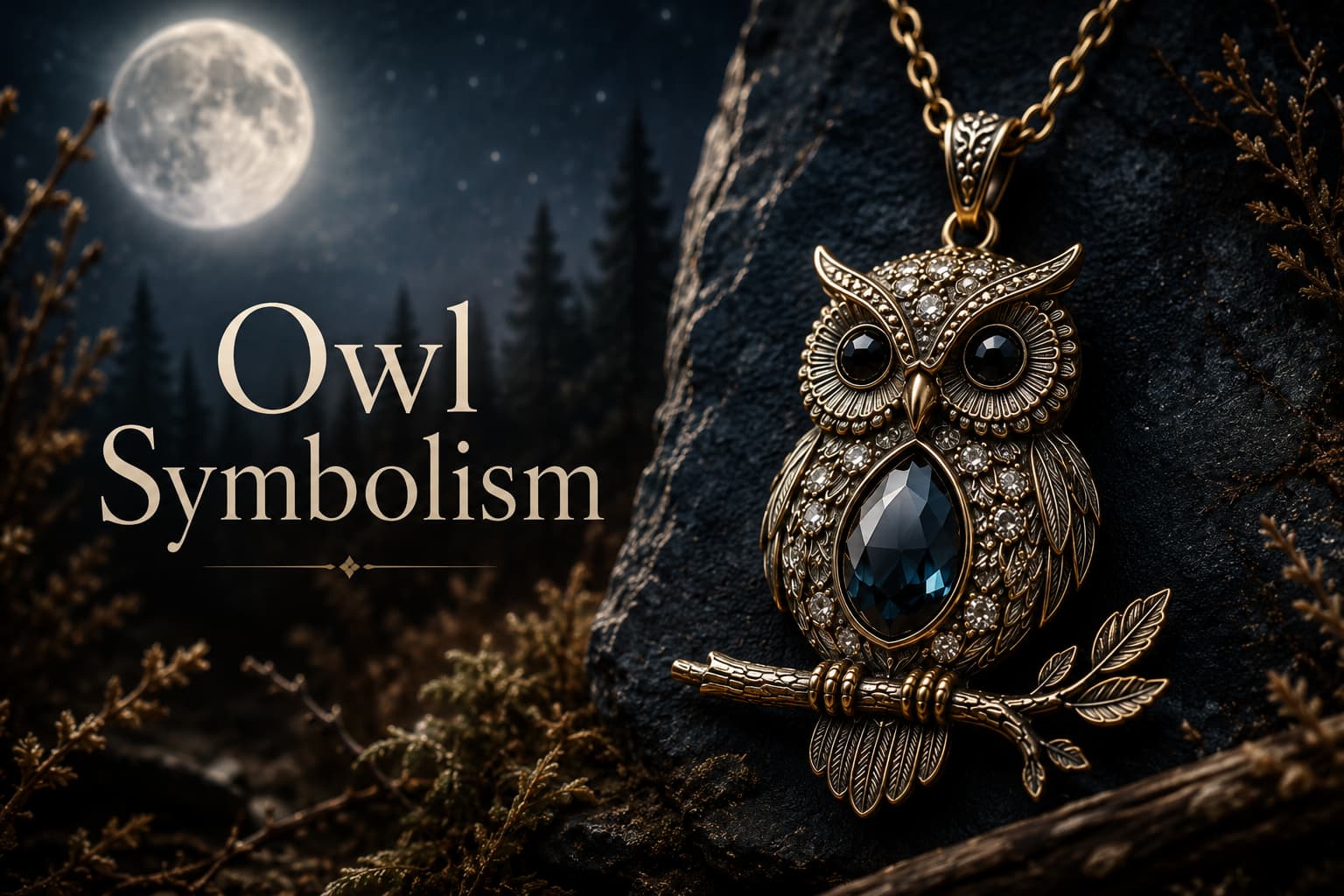
An owl piece of jewelry rarely gets picked at random. Something about those big, forward-facing eyes and that silent, almost ghostly flight has made owls stand out in human imagination for thousands of years, and that fascination has followed them straight onto rings, necklaces, and earrings. Depending on the culture in question, an owl can mean sharp intelligence, quiet protection, a warning of death, or even good luck arriving at the door. Understanding where those meanings come from makes an owl piece feel a lot more personal than just “a cute bird on a chain.”
What Does an Owl Symbolize?
An owl most commonly symbolizes wisdom, intuition, and the ability to see clearly even when things are dark or confusing. That reputation comes largely from the owl’s real-life traits — huge eyes built for night vision, a head that can turn almost all the way around, and a hunting style so quiet that prey never hears it coming.
Those physical facts turned into legend over time. Owls hunt at night with forward-facing eyes that give them an oddly human-like stare, and their feathers are built to muffle sound so completely that their flight is nearly silent. People watching an owl swivel its head and lock eyes with them in the dark, long before anyone understood animal biology, came away thinking the bird could see things humans couldn’t — including the truth, the future, or the spirit world. That’s the seed of almost every owl meaning that follows, whether it lands on the side of wisdom or the side of fear.
The Owl in Ancient Greek and Roman Culture
In Greek mythology, the owl belonged to Athena, the goddess of wisdom and strategic warfare, which is why it’s still the go-to symbol for “smart” in Western culture today. The species most closely tied to her was the Little Owl, and its image showed up on Greek coins and shields as a mark of both insight and protection. The bird also traveled with Greek armies almost like a good-luck charm, believed to bring clear judgment into battle.
The Romans kept the tradition going but shifted the goddess to Minerva, their own version of Athena. That connection is still visible today in a very specific way: the little owl species itself carries Minerva’s name in both Finnish (“minervanpöllö”) and Swedish (“minervauggla”), even though the everyday words for “owl” in those languages come from unrelated roots. An owl ring or pendant with a classical, almost architectural look often nods to this Greco-Roman legacy, which is probably the single most recognizable owl meaning in Western jewelry today: knowledge, strategy, and clear-headed thinking.
Not every Roman owl story was flattering, though. The Roman writer Pliny the Elder had a much darker view of the bird, once calling it a creature that brought nothing but bad news, and Roman folklore also blamed owls for witchcraft and misfortune. So even in ancient times, the symbol wasn’t universally positive.
The Owl as a Symbol of Death and Bad Omens
In several European folk traditions, hearing an owl hoot near a house was treated as a warning that death was coming. This belief shows up again and again, from ancient Rome through the Middle Ages and into Celtic folklore.
Pliny the Elder, writing in the first century AD, called the owl “the very monster of the night” and believed its appearance was a sign of coming misfortune.
The Celts carried a similar idea. They connected certain owls to a death-goddess figure sometimes described as an “old woman of the night,” and treated the bird’s screech as a sign that someone nearby was about to die. Medieval Europeans leaned into this fear too, with some communities nailing dead owls to barn doors in the belief it would ward off evil spirits. This darker thread is a real part of the symbol’s history, though almost nobody wearing an owl pendant today is thinking about ancient warnings of doom — the wisdom meaning has firmly taken over in modern jewelry design.
Owl Symbolism in Egypt, Native America, and Celtic Culture
Ancient Egyptians associated owls with guarding sacred knowledge and standing watch against harmful forces, which lines up neatly with the bird’s night-hunting habits and unmoving, watchful stare. Egyptian hieroglyphics actually used an owl symbol to represent the letter “M,” so the bird was worked directly into their writing system, not just their mythology.
Across various Native American traditions, the meaning of an owl depends heavily on the specific nation and story being told. In some traditions the owl acts as a guardian spirit that watches over the sleeping world at night, tied to the idea of death as a passage or transformation rather than something purely frightening. Other communities treated an owl’s call as a signal that change, and sometimes trouble, was on its way.
Celtic mythology adds one more layer to the symbol, relevant for owl jewelry with a folklore-inspired feel. One well-known Welsh story from the Mabinogion tells of a woman named Blodeuwedd, created from flowers by a magician, who was eventually transformed into an owl after a story involving betrayal. That myth loosely ties owls in Celtic tradition to themes of transformation and consequence, sitting alongside the death-omen beliefs mentioned earlier.
Owl Symbolism in Japan, China, and India
Owl meaning takes a noticeably brighter turn across parts of Asia. In Japan, the bird is genuinely considered lucky rather than frightening — the Japanese word for owl, “fukurou,” sounds similar to a phrase that can be read as “no hardship,” and that wordplay is part of why small owl charms and amulets became popular as good-luck talismans meant to ward off misfortune. This is one of the more jewelry-relevant facts in owl symbolism, since it directly explains why owl charms and small owl pendants are still marketed as luck pieces today, rooted in language rather than superstition alone.
China’s traditional view leans more cautious. Owls have sometimes been linked to bad fortune or disrespectful behavior in Chinese folklore, tied to their nocturnal habits and eerie calls, even though their sharp eyesight and hunting skill are still respected as a form of insight.
India carries a real split in owl symbolism, tied to wealth on one side and superstition on the other. Lakshmi, the Hindu goddess of wealth, is depicted riding a barn owl as her chosen vehicle, and in the Bhagavad Gita the owl is compared to a sthita prajna, someone whose wisdom stays steady no matter the circumstance, a reminder not to be seduced by wealth alone. At the same time, everyday Hindi carries the opposite message: “ullu,” the word for owl, is also a common insult meaning fool, and in parts of Indian folk belief the bird’s presence is treated as a bad omen rather than a good one, so the culture genuinely holds both meanings at once rather than settling on just one.
The Modern Meaning of Owl Jewelry
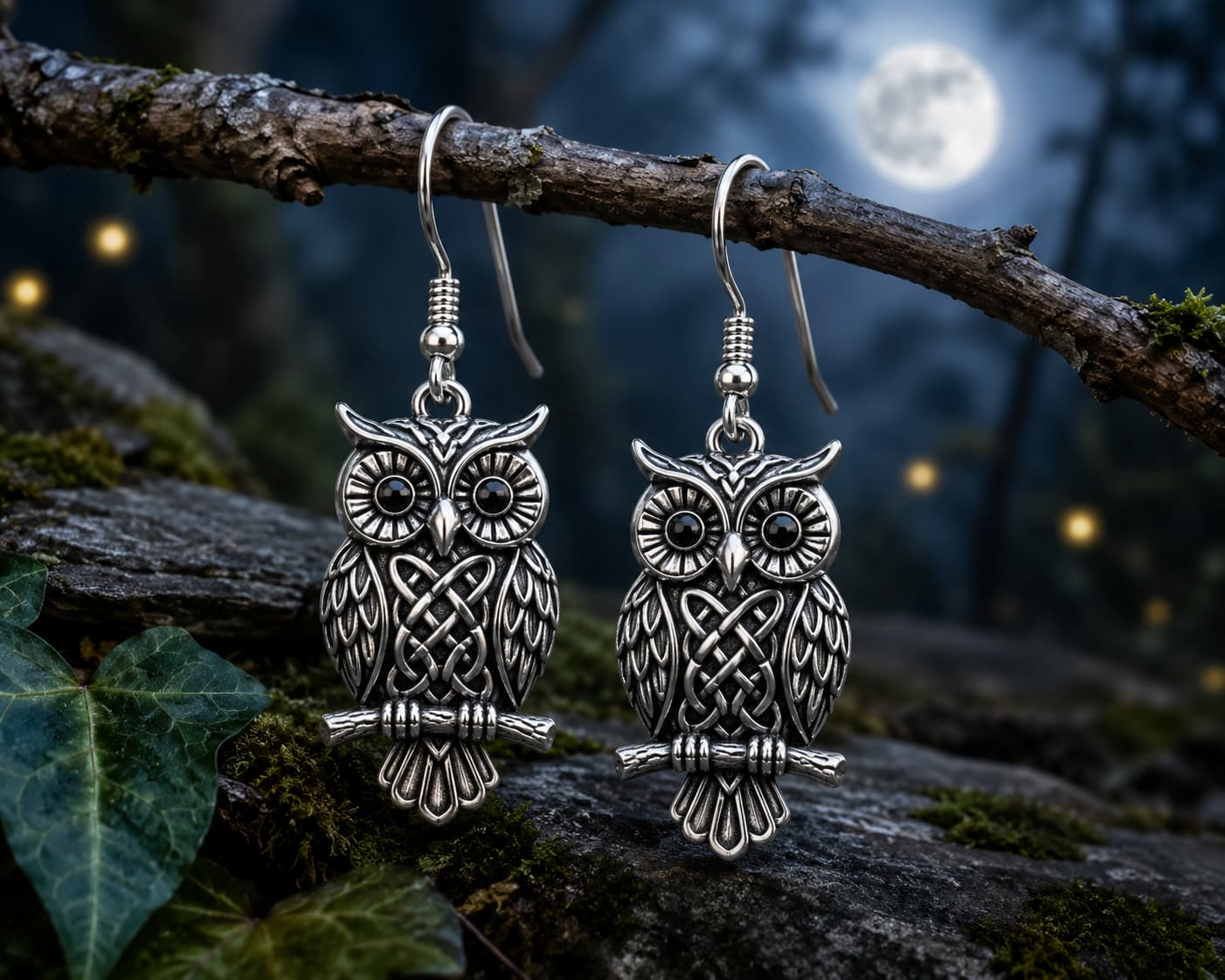
In modern jewelry, an owl almost always leans positive, standing in for wisdom, intuition, independence, and quiet confidence rather than any of the older death-omen associations. Most people buying or gifting an owl piece today are thinking about the Athena-style meaning — someone sharp, observant, and a little bit unbothered by what others think, much like the bird itself.
Specific occasions and relationships tend to draw on specific pieces of that history:
- New job or big life change: leans on the “seeing clearly in the dark” meaning, representing steady judgment during the unknown. A simple, unadorned owl silhouette tends to fit this occasion best, since the symbol is doing the talking rather than the design.
- Graduation or academic achievement: leans on the Athena and Greek wisdom association, representing knowledge and hard-won insight. This is the pairing most people already recognize, so even a classic owl-on-a-book charm reads clearly without needing explanation.
- General good-luck gift: leans on the Japanese “fukurou” meaning, representing protection from hardship. Small, wearable-everyday pieces like a stud earring or a slim ring suit this meaning well, since luck charms are traditionally meant to be worn constantly rather than saved for occasions.
- Gift tied to wealth or a new venture: leans on the Hindu association with Lakshmi, representing discernment around prosperity. This pairing works well for someone starting a business or a new financial chapter, since the myth itself is about staying grounded rather than chasing wealth carelessly.
- Gift for someone independent or a night owl by nature: leans on the bird’s real-life traits, representing self-reliance and sharp instincts. A more detailed, statement-style piece suits this meaning, since it’s less about ancient mythology and more about a personality trait the wearer already recognizes in themselves.
Because owl symbolism is genuinely layered across cultures, it also makes a thoughtful gift for someone with roots in Greek, Japanese, or Indian tradition specifically, since the meaning can be tailored to something personal rather than generic.
Popular Types of Owl Jewelry
Owl symbolism shows up across nearly every category of jewelry, and the format someone chooses often says as much as the symbol itself. A small, subtle owl charm reads very differently than a large, detailed owl ring meant to be the centerpiece of an outfit.
- Pendants and necklaces: the most common way to wear an owl, ranging from a tiny minimalist silhouette on a delicate chain to a detailed piece with gemstone eyes and textured feather engraving. Because a pendant sits close to the chest, it’s the format most people reach for when the meaning is personal rather than decorative, such as a self-bought reminder or a gift tied to a specific milestone.
- Rings: often designed with the owl’s face turned outward, sometimes with small gemstones standing in for the eyes, making them a popular choice for a statement piece. Owl rings tend to be more sculptural than other formats since there’s more surface area to work with, which is why they’re often the piece someone picks when they want the symbol to be immediately noticeable.
- Earrings: studs keep the symbol subtle for everyday wear, while dangle or hoop styles with an owl charm give it more presence. Stud owl earrings are especially common as a first piece for someone new to the symbol, since they’re low-commitment compared to a ring or pendant.
- Brooches and pins: a traditional way to wear an owl, historically popular for adding a detailed, sculptural design to a coat, jacket, or scarf. Because a brooch has more room for detail than a ring or earring, it’s often where the more intricate, feather-by-feather designs show up.
- Charm bracelets: owls are a common single charm added to a bracelet alongside other personal symbols, rather than being the whole piece. This format lets someone combine an owl with a second meaningful symbol, like a moon or a key, to build a more specific, personal message than the owl alone would carry.
- Cufflinks: a less common but classic way an owl’s wisdom symbolism gets carried into menswear and formalwear. They tend to favor a simplified, more geometric take on the owl, since the design has to read clearly at a small size and from a distance.
Frequently Asked Questions
Is an owl a good luck symbol?
It depends on the culture. In Japan specifically, yes — the word for owl doubles as a phrase suggesting freedom from hardship, which is why owl charms are worn there as good-luck talismans. India actually holds both views: the owl is Lakshmi’s vehicle and tied to wealth, but everyday Hindi slang also uses the same word as an insult meaning fool. In much of medieval European tradition, meanwhile, the owl was seen as a bad omen, so the “luck” answer really comes down to which cultural tradition is being followed.
Why is the owl connected to wisdom?
This traces back to ancient Greece, where the Little Owl was sacred to Athena, goddess of wisdom, and appeared alongside her on coins and in art as a symbol of insight and protection. The bird’s physical traits — big forward-facing eyes and a calm, watchful stare — reinforced the idea that it could “see” things others couldn’t, which is where the wisdom association really took hold.
Does an owl symbolize death?
In several traditions, yes. Ancient Roman writers linked owls to bad omens, medieval Europeans associated an owl’s hoot with an approaching death, and Celtic folklore tied the bird to a death-goddess figure. That said, this meaning has largely faded from modern jewelry, where owls are worn mostly as symbols of wisdom and intuition rather than mortality.
What does an owl piece of jewelry say about a person?
There’s no single fixed meaning, but owl jewelry is commonly chosen by people who want to represent intelligence, independence, or a strong sense of intuition. Because the symbol carries such different meanings across cultures, the message often comes down to which tradition the wearer personally connects with.
Does owl species or color change the meaning?
Jewelry design doesn’t usually distinguish between owl species the way mythology sometimes does. In folklore, though, specific species carried specific weight — the Little Owl was Athena’s bird in Greece, while the barn owl carried both the Celtic death-goddess association and the Hindu wealth symbolism tied to Lakshmi. A white or pale owl design may lean more toward those barn owl associations of purity, wealth, or omen, depending on the tradition being referenced.
Conclusion
Owl symbolism has swung between wisdom and warning for thousands of years, and both readings are still technically “correct” depending on which culture’s story is being followed. What’s changed is which meaning has won out in everyday jewelry: today, an owl piece overwhelmingly represents sharp thinking, quiet strength, and the ability to stay clear-eyed when things get dark, borrowed straight from Athena’s shoulder and Japan’s lucky charms rather than Pliny’s warnings of doom. That history turns a simple owl pendant into something with real weight behind it, whether it’s worn as a personal reminder or given as a gift to someone whose wisdom is genuinely admired.