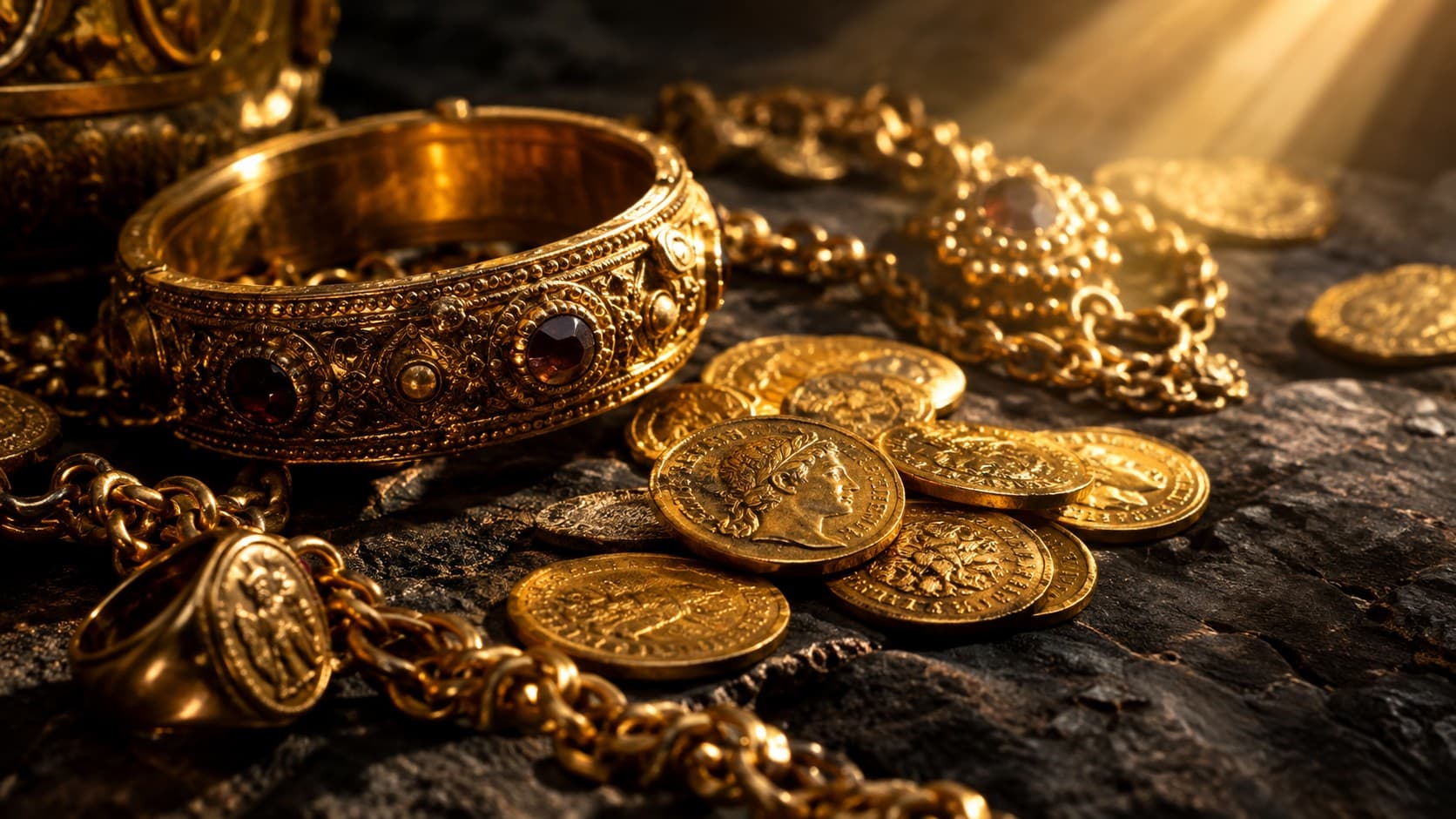
Gold has never just been a metal. Long before anyone weighed it in grams or set a price on it, people looked at its warm glow and decided it had to come from somewhere special, maybe even somewhere divine. Ancient cultures built entire belief systems around this yellow metal, connecting it to gods, the sun, and the forces that they believed ran the universe. Some of these old stories still shape the way gold jewelry is viewed today, even though most people rarely stop to notice it.
Why Ancient People Worshipped Gold
People linked gold to gods because it never rusts, tarnishes, or rots, unlike almost everything else they knew. That single property made it feel unlike any other material on earth. Iron rusted. Wood rotted. Even silver turned dark over time. Gold, however, stayed bright for centuries, buried in tombs or sitting at the bottom of rivers.
To ancient minds without modern chemistry, this permanence looked like magic. If a metal never decayed, it must belong to beings who also never decayed, meaning gods, spirits, or the sun itself. This idea popped up independently in cultures that had no contact with each other, from Egypt to Peru to China, which shows how naturally the human mind reaches for that connection.
Gold also had a practical head start over other metals. It’s one of the few metals found in nature already in its pure, metallic form, often as nuggets or flakes sitting in riverbeds. That meant early humans could pick it up and shape it with simple tools, long before anyone figured out how to smelt copper or iron out of rock. Gold was likely one of the first metals people ever worked with, which gave it a many-thousand-year head start on building up its reputation.
Gold’s resistance to tarnish comes down to simple chemistry: it barely reacts with oxygen or most other elements. Ancient people had no way to know that, so they explained it through myth instead.
Gold in Ancient Egypt: Flesh of the Gods
The ancient Egyptians believed gold was literally the skin or flesh of their gods, especially Ra, the sun god. This wasn’t just poetic language to them. It was a religious fact that shaped how they treated the metal for thousands of years.
Egyptian texts describe Ra as having golden flesh, silver bones, and hair made of lapis lazuli. Because pharaohs claimed to be direct descendants of Ra, they wrapped themselves and their tombs in gold to show their divine connection. Tutankhamun’s famous burial mask, made from more than 10 kilograms of hammered gold, wasn’t created to impress future museum visitors. It was meant to give the young pharaoh a godlike, imperishable body for the afterlife.
Most of that gold traveled a long way to reach the Nile Valley. Egypt got much of its supply from Nubia, a region to the south so closely tied to gold mining that its name is widely believed to come from the ancient Egyptian word for the metal itself. Egyptians treated mining as a sacred task rather than just hard labor, and miners even had their own protector, the goddess Hathor, who had shrines built near mining camps in the Sinai desert.
Gold also played a practical role in Egyptian religion beyond royalty. Priests placed small gold objects, including gold tongues, inside the mouths of some mummies so the dead could speak in the next world. Every use of gold in Egyptian tombs pointed back to the same core belief: this metal belonged to eternity, and so should the people buried with it.
The Inca Belief: Gold Is the Sweat of the Sun
The Inca people believed gold formed from the sweat of Inti, their sun god, while silver came from the tears of Mama Killa, the moon goddess. This belief explains why the Inca covered entire temple walls in gold sheets instead of treating it as currency.
The most famous example was the Coricancha, the Sun Temple in Cusco, Peru. Its walls were lined with hundreds of gold panels, and its courtyard reportedly held a garden filled with life-sized gold and silver sculptures of corn, llamas, and shepherds. None of it was meant to be spent or traded. It existed purely to honor Inti.
Gold even shows up in Inca origin stories. According to legend, the first Inca ruler, Manco Capac, was told to travel until he found a spot where he could drive a golden staff into the ground with a single blow. That spot became Cusco, the capital of the empire. In other words, the Inca didn’t just use gold to decorate their most sacred city, they believed gold itself had chosen the site.
This belief had tragic consequences during the Spanish conquest in the 1530s. When Spanish conquistadors captured the Inca ruler Atahualpa, he offered to fill a room with gold and two rooms with silver in exchange for his freedom. Over the following months, the Inca delivered an estimated 6,000 kilograms of gold and roughly 12,000 kilograms of silver, not realizing the Spanish valued it as wealth rather than divine sweat. Atahualpa was executed anyway, and much of that irreplaceable religious gold was melted down into bars for shipping back to Europe.
Why the Aztecs Called Gold “Excrement of the Gods”
The Aztecs called gold teocuitlatl, a word that translates to “excrement of the gods.” That might sound like an insult by today’s standards, but in Aztec belief, it was actually high praise.
The Aztecs believed gold was waste material left behind by the sun as it traveled through the underworld each night, later rising back into the earth. Since the sun itself was sacred, anything connected to it, even something framed as waste, carried divine importance. Gold in Aztec society was reserved almost entirely for rulers and nobles, worn in items like labrets, small ornaments fitted through a hole in the lower lip. Wearing one wasn’t just decorative; it marked a person as someone whose speech carried royal authority.
This shows something important about how symbolism works across cultures. Two civilizations, the Inca and the Aztec, both tied gold to the sun, yet they described the exact same idea in almost opposite ways. One saw sweat, a sign of exertion and life. The other saw waste, a byproduct of a powerful process. Both meanings pointed to the same conclusion: gold came from the sun, and that made it sacred.
Greek Mythology: The Legend of King Midas
The myth of King Midas warns that getting everything one wishes for can turn into ruin, using gold as the ultimate cautionary symbol. Midas, a legendary king of Phrygia in what is now Turkey, helped return a lost satyr named Silenus to the god Dionysus. Grateful, Dionysus offered Midas any wish he wanted.
Midas asked for the power to turn everything he touched into gold. At first this seemed perfect. Trees, stones, and furniture all became solid gold under his fingertips. The problem appeared at dinner, when his food and wine turned to gold the moment they touched his lips. In the most famous version of the story, even his own daughter turned to gold when he embraced her.
Dionysus eventually took pity on Midas and told him to wash in the river Pactolus, which reversed the curse. According to the myth, this is why gold deposits were later found in that river’s sands. Midas probably wasn’t a complete invention. Ancient Assyrian records mention a real Phrygian king named Mita around the same era, suggesting the myth grew up around an actual ruler whose kingdom happened to sit near genuinely gold-rich rivers.
Unlike the Egyptian, Inca, and Aztec stories, which treated gold as something purely divine and good, the Midas myth introduced a darker idea that still echoes today: unlimited wealth can come at the cost of the things that matter most.
Gold’s Meaning in Biblical Tradition
In the Hebrew Bible, gold marks the presence of God rather than just royal wealth. The clearest example is the Ark of the Covenant, described in the Book of Exodus as a wooden chest that the Israelites were instructed to overlay with pure gold, inside and out. The Ark wasn’t decorated with gold to look impressive. It was gold specifically because it held the stone tablets of the covenant and was believed to be the place where God’s presence rested among the people.
That same logic shaped Solomon’s Temple in Jerusalem centuries later. According to the Book of Kings, Solomon overlaid the entire interior of the temple with pure gold, including the altar, the doors, and even the chains stretched across the inner sanctuary. Nearly every object used in worship there, from lampstands to incense altars, was made of or covered in gold. The message was consistent throughout: gold signaled that a space or object belonged to God, not just to a wealthy king.
The New Testament carries this symbolism forward in a single, well-known moment. When the Magi visited the infant Jesus, they presented three gifts, and gold was the first one named. Unlike myrrh and frankincense, which carried more spiritual or symbolic meanings tied to death and worship, gold was understood as a gift fit for a king, publicly recognizing Jesus’s status even as a newborn.
Hindu Traditions Behind Wearing and Gifting Gold
In Hindu tradition, gold is closely associated with Lakshmi, the goddess of wealth, prosperity, and good fortune. Because of this connection, gold isn’t just decorative in Hindu households, it’s considered auspicious, meaning it’s believed to invite luck and blessings into a home or a marriage.
This belief is most visible on Dhanteras, a festival that opens the five-day Diwali celebration and is dedicated specifically to Lakshmi and Kubera, the god of wealth. One popular legend behind the day tells of a young prince fated to die from a snakebite on the fourth night of his marriage. His new wife piled gold and silver jewelry at their bedroom door and kept the lights burning all night, and when the god of death arrived disguised as a snake, the dazzling glow blinded him and he left without harming the prince. Families still buy gold on Dhanteras today to invite that same protection and prosperity into their homes.
Gold plays an equally central role in Indian weddings, where it’s given as much as a spiritual gesture as a financial one. Historically, jewelry has also been one of the few assets a woman could own and control outright in many parts of South Asia, which gave wedding gold a practical purpose alongside its symbolic one.
Why Gold Represents Fortune in Chinese Culture
In Chinese culture, gold represents wealth, power, and good fortune, and it’s closely tied to imperial authority throughout history. For centuries, certain shades of gold and yellow were reserved specifically for the emperor, since yellow was considered the color of the earth element and of centrality in Chinese cosmology. Wearing or using that color without permission could be treated as a serious offense against the throne.
Gold jewelry remains a common gift during Chinese New Year and weddings today, often in the form of items shaped like coins, dragons, or other lucky symbols. Giving gold at these events isn’t viewed as showing off. It’s viewed as wishing someone a prosperous, fortunate life, which is why older generations in Chinese families often pass down gold jewelry rather than cash.
Alchemy’s Long Obsession With Gold
Alchemists across medieval Europe and the Islamic world spent centuries trying to transform ordinary metals like lead into gold. This wasn’t simple greed. Many alchemists believed gold represented a kind of perfection that other metals were still striving toward, almost like a spiritual endpoint rather than just a valuable material.
Alchemy blended early chemistry with mysticism and religion. Practitioners searched for something called the “philosopher’s stone,” a legendary substance believed capable of turning base metals into gold and even granting immortality. No one ever succeeded, because turning lead into gold requires nuclear reactions, not chemical ones, something nobody could have known at the time. Still, this centuries-long obsession pushed forward real scientific discoveries in chemistry, even though the original goal was never achieved.
Even gold’s chemical symbol carries a trace of this old reverence. Au comes from aurum, the Latin word for gold, which many scholars link back to root words meaning “glowing” or “shining dawn.” Thousands of years after the alchemists gave up their search, that ancient sense of gold as something almost like captured light still sits quietly in a two-letter symbol on the periodic table.
How Ancient Gold Beliefs Still Shape Life Today
Modern gold traditions carry clear echoes of these ancient beliefs, whether people realize it or not.
- Wedding rings: Gold’s link to permanence and the divine made it a natural symbol for marriage vows meant to last forever.
- Olympic gold medals: Ranking gold above silver and bronze directly reflects thousands of years of treating gold as the top-tier, most sacred metal.
- The gold standard: Governments backed their currencies with gold for centuries, an economic decision rooted in the same ancient idea that gold represents unmatched, lasting value.
- Religious art and objects: Many religions, from Christianity to Buddhism, still use gold in altars, statues, and sacred texts to signal holiness and importance.
None of these modern uses are accidental. They’re the descendants of beliefs that started with Egyptian priests, Inca sun worshippers, and Aztec artisans who all reached the same basic conclusion from different directions: gold belongs to something greater than everyday life.
Frequently Asked Questions
Why did so many ancient cultures connect gold to the sun?
Gold’s bright yellow color closely resembles sunlight, and its resistance to tarnishing made it seem eternal, much like the sun itself appeared to ancient people. Civilizations with no contact with each other, including the Inca, Aztec, and Egyptians, independently made this same visual and symbolic connection.
What does the Midas myth actually teach?
The Midas myth warns against greed and against getting exactly what one wishes for without thinking through the consequences. It shows that even something as universally desired as gold can become a curse when taken to an extreme.
Is gold considered lucky in most cultures?
Gold is widely considered lucky or auspicious, particularly in Hindu and Chinese traditions, where it’s linked to prosperity gods and imperial power. That said, symbolism does vary by culture, and some traditions focus more on gold’s spiritual or religious meaning than on luck specifically.
Why was gold used in ancient burial practices?
Many ancient cultures, especially the Egyptians, believed gold never decayed because it belonged to the gods, making it the ideal material to accompany the dead into the afterlife. Gold masks, jewelry, and even gold tongues were meant to grant the deceased a form of divine protection or communication beyond death.
Did ancient people know why gold doesn’t tarnish?
No, ancient civilizations had no concept of atomic chemistry, so they explained gold’s resistance to tarnishing through religion and myth instead of science. Modern chemistry now confirms that gold is simply unreactive with oxygen and most other elements, which is the real reason it stays shiny for thousands of years.
The Bottom Line
Across Egypt, Peru, Mexico, Greece, ancient Jerusalem, India, and China, ancient people reached remarkably similar conclusions about gold despite having no way to communicate with each other. They saw a metal that never decayed and decided it had to belong to something eternal, whether that was a sun god, a goddess of fortune, or the emperor himself. The specific stories differ wildly, from sacred sweat to divine excrement to a king’s regretful wish, but the underlying instinct is identical: humans have always treated gold as a bridge between the ordinary world and something bigger than themselves. That instinct didn’t disappear with ancient temples and pharaohs. It’s still sitting quietly inside every wedding ring, gold medal, and heirloom necklace passed down today.