Long before anyone had heard of reading glasses or contact lenses, fashionable men and women solved their eyesight problems with a strange little tool that also happened to double as jewelry. It looked like a tiny magnifying glass on a stick, hung from a ribbon or chain around the neck, and it was called a quizzing glass. It sounds like something out of a storybook, but it was a very real, very popular accessory two hundred years ago, and understanding it says a lot about how people used to think about vision, fashion, and even flirting.
What Is a Quizzing Glass?
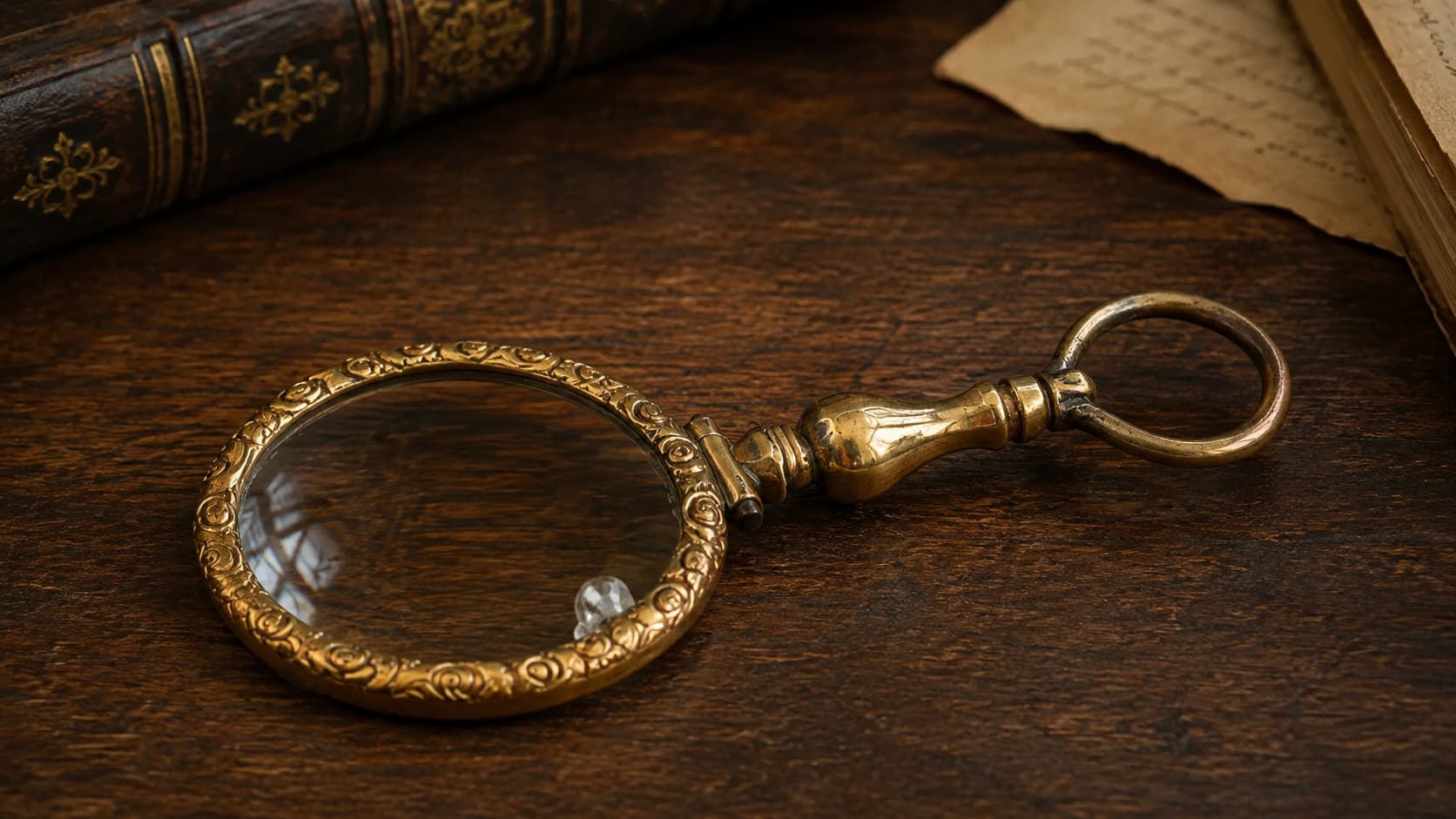
A quizzing glass is a single magnifying lens set into a frame, attached to a handle or a ring, and worn on a ribbon, cord, or chain around the neck. Instead of resting on the nose like modern glasses, it was held up to one eye whenever a closer look was needed, whether at a letter, a piece of art, or another person across the room.
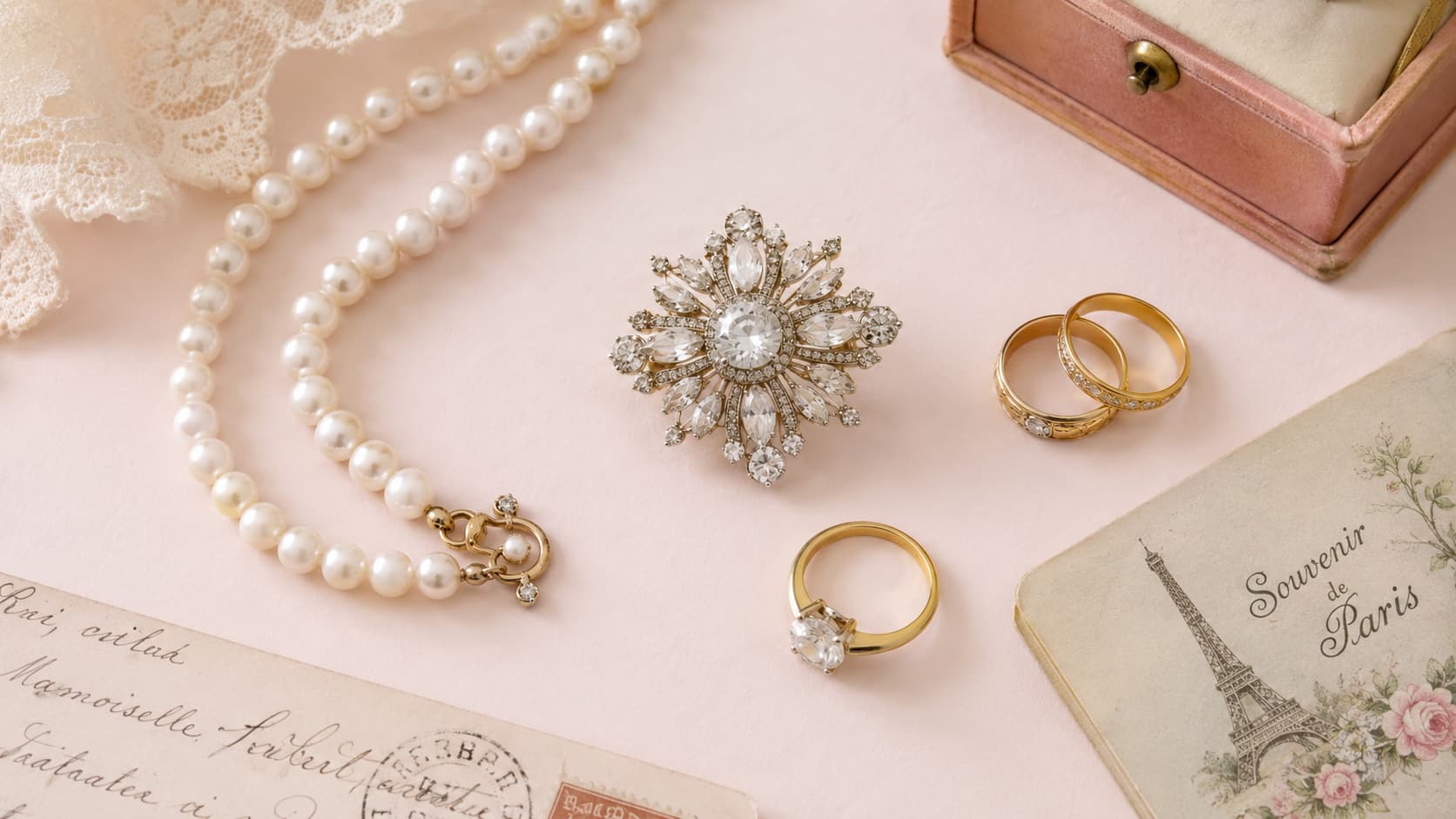
The lens was usually mounted in a frame made from gold, silver, or another precious metal, attached to a chain or ribbon so it could be worn around the neck or tucked away in a pocket. Some were plain and simple. Others were covered in tiny engravings, gemstones, or detailed metalwork, which is why collectors today often treat them less like an old vision aid and more like a piece of fine jewelry.
It was part magnifying glass, part fashion statement, and part substitute for a pair of glasses that nobody wanted to admit they needed.
Most surviving examples measure only two and a half to three inches long, small enough to slip into a pocket or vanish inside a closed fist. The magnification itself was fairly gentle, often somewhere around five times, just enough to bring small print or fine detail into focus without turning the whole object into a bulky tool. That modest strength is part of why it worked so well as jewelry: it needed to look elegant first and function second.
The Origins of the Quizzing Glass
The quizzing glass became fashionable in the mid-1700s and stayed popular for roughly a century, reaching its biggest moment in the early 1800s. The name itself started being used near the end of the 1700s. Before that, people had access to actual spectacles, but wearing them in public was considered awkward or even a little embarrassing for anyone who cared about looking stylish.
Regular spectacles that rested on the nose and ears had already been invented decades earlier, but the fashionable crowd didn’t consider them stylish, so people reached for other tools instead. A quizzing glass let a person quietly squint at something up close without admitting their eyesight wasn’t perfect. It was a workaround dressed up as a trend, a practical fix disguised as a piece of style.
By the early 1800s, the word had also picked up a second meaning: to “quiz” someone meant to look at them with amusement, doubt, or even mockery. That’s part of where the name likely comes from. When someone lifted the little glass to their eye and stared, it wasn’t always about seeing better. Sometimes it was about sending a message.
What Was a Quizzing Glass Used For?
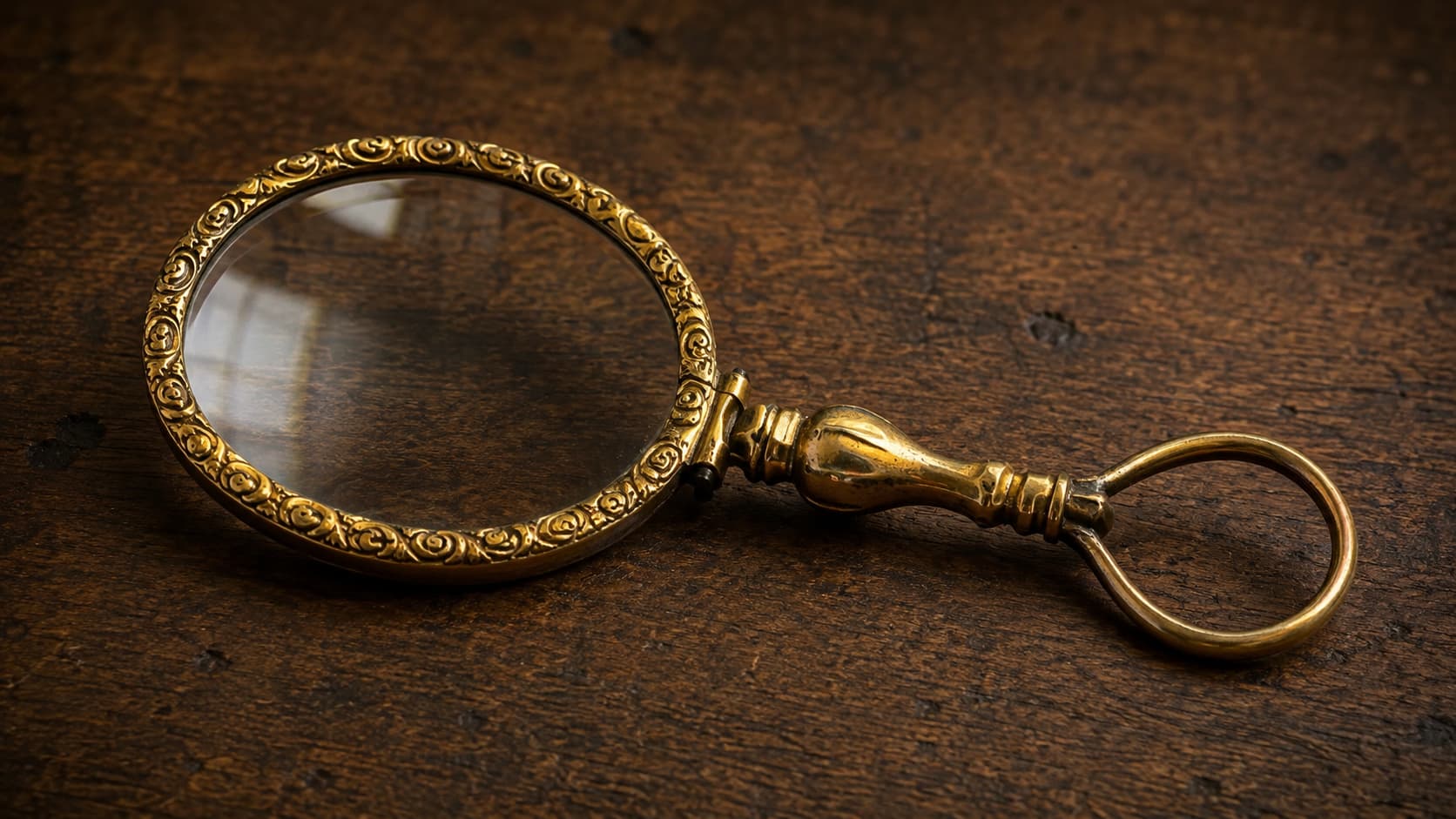
People raised the lens to one eye whenever they wanted to look closely at something, whether that meant reading tiny print, admiring a painting, or looking directly at another person in a crowded room. It only worked on one eye at a time, so using it required holding it steady with a hand the whole time.
That single detail made it a surprisingly powerful social tool. Beau Brummell, one of the most famous style icons of the era, reportedly used his quizzing glass to stare disapprovingly at someone, and that kind of public judgment could genuinely damage a person’s reputation in fashionable society. Lifting the glass, studying someone from head to toe, and then lowering it again without saying a word could be a bigger insult than any sentence.
The word even worked its way into the literature of the time. Jane Austen used it herself in Northanger Abbey, having a character ask “Where did you get that quiz of a hat?” to describe something odd or ridiculous. Decades later, the quizzing glass showed up again as a favorite prop in Regency-era novels, where authors used it as shorthand for a character who was sharp-tongued, socially confident, or quietly judging everyone in the room.
It wasn’t only used to judge strangers, either. People also used it during courtship, where a woman might use hers to quietly study a potential suitor while a man might use his to admire someone from across a room. And contrary to what many assume, plenty of fashionable young women carried and used quizzing glasses too, not just older men trying to look distinguished.
Quizzing Glass vs. Monocle vs. Lorgnette
These three accessories get mixed up constantly, but they’re not the same thing:
| Accessory | Number of Lenses | How It’s Worn |
|---|---|---|
| Quizzing glass | One | Handheld, on a chain or ribbon |
| Monocle | One | Wedged into the eye socket, no hands needed |
| Lorgnette | Two | Handheld, often folds like small glasses |
A monocle sits directly in the eye socket, held in place by the muscles around the eye, so a person’s hands stay free once it’s in. A quizzing glass, on the other hand, always needed a hand to hold it up, which is exactly why it became such a dramatic, theatrical gesture. A lorgnette has two lenses instead of one and looks more like a small pair of folding glasses on a handle.
Quizzing glasses stayed popular with women into the 1820s and 1830s before lorgnettes took over as the more fashionable choice for them, while quizzing glasses continued being worn by men into the early 1900s, when monocles eventually became more popular.
Materials Used in Quizzing Glasses
Most quizzing glasses were crafted from gold, sterling silver, or pinchbeck, a shiny brass alloy designed to look like gold at a fraction of the cost. Surviving examples from the early 1800s are typically only two and a half to three inches long, most often gold, occasionally sterling silver, usually with a swivel-mounted loop handle.
The lens itself was ground and polished by an optician, since getting the magnification right took real skill, while the metal frame around it was usually the work of a goldsmith or jeweler. That split between two different craftspeople is part of why a well-made quizzing glass could be so detailed. Some were plain gold ovals. Others hid small compartments, held a dab of perfume, or were decorated with engraved patterns, initials, or gemstones, turning a practical object into a genuine keepsake.
Some handles went a step further and opened into a small hidden locket, often revealing a lock of woven hair kept beneath a tiny glass cover, a common way for Georgian jewelry to double as a personal keepsake. The handle also had to hold up to daily use, so many were built with a swivel-mounted loop that let the lens turn freely without straining the frame, a small mechanical detail that made an otherwise delicate object surprisingly durable.
Why Did Quizzing Glasses Fall Out of Fashion?
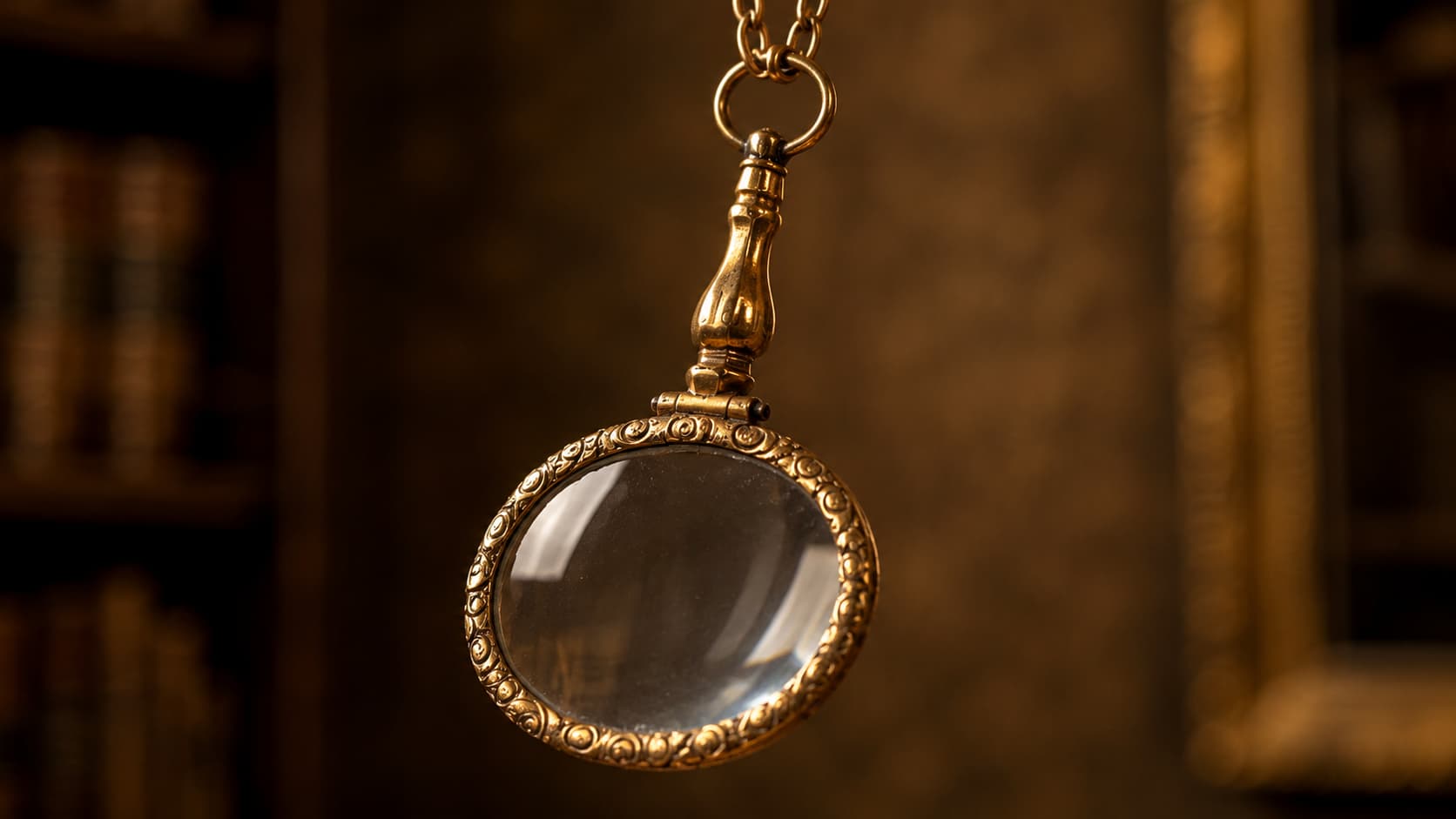
Quizzing glasses gradually lost their popularity as other eyewear became more socially acceptable and more convenient to use. They were most common from the early 1700s through the mid-1800s, before various types of spectacles and monocles took their place.
Fashion rarely disappears for just one reason, and this was no exception. Spectacles kept improving and slowly became more acceptable in public. The monocle offered the same single-lens idea without needing a free hand. And attitudes about wearing corrective lenses in public simply relaxed over time, so there was less pressure to hide the fact that someone needed help seeing clearly. Once that stigma faded, the entire reason the quizzing glass existed in the first place started to fade with it.
Can You Still Find a Quizzing Glass Today?
Quizzing glasses themselves stopped being manufactured close to two centuries ago, so any genuine antique piece in circulation today is a true historical object, not a new production. They haven’t been made for nearly 200 years, which is part of what makes original pieces so hard to track down.
That said, the idea behind them never really vanished. Modern pendant magnifiers, monocle-style necklaces, and vintage-inspired lorgnettes borrow directly from the same concept: a lens worn as jewelry, ready to be lifted up whenever it’s needed. Antique quizzing glasses also show up at estate sales, auctions, and specialty antique jewelry dealers, prized as much for their craftsmanship and history as for their original job of helping someone read fine print.
On the resale market, prices for an authentic antique quizzing glass typically start around several hundred dollars and can climb well past ten thousand for especially rare or elaborate examples, with many changing hands somewhere in the low thousands. Gold pieces from the Georgian era, roughly 1714 to 1830, tend to carry the highest value, especially when they still have their original case, chain, and clear, undamaged lens.
Frequently Asked Questions
Is a quizzing glass the same thing as a monocle?
No. A quizzing glass is handheld and worn on a chain, while a monocle wedges directly into the eye socket and stays in place without being held. They share the idea of a single magnifying lens, but they work completely differently.
Did only rich people wear quizzing glasses?
Quizzing glasses were most closely associated with wealthy, fashionable society, since the gold and silver versions were expensive to have made. Simpler versions in less costly materials did exist, but the accessory as a whole was strongly tied to upper-class fashion.
Could a quizzing glass actually correct someone’s vision?
Yes, in a basic way. The lens magnified whatever the wearer looked at, which helped with reading small text or examining fine details, similar to a small magnifying glass held up to one eye.
Why were quizzing glasses considered rude?
They weren’t rude by design, but the way people used them could be. Staring at someone through the lens for an extended time was a recognized way to silently judge or mock them, which is part of where the word “quizzing” comes from in the first place.
Can an authentic antique quizzing glass still be bought today?
Yes, though it takes some searching. Antique dealers, estate sales, and jewelry auctions occasionally offer genuine 18th and 19th century pieces, usually in gold, silver, or pinchbeck, often with visible wear that reflects their age.
How much is an antique quizzing glass worth?
Prices vary a lot depending on age, material, and condition, but genuine antique pieces generally range from a few hundred dollars to well over ten thousand. Gold Georgian examples with their original case and chain intact tend to sell for the most.
Conclusion
The quizzing glass tells a bigger story than its small size suggests. It started as a practical answer to a vision problem, turned into a genuine fashion statement, and somewhere along the way became a tool for silent judgment, quiet flirtation, and social power, all through the simple act of lifting a lens to one eye. It disappeared once spectacles and monocles made hiding poor eyesight unnecessary, but the pieces that survive today remain small, wearable pieces of history, proof that even the most practical objects can end up saying something about the people who carried them.