Almost any jewelry store, yoga studio, or online shop carries the same curvy little symbol dangling from a necklace or stamped onto a ring: Om. It looks simple, almost like a doodle, but it is actually one of the oldest written symbols still used in jewelry anywhere in the world. Understanding what the shape is really saying, which cultures hold it sacred, and why so many people feel strongly about how it gets worn adds real context to a piece that often gets treated as purely decorative.
What Does the Om Symbol Mean?
Om represents the sound of the entire universe — its beginning, its middle, and everything still to come. In Hinduism, Buddhism, Jainism, and Sikhism, it is treated as the original vibration that everything else grew out of, almost like the universe’s very first note. Chanting or wearing it is meant to connect a person to that larger, unified sense of existence.
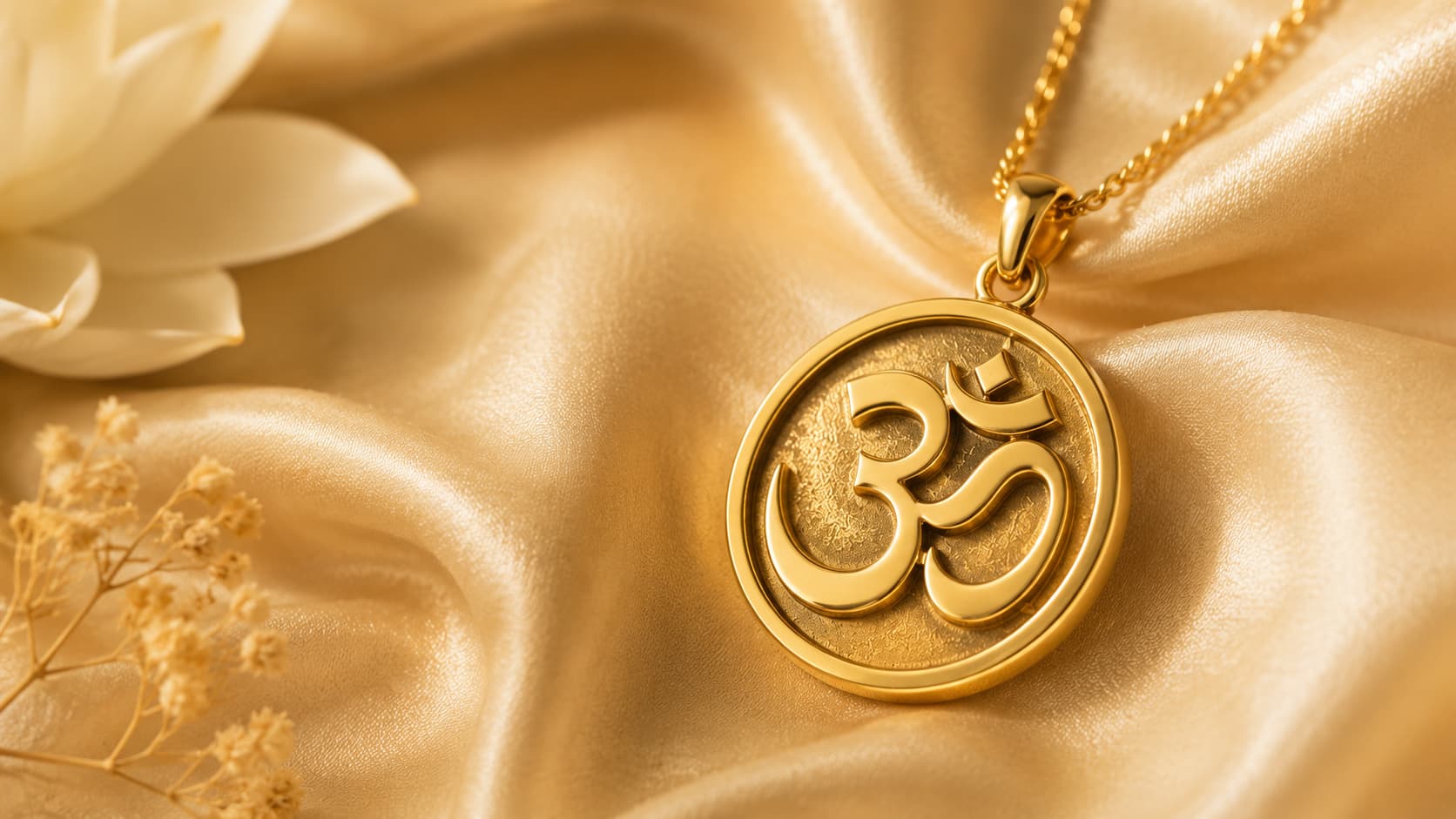
The symbol is built from three curved lines, one smaller curve, and a dot, and each part carries its own meaning. Most teachers explain the three big curves as three states people move through every single day: being awake, dreaming, and sleeping deeply without dreams. The smaller curve near the top stands for illusion, the tricky sense that the everyday world people experience is not the full picture.
The dot sitting above everything is easy to overlook, but it points to what many teachers consider the whole reason the symbol exists. It represents a fourth state, called turiya in Sanskrit, which is not waking, dreaming, or sleep, but the quiet gap that follows right after the sound of Om fades out. Traditionally, chanting Om ends with a deliberate pause of silence, and that silence is treated as its own experience — pure awareness with nothing else layered on top of it. Seen this way, the symbol is not just describing three states of mind side by side; it is pointing past all three of them, toward the stillness underneath.
Where Did the Om Symbol Come From?
Om began in ancient India more than 3,000 years ago as part of the Vedas, the oldest sacred texts in Hinduism. Its roots go back to the Vedic period, and the Rig Veda, considered the oldest surviving Hindu scripture, is one of the earliest known sources to mention the sound. Long before anyone wrote it down as a symbol, Om was simply chanted out loud, placed at the start and the close of sacred verses almost like a spoken bookend.
Later Hindu texts called the Upanishads expanded on the idea a great deal. One of them, the Chandogya Upanishad, describes Om as a sound that runs through every part of existence, tying all living things back to one shared source, and it encourages meditating on the sound as a path toward understanding one’s true nature. Over the following centuries, Om traveled with these ideas into Buddhism, Jainism, and Sikhism, picking up slightly different shades of meaning in each tradition while keeping its core identity as a sound representing wholeness.
“Om” is often translated in ancient texts as standing for everything that has already happened, everything happening right now, and everything still to come — a way of saying the symbol covers the whole of existence in one syllable.
How the Three Sounds Fit Together
Written out, Om is really three sounds squeezed into one: A, U, and M. Each letter is usually tied to one part of a repeating cycle that Hindu philosophy sees playing out constantly in the universe.
| Sound | Common Meaning | Associated Deity |
|---|---|---|
| A | Creation — the start of something new | Brahma, the creator |
| U | Preservation — keeping what exists going | Vishnu, the preserver |
| M | Dissolution or destruction — the ending that makes room for a new beginning | Shiva, the destroyer |
This trio of deities is known as the Trimurti, and pairing them with Om is one of the oldest ways Hindu texts explain the symbol. The idea is not that things simply end and stop, but that endings clear space for the next round of creation, similar to how a season closes so a new one can begin.
There is also a fun visual detail some people notice once they know the written symbol well: the two large curves are sometimes compared to the head and trunk of an elephant, which has led some writers to connect Om’s shape loosely to Ganesha, the elephant-headed deity associated with new beginnings. This is a popular observation rather than an official rule of the symbol, but it is a good example of how much extra meaning people have layered onto Om’s shape over the centuries.
Om in Buddhism, Jainism, and Sikhism
Om is not only a Hindu symbol. In Mahayana Buddhism, the sound was absorbed through Hindu influence even though it was not part of the earliest Indian Buddhist teachings, and it now appears as a prefix or suffix in well-known mantras such as Om mani padme hum. In Jainism, the symbol is used as a chant of respect toward spiritual teachers and enlightened figures. Sikhism uses a related form, sometimes written as Ik Onkar, to express the idea of one universal divine presence, an idea Guru Nanak, the religion’s founder, wove into daily prayer.
Ik Onkar is not simply the Hindu Om symbol reused. It is written as its own distinct character in Gurmukhi script, combining the numeral “one” with the sound “Onkar,” and it looks noticeably different from the curved Devanagari Om most people picture. The two symbols share a common root idea — one universal, unifying presence — but a Sikh-specific piece would use the Ik Onkar design rather than the Hindu Om.
Because it appears across so many belief systems, Om is sometimes described as a bridge symbol — one that carries slightly different specifics depending on the tradition, but always circles back to the same core idea of unity and the sound behind all existence.
Why Is Om So Common in Jewelry?
Om found its way into Western jewelry mainly through the spread of yoga, which exploded in popularity outside India from the late twentieth century onward. As more people took up yoga classes and meditation, they encountered Om constantly, chanted at the start or end of a session, and naturally wanted a physical reminder of that practice they could carry with them.
That popularity is exactly why the symbol shows up on so many different jewelry styles today, including pendants, charms, rings, earrings, and bracelets. It pairs easily with gemstone beads and casual, nature-inspired designs, which is part of why it became such a common sight in boho-style jewelry collections. Its rounded, balanced shape also just looks good as a small, simple accessory — clean enough to wear every day without feeling flashy.
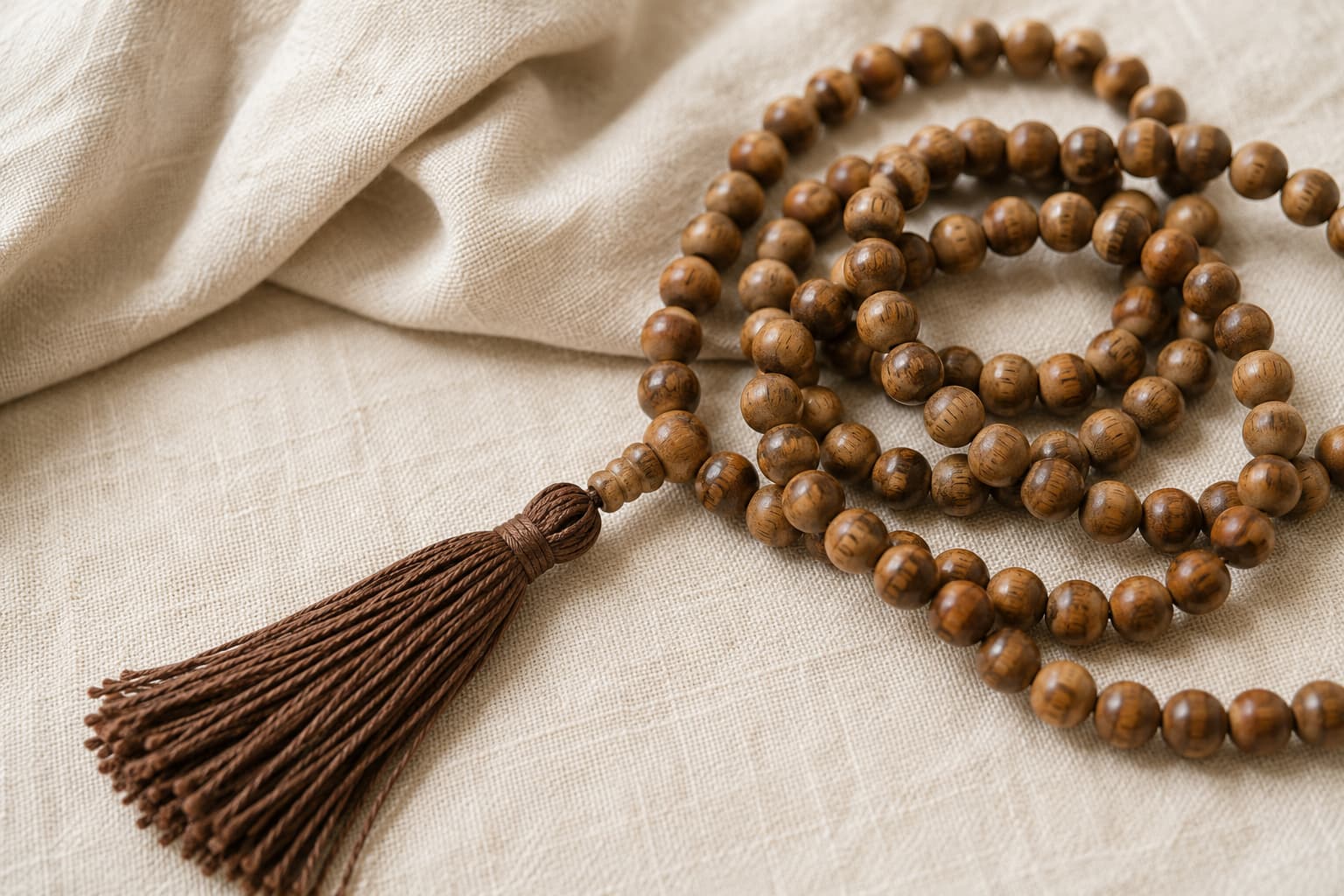
The trend actually has roots going back further than most people realize. Interest in yoga and Eastern spirituality first spread through Western counterculture in the 1960s and 1970s, and that is when items like mala necklaces, strings of prayer beads traditionally used to count mantras, started appearing outside of India for the first time. A traditional mala has 108 beads plus one larger “guru bead,” and while the exact reason for that number has several explanations across Hindu and Buddhist teaching, it is often tied to completeness and the idea of counting through a full cycle of chanting. Many modern Om necklaces borrow directly from this format, even when the wearer has no plan to use them for counting mantras.
Om also shows up constantly in chakra-themed jewelry, which is another reason it is so common in gemstone pieces. In meditation practice, Om is closely linked to the crown chakra, thought to sit at the very top of the head and connected to awareness and spiritual connection, as well as the third eye chakra just above and between the eyebrows, linked to intuition and inner focus. This is why so many Om pendants get paired specifically with purple or indigo stones like amethyst — the color is meant to match the chakra the symbol is associated with, not chosen at random.
Is It Okay to Wear an Om Symbol If You’re Not Hindu?
Wearing Om outside of Hindu, Buddhist, Jain, or Sikh practice is not automatically disrespectful, but it does call for a bit of thought. Because the symbol is sacred scripture to over a billion people, treating it as a throwaway trend rather than something with real meaning is where most of the criticism comes from.
This has played out publicly more than once. In 2021, Kim Kardashian faced criticism from members of the Hindu community after wearing large silver earrings featuring the Om symbol during a photoshoot. Critics argued the symbol was being used as a pure fashion statement by someone outside the faith, while others felt wearing it was a fine way to show appreciation. The disagreement highlights a real, ongoing conversation rather than one single “correct” answer, but a common thread among people who study the symbol closely is that understanding its meaning first goes a long way toward wearing it respectfully, and that respect tends to come down to a few consistent practices:
- Understanding what the symbol actually represents, rather than choosing it purely for its look.
- Favoring well-made pieces where the curves and dot are clearly and accurately shaped, instead of a blurry or distorted version of the symbol.
- Keeping Om away from items connected with the lower body or anything meant to be walked on or discarded quickly, since that runs against its sacred meaning in the cultures it comes from.
- Caring for the piece over time, rather than treating it as disposable costume jewelry.
None of this means the symbol is off-limits to people outside these religions. It means treating it the way its own traditions do: as something with weight, not just a shape that happens to look nice on a chain.
What Materials Are Om Pieces Usually Made From?
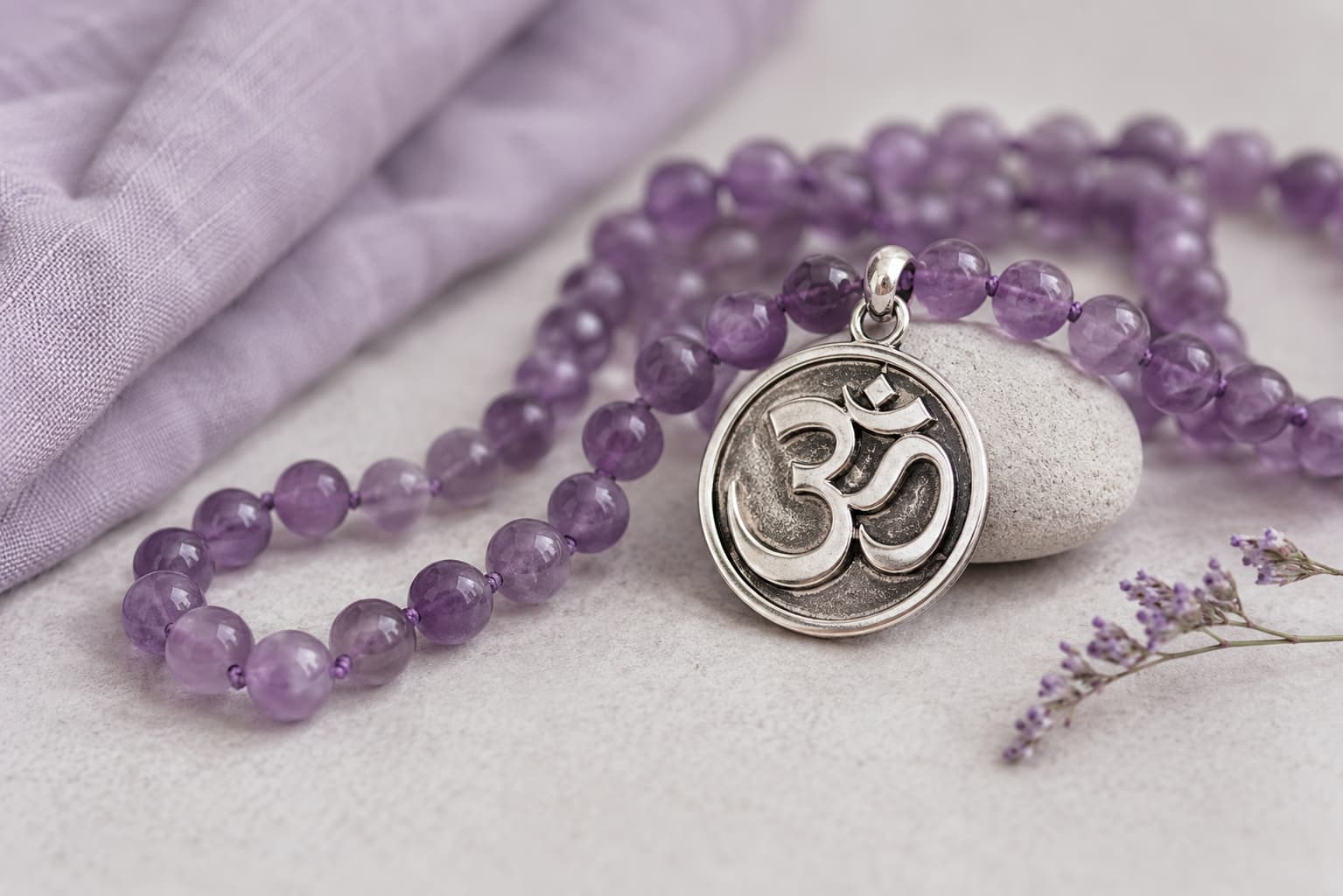
Om jewelry appears in nearly every material used in modern jewelry making, from sterling silver and gold to wood, brass, and gemstone beads. Silver and gold versions tend to lean more formal and long-lasting, often engraved or cast as a solid pendant or ring. Wood, clay, and beaded versions usually show up in more casual, yoga-inspired pieces, often strung alongside natural stones like turquoise or rose quartz.
There is no single “correct” material required by tradition. The choice mostly comes down to personal style, budget, and how the piece will be worn — an engraved gold ring for daily wear versus a beaded mala-style necklace worn during meditation, for example.
Beaded Om pieces specifically tend to favor a few traditional materials worth knowing. Sandalwood is a common choice because of its light, calming scent, while rudraksha seeds, taken from a type of evergreen tree native to parts of Asia, have been used in prayer beads for centuries and are often chosen for their texture and history rather than for looks alone. Neither material is required to wear an Om piece, but recognizing them helps explain why some Om jewelry looks distinctly different from a standard beaded bracelet.
Frequently Asked Questions
What does the Om symbol actually look like?
It is made up of three curved lines, a smaller crescent-shaped curve, and a dot placed above the rest of the symbol. Together these parts form one continuous shape rather than separate letters, even though it represents three combined sounds: A, U, and M.
Is Om a Hindu symbol or a Buddhist symbol?
It began in Hinduism, first appearing in the Vedas thousands of years ago, and was later adopted into Buddhism, Jainism, and Sikhism, each of which gives it a slightly different role within their own practices and prayers.
Can Om jewelry be worn every day?
Yes. Many people wear Om jewelry daily as a small reminder of calm, balance, or their meditation practice. The key is choosing a well-made piece and treating it with a bit of respect rather than as disposable costume jewelry.
Does wearing Om jewelry mean someone practices Hinduism or Buddhism?
No, and most people who wear it are not practicing Hindus or Buddhists. It is worn by a wide range of people, often connected to yoga or meditation rather than religious practice specifically. The main thing that matters to most people who study the symbol is wearing it with awareness of its meaning.
Does the Om symbol have to face a certain way?
Yes, in the sense that Om is a character in the Devanagari script, so it has one standard, correctly written form, the same way any letter of an alphabet does. Jewelry that shows the symbol flipped, mirrored, or rotated is usually just a design or manufacturing mistake rather than an intentional alternate meaning.
Is it “Om,” “Aum,” or “Ohm”?
Om and Aum refer to the same sound and are just two different ways of writing it out in English, since the “o” is really a blend of “a” and “u” sounds said quickly together. “Ohm,” on the other hand, is a completely unrelated word — it is the unit used to measure electrical resistance, named after a 19th-century physicist, and has nothing to do with the sacred symbol despite sounding similar.
What is the correct way to pronounce Om?
It is typically pronounced as a single, drawn-out syllable that blends three sounds together: “ah,” rolling into “oo,” and finishing with a closed-mouth “mmm.” Many people chant it slowly, letting the hum of the final “m” continue until the breath runs out.
Conclusion
Om has carried the same core message for roughly three thousand years: that everything in existence, from the smallest sound to the widest universe, connects back to one shared source. That is a lot of meaning packed into a symbol small enough to sit on a fingertip or hang from a chain. Wearing it does not require belonging to any particular faith, but it does mean something different than wearing a random decorative shape — and that difference is really the whole point of an Om piece in the first place.