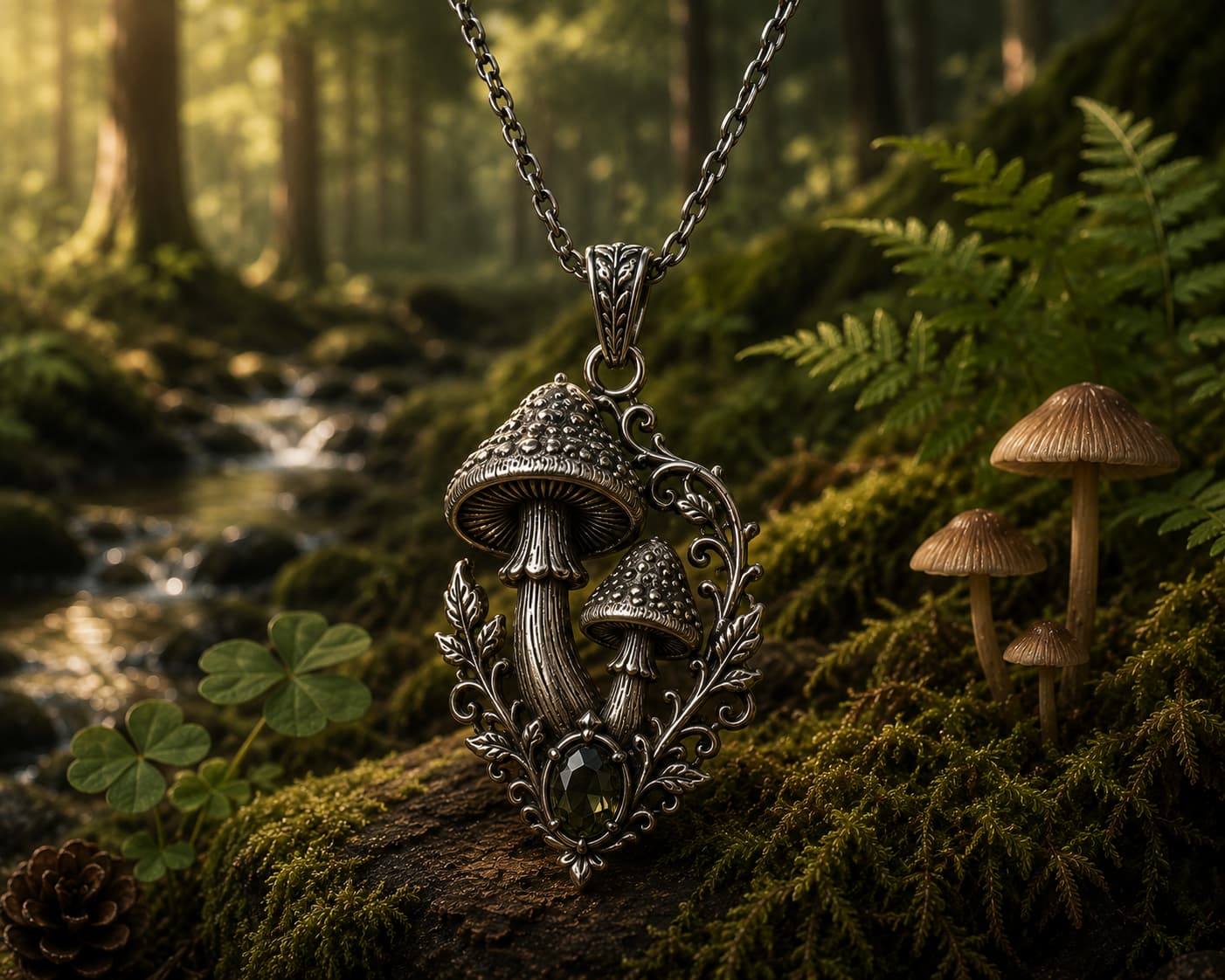
A little mushroom charm hanging from a chain looks playful at first glance, but the symbol underneath it has been carried by humans for thousands of years. Long before mushrooms became a favorite motif on rings and earrings, they showed up in cave paintings, folk stories, and sacred rituals on nearly every continent. People kept returning to the same strange fact: a mushroom can seem to appear overnight, grow in a perfect circle, and then vanish just as fast, and that mystery gave it a symbolic weight most other natural shapes never earned.
What Does a Mushroom Symbolize in Jewelry?
A mushroom generally stands for life, death, and rebirth happening all at once, since it grows straight out of decay and returns to the ground in a matter of days. Unlike a tree or a flower, it doesn’t need sunlight or a slow season to appear — it can push up out of the dark practically overnight, which is a big part of why it became tangled up with ideas about the natural cycle of living and dying in the first place. That single idea — something magical growing out of something dying — is the thread that connects almost every mushroom legend across different cultures.
The symbol branches out from there depending on the tradition. Some traditions focus on the mushroom’s sudden appearance and treat it as a sign of luck or fortune. Others focus on its connection to the forest floor and treat it as a symbol of humility, patience, and quiet growth. Because a mushroom’s cap and stem can also resemble other shapes in nature, artists and jewelers have never run short of ways to reinterpret it.
In jewelry specifically, that flexibility is exactly why the motif has stuck around. A mushroom shape is small, instantly recognizable, and easy to work into a ring, stud, or pendant without losing its meaning, unlike more complicated symbols that need extra detail to read clearly. That makes it a natural fit for people who want a piece that says something personal — luck, growth, a fresh start — without wearing anything overtly literal like a written word or date.
Where Does Mushroom Symbolism Come From?
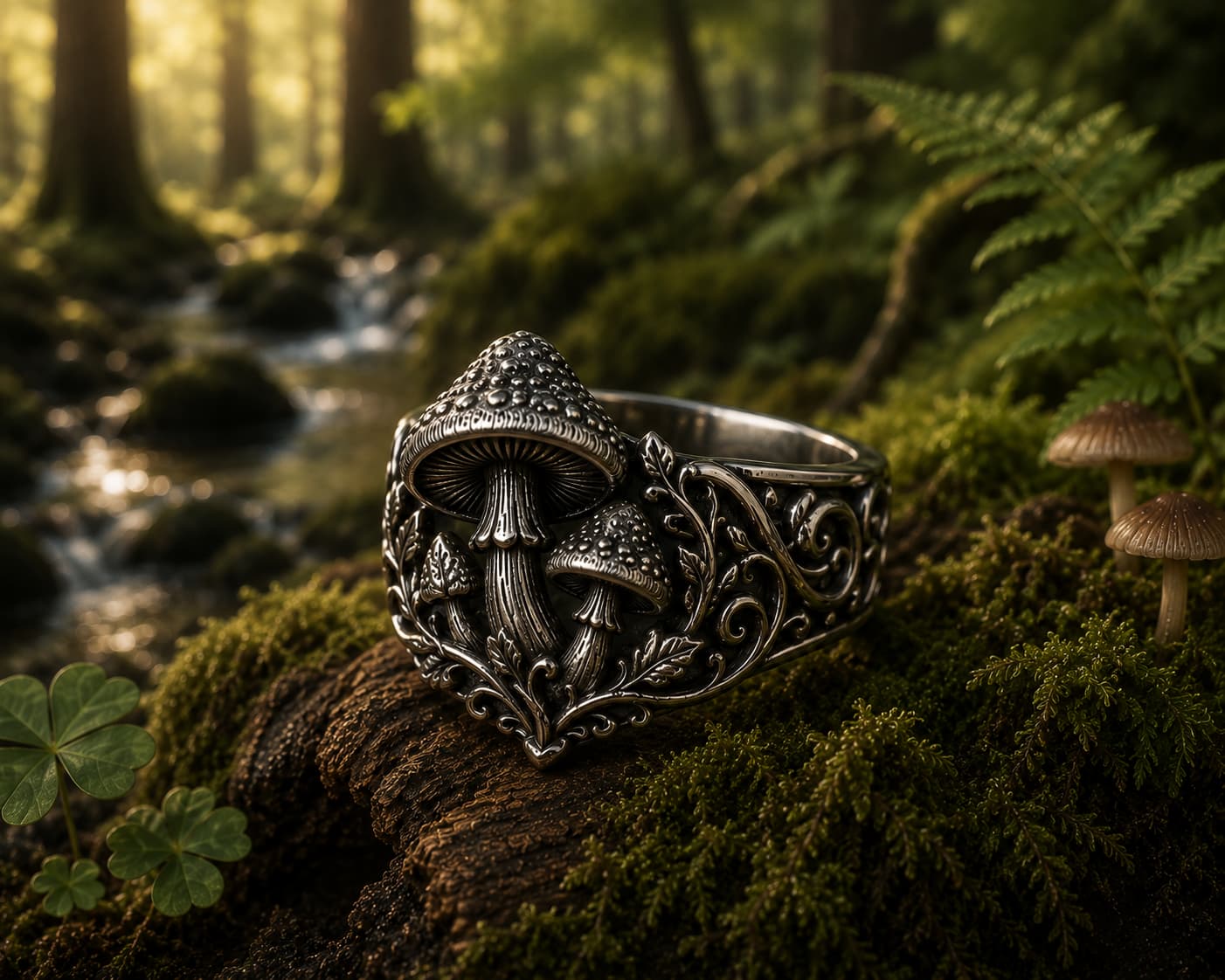
Mushroom symbolism comes from a mix of ancient spiritual practice, European folklore, and the simple observation of how fungi behave in nature. Different cultures arrived at surprisingly similar conclusions on their own, which is part of why the symbol still feels universal today.
Celtic and European Folklore
Much of what gets repeated today about druids and mushrooms sits closer to legend than documented history. The druids left no writing of their own, so nothing describing their private rituals has actually survived. What has come down through oral tradition and later folklore is the idea that a mushroom marked a kind of threshold — a spot where the ordinary world briefly overlapped with something older and stranger. That belief shaped the way mushrooms were treated across the British Isles for generations, even without a written record to confirm it.
The folk beliefs that grew out of that idea were often far more everyday than mystical. In Scotland, spotting what looked like a ring inside a mushroom was taken as a sign that a wedding was coming. In Ireland, the small clearings where mushrooms tended to sprout up overnight were said to belong to the fairies rather than to anyone human. That second belief is really the origin of the “fairy ring” — a circle of mushrooms appearing in a lawn or meadow, blamed, half-jokingly and half-seriously, on a night of fairy dancing.
Ancient Egypt and Mesoamerica
Ancient Egyptian sources treated the mushroom as something too sacred for ordinary hands. Surviving texts refer to mushrooms as “food of the gods” and describe them as a gift from Osiris, the god tied to the afterlife and rebirth. That reputation came with a real, practical restriction: several historical accounts describe mushrooms as a food reserved specifically for pharaohs and the highest levels of Egyptian society, with ordinary people barred from eating them at all.
A similar pattern shows up independently on the other side of the ocean in ancient Mesoamerica, where mushrooms carried religious weight rather than culinary status. Archaeologists have uncovered carved “mushroom stones” in Guatemala dating back roughly 3,000 years, and Spanish chroniclers who arrived centuries later recorded that the Aztecs used a specific term, teonanácatl, meaning “flesh of the gods,” for the sacred mushrooms used in ceremony. The Aztec god Xochipilli, associated with art, pleasure, and flowers, is depicted in surviving artwork wearing and surrounded by these mushrooms, underscoring how deeply the plant was woven into ritual life across the region.
Norse Mythology
The link between Norse mythology and mushrooms is one of the more debated corners of this history. No surviving Norse text names a specific mushroom in a ritual context, and no archaeological find ties any particular fungus to Norse religious practice. What exists instead is a comparison drawn by later scholars: Odin’s role as a wandering figure who endures hardship to gain hidden knowledge closely resembles Siberian shamanic tradition, where the red-and-white Amanita muscaria mushroom was a documented part of ritual life. That resemblance led some researchers to propose a similar mushroom tradition may have existed among the Norse, though the theory remains speculative rather than proven.
A related and equally debated idea concerns the ancient Vedic ritual drink Soma, described in the Rigveda as fit for the gods. Ethnobotanist R. Gordon Wasson argued in a 1968 book that Soma was made from Amanita muscaria, tying the same red-and-white species to a separate ancient tradition on the other side of Eurasia. Historians still disagree on whether that theory holds up, but it’s part of why this particular mushroom shape has become the default image people picture when they think of magic or myth.
Mushroom Symbolism in China and Japan
China’s mushroom symbolism centers on one specific species rather than mushrooms in general: the lingzhi, known as reishi in Japan and yeongji in Korea. For roughly two thousand years, finding a lingzhi mushroom in the wild was treated as significant enough to be reported directly to the emperor, and the mushroom itself became shorthand for a long, healthy, fortunate life.
That reputation worked its way into the highest levels of Chinese court life. Emperors carried a ceremonial scepter, its head shaped like a lingzhi cap, meant to symbolize a wish for good fortune and long life. The mushroom’s outline was carved into palace architecture, painted onto imperial robes, and paired with other traditional symbols of long life in Chinese art. That history is why a mushroom-shaped gift in parts of East Asia can carry a “wishing you good health and a long life” meaning quite different from the whimsical or spooky reputation the mushroom carries in Western folklore.
Mushroom Colors and Their Meanings
The meaning of a mushroom design often shifts depending on which real-world mushroom it’s based on, since different species carry their own folklore on top of the general symbolism.
- Red-and-white spotted caps (Amanita muscaria): Often called the fly agaric, this is the mushroom most people picture in fairy tales, and it usually represents magic, whimsy, and a connection to folklore rather than anything more serious.
- Simple brown or tan toadstools: These lean into the earthier, more grounded side of mushroom symbolism — humility, quiet growth, and a bond with the forest rather than the fantastical.
- Mushroom rings or clusters: A circle of mushrooms nods directly to the fairy ring legend, tying the piece to ideas of luck, celebration, and hidden gatherings.
- Glowing or luminous mushroom designs: These reference bioluminescent fungi found in real forests and usually stand for hidden light, quiet resilience, or things that reveal themselves only in the dark.
Why Are Mushrooms Popular in Jewelry Right Now?
Mushroom jewelry has grown popular largely because it rides alongside a broader shift toward nature-themed, unhurried aesthetics such as cottagecore and fairycore. Within those styles, small nature symbols — flowers, leaves, and mushrooms among them — paired with crystals or moonstone have become one of the easiest ways to signal the look without overhauling an entire wardrobe.
The mushroom motif has also split into two distinct moods depending on which corner of that aesthetic a piece leans toward. On one end, designs stay soft and airy, pairing a mushroom shape with delicate chains, pearls, or pastel tones. On the other, a more woodland-inspired style leans into rougher textures and deeper, earthier colors, pairing the mushroom with other forest imagery like acorns and leaves. That range is part of why the motif has held on rather than fading after a single trend cycle — it works equally well as something delicate or something a little wilder, depending on what a person is going for.
Popular Types of Mushroom Jewelry
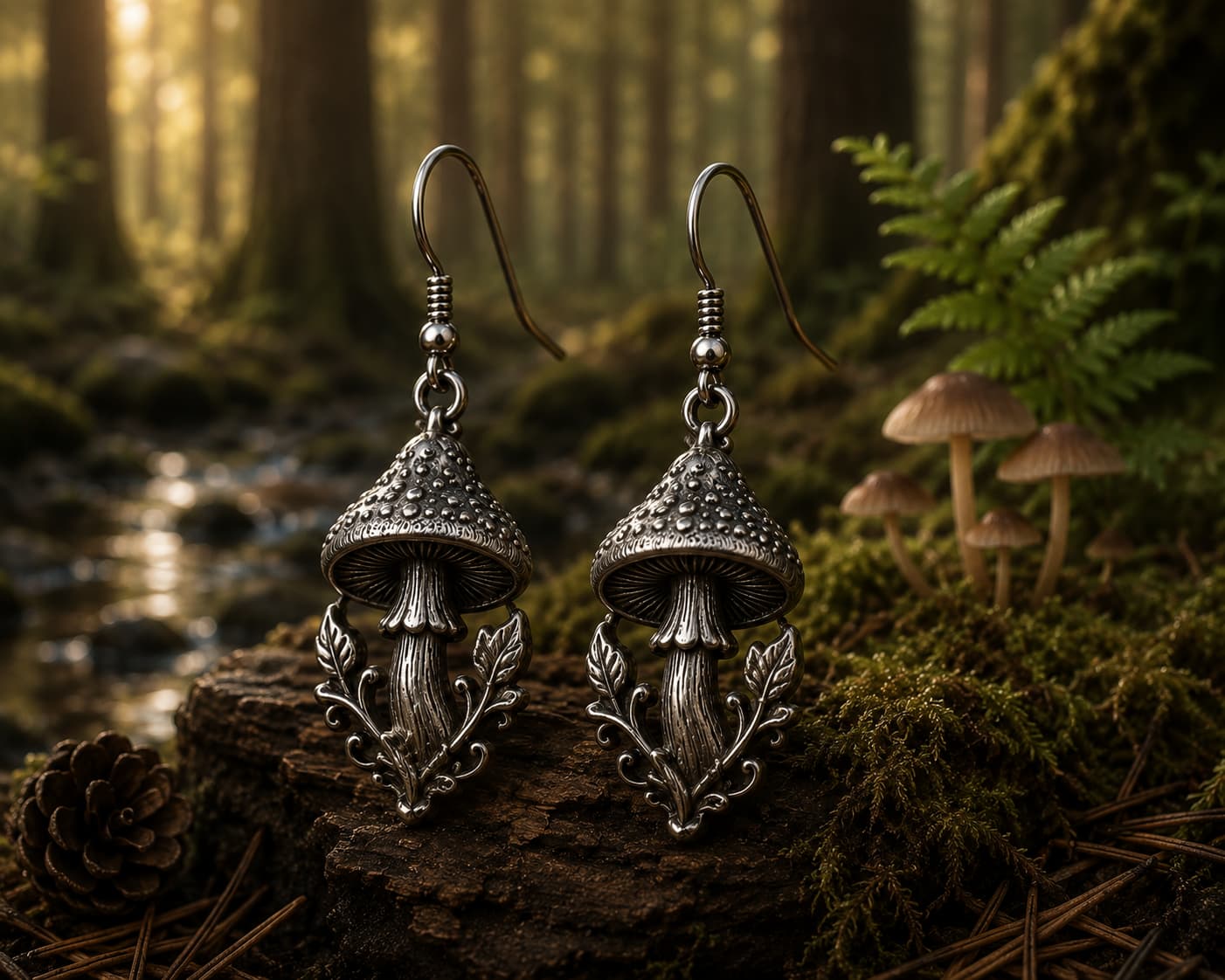
Mushroom symbolism shows up across nearly every type of jewelry, and the piece someone chooses often depends on how subtle or bold they want the meaning to read.
- Rings: Usually a small mushroom cap set on the band or as the ring’s focal point, sometimes paired with tiny stars or moons to lean further into the fairycore look.
- Pendants and necklaces: The most common format, ranging from a single delicate charm on a fine chain to a more detailed, sculptural mushroom pendant meant to stand out.
- Earrings: Often sold as a mismatched or varied pair featuring different mushroom species, playing into the whimsical, storybook side of the symbol.
- Charms and bracelets: A mushroom charm added to an existing charm bracelet is a common way to bring in the symbolism without committing to a full standalone piece.
A mushroom motif is one of the rare jewelry symbols that works equally well as a subtle nod to folklore or as a full statement piece, depending entirely on the style and scale it’s made in.
Frequently Asked Questions
Is a mushroom a good luck symbol?
In several folk traditions, yes. Irish and Scottish folklore tied mushrooms to fairies, fortune, and even marriage omens, and that association with luck has carried into how the symbol is used in jewelry and gift-giving today.
What does a mushroom ring symbolize spiritually?
A mushroom ring most often symbolizes transformation and rebirth, since the plant itself grows from decay and returns to the earth in a short life cycle. Some wearers also connect it to personal growth or a fresh start, building on that same underlying idea.
Are mushroom and toadstool jewelry the same thing?
Functionally, yes — “toadstool” is simply an older folk term for a mushroom, particularly one that looks inedible or unusual, and jewelry listings often use the two words interchangeably to describe the same style of charm or pendant.
What culture is most associated with mushroom symbolism?
No single culture owns the symbol. Celtic, Egyptian, Mesoamerican, Norse, and Chinese traditions all developed their own mushroom folklore independently, which is part of why the motif feels so widely recognized rather than tied to one specific origin.
Does mushroom jewelry have a religious meaning?
It can, depending on the wearer. Mushrooms held genuine religious significance in cultures like the Aztec and Maya, where certain species were considered sacred, but in most modern jewelry the symbol is worn more for its folklore and nature connection than for formal religious meaning.
How is mushroom jewelry cared for?
Care depends on the material. Metal pieces like sterling silver should stay dry and be stored in a pouch to slow tarnishing, while enamel, resin, or wood mushroom charms are more delicate and should be kept away from hard knocks and long stretches of direct sunlight, which can chip the finish or fade the color over time.
Conclusion
Mushroom symbolism has survived for thousands of years because it taps into something people keep noticing on their own: growth, decay, and rebirth happening in a single small shape. Whether a piece leans toward the whimsical red-and-white fairy tale look or a quieter, earthier toadstool design, the meaning underneath stays remarkably consistent across cultures — transformation, hidden magic, and the idea that something small and easy to overlook can still carry real weight.