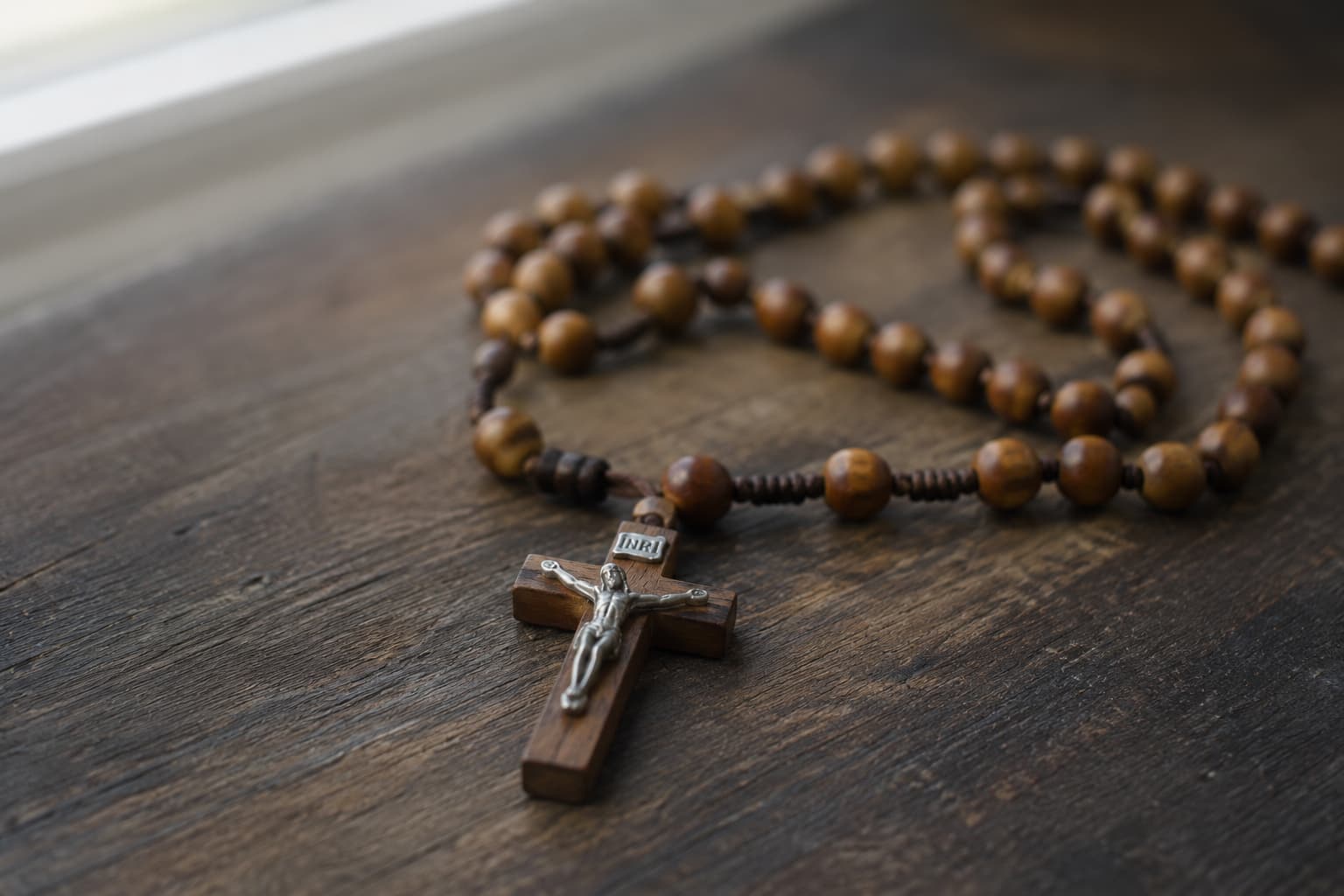
A rosary is a loop of beads used for counting prayers, and for hundreds of millions of people it’s one of the most familiar objects in the world. It’s often seen hanging from a car mirror, wrapped around a wrist, or resting on a nightstand, and it’s easy to assume it’s just a pretty string of beads. But every part of a rosary, from the small beads to the crucifix at the end, has a job to do and a story behind it. Understanding where the rosary came from and what it actually means makes it a lot more than decoration; it turns it into a small, physical map of a very old tradition.
Rosary Definition and Meaning
A rosary is a string of beads Catholics use to keep count while praying a specific set of prayers, most often the Hail Mary and the Our Father. The word itself comes from the Latin rosarium, which means “rose garden,” a name that grew out of the idea of each prayer being like a rose offered up as a spiritual gift.
The beads aren’t the prayer itself; they’re a tool. Because the full prayer involves repeating certain lines dozens of times while also thinking about specific moments from the life of Jesus and Mary, it’s easy to lose track. The beads solve that problem the same way a tally counter helps someone keep count of something else entirely. The fingers move automatically from bead to bead, which frees the mind to focus on the meaning of the prayer instead of counting.
The word “rosary” actually refers to two different things at once, and that’s part of why it can feel confusing. It’s the name of the prayer itself, the full sequence of Creeds, Our Fathers, and Hail Marys said in order, and it’s also the name of the physical object used to count that prayer. Someone can technically “pray the rosary” using nothing but their fingers and no beads at all, though the beaded version is by far the more common one.
Origins of the Rosary
The short answer is that nobody knows the exact moment the rosary was invented, because it grew slowly over more than a thousand years instead of being created all at once. Historians describe its origins as genuinely unclear, pieced together from fragments of monastic history rather than one single event.
Counting Prayers Before Christianity
Using small objects to count repeated prayers is much older than the rosary itself. Long before Christianity existed, people in various religious traditions used pebbles, knotted cords, or strings of beads to keep track of repeated chants and prayers. Similar counting tools still exist today in Hinduism, Buddhism, Islam, and other faiths, which suggests the basic idea of “count your prayers with your hands” is one that many cultures arrived at independently.
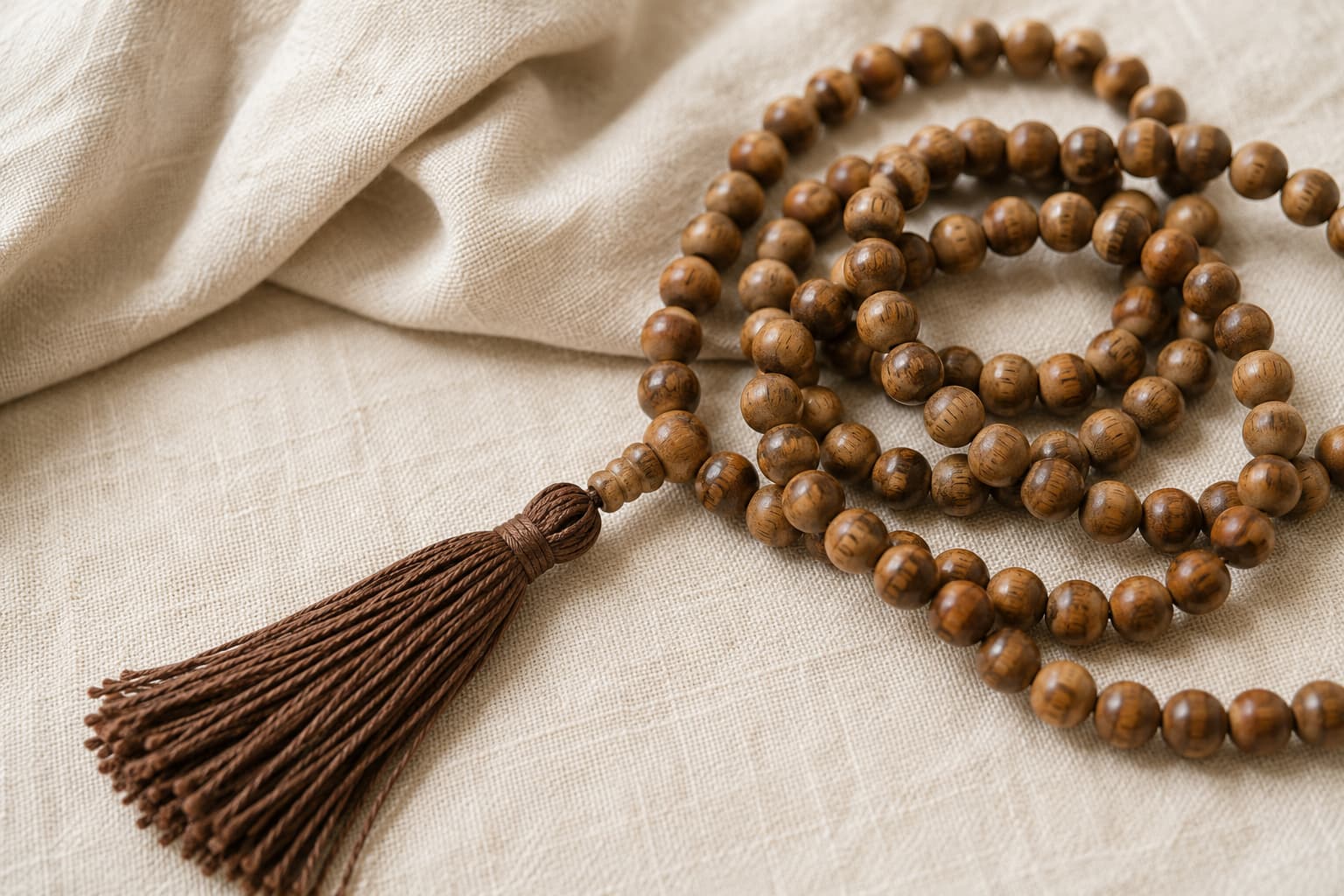
Each tradition also settled on its own bead count, usually tied to a meaningful number. A Hindu or Buddhist japa mala typically has 108 beads, a number with its own layered symbolism in those faiths, while an Islamic misbaha or tasbih usually has 99 beads, one for each of the traditional names of God, or a shorter string of 33 that gets counted through three times. Sikh malas also commonly use 108 beads. The Catholic rosary’s total of 59 beads sits alongside these older systems as one more example of the same basic human habit, just organized around its own set of prayers and its own history.
The Desert Fathers and Early Prayer Ropes
Within Christianity, the trail starts with a group known as the Desert Fathers, early Christian monks and hermits who lived alone in the Egyptian desert during the third and fourth centuries. To keep track of the prayers they repeated throughout the day, they carried pouches of small stones, moving one stone aside for each prayer said. Over time, some of these monks began tying knots into a rope instead, creating an early prayer rope that let them count without needing to carry loose stones around.
A separate but related habit developed around the 150 Psalms of the Bible. Monks who couldn’t read Latin, and therefore couldn’t recite the Psalms themselves, would instead say the Our Father 150 times as a substitute. To count that many repetitions, they used a string of 150 beads that became known as a “Paternoster,” the Latin word for “Our Father.” This string of beads is considered one of the most direct ancestors of the modern rosary.
This knotted-rope tradition didn’t disappear once the rosary developed in the West; it kept going on its own separate path in Eastern Christianity. Eastern Orthodox Christians still use a knotted prayer rope called a chotki or komboskini instead of a beaded rosary, typically tied with 33, 50, or 100 knots, and used to repeat the Jesus Prayer rather than the Hail Mary. It’s a useful reminder that the Catholic rosary is one branch of a much older and wider Christian habit, not the only version of it.
St. Dominic and the Rosary Legend
The most famous story about the rosary’s origin involves St. Dominic, the Spanish priest who founded the Dominican religious order in the early 1200s. According to a long-standing Catholic tradition, Mary appeared to Dominic in a vision and personally gave him a rosary, asking him to teach people to pray it. Dominic then spent his life spreading this new form of prayer across Europe.
The story is usually placed in a specific setting: southern France in the 1200s, where Dominic was preaching against a religious movement the Catholic Church considered a heresy. Tradition holds that the vision came to him during this period as a way of giving him a simple, repeatable prayer that ordinary people, not just monks, could use to deepen their faith. That detail matters because it points to what made the rosary different from earlier prayer counters: it was designed from the start to be something regular laypeople could pray, not just something reserved for monasteries.
Whether or not the vision happened exactly as the story describes, historians agree that Dominic and the Dominican order played a genuine role in popularizing repeated, meditative prayer using beads during the 1200s and 1300s.
How the Rosary Became What It Is Today
The rosary didn’t arrive in its current form right away. Over the 1300s and 1400s, different religious communities kept refining it, gradually shifting the main prayer from the Our Father to the Hail Mary and adding short reflections on events from the life of Christ. A Dominican monk named Alan de la Roche is often credited with helping popularize the version organized around what we now call the “Joyful, Sorrowful, and Glorious” mysteries. He also helped establish groups called Confraternities of the Rosary, essentially local prayer clubs that met regularly to pray it together, which did a lot of the work of spreading the practice beyond monasteries and into ordinary parish life.
The rosary reached its now-familiar, standardized structure in the 1500s. In 1569, Pope Pius V formally established the prayer’s format, and two years later the Christian victory at the Battle of Lepanto was widely credited to rosary prayer, which cemented its importance in Catholic life for centuries afterward.
The Different Parts of a Rosary
A traditional rosary is made of a small number of simple pieces, and each one marks a different stage of the prayer.
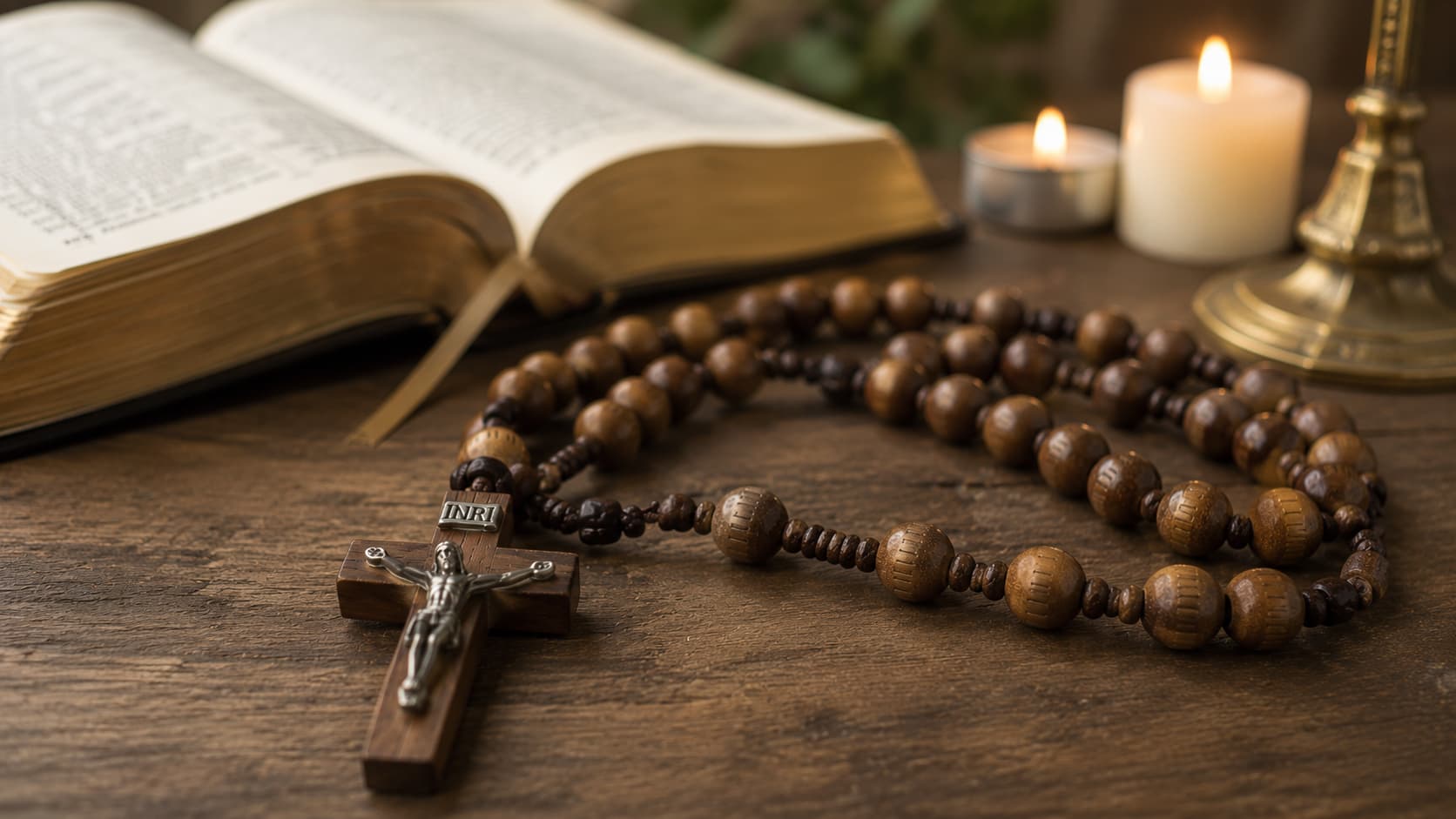
| Part | Bead Count | What It’s Made Of | What Happens There |
|---|---|---|---|
| Crucifix | 1 | A small cross with a figure of Christ | The prayer begins here with the Sign of the Cross and the Apostles’ Creed |
| Short Strand | 5 | One large bead, then three small beads, then another large bead | The Our Father, three Hail Marys, and a Glory Be are prayed here |
| Centerpiece | 1 medal | A small medal or connecting piece | Joins the short strand to the main loop and often shows an image of Mary |
| The Decades | 54 | Five groups of ten small beads, separated by one larger bead each | Each group of ten beads is a “decade,” where ten Hail Marys are prayed while thinking about a specific mystery |
The Crucifix
The crucifix sits at the very bottom of the rosary and marks the starting point of the entire prayer. Beginning at the cross is meant to remind the person praying that everything that follows is rooted in the story of Christ’s death and resurrection.
The Centerpiece
The centerpiece is the small medal or decorative link that connects the short introductory strand to the large circular loop of beads. It’s often stamped with an image of Mary or another meaningful design, and it marks the transition point where the person praying announces the first “mystery,” or theme, they’ll be reflecting on. Common designs include an image of Our Lady with the words “Mother of God,” or a depiction of a specific apparition of Mary, and this is usually the most personalized part of a rosary, since the image chosen often reflects a particular devotion, family tradition, or place of pilgrimage.
The Decades
The main loop of a rosary is broken into five sections called decades, each made up of ten small beads. On each of these ten beads, the person praying says a Hail Mary, and each decade is dedicated to meditating on one specific event, or “mystery,” from the life of Jesus or Mary. A single larger bead separates each decade from the next, and that’s where an Our Father is prayed before moving into the next set of ten.
What Prayers Go With Each Bead?
Each bead on a rosary is tied to a specific, memorized prayer, so the order never really changes. On the crucifix, the person praying recites the Apostles’ Creed, a statement of core Christian beliefs. The first large bead carries an Our Father, and the three small beads that follow are each a Hail Mary, traditionally said as a request for an increase in faith, hope, and love. After those three beads comes a Glory Be, a short prayer of praise.
From there, the pattern repeats five times, once for each decade: an Our Father on the large bead, ten Hail Marys on the small beads while thinking about that decade’s mystery, and a Glory Be to close it out. Many people also add a short prayer connected to the Fatima apparitions after each decade. The whole sequence usually takes somewhere between fifteen and twenty-five minutes to complete.
What Are the Mysteries of the Rosary?
The “mysteries” are the twenty specific events from the lives of Jesus and Mary that a person reflects on while praying each decade, and they’re grouped into four sets of five. Rather than praying all twenty mysteries at once, tradition assigns different sets to different days of the week.
- Joyful Mysteries (Monday and Saturday) – cover the Annunciation, the Visitation, the Nativity, the Presentation in the Temple, and the Finding of Jesus in the Temple.
- Sorrowful Mysteries (Tuesday and Friday) – focus on the Agony in the Garden, the Scourging, the Crowning with Thorns, the Carrying of the Cross, and the Crucifixion.
- Glorious Mysteries (Wednesday and Sunday) – center on the Resurrection, the Ascension, the coming of the Holy Spirit, the Assumption of Mary, and her Coronation.
- Luminous Mysteries (Thursday) – cover the Baptism of Jesus, the Wedding at Cana, the Proclamation of the Kingdom, the Transfiguration, and the Institution of the Eucharist.
The Luminous Mysteries are the newest addition to the group by far. Pope John Paul II introduced them in 2002, nearly five hundred years after the rest of the rosary’s structure had already been standardized, in order to give the prayer a stronger focus on the years Jesus spent teaching and performing miracles.
A single five-decade rosary adds up to exactly 50 Hail Marys, and if someone prays through one full set of Joyful, Sorrowful, and Glorious mysteries in a day, that comes out to 150 Hail Marys total, the same number as the original 150 Psalms that monks were substituting prayers for, centuries before the rosary existed in anything like its current form.
Why Is It Called a “Rosary”?
The name comes from the Latin word rosarium, meaning “rose garden,” which by the medieval period had also come to mean something closer to “garland” or “string of prayers.” The idea behind the name was that each prayer offered on the beads was like a single rose, and the finished set of prayers formed a garland, or a rosarium, given as a gift. That poetic image is also why roses show up so often in Catholic art connected to Mary.
The rosary also goes by other names in different languages and traditions. In Italian it’s sometimes called a corona, meaning “crown,” which points to a slightly different image: not a garland of flowers, but a crown of prayers offered to Mary as a kind of queen. Both images, the garland and the crown, describe the same object; they’re just two different ways different cultures chose to picture what a completed set of fifty prayers actually represents.
Rosaries as Jewelry and Personal Objects
Beyond their use in formal prayer, rosaries have long doubled as personal, wearable objects. They’re made from an enormous range of materials, including olive wood, freshwater pearl, glass, and various metals, and the choice of material often carries its own meaning, such as olive wood connecting the piece to the Holy Land. Because a rosary is carried daily, kept in a pocket, hung on a bedpost, or looped around a wrist, it often becomes deeply personal in a way that goes beyond its religious function, similar to how other meaningful jewelry gets tied to memory and identity over time.
Rosaries are also common gifts marking specific milestones, especially First Communion, confirmation, and weddings, and older rosaries are frequently passed down as family heirlooms, sometimes accompanying a person for their entire life. The tradition has even influenced other Christian denominations that historically didn’t use prayer beads at all; in the 1980s, an Episcopal priest named Rev. Lynn Bauman introduced a set of Anglican prayer beads with 33 beads arranged in four groups of seven, adapting the same basic hand-and-mind rhythm for a different tradition entirely.
Frequently Asked Questions
How many beads are on a rosary?
A standard five-decade rosary has 59 beads in total: 54 beads on the main loop, which includes the fifty small “Hail Mary” beads across the five decades plus the larger “Our Father” beads that separate them, and five more beads on the short introductory strand leading up to the centerpiece.
What’s the difference between a rosary and a chaplet?
A rosary always follows the traditional five-decade structure and its set list of prayers and mysteries, while a chaplet is a shorter, separate devotion with its own bead pattern and its own specific prayers, often focused on a particular saint or theme.
Does someone need to be Catholic to wear a rosary?
The rosary is specifically a Catholic devotional tool, and within Catholic tradition it’s meant to be prayed rather than worn purely as an accessory, so many Catholics consider wearing one as jewelry without praying it to be disrespectful to its purpose.
Why does a rosary have exactly five decades?
The five decades correspond to the five mysteries within whichever set (Joyful, Sorrowful, Glorious, or Luminous) is being prayed that day, so the physical structure of the beads mirrors the five-part structure of the meditation itself.
Who is credited with creating the rosary?
No single person is confirmed to have invented it, but Catholic tradition credits St. Dominic in the 13th century with receiving and spreading an early form of the prayer, while the fully standardized version used today wasn’t formally established until Pope Pius V did so in 1569.
Conclusion
The rosary is really the result of over a thousand years of small changes, starting with Egyptian monks counting stones and ending with a fixed, five-decade prayer form set in 1569. Every piece of it, from the crucifix to the final small bead, was built to serve one purpose: helping a person keep their place in a long, repeated prayer without losing their focus. Whether someone encounters a rosary in church, in a family heirloom box, or hanging from a rearview mirror, knowing the structure behind it turns a simple string of beads into something with real, traceable history.