Angelite is a pale, powdery-blue stone that has become a favorite among collectors who love soft, soothing colors, even though most jewelry fans have never heard its name. It isn’t a traditional gemstone in the way sapphire or amethyst are. Instead, it’s a trade name for a specific type of mineral found in just a few places on Earth, and its story involves water, pressure, and millions of years of geology. Because it’s unusually delicate compared to stones like quartz or topaz, angelite also raises a lot of practical questions about how to wear it, clean it, and keep it looking its best.
Angelite Formula and Mineral Type Explained
Angelite is a blue-colored variety of a mineral called anhydrite, and its chemical formula is calcium sulfate (CaSO4). The name “anhydrite” comes from a Greek word meaning “without water,” which is a clue to how the stone forms.
Anhydrite starts out as gypsum, a much more common mineral that contains water locked inside its crystal structure. Over time, heat and pressure deep underground squeeze that water out, leaving behind a denser, drier mineral: anhydrite. The pale blue to blue-gray material that comes specifically from Peru is what the jewelry trade calls angelite, while colorless or white anhydrite found elsewhere usually isn’t given that name at all.
Anhydrite crystallizes in what’s called an orthorhombic system, and it has a specific gravity of about 2.9, meaning it’s noticeably denser than many popular jewelry stones of a similar size. That density, combined with its water-sensitive chemistry, is also why the gypsum-to-anhydrite transformation can run in reverse: if anhydrite sits in a wet environment long enough, it slowly reabsorbs water and converts back into gypsum. This two-way relationship is part of what makes angelite such an unusual, chemically “alive” mineral compared to most other gemstones.
Angelite is not its own mineral species. It’s a commercial name for a particular color and locality of anhydrite, similar to how “ruby” is really just red corundum.
Angelite Hardness on the Mohs Scale
Angelite scores about 3.5 on the Mohs hardness scale, which makes it one of the softer stones used in jewelry. For comparison, a fingernail is roughly 2.5 and a copper penny is close to 3, so angelite can be scratched fairly easily by everyday objects.
This softness comes with another weak point: angelite has three directions of perfect cleavage, meaning it can split cleanly along flat planes if it’s knocked or dropped. Cutters almost never facet angelite into sharp-edged shapes because of this. Instead, you’ll mostly find it as smooth, rounded cabochons, simple beads, or small carved pieces, since these shapes put less stress on the stone’s weak points. Rings made from angelite are rarely a good idea, since fingers bump into things constantly throughout the day.
Interestingly, a rare, transparent purple variety of anhydrite does occasionally get faceted for collectors, since gem labs have examined specimens cut into traditional step cuts. This purple material is a completely different find from blue angelite, though, and it’s treated as a curiosity for mineral collectors rather than something you’d see in everyday jewelry. It’s a good reminder that “anhydrite” is a whole family of stones, and angelite is just the best-known, bluest member of that family.
Angelite Color and Appearance
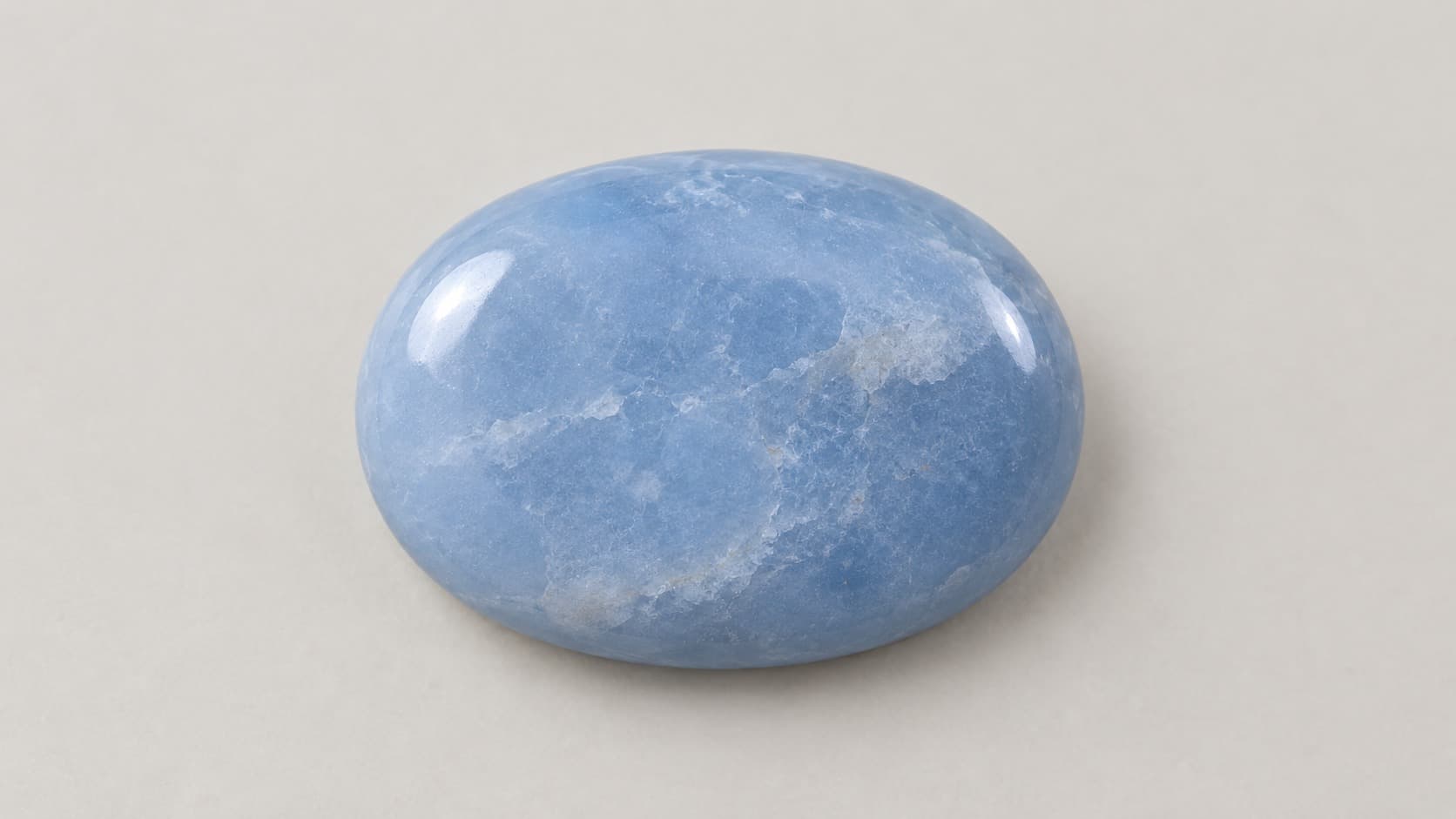
Angelite is best known for a soft, milky blue color, often described as glacier blue or a muted sky blue. Some pieces lean more toward lilac or blue-gray, and many specimens show white or faint rust-colored streaks running through them.
The color comes from trace elements trapped in the stone while it was forming underground, not from any dye or coating. Because the shade is naturally gentle rather than bold, angelite tends to pair well with soft, neutral styling rather than bright, high-contrast looks. Pure white or colorless anhydrite also exists, but it isn’t the material that earns the angelite name in the gem trade.
One thing angelite doesn’t offer is sparkle in the way a diamond or zircon does. Its dispersion, the property that splits light into flashes of rainbow color, is essentially negligible. Angelite’s appeal is entirely about its color and smooth, matte-to-satin surface texture, not about brilliance or fire, which is part of why it’s almost always polished into soft, rounded shapes rather than faceted.
Angelite Origin and Mining Locations
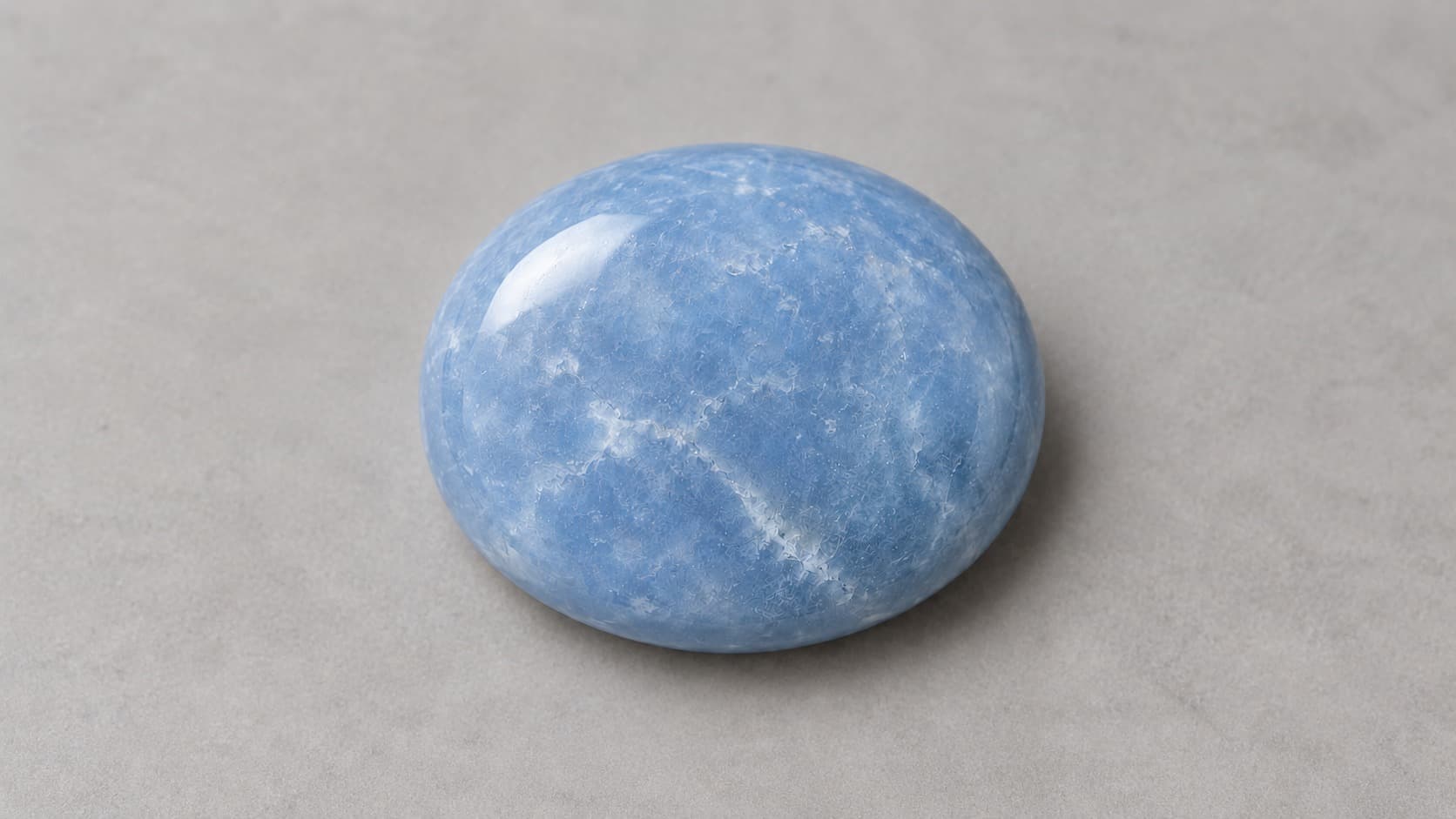
Angelite’s blue variety is most closely associated with Peru, and that country is still considered its primary commercial source. Anhydrite as a mineral family is far more widespread, with notable deposits also found in Mexico, Germany, Poland, and Libya.
Geologically, anhydrite forms in sedimentary environments, often where ancient seawater evaporated and left behind layers of mineral-rich sediment. Because gypsum is so much more abundant near the Earth’s surface, true anhydrite deposits tend to form deeper underground, where pressure is high enough to drive out the water content permanently. These conditions happen in a limited number of places worldwide, which is one reason Peru’s blue material became the recognized commercial standard rather than just one source among many.
Does Angelite Have Any Treatments?
Most angelite on the market is sold in its natural state, without dyes or artificial color treatments. Dealers and gemstone references generally list it as untreated, since its signature pale blue color occurs naturally in the stone.
That said, buyers should still be cautious when shopping for angelite jewelry, simply because the broader market for soft blue minerals includes plenty of dyed and imitation stones sold under misleading names. If a piece is priced far below what you’d expect, or the color looks unusually uniform and saturated, it’s reasonable to ask the seller directly whether the stone has been treated and what material it actually is.
Angelite Care Tips and Cleaning
Angelite should stay away from water, since it’s chemically unstable when wet. Because angelite is a close cousin of gypsum, exposure to moisture can cause it to slowly degrade, lose its surface polish, or even begin dissolving over long periods.
A few practical care habits:
- Remove angelite jewelry before showering, swimming, or washing your hands.
- Avoid wearing it while exercising or on hot days when you’re likely to sweat heavily.
- Clean it only with a soft, dry cloth — never ultrasonic cleaners, steam cleaners, or soapy water.
- Store it away from direct sunlight, since prolonged UV exposure can fade its color over time.
- Keep it in its own soft pouch or lined box, separate from harder stones that could scratch it.
Because of these limitations, angelite tends to work best in pieces that see gentle, occasional wear — necklaces, drop earrings, or hair accessories — rather than everyday rings or bracelets that face constant friction.
Angelite vs. Celestite: What’s the Difference?
Angelite and celestite are two different minerals that are frequently confused, partly because of a mix-up that appeared in an early popular reference book. Despite the mistaken association, they are not the same material.
| Feature | Angelite | Celestite |
|---|---|---|
| Chemical formula | CaSO4 (calcium sulfate) | SrSO4 (strontium sulfate) |
| Mohs hardness | About 3.5 | About 3 to 3.5 |
| Typical form | Massive, fine-grained | Often found as geode crystals |
| Streak color | White to light gray | White |
| Common source | Peru | Various, often in limestone |
The easiest visual difference is usually the crystal habit: celestite often grows as clusters of pale, glassy crystals inside a geode, while angelite is typically a solid, opaque mass without visible crystal faces. Chemically, the two aren’t even related in the way their similar appearance suggests — angelite’s structure is almost identical to gypsum minus its water content, while celestite belongs to the barite family and gets its name from a different root entirely, referring to its sky-blue color rather than any connection to anhydrite.
Frequently Asked Questions
Can angelite go in water?
No, angelite should not be exposed to water. It’s chemically related to gypsum and can slowly absorb moisture, which may damage its surface or cause it to break down over time.
Does angelite fade in sunlight?
Yes, extended exposure to sunlight or heat can cause angelite’s blue color to fade. Storing pieces in a dark drawer or pouch when they’re not being worn helps preserve the color.
Is angelite the same as howlite or turquoise?
No. Angelite, howlite, and turquoise are three separate minerals with different chemical formulas, hardness levels, and origins. They can look somewhat similar in soft blue tones, but testing hardness, streak color, or chemical composition easily tells them apart.
Is angelite expensive?
Angelite is generally an affordable stone. Because anhydrite is fairly abundant and the material is mostly cut into simple shapes like cabochons and beads rather than complex facets, prices tend to stay low compared to harder, rarer gemstones.
Can angelite be worn every day?
It’s not the best choice for daily wear. Its low hardness and tendency to cleave along flat planes mean it scratches and chips more easily than most jewelry stones, so it holds up best in pieces worn occasionally rather than constantly.
Does angelite have any traditional or spiritual associations?
In crystal healing traditions, angelite is often linked to calm, communication, and the throat area, and some practitioners connect it with the astrological sign Aquarius. These associations are part of folklore and personal belief rather than scientific fact, so they’re worth noting as cultural context rather than treating as established properties of the stone.
The Bottom Line
Angelite earns its place in the gem world not through toughness or rarity, but through its distinctive, calming blue color and the unusual geological journey that creates it — gypsum slowly losing its water content under pressure until anhydrite remains. Its low hardness and tendency to cleave mean it needs real care: no water, no sunlight for long stretches, and no rough daily wear. Treat it as a stone for occasional, gentle use rather than an everyday piece, and its soft glacier-blue color will stay intact for years to come.