Most diamonds stay the same color no matter where they’re placed. Chameleon diamonds break that rule. A stone kept in a dark drawer for a while shifts from a soft olive green to a warm brownish yellow once it’s brought back into the light, and gentle heat produces the same change even faster. Scientists have studied these stones for decades and still cannot fully explain why this happens, which is part of what makes them one of the strangest and most sought-after oddities in the diamond world.
Chameleon Diamond Meaning and Definition
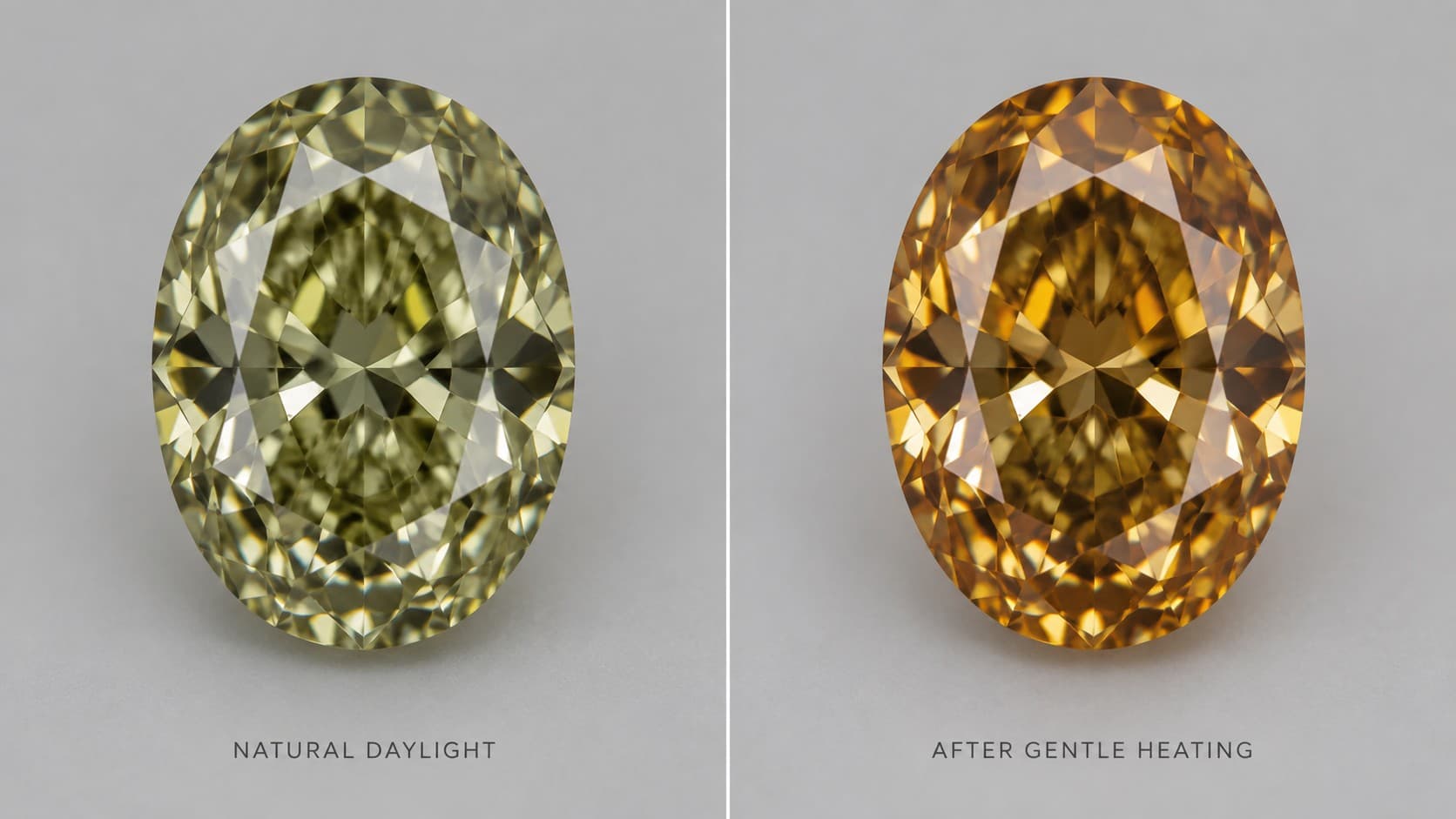
A chameleon diamond is a natural fancy color diamond that temporarily changes color when it’s heated or kept away from light. Its normal, resting color is usually a grayish yellowish green or grayish greenish yellow, often described simply as “olive.” When warmed or left in darkness, that color shifts to a brownish or orangy yellow, then fades back to the original olive shade once it cools down or sees light again.
This isn’t a trick of lighting or a trick of the eye. The actual color of the stone changes at a molecular level, then reverses itself. Jewelers in the trade started calling these diamonds “chameleons” because of how closely the effect mirrors the lizard everyone already knows for changing color, even though the diamond isn’t reacting to its surroundings the same way a real chameleon does. The name stuck, and today it’s the official term gemologists use on lab reports.
According to one widely repeated trade account, diamond broker Peter K. Kaplan was the first to notice the effect in 1943, after a stone appeared to change color near a hot polishing wheel. The stone’s owner reportedly assumed something was wrong with it and tried to return it, not realizing she was holding onto one of the rarest diamond varieties in existence. The exact details of that first discovery vary slightly depending on the retelling, but the year and the underlying surprise, a diamond that seemed to misbehave, show up consistently across trade histories.
What Causes the Chameleon Diamond Color Change?
Nobody knows the exact cause, and that’s the honest answer even from the world’s top gem labs. The Gemological Institute of America (GIA), which has studied chameleon diamonds more closely than anyone, believes the color shift comes from two separate effects working together: one triggered by light (called photochromism) and one triggered by heat (called thermochromism). Because both can cause the change on their own, researchers think more than one mechanism might be at work inside the stone.
Most gemologists point to defects in the diamond’s crystal structure, specifically tiny amounts of hydrogen and nitrogen trapped inside the carbon lattice when the diamond formed deep underground. These trace elements are common suspects behind color in many fancy diamonds, but how they interact to produce a reversible color change in chameleons specifically is still not settled science. A few researchers have floated other explanations too, including links to the diamond’s luminescent and phosphorescent properties, meaning the same structural quirks that make the stone glow faintly under ultraviolet light may also be involved in the color shift. It’s one of the few remaining mysteries in modern gemology, and that uncertainty is part of what collectors find so appealing.
A chameleon diamond’s color change isn’t permanent damage or deterioration. It’s a built-in, repeatable reaction that happens every single time the right conditions are met, for as long as the diamond exists.
How Heat and Darkness Change a Chameleon Diamond’s Color
Heating a chameleon diamond to around 150°C (302°F), roughly the temperature of a hot oven, triggers the full color change almost immediately. The stone shifts from its resting olive tone to a noticeably warmer brownish or orangy yellow. As soon as it cools back down, the color fades back to normal within minutes.
The dark-storage version works differently. Keep a chameleon diamond away from light for several hours or days, and it will also shift color, though usually not as dramatically as the heat-triggered change. Once it’s exposed to light again, most of that color fades back within about ten minutes. Some stones have even been shown to hold a visible color shift for fifteen minutes or more after just one minute under an ultraviolet lamp, which gives a sense of how sensitive the reaction can be.
Not every chameleon diamond behaves exactly the same way, either. Some shift from a darker hue to a lighter one, while others do the reverse. A handful of stones hide their chameleon nature almost entirely, looking like an ordinary green diamond until a gemologist specifically tests them for the effect.
Chameleon Diamonds vs. Regular Green Diamonds
The key difference comes down to permanence. A regular green diamond that gets exposed to very high heat, generally above 140°C (284°F) in testing conditions, can change color permanently. Once that happens, there’s no going back. A true chameleon diamond behaves the opposite way: no matter how many times it’s heated or kept in the dark, it always returns to its original olive color once conditions go back to normal.
This distinction matters a lot to gem labs, because it’s also one of the only reliable natural signatures a green diamond can have. Chameleon behavior has never been reproduced through artificial treatment or in a lab-grown diamond, so when a stone shows true chameleon behavior, it’s considered strong proof that its color is entirely natural.
How Rare Are Chameleon Diamonds?
Chameleon diamonds are among the rarest fancy color diamonds that exist, even rarer than many other colored diamond varieties that already make up a tiny fraction of all diamonds mined. The earliest documented mention of a color-changing diamond dates back to a Paris diamond trader in 1866, but the specific term “chameleon diamond” wasn’t used in the jewelry trade until 1943.
Most chameleon diamonds that have been studied or sold are small. GIA’s major research study looked at 39 chameleon diamonds ranging from 0.29 to 1.93 carats, which gives a good sense of the typical size range collectors encounter. Stones over a few carats are considered exceptional finds, and anything in the double digits is treated as a world-class rarity.
That scarcity shows up clearly whenever multiple chameleon diamonds appear in one place. Bonhams once auctioned a necklace in Hong Kong set with nine chameleon diamonds totaling 13.87 carats, and at the time, the house described it as the largest group of chameleon diamonds ever offered at a single sale. The fact that gathering just nine of these stones into one piece was considered a milestone says a lot about how few exist in the market at any given moment.
Individual stones of real size are rarer still. The biggest confirmed chameleon diamond found to date is an oval stone weighing just over 31 carats, acquired by Swiss jeweler Chopard in 2017. Given that most studied examples fall well under two carats, a stone of that size is considered an extreme outlier, roughly the equivalent of finding one giant panda in a population made up almost entirely of house cats.
| Condition | Typical Color |
|---|---|
| Resting state (room light, room temperature) | Grayish yellowish green to grayish greenish yellow (olive) |
| After heating to around 150°C | Brownish or orangy yellow to yellow |
| After extended time in the dark | Slightly warmer tone, change less intense than heat-triggered shift |
How Gemologists Test and Grade Chameleon Diamonds
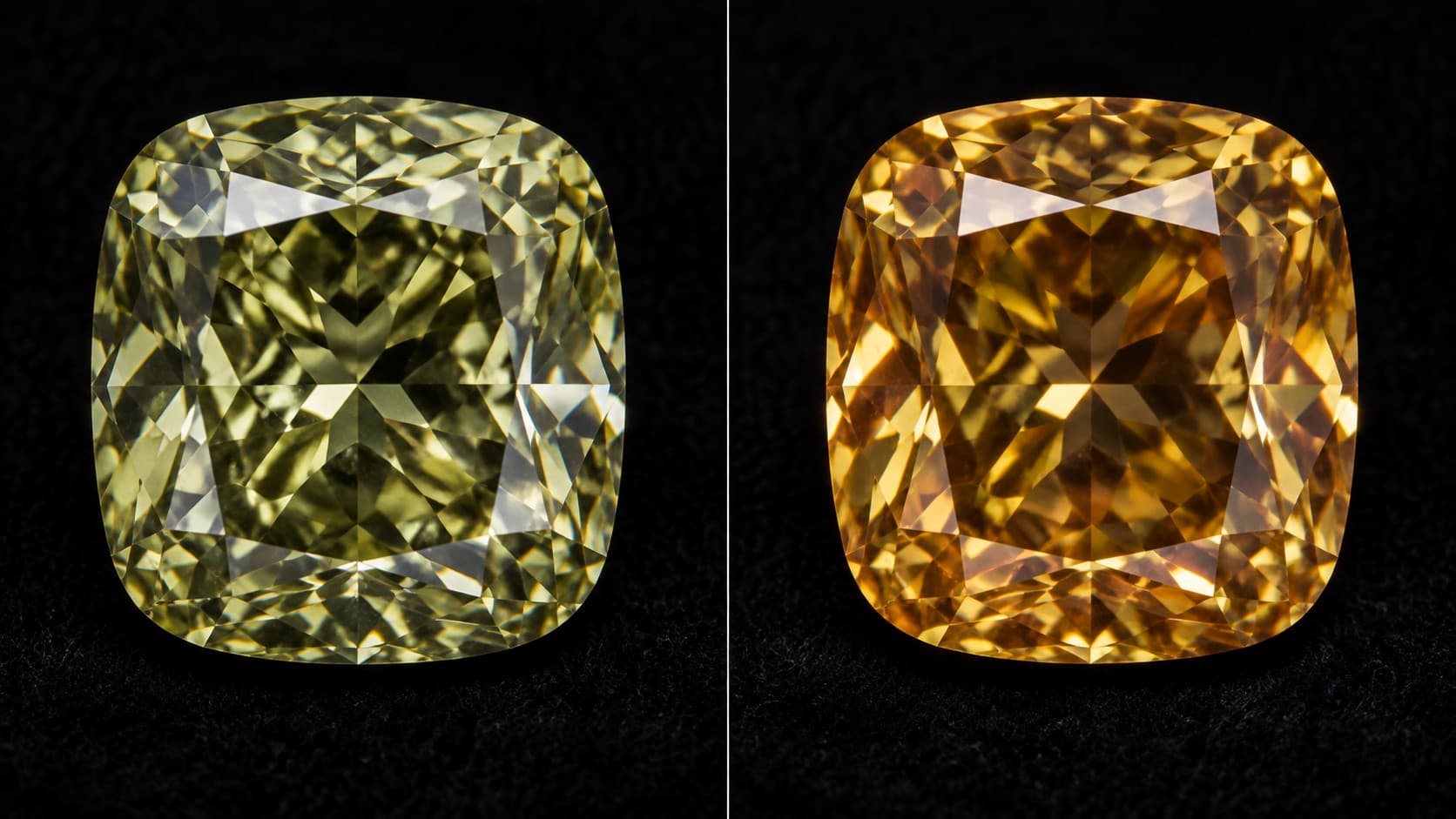
Labs confirm chameleon behavior through a specific, repeatable test rather than guesswork. According to GIA, a diamond earns the “chameleon” label on its report only if it meets three conditions: it has a greenish color component, it glows (phosphoresces) under shortwave ultraviolet light, and it shows a genuine, temporary color change when gently heated or kept in darkness.
To check for the effect, graders record the diamond’s full color and absorption spectrum, the same process used for every colored diamond. Then they watch specifically for a shift after applying mild heat or placing the stone away from light for a period of time. If the color visibly changes and then returns to normal, the lab adds “chameleon” as a note in the report’s comments section. Because this behavior can’t be faked or induced in diamonds that don’t naturally have it, the chameleon designation itself acts as a kind of built-in authenticity check.
Does Cleaning or Resizing Affect a Chameleon Diamond?
No, routine jeweler work on a chameleon diamond is safe and won’t cause any lasting damage. Resizing a ring involves a torch, and both ultrasonic and steam cleaners use heat, all of which can trigger the same temporary color shift the stone naturally goes through on its own. That’s expected behavior, not a sign of harm.
The only real difference an owner might notice is that the stone could look a shade or two warmer right after a cleaning or repair, before settling back to its normal olive color over the following minutes once it cools. A jeweler familiar with chameleon diamonds will usually recognize this immediately and won’t mistake it for a problem with the setting or the stone itself.
Are Chameleon Diamonds Valuable?
Chameleon diamonds carry real value, driven almost entirely by their rarity rather than their size or brilliance in the traditional sense. Because so few exist and the color-change effect can’t be manufactured, demand from collectors and diamond specialists tends to outpace the limited supply whenever one comes to market.
Pricing them accurately is genuinely difficult, even for experienced dealers, because there isn’t a large, consistent sales history to compare against the way there is for white diamonds or more common fancy colors like yellow or pink. Every sale tends to be treated almost as its own unique event, with condition, carat weight, clarity, and the strength of the color change all playing a role in what a buyer is willing to pay.
Trade-reported sales give some sense of the range. An 8.80-carat chameleon diamond ring reportedly sold at Christie’s Hong Kong in 2011 for around $590,000, while an 8.04-carat radiant-cut stone graded by GIA as a fancy dark grey-green chameleon has reportedly been valued at roughly $2.1 million. The gap between those two figures, for stones of a similar size, hints at how much intensity of color, cut, and clarity can swing a chameleon diamond’s price.
Frequently Asked Questions
Is the color change in a chameleon diamond permanent?
No. The color always returns to the diamond’s original olive tone once it cools down after heating, or once it’s exposed to light again after being kept in the dark. This reversibility is exactly what separates a true chameleon diamond from a green diamond that’s been permanently altered by extreme heat.
Can a chameleon diamond’s effect wear out over time?
There’s no evidence that the color-change ability fades or weakens with age or repeated use. The reaction is tied to the diamond’s internal structure, which doesn’t change through normal wear, so the effect should keep happening indefinitely under the right conditions.
Are chameleon diamonds lab-created?
No known lab-grown or treated diamond has ever reproduced true chameleon behavior. This is actually one of the reasons gemologists consider the chameleon designation strong evidence that a stone’s color is entirely natural.
What causes a diamond to become a chameleon diamond in the first place?
The exact cause still isn’t confirmed, but most researchers believe it relates to trace hydrogen and nitrogen defects within the diamond’s crystal lattice, formed naturally while the diamond was growing underground. No single accepted theory fully explains the reaction yet.
How is a true chameleon diamond confirmed?
The only reliable way is through testing at a recognized gem lab, where graders apply controlled heat or dark storage and watch for a genuine, reversible color shift. Color change alone isn’t enough; a lab also checks for phosphorescence under shortwave UV light before confirming the chameleon designation on a report.
Is a chameleon diamond the same thing as alexandrite?
No, even though both are famous for changing color. Alexandrite shifts color depending on the type of light it’s viewed under, typically green in daylight and red under incandescent light, while a chameleon diamond shifts because of heat or time spent in darkness. They’re two completely different gemstones with two completely different triggers behind the effect.
The Bottom Line
Chameleon diamonds remain one of the few true mysteries left in gemology, a natural phenomenon that scientists can document and test for but still can’t fully explain. What makes them worth knowing about isn’t just the color-changing trick itself, but what that trick represents: a diamond behavior so specific and so hard to fake that it doubles as proof of a stone’s natural origin. For collectors, that combination of rarity, reversibility, and scientific mystery is exactly why a single chameleon diamond, even a small one, holds a level of fascination that far outweighs its size.