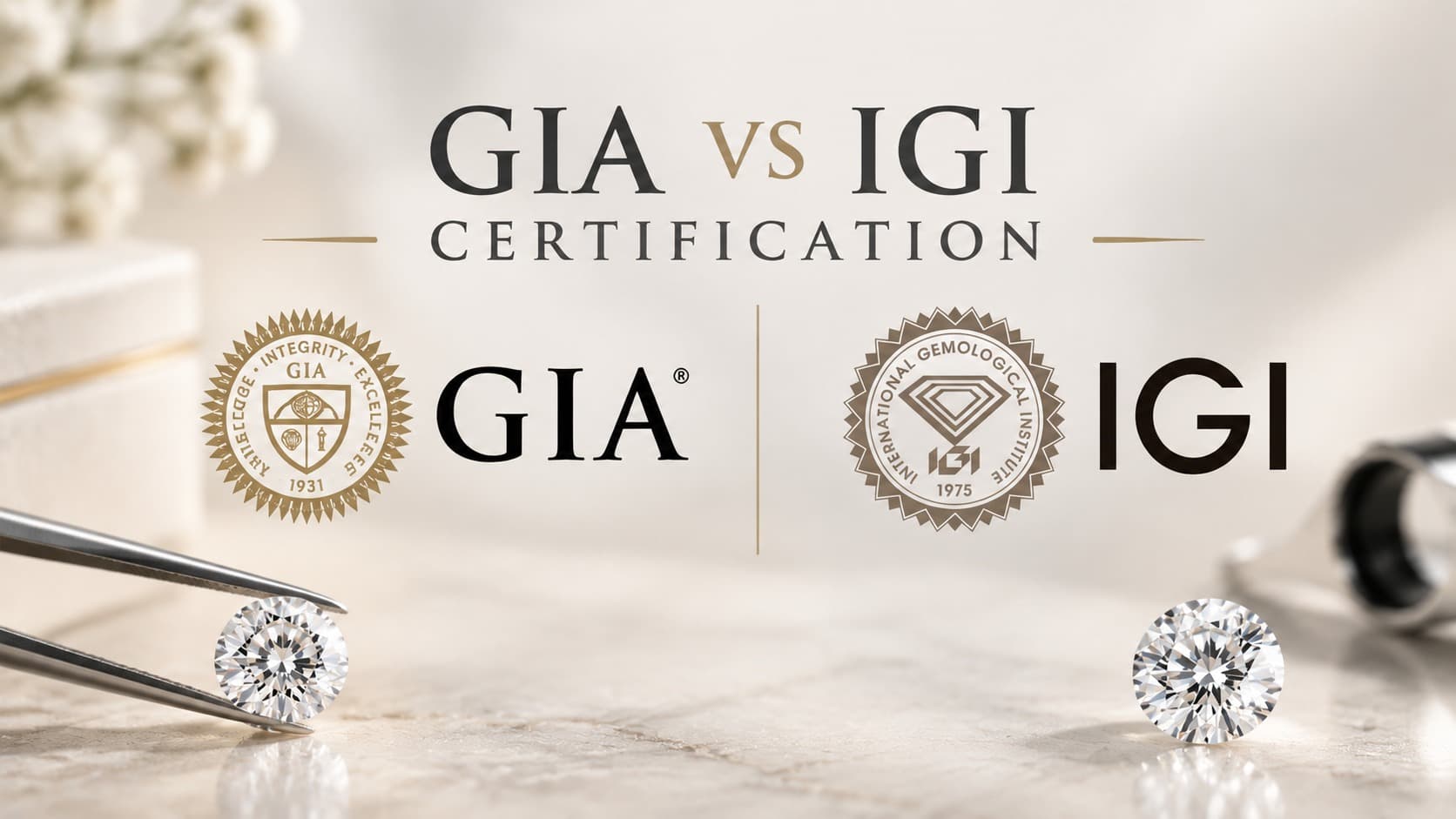
Anyone shopping for a diamond eventually runs into a small string of letters printed on a certificate: IGI or GIA. These letters matter more than most buyers realize, because they come from two separate laboratories that don’t always agree on how a diamond should be graded. A stone with an IGI report can carry a different color and clarity grade than the exact same stone would receive from GIA, and that gap can change what a buyer pays and what the diamond is actually worth later. Understanding how these two labs differ isn’t just trivia for gem nerds — it directly affects whether buyers get the quality they think they’re paying for.
What Is GIA Diamond Certification?
GIA stands for the Gemological Institute of America, a nonprofit lab founded in 1931 that created the diamond grading system almost everyone in the jewelry industry still uses today. Robert Shipley started GIA in Los Angeles during the Great Depression because he noticed jewelers had no shared, reliable way to judge gem quality. Across the 1940s and early 1950s, GIA researchers built out the 4Cs — cut, color, clarity, and carat weight — which turned diamond grading from guesswork into a repeatable science.
GIA doesn’t sell diamonds. It only grades and researches them, which is part of why the jewelry trade treats its reports as the benchmark. A GIA report lists the stone’s shape, measurements, color grade, clarity grade, cut grade, polish, symmetry, and fluorescence, along with a plotted diagram of any inclusions found inside the stone.
One detail surprises a lot of buyers: GIA only issues a formal cut grade for standard round brilliant diamonds in the D-to-Z color range. Fancy shapes like ovals, pears, and marquises currently get polish and symmetry ratings but no overall cut grade, though GIA has announced plans to extend cut grading to those three shapes starting in 2027. Until then, judging the cut quality of a fancy-shaped diamond relies more on the buyer’s own eye and a jeweler’s guidance than on a single letter grade.
What Is IGI Diamond Certification?
IGI, the International Gemological Institute, is a for-profit lab founded in 1975 in Antwerp, the historic center of the diamond trade. It has grown into the world’s second-largest independent gem certification provider by overall market share, behind GIA, operating roughly 30 laboratories across about ten countries. IGI grades both natural and lab-grown diamonds using the same 4C framework GIA popularized.
IGI reports look similar to GIA’s on the surface — same categories, same letter and number grades. The lab has built a strong reputation for speed and lower prices, which made it the default choice for many jewelers selling in high volume, especially in markets where fast turnaround matters more than the strictest possible grading.
IGI is also, today, a publicly traded company. The investment firm Blackstone bought IGI in 2023 and later listed it on Indian stock exchanges, where it now trades as a public business. That ownership structure is part of why IGI operates more like a commercial company than GIA’s nonprofit model — it’s built to scale quickly and serve high volumes of stones across dozens of countries. IGI was also the first major lab to certify lab-grown diamonds, starting back in 2005, well before lab-grown stones became mainstream. That head start is a big reason it holds the position it does in that market today.
GIA vs IGI: How Grading Standards Differ
The short answer is that GIA grades more strictly than IGI, often by one full grade on color and clarity. A diamond that IGI calls a G color might come back as an H from GIA on the same physical stone. A clarity grade of VS2 from IGI could land at SI1 under GIA’s microscope. Neither lab is cheating — they simply apply their internal standards with different levels of strictness.
This gap isn’t a secret complaint from one side of the industry. Multiple diamond retailers and pricing guides note that IGI grades slightly more leniently than GIA, and one pricing analysis found that a diamond IGI grades as VS2 has roughly a 68% chance of coming back as SI1 if it’s sent to GIA for a second opinion. That’s a meaningful difference for buyers comparing two stones side by side when one carries a GIA report and the other an IGI report — the two are not on the same scale, even though the labels look identical.
Think of it like two teachers grading the same essay. One teacher is a tougher grader overall, so a “B” from that teacher might be closer to an “A-” from the easier grader. The essay didn’t change — the grading scale did.
The two labs differ across several practical categories.
| Category | GIA | IGI |
|---|---|---|
| Founded | 1931, USA | 1975, Belgium |
| Structure | Nonprofit | For-profit |
| Grading style | Stricter, more conservative | Slightly more lenient |
| Best known for | Natural diamonds | Lab-grown diamonds |
| Typical cost | Higher | Lower (roughly 5-10% less) |
| Report turnaround | Slower | Generally faster |
IGI and GIA aren’t the only labs in the market, either. EGL is another name buyers sometimes encounter, and it’s generally regarded within the trade as more permissive than either GIA or IGI — a stone that EGL calls VS2 might reasonably land closer to an SI2 once evaluated under GIA’s criteria. That’s a different situation from the IGI-GIA gap, which reflects a genuine difference in strict internal standards rather than inconsistency, so EGL sits in its own category when comparing certificates.
Myth: GIA Only Certifies Natural Diamonds and IGI Only Certifies Lab-Grown
This isn’t true, and it’s one of the most common mix-ups in diamond shopping. Both GIA and IGI grade natural diamonds and lab-grown diamonds — neither lab is limited to one type, and neither one refuses to certify the other kind of stone.
The confusion comes from market share, not eligibility. GIA remains the more trusted name for natural diamonds, so most high-value natural stones carry its reports. IGI has become the dominant name in lab-grown certification, holding roughly two-thirds of that market, so most lab-grown stones a buyer encounters happen to carry an IGI report. That pattern in the marketplace is real, but it reflects which lab buyers and sellers tend to choose for each category — not a rule about which lab is allowed to grade what. The one real difference between the two labs on lab-grown diamonds comes down to report format rather than eligibility.
IGI vs GIA for Lab-Grown Diamonds
This is the part that trips up a lot of buyers in 2026. As of 2025, GIA stopped issuing standard color and clarity letter grades for lab-grown diamonds. Instead of a specific grade like “G color, VS1 clarity,” GIA now uses broader descriptive categories for lab-grown stones, while IGI continues to issue the full, familiar 4C letter grades on lab-grown diamonds.
That single policy change is a big part of why IGI now dominates lab-grown diamond certification. IGI’s own public filings put its share of the global lab-grown certification market at roughly two-thirds, a position built on the fact that it started grading lab-grown diamonds back in 2005, years before most competitors entered that space. Buyers shopping specifically for a lab-grown diamond who want a precise color and clarity grade printed on the report currently have only one major lab offering that in the traditional format: IGI.
For natural, mined diamonds, both labs still issue full 4C reports, and GIA remains the more widely trusted name — especially where resale or insurance is a concern down the line.
Does Certification Affect Diamond Resale Value?
Yes, and this matters most for natural diamonds. A GIA report tends to hold more weight with dealers, auction houses, and secondary-market buyers than an IGI report on a comparable natural stone. One industry pricing source frames this resale gap as substantial rather than minor, particularly for high clarity grades and rare fancy colors, where a D Flawless natural diamond with GIA papers sits in a completely different pricing tier than the same stone certified by IGI.
At lower, more common grades — something like an H color, SI1 clarity round stone — that resale gap narrows, because buyer expectations and typical resale prices are already compressed at that level. For lab-grown diamonds, this concern mostly disappears. Lab-grown stones don’t hold resale value the way natural diamonds sometimes do, so the choice between IGI and GIA carries much less financial weight there.
How to Compare GIA and IGI Grades
Because the two labs don’t share a scale, comparing a GIA-graded diamond directly against an IGI-graded one by letter grade alone can be misleading. A practical adjustment is to mentally shift IGI grades down by about one step before comparing them to GIA grades.
- An IGI color grade of F is roughly comparable to a GIA G.
- An IGI clarity grade of VVS2 is roughly comparable to a GIA VS2.
- Cut, polish, and symmetry grades tend to be closer between the two labs than color and clarity are.
This isn’t a precise formula — it’s a rough adjustment that puts stones on more equal footing rather than assuming identical letters mean identical quality. Buyers wanting more certainty on a specific stone can ask a jeweler whether it has been cross-checked against the other lab’s standard, since some sellers do this for higher-value pieces.
How to Confirm a GIA or IGI Report
A report should always be verified directly rather than trusted at face value, regardless of which lab issued it. Both labs run free online tools for this exact purpose, and skipping this step is one of the most common mistakes buyers make, because a certificate can be altered or mismatched to a different stone.
- Locate the report number printed on the certificate.
- Visit the lab’s own verification page — GIA’s is at gia.edu, IGI’s is at igi.org.
- Confirm the details match the diamond in question, including carat weight and measurements.
That two-minute check removes the risk entirely, and it’s a habit worth keeping even when buying from a trusted jeweler.
Frequently Asked Questions
Is IGI a scam or unreliable lab?
No. IGI is a legitimate, internationally recognized lab that has operated since 1975. It grades more leniently than GIA on average, but that’s a difference in standards, not a sign of dishonesty or poor quality control.
Which certification is better for an engagement ring?
For a natural diamond engagement ring, GIA is generally the safer choice because of its stricter grading and stronger resale reputation. For a lab-grown diamond, IGI is currently the more practical option since it still issues full 4C grades on lab-grown stones.
Can a diamond be re-certified by a different lab?
Yes, diamonds can be resubmitted to a different lab for a new report, though this takes time and costs money. Because grading standards differ between labs, the new report may show a different color or clarity grade than the original one.
Why did GIA stop grading lab-grown diamonds the same way?
GIA shifted to descriptive categories instead of specific letter grades for lab-grown stones starting in 2025. The company hasn’t tied this to quality concerns about lab-grown diamonds themselves — it reflects a policy change in how GIA chooses to report on that category.
Does a lower grade from GIA mean the diamond is worse than an IGI report suggested?
Not necessarily worse — just measured against a stricter yardstick. The physical diamond hasn’t changed between the two reports. What changed is which lab’s internal standard was applied to it.
The Bottom Line
Choosing between IGI and GIA comes down to what’s being purchased and what the buyer plans to do with it. For a natural diamond, especially one that might be resold or insured at a high value, GIA’s stricter grading and stronger market reputation make it the safer bet. For a lab-grown diamond, IGI is now the practical default, since it’s the lab still issuing full, specific color and clarity grades in that category. Either way, the certificate itself isn’t the finish line — checking the report number against the issuing lab’s own database is what actually confirms the diamond matches what’s being paid for.