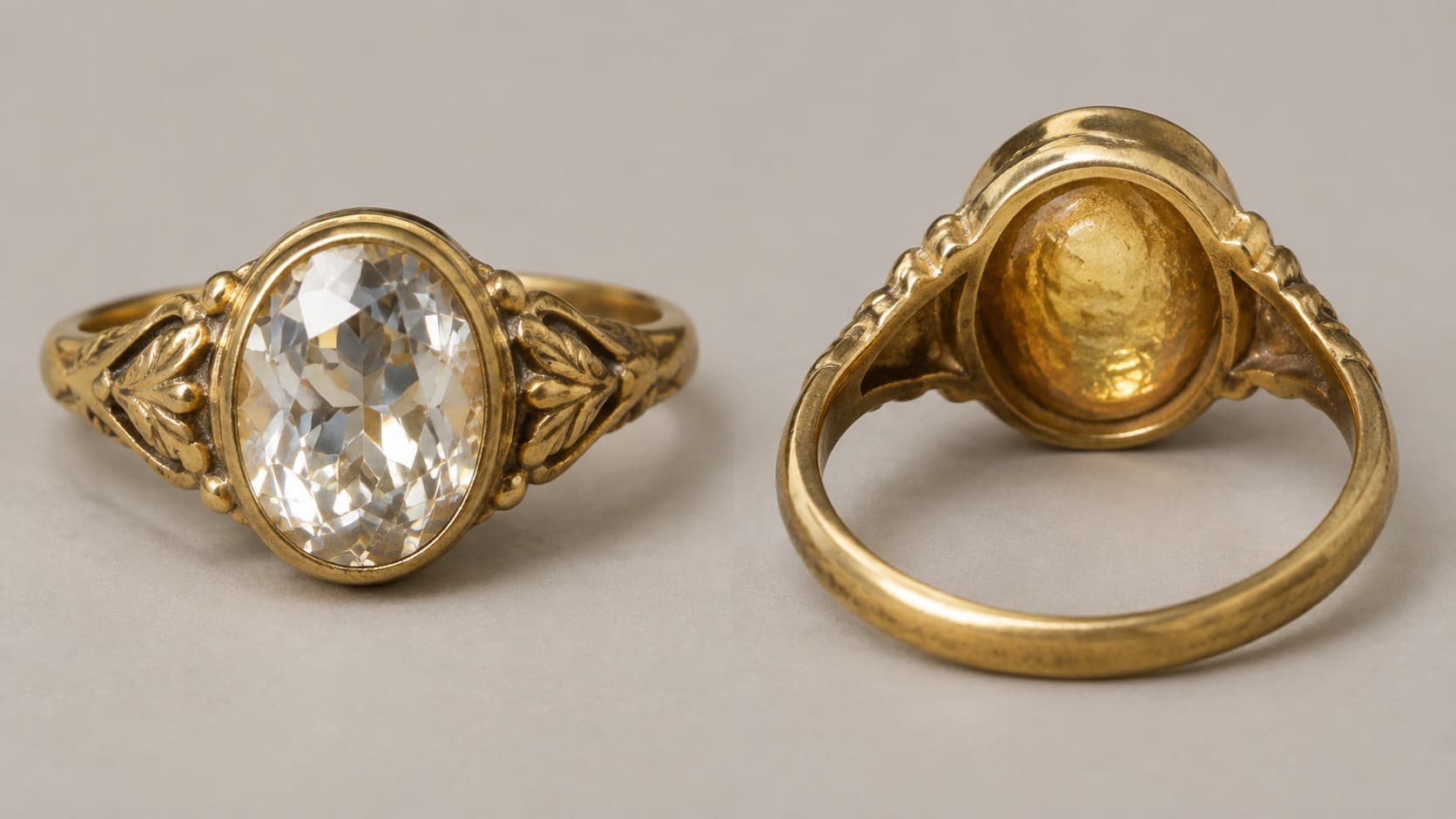
What is Foil Backed Jewelry: Historic Jewelry Technique

Learn about foil backed jewelry, an ancient technique using metal foils behind gemstones to enhance brilliance, including history and care tips.

We include products we think are useful for our readers. If you buy through links on this page, we may earn a small commission.

Read more

Affiliate Disclosure: This post may contain affiliate links, which means we may receive a commission if you click a link and purchase something that we have recommended. While clicking these links won't cost you any extra money, they help us keep this site up and running. We only recommend products or services that we genuinely believe will add value to our readers. Thank you for supporting us!

Transparency: We are a participant in various affiliate programs, including the Amazon Services LLC Associates Program, an affiliate advertising program designed to provide a means for us to earn fees by linking to Amazon.com and affiliated sites. Our editorial content is not influenced by affiliate partnerships, and we strive to provide honest and unbiased reviews and recommendations.

To learn more about our vetting process, please visit our Affiliate Disclosure Statement

Article Content

Close up of Georgian era style ring with foil backed blue sapphire in closed back setting showing ornate gold filigree work and period craftsmanship

Foil backed jewelry represents one of the most fascinating techniques in jewelry history. For over 4,000 years, skilled craftsmen have used this method to transform ordinary gemstones into brilliant treasures by placing a thin sheet of metal behind stones to reflect more light and color back toward the viewer. While some modern enthusiasts view foil backing with suspicion, this ancient art form was actually considered the height of sophistication, practiced by master jewelers who understood how to maximize the beauty of available materials. Today, understanding foil backing has become essential for collectors and anyone curious about the rich history hidden in vintage jewelry.

What is Foil Backed Jewelry?

Foil backed jewelry uses a thin sheet of metal or other material placed behind gemstones to reflect more light and color back into the stone and toward the viewer. This technique transforms the optical performance of gemstones by creating a mirror-like surface that captures and redirects light, making stones appear more brilliant and colorful than they would naturally. The practice involves carefully cutting thin metallic foils to fit precisely behind each stone in a closed-back setting, where they remain hidden from view while dramatically enhancing the gem’s appearance.

  • The foil acts as both a reflector and a coloring agent, with plain silver foil making stones appear brighter and more brilliant, while colored foils can completely change how a stone looks, turning a pale yellow topaz into what appears to be a vibrant emerald or ruby depending on the foil color used.
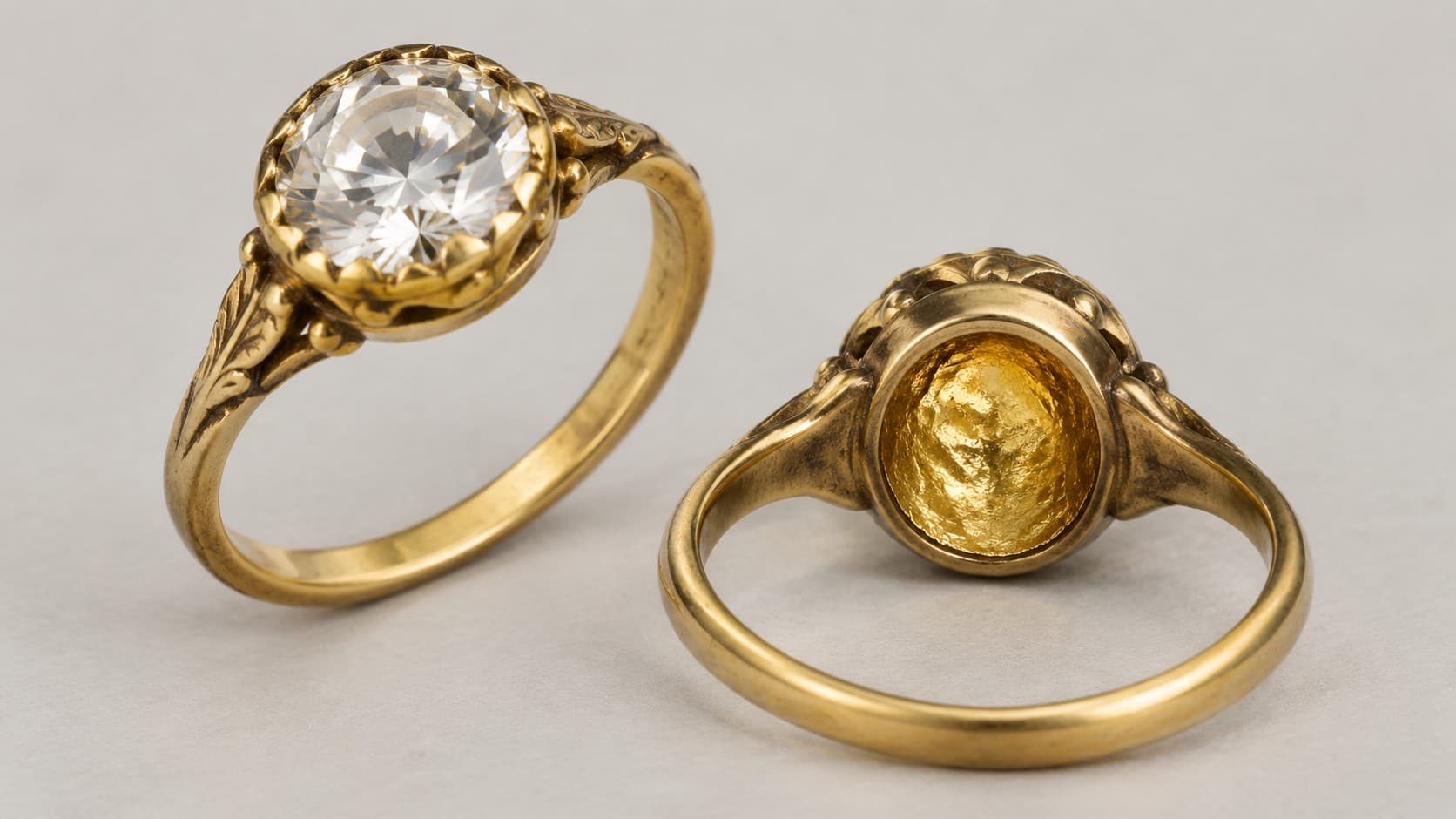
  • Most foiled gemstones are set in closed backs to protect the foil from deterioration, which means you can’t see through the back of the jewelry piece like you can with modern open-back settings, and this closed construction becomes a key identifying feature of foil backed pieces.
  • Creating foil backing takes a skilled jeweler a great deal of time and precision to carefully create a foil backing, custom cut for each setting, as each piece of foil must be perfectly shaped to match the individual stone and setting, making this a labor-intensive artisanal process.
  • Rather than being a deceptive practice, foil backing was considered sophisticated craftsmanship that allowed jewelers to create stunning effects with available materials, making beautiful jewelry accessible to more people while also enhancing even the finest gemstones owned by wealthy patrons.

The beauty of foil backed jewelry lies not in deception, but in the masterful understanding of light and optics that allowed historical jewelers to maximize the potential of every gemstone. This technique represents centuries of accumulated knowledge about how to make gems perform at their absolute best, turning what might otherwise be lackluster stones into pieces worthy of kings and queens.

How Does Foil Backing Work in Jewelry?

The science behind foil backing is actually quite straightforward when you understand how light behaves around gemstones. Foil back stones produce sparkle from the “mirror” foil, where light enters the stone and bounces back through the facets creating the sparkle. This differs dramatically from how modern gemstones work, where advanced cutting techniques allow light to bounce around inside the stone through total internal reflection. In foil backed pieces, the thin metallic backing creates an artificial light source that compensates for less sophisticated cutting methods used in historical periods.

  • Light enters the gemstone from the top and travels through the crystal structure, but instead of potentially leaking out the bottom (which would make the stone appear dull), it hits the reflective foil surface and bounces directly back through the stone toward the viewer’s eye, creating maximum brilliance from every ray of light that enters.
  • The clearer or sharper the cut glass, the greater the light’s reflection, meaning that even with foil backing, the quality of the gemstone’s cut still matters significantly for the final optical effect, but the foil compensates for cutting limitations that were common in earlier eras.
  • When foil becomes damaged, tarnished, or separated from the stone, these gemstones are often considered dead or lacking in sparkle because they lose their primary light source and return to their natural, often much duller appearance without the artificial enhancement.
  • Colored foils work by filtering the light that bounces back through the stone, so a blue foil behind a clear quartz will make the entire stone appear blue, while a gold foil can warm up the color of any stone and make it appear more valuable and rich.
  • Stones without foil backing (also called transmission stones) reflect only from the surface shine, which explains why removing or losing the foil backing makes such a dramatic difference in a stone’s appearance and why historical jewelers considered this technique essential.

This scientific understanding explains why foil backing was so revolutionary in its time and why moisture can damage foil and make the stone ‘dead’, losing its brilliance when water gets behind the setting. The foil essentially turns every gemstone into a tiny mirror system, maximizing the visual impact of available light and creating effects that seemed almost magical to people who didn’t understand the optical principles involved.

History of Foil Backed Jewelry

Victorian era style ring with foil backed pink gemstone in closed back gold setting showing intricate metalwork and foil enhancement technique

The history of foil backed jewelry spans thousands of years and represents one of humanity’s longest-running experiments in enhancing natural beauty through technology. The practice of foil-backing gemstones can be traced back to Minoan times around 2000 BC, making it older than many of the world’s major civilizations. This technique reached its absolute peak during the Georgian period in England, roughly from 1714 to 1830, when it became the standard method for setting gemstones in fine jewelry, practiced by the most skilled craftsmen of the age.

  • Early written accounts of foil backing appear in ancient Roman texts from the 1st century AD, demonstrating that even ancient writers understood and documented this technique, showing how widespread and accepted the practice had become across different cultures and time periods.
  • In 1568, the famous Italian goldsmith Benvenuto Cellini provided detailed technical instructions for creating foil backing, including specific formulations for different colored foils and precise techniques for their application, treating this as high-level professional knowledge worthy of preservation and sharing among master craftsmen.
  • The main gemstone cuts used in Georgian times were the rose cut, table cut and old mine cut, which did not give maximum brilliance or fire to the stones, which was compensated for by the extensive use of foils, explaining why this technique became so essential rather than optional during this period.
  • During the Victorian period there were advances in gem cutting techniques, leading to the introduction of the old European cut and eventually to the development of the modern day brilliant cut, which became popular in 1919, which began to make foil backing less necessary as stones could achieve brilliance through cutting alone.
  • The Victorian era also saw a transformation in the setting of gemstones into jewelry, as settings were opened up in the back, and stones enhanced in brilliance by being set in claws and prongs, representing a fundamental shift in jewelry design philosophy from closed, foil-enhanced settings to open, naturally brilliant stones.
  • The decline of foil backing wasn’t immediate but happened gradually as new cutting techniques proved they could achieve similar or better results without the maintenance issues and fragility problems associated with foil, though the technique never completely disappeared.

The historical importance of foil backing cannot be overstated – it represents humanity’s first successful attempt to systematically enhance gemstone beauty through scientific understanding of light and reflection. Today foil-backed stones have once again become a highly desired commodity and authentic Georgian jewelry has become an investment as sound as any bond, proving that modern collectors and investors recognize the historical significance and craftsmanship involved in these pieces.

What Metals Were Used for Foil Backing in Jewelry?

The variety of foils used in historical jewelry demonstrates the sophisticated understanding that craftsmen had of color theory and light manipulation. The famous goldsmith Cellini documented recipes for four types of foil: common (yellow) foil, red foil, blue foil and green foil, all of which contain the three metals gold, silver and copper at varying ratios. These different foil compositions weren’t just about creating different colors – they also had varying reflective properties, durability characteristics, and cost considerations that influenced when and how they were used.

  • Yellow or common foil was made by melting copper first, before adding the other precious metals to the molten solution, before cooling the foil and proceeding to flatten and scrape it down until it is thin enough to use, requiring exceptional skill to achieve the paper-thin consistency needed without tearing or creating holes in the delicate metal.
  • Silver foil was the most commonly used type because it provided maximum light reflection without adding color, making it perfect for enhancing diamonds and other colorless stones where the goal was pure brilliance rather than color enhancement, and it was also more affordable than gold-based foils.
  • Red foils were created using higher copper content in the alloy and were particularly popular for enhancing garnets, rubies, and other red stones, or for making pale stones appear to have rich red coloration, effectively allowing jewelers to create the appearance of valuable ruby jewelry using less expensive materials.
  • Blue and green foils required different metal combinations and were often used to simulate expensive sapphires and emeralds, with the foil color completely transforming the appearance of clear or pale stones into what appeared to be valuable colored gemstones.
  • Some later foil recipes used mercury and tin instead of the traditional gold, silver, and copper combinations, showing how the exact formulations evolved over time as jewelers experimented with different materials and as some metals became more or less available in different historical periods.
  • The thickness and quality of foil varied significantly depending on the intended use, with the finest pieces requiring foils so thin they were almost transparent, while costume jewelry might use thicker, less refined foils that were easier to work with but provided less sophisticated optical effects.

The mastery required to create these different foils cannot be understated – each type required different melting temperatures, cooling rates, and finishing techniques to achieve the desired color and reflective properties. After creating the foil, craftsmen had to clean and polish it with tartar, salt and water, then wash in clear water, rub clean with a rag lightly, and then scrub it on a big copper tube that must be very clean and shining, demonstrating the meticulous attention to detail required for professional-quality results.

What Gemstones Were Foil Backed?

The range of gemstones that received foil backing treatment was surprisingly broad, encompassing both precious and semi-precious materials as well as high-quality glass substitutes. Many colorless stones like quartz, topaz, beryl and sapphire were commonly foil backed, and even rose cut diamonds frequently received this treatment, showing that even the most valuable gemstones of the time were routinely enhanced using this technique. The choice of which stones to foil back depended on factors including the stone’s natural optical properties, its intended use in a piece of jewelry, and the desired final appearance.

  • Diamond, considered the king of gemstones, was often foiled with a rich silvery foil to give the illusion of increased brilliance, demonstrating that foil backing wasn’t reserved for inferior stones but was considered an appropriate enhancement even for the most precious gems available to wealthy patrons.
  • Many colorless stones including quartz, topaz, beryl and sapphire were particularly suitable for foil backing because their transparency allowed the foil’s reflective and color properties to show through effectively, creating convincing simulations of more expensive colored gemstones.
  • Many of these stones had colorless appearance and the color one sees is actually the color of the foil itself, meaning that jewelers could take inexpensive clear stones and create the appearance of valuable rubies, sapphires, or emeralds simply by choosing the appropriate foil color.
  • Glass stones were also commonly foil backed, with colorless glass enhanced to give more light return and sparkle, allowing skilled jewelers to create convincing imitations of gemstone jewelry that could fool casual observers while remaining much more affordable than pieces using genuine stones.
  • Rose cut diamonds were especially popular candidates for foil backing because this cut, while beautiful, didn’t provide the light return of modern brilliant cuts, so the foil backing compensated for the cutting limitations while maintaining the diamond’s natural beauty and value.
  • Garnets, amethysts, and other naturally colored stones were sometimes foil backed not to change their color but to intensify their existing hues, making pale or medium-toned stones appear much more saturated and valuable than they would naturally.
  • Some foil backing involved not just metallic foils but also colored treatments that could be damaged by improper care with cleaning solutions, making proper maintenance crucial for preserving the intended appearance of these enhanced stones.

The democratizing effect of foil backing cannot be overlooked – this technique allowed people of modest means to own jewelry that appeared to contain valuable gemstones, while also allowing wealthy patrons to maximize the visual impact of their genuine precious stones. The skill lay not in deception but in understanding how to make the most of available materials to create beautiful, lasting jewelry that brought joy to its wearers regardless of their economic circumstances.

How to Tell if Jewelry Has Foil Backing

Identifying foil backed jewelry requires understanding the visual and structural clues that distinguish these pieces from modern open-back settings. Foil backed closed settings are a typical characteristic and identifier of Georgian jewelry, making the setting style itself one of the most reliable indicators you’re looking at a piece that likely uses this technique. The identification process involves examining both the front and back of jewelry pieces, looking for specific construction details that were necessary to protect and conceal the foil backing.

  • The most obvious identifier is the closed-back setting, where you cannot see through to the back of the stone as you can with modern jewelry – the entire back of each stone’s setting is covered with metal, creating a sealed compartment that houses the foil and protects it from moisture and damage.
  • The backs of these jewels were often as ornate as the front just without the gemstones, showing that Georgian and Victorian jewelers took pride in creating beautiful construction even on parts of the jewelry that wouldn’t normally be visible, often featuring engraved patterns or decorative metalwork.
  • When foil darkens or peels, these gemstones are often considered dead or lacking in sparkle, so examining stones for uneven brightness, dark spots, or areas that appear cloudy or dull can indicate damaged foil backing that affects the stone’s appearance.
  • Age and provenance provide important clues, as foil backing was most common during specific historical periods, particularly the Georgian era (1714-1830) and early Victorian period, so jewelry from these eras is much more likely to feature this technique than pieces from other time periods.
  • The overall style and construction quality can indicate foil backing, as this technique was primarily used in fine jewelry made by skilled craftsmen rather than in crude or obviously inexpensive pieces, though it was also used in high-quality costume jewelry of certain periods.
  • Stones that appear unusually brilliant or colorful for their apparent quality might be foil backed, especially if the brilliance seems to come from behind the stone rather than from internal light reflection, which can create a distinctive visual effect that differs from modern brilliant-cut stones.
  • Look for signs of moisture damage around stone settings, as water can get in behind the stone and settle between the foil and the gemstone itself where it is unable to escape, with the liquid eventually evaporating as a result of the wearer’s body heat, which can cause the stone to have a cloudy appearance.

Proper identification requires patience and good lighting, as some of these visual cues can be subtle. The combination of closed-back settings, historical styling, and the distinctive appearance of foil-enhanced stones usually makes identification possible even for novice collectors, though definitive authentication may require professional evaluation for valuable pieces.

Modern Foil Backed Jewelry: Today’s Uses and Applications

While traditional foil backing declined dramatically after the Victorian era, the technique never completely disappeared and has found new applications in contemporary jewelry and decorative arts. There are still companies that practice the art of foiling, such as Larkspur & Hawk, a modern-day company based in New York, demonstrating that skilled craftsmen continue to appreciate and utilize this historical technique for creating unique, luxury jewelry pieces. Today’s foil backing applications range from high-end artisanal jewelry to mass-produced costume pieces and craft supplies.

  • Rhinestones are machine made crystal stones crafted to resemble jewels and diamonds, and while modern jewelers seldom use foiling behind actual gemstones, artificial gems are still made using similar techniques today, showing how the technique has evolved to focus primarily on enhancing glass and crystal rather than natural stones.
  • Swarovski brand crystal foil backs are commonly found in most “costume” quality jewelry, designer jewelry, watches, and accessories, indicating that major crystal manufacturers continue to use foil backing as a standard technique for maximizing the optical performance of their products.
  • Modern foil backing benefits from advanced manufacturing techniques and materials, allowing for more consistent quality, better adhesion, and improved durability compared to historical hand-made foils, though the basic optical principles remain unchanged from ancient times.
  • Currently, major crystal manufacturers like Signity, a subsidiary of Swarovski, manufacture beautiful cabochon cut gemstones with metallic back foil and fully disclose this enhancement, showing how modern manufacturers can use this technique transparently and ethically when proper disclosure is provided to consumers.
  • Contemporary artisans and jewelry makers use foil backing for restoration projects, where damaged antique pieces need historically accurate repairs, requiring them to learn and practice traditional techniques to maintain the authenticity and value of vintage jewelry.
  • The craft and hobby market has embraced foil backing for rhinestone applications, nail art, costume jewelry making, and decorative arts projects, making supplies and instructions widely available to amateur creators who want to experiment with this technique.
  • The traditional art of foiling has largely been lost, despite the high demand for antique pieces, primarily because the foiling process is lengthy and costly, making it economically challenging for most contemporary jewelers to justify the time investment required for custom work.

The modern revival of interest in foil backing reflects broader trends toward artisanal craftsmanship, historical authenticity, and unique visual effects that can’t be achieved through mass production. While it may never again reach the prominence it held during the Georgian era, foil backing continues to offer contemporary jewelers and artists a distinctive technique for creating pieces with exceptional visual impact and historical resonance.

How to Clean Foil Backed Jewelry

Antique Georgian style halo ring with foil backed blue center stone surrounded by smaller foil enhanced gems in closed back gold setting

Proper care of foil backed jewelry requires understanding both the myths and realities surrounding this delicate technique, as decades of misinformation have led many people to treat these pieces with unnecessary fear or inappropriate methods. Contrary to popular belief in vintage jewelry communities, you can actually get rhinestone jewelry wet – this common myth isn’t true, and modern testing has proven that many traditional care recommendations were based on assumptions rather than scientific evidence. The key is understanding which cleaning methods are safe and which can cause irreversible damage to the foil backing.

  • Washing your jewelry with water is completely fine! The recommended approach is to dry pieces upside down and make sure they are completely dry before storing, contradicting decades of advice that suggested water would automatically damage foil backed pieces, though proper drying technique remains crucial for preventing other types of damage.
  • Vinegar is too acidic for rhinestones and can damage the foil backing, and you should never use glass cleaner with ammonia on your rhinestone pieces, as these chemicals can dissolve or discolor the delicate metallic foils that provide the stones’ brilliance and color.
  • For foil-backed rhinestones, avoid full rinsing and instead use a damp cloth to wipe away any residue, providing a safer alternative to full immersion while still allowing for effective cleaning of surface dirt and oils that can accumulate over time.
  • Some foil-backed rings cannot be immersed in water, particularly those with compromised settings or visible gaps where water could penetrate behind the stones, so individual assessment of each piece’s condition is important before choosing cleaning methods.
  • The primary concern with moisture is actually corrosion of the metal settings rather than direct damage to the foil itself, though both issues can affect the jewelry’s appearance and longevity, explaining why proper drying is more important than avoiding water completely.
  • Storage requires attention to humidity control, and you can use silica packets to absorb extra moisture in humid environments, while avoiding plastic storage bags which can trap moisture and create conditions that promote corrosion or foil degradation.
  • Cleaning your rhinestone jewelry once a month is usually enough to keep it sparkling, as over-cleaning can be more damaging than beneficial, particularly with delicate antique pieces where the settings may have loosened over time.
  • Professional restoration may be necessary when the stone must be taken out and cleaned and the foil replaced, which is a costly and inconvenient process, but this investment can restore pieces to their original beauty and preserve their historical and monetary value.

Understanding proper care techniques allows collectors and wearers to enjoy their foil backed jewelry without fear while preserving these historical pieces for future generations. The key is balancing necessary maintenance with gentle treatment, always erring on the side of caution when dealing with irreplaceable antique pieces.

Why Did Foil Backing Disappear from Jewelry?

The decline of foil backing wasn’t sudden but resulted from a combination of technological advances, changing social attitudes, and practical considerations that made alternative techniques more attractive to both jewelers and consumers. The Victorian era began to see the decline of the popularity of foils, partially due to advancements in gem cutting and diamond manufacturing, as new cutting techniques made it possible to achieve brilliant effects without the maintenance and fragility issues associated with foil backing. This technological evolution fundamentally changed what was possible in jewelry design and shifted expectations about how gemstones should perform.

  • The development of the modern brilliant cut, which became popular in 1919, provided a revolutionary alternative that could make diamonds and other stones incredibly brilliant through cutting alone, eliminating the need for artificial enhancement while providing superior optical performance that lasted indefinitely without maintenance.
  • These more advanced gemstone cuts used scientific principles to allow for greater reflection and refraction within the stones, meaning that it was no longer necessary to use foils to increase the optical performance of the stone, representing a fundamental shift from external enhancement to internal optical engineering that produced better and more reliable results.
  • Social attitudes began changing toward the end of the 19th century, with experts writing that “the possibility of temporarily masking the color of yellow diamonds has, in recent years, frequently led to fraud,” showing how practices once considered legitimate craftsmanship began to be viewed with suspicion as concepts of authenticity evolved.
  • Cost and fragility became major practical concerns as jewelry became more democratized and people expected pieces they could wear regularly without special care requirements, while foil backed pieces required careful handling and periodic maintenance that many consumers found inconvenient.
  • Moisture can damage foil and make the stone appear ‘dead’, losing its brilliance, creating reliability issues that became less acceptable as people’s lifestyles became more active and they expected their jewelry to withstand normal daily activities including hand washing and exposure to humidity.
  • In a society where commissioned jewelry became rare, it would not be economically viable to mass-produce foil backed pieces, as the technique requires individual attention to each stone that doesn’t translate well to industrial manufacturing processes that prioritize speed and consistency.
  • By the 1920s this practice had almost completely disappeared and only a small portion of goldsmiths had the knowledge required when repairs were needed, creating a cycle where fewer craftsmen knew the technique, making repairs more expensive and difficult, which further discouraged its use.

The decline of foil backing represents a classic example of how technological progress can make traditional techniques obsolete, not because they were inferior in their time, but because new methods offered superior results with fewer drawbacks. While we can appreciate the skill and artistry of historical foil backing, the practical advantages of modern cutting and setting techniques explain why the industry moved away from this labor-intensive enhancement method.

Collecting and Valuing Foil Backed Jewelry

The market for foil backed jewelry has experienced a remarkable renaissance as collectors and investors recognize both the historical significance and artistic merit of these pieces. Today foil-backed stones have once again become a highly desired commodity and authentic Georgian jewelry has become an investment as sound as any bond, reflecting not just nostalgia but genuine appreciation for the craftsmanship and rarity of well-preserved examples. Understanding what makes these pieces valuable requires knowledge of historical context, condition factors, and market trends that affect pricing and desirability.

  • Authenticity verification is crucial, as the popularity of foil backed jewelry has led to modern reproductions that can fool inexperienced buyers, making it essential to understand period-appropriate construction techniques, materials, and stylistic details that distinguish genuine Georgian and Victorian pieces from later copies.
  • Condition of the foil backing itself dramatically affects value, with pieces showing bright, intact foil commanding premium prices, while those with darkened, damaged, or missing foil may be worth significantly less even if the settings and stones are otherwise in excellent condition.
  • Provenance and documentation can substantially increase value, particularly for pieces with known makers, historical associations, or clear chain of ownership that connects them to specific periods or notable previous owners, as this historical context adds both authenticity and story value.
  • The backs of these jewels were often as ornate as the front just without the gemstones, and collectors particularly prize pieces that show exceptional craftsmanship in all aspects of construction, including decorative work on normally hidden surfaces that demonstrates the maker’s commitment to quality.
  • Market trends favor pieces that represent the best examples of their type, with museum-quality construction, unusual or particularly successful color combinations, and intact original condition commanding the highest prices among serious collectors who understand the historical significance.
  • Investment potential depends partly on rarity, as the art of foiling has largely been lost, meaning that no new pieces of comparable quality are being produced, making surviving examples increasingly scarce as collections are dispersed or pieces are damaged beyond repair.
  • Size and type of jewelry affects collectibility, with larger statement pieces like necklaces and brooches often commanding higher prices than smaller items, though exceptional rings or earrings with particularly fine foil work can also achieve significant values.
  • Restoration considerations must be factored into purchasing decisions, as removing stones to clean and replace foil is a costly and inconvenient process, and the expense of proper restoration may exceed the value of less exceptional pieces.

Successful collecting of foil backed jewelry requires patience, education, and often significant financial resources, but rewards collectors with ownership of pieces that represent centuries of jewelry-making tradition and offer beauty that cannot be replicated using modern techniques. The combination of historical significance, artistic merit, and increasing scarcity continues to drive collector interest and support strong market values for exceptional examples.

Foil Backed Jewelry Issues: Damage, Repair, and Solutions

Foil backed jewelry faces several characteristic problems that result from both the inherent fragility of the technique and the effects of age on delicate materials. The foils placed behind the stones are often fragile and have a tendency to wear over time, creating challenges that require understanding both the causes of deterioration and the available solutions for restoration or mitigation. Most problems stem from moisture infiltration, mechanical damage, or chemical reactions that affect the metallic foils over decades or centuries of existence.

  • Moisture can damage foil and make the stone appear ‘dead’, losing its brilliance, as water gets in behind the stone and settles between the foil and the gemstone itself where it is unable to escape, with the liquid eventually evaporating as a result of the wearer’s body heat, which can cause the stone to have a cloudy appearance, representing the most common and problematic issue affecting these pieces.
  • Foil tarnishing occurs naturally over time as the metallic components react with trace amounts of sulfur, oxygen, and other environmental contaminants, causing the reflective surface to darken and lose its mirror-like properties, which directly reduces the stone’s apparent brilliance and color saturation.
  • Mechanical separation happens when the adhesive or physical contact between foil and stone deteriorates, creating gaps that allow light to escape rather than reflect back through the stone, often resulting in patches of reduced brilliance or complete dead spots in affected areas.
  • Setting looseness can develop over time as the metal mountings expand and contract with temperature changes or suffer impact damage, creating gaps that allow moisture and contaminants to reach the foil while also making stones more likely to fall out entirely.
  • Professional restoration involves taking the stone out and cleaning it and replacing the foil, which is a costly and inconvenient process, but may be the only way to restore pieces to their original beauty, particularly for valuable or historically significant examples.
  • Preventive care focuses on controlling environmental conditions, avoiding exposure to moisture and chemicals, and handling pieces gently to minimize mechanical stress on already-fragile components, as prevention is always less expensive and more effective than restoration.
  • Documentation of current condition through detailed photography and written descriptions helps track changes over time and provides valuable information for insurance purposes or future restoration decisions, particularly important for pieces with significant monetary or sentimental value.
  • Partial solutions may be possible for less severe problems, such as gentle cleaning of accessible surfaces or minor setting adjustments that can improve appearance and stability without requiring complete disassembly and foil replacement.

Understanding these common problems helps owners make informed decisions about care, restoration, and realistic expectations for the longevity of foil backed pieces. While these challenges can seem daunting, many pieces have survived centuries with minimal intervention, proving that proper care and occasional professional attention can preserve these historical treasures for future generations.

Traditional Foil Backing vs Contemporary Jewelry Techniques

Three antique style rings with foil backed gemstones showing blue red and green stones in ornate gold settings demonstrating foil backing color effects

The fundamental differences between foil backed jewelry and modern open-back settings reflect centuries of evolution in both gemstone cutting technology and jewelry design philosophy. Modern cutters make use of an optical phenomenon called total internal reflection to let as much light as possible that enters the stone to be redirected back to the eye, while foil backing relies on external reflection to achieve similar visual effects. This technological divide represents one of the most significant advances in jewelry history, fundamentally changing how gemstones perform and how jewelry is constructed.

  • Modern brilliant cuts achieve their optical performance through precise mathematical angles that trap light inside the stone and redirect it back to the viewer, creating consistent brilliance that doesn’t depend on external enhancement and remains stable regardless of environmental conditions or maintenance.
  • Earlier gem cutters were not in such a position of luxury nor did they have the modern gemological knowledge that cutters possess today, explaining why historical jewelers needed to rely on foil backing to compensate for cutting limitations that prevented stones from achieving their full optical potential.
  • Open-back settings allow light to enter stones from multiple directions and enable easy cleaning and inspection, while also reducing the overall weight of jewelry pieces and creating more delicate, refined appearances that suit modern aesthetic preferences.
  • Durability considerations favor modern settings, as open-back mounting eliminates the moisture and corrosion problems associated with closed settings, while brilliant-cut stones maintain their performance indefinitely without requiring maintenance or restoration of enhancement materials.
  • The yield a cutter can get from a rough mineral to cut a gemstone with modern techniques is typically less than 50%, meaning modern cutting techniques sacrifice significant amounts of raw material to achieve optimal optical performance, a luxury that historical jewelers couldn’t afford when gemstones were much rarer and more expensive.
  • Cost considerations differ significantly between the two approaches, with foil backing requiring extensive hand labor but using less expensive stones and simpler cuts, while modern techniques require expensive precision cutting but eliminate ongoing maintenance costs and provide more reliable long-term performance.
  • Aesthetic differences reflect changing tastes, with foil backed pieces often appearing more dramatic and colorful due to the artificial enhancement, while modern pieces emphasize natural stone beauty and subtle brilliance that doesn’t depend on external factors for effectiveness.
  • Historical authenticity makes foil backed pieces valuable for period jewelry collections and restoration projects, while modern techniques better serve contemporary needs for durability, low maintenance, and consistent performance in daily wear situations.

The comparison between these two approaches isn’t about superiority but about different solutions to the same challenge of maximizing gemstone beauty within the constraints of available technology and materials. Both techniques represent sophisticated understanding of optics and craftsmanship, adapted to the needs and capabilities of their respective eras, and both continue to have valid applications in contemporary jewelry depending on the desired aesthetic and functional requirements.

Conclusion

Foil backed jewelry represents far more than a historical curiosity – it embodies centuries of human ingenuity in the pursuit of beauty and the democratization of luxury. From its ancient origins in Minoan civilization through its golden age during the Georgian period, this technique allowed skilled craftsmen to transform ordinary materials into extraordinary treasures that could rival the finest natural gemstones. The sophisticated understanding of optics, metallurgy, and color theory required to master foil backing demonstrates that our ancestors were far from primitive in their approach to enhancing natural beauty. While modern technology has made many aspects of this technique obsolete, the artistry and craftsmanship involved in creating these pieces continue to command respect and premium prices among collectors who recognize their historical significance and irreplaceable beauty.

Today’s renewed appreciation for foil backed jewelry reflects broader cultural trends toward valuing handcrafted artistry, historical authenticity, and unique visual effects that cannot be mass-produced. As we’ve seen, proper care and understanding can preserve these delicate pieces for future generations, while modern applications of foil backing continue to serve specific niches in contemporary jewelry and decorative arts. Whether you’re a collector seeking investment-quality Georgian pieces, a jewelry enthusiast curious about historical techniques, or simply someone who appreciates the ingenuity of past craftsmen, foil backed jewelry offers a fascinating window into human creativity and the eternal desire to make beautiful things even more beautiful. The legacy of this ancient technique reminds us that true craftsmanship transcends technological limitations and that the pursuit of beauty has always been a driving force in human culture.

Nobbier logo

Subscribe To Our Weekly Newsletter

Get notified about new articles