
Airport security can be stressful enough without worrying about whether your favorite jewelry will trigger metal detectors and delay your trip. Most jewelry actually passes through checkpoints without any issues, though certain pieces might require additional screening or removal. Understanding which types of jewelry are likely to cause problems, how metal detectors work, and what TSA rules really say helps you make smart decisions about what to wear when traveling. Whether you’re concerned about valuable pieces, body piercings, or that chunky statement necklace you love, knowing the facts about flying with jewelry can make your entire travel experience much smoother.
Which Jewelry Sets Off Airport Metal Detectors?
Surprisingly, most jewelry you typically wear won’t set off airport metal detectors. Gold, silver, and platinum are non-ferrous metals (not magnetic), so small pieces are unlikely to cause alarms, and most jewelry won’t alarm, and if it does you can let an officer inspect it with you there. The real issue comes down to size, metal composition, and how much metal you’re wearing total.
- High-quality gold, silver, or platinum pieces are usually fine but cheap, chunky, or magnetic-metal pieces may trigger scanners. Small, everyday jewelry made from these precious metals typically passes through without issues, but larger pieces or those mixed with other metals can cause problems
- Costume jewelry and fashion accessories are more likely to set off alarms because they’re frequently made with magnetic metals like steel, nickel, and iron, which are the same metals detectors are specifically designed to find in weapons.
- Skip rings that go over two or three fingers, as they might trigger an alarm. Multiple rings on several fingers can collectively create enough metal mass to register on detectors
- Pass on anything super large and bulky earring-wise - the machine is looking for your body, and if all of a sudden something is protruding from your body, the machine might trigger an alarm.
- If you like to wear lots of those bangle bracelets, keep them in your carry-on bag. Stacked bracelets or thick bangles contain enough metal to frequently cause alarms
- If you’ve got one of those big belt buckles, Southwest style, that really will trigger an alarm. Metal belts and large buckles are among the most common jewelry-related items to set off detectors
- While sterling silver, platinum and gold shouldn’t have a problem going through security, the alloys mixed into these metals can sometimes cause issues, especially in larger pieces
- Gold watches will alarm, due to the base metals inside the case, and white gold may set off alarms because it has rhodium plating and will have a nickel undercoating.
The bottom line is that simple, small jewelry pieces made from precious metals are rarely a problem, while large, chunky pieces or costume jewelry containing magnetic metals are more likely to trigger alarms. The TSA recommends putting on heavy jewelry after you go through security, to reduce the likelihood of an alarm that results in a pat-down screening. When in doubt, it’s always better to pack questionable pieces in your carry-on and put them on after security rather than risk delays at the checkpoint.
How Airport Scanners Detect Different Metals in Jewelry
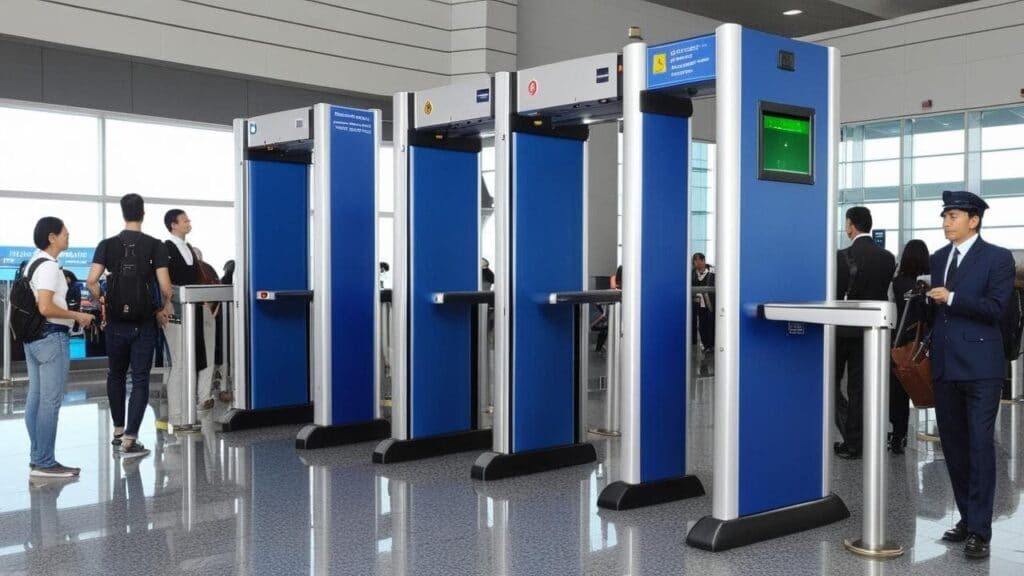
Metal detectors at airports use sophisticated technology to identify potential security threats while minimizing false alarms from everyday items. Most airports use walk-through metal detectors which rely on pulse induction technology, creating electromagnetic fields that detect disruptions caused by metallic objects. The key distinction is between ferrous metals (those containing iron, which are magnetic) and non-ferrous metals (like gold, silver, and platinum, which are not magnetic).
- Coils in the metal detectors send short pulses of current which generate a magnetic field within the “arch” of the WTMD. When you step through this magnetic field with certain metal objects they disrupt the field enough to send a signal back to the receiver coil and trigger the alarm.
- Metal detectors are calibrated to ignore small metal objects, focusing on items of substantial size or mass that could be potential security threats. This is why most small jewelry pieces don’t cause issues
- Some more sophisticated walk through metal detectors can even locate where within the magnetic field the metal object is located, helping security agents identify whether the alarm is coming from jewelry or something more concerning
- Generally, ferrous (iron containing) metals are the easiest for metal detectors to find due to their magnetic properties. But even non-ferrous metals can be picked up, especially in larger quantities
- Stainless steel is difficult for metal detectors to pick up because of its low magnetic permeability, but it can still trigger alarms depending on the amount and sensitivity settings
- It’s reported that the metal detectors used for TSA Pre-Check screenings are less sensitive than the metal detectors used for the general public, meaning you may have fewer issues with jewelry if you have PreCheck status
- Full body scanners use advanced imaging technology to detect objects hidden under clothing, and while they can pick up jewelry, TSA agents can usually identify it as non-threatening
Understanding these technology differences helps explain why you can’t always predict what will and won’t set off the detectors. You can’t always predict what the metal detector will pick up. For that reason it’s usually best to reduce the chances of a metal detector picking up on your jewelry by simply removing all or most of it. The good news is that most modern security equipment is sophisticated enough to distinguish between harmless jewelry and potential threats.
TSA Rules and Regulations for Jewelry
The Transportation Security Administration has relatively straightforward and traveler-friendly policies regarding jewelry, with no specific limits on how much you can wear or bring. There are no specific TSA jewelry rules, as such, so you can take as much jewelry as you want with you through the security checkpoint. The TSA focuses on security threats rather than restricting personal accessories, making it easier for travelers to wear their favorite pieces.
- According to TSA guidelines, small pieces like rings, earrings, and watches usually don’t set off metal detectors, so you can keep them on. This includes wedding rings, engagement rings, small stud earrings, and simple chain necklaces
- In general, jewelry doesn’t need to be removed before going through security, but TSA recommends putting on heavy jewelry after you go through security, to reduce the likelihood of an alarm that results in a pat-down screening.
- If you are travelling with valuable items such as jewelry, please keep those items with you at all times (do not put them in checked baggage). The TSA strongly advises against checking valuable jewelry due to theft and loss risks
- You can ask the TSA officer to screen you and your valuables in private to maintain your security. This option is available if you’re traveling with particularly expensive pieces or items you prefer to keep confidential
- If your jewelry does set off the alarms at airport security then it really isn’t a big deal. You will probably just have an additional pat down by a TSA officer or the TSA agent may just carry out checks using a metal detector wand.
- TSA PreCheck members often don’t need to remove as much jewelry. Small and simple pieces can usually stay on, making the process faster and less stressful.
- Even if an item is generally permitted, it may be subject to additional screening or not allowed through the checkpoint if it triggers an alarm during the screening process.
The TSA’s approach prioritizes both security and convenience, recognizing that jewelry is a normal part of travelers’ personal effects. During any security check, a TSA officer has the final say on what items are allowed through a scanner or onto the plane. Their flexibility extends to offering private screening options for valuable items and understanding that most jewelry poses no security threat when properly screened.
Types of Jewelry and Their Detection Levels
Different types of jewelry have varying likelihood of triggering airport security alarms based on their size, composition, and metal content. Understanding these categories can help you make informed decisions about what to wear when flying.
High-Trigger Items
- Large, heavy bracelets like James Avery charm bracelets with multiple charms and bangle bracelets worn in stacks are among the most likely to set off metal detectors due to their substantial metal content
- Rings that go over two or three fingers and multiple rings worn on several fingers collectively create enough metal mass to trigger alarms
- Large and bulky earrings that protrude significantly from the body are more likely to be detected by the scanning machines
- Big belt buckles, Southwest style and thick metal belts consistently trigger metal detectors and must usually be removed
- Gold watches will alarm, due to the base metals inside the case, and any watches with substantial metal bands or large cases
- Large plate jewelry, gold fill, silver fill, or costume jewelry frequently set off detectors due to their magnetic metal content
- Body jewelry that’s particularly large or made of multiple pieces, such as industrial piercings with long barbells, may trigger alarms
Medium-Trigger Items
- Standard rings and earrings made from mixed metals or containing alloys with magnetic properties have moderate detection potential
- White gold jewelry may trigger alarms because it has rhodium plating and will have a nickel undercoating.
- Most jewelry is made of an alloy - a mixture of metals that can include zinc, copper, cobalt, palladium, iridium, ruthenium, or nickel, which may influence detection
- Medium-weight necklaces and chains, especially those with pendants containing mixed metals
- Costume jewelry that doesn’t contain significant amounts of iron or steel but may have other dense metals
- Toe rings, anklets, and foot jewelry made from standard metals typically fall into this category
Low-Trigger Items
- Small gold, sterling silver, and platinum jewelry pieces such as stud earrings or wedding bands are least likely to cause issues
- Silicone rings are popular among travelers due to their non-metallic nature and never trigger metal detectors
- Wooden or fabric bracelets also make excellent alternatives, reducing the risk of setting off detectors.
- Medical bracelets are typically made of non-metallic materials, such as silicone or fabric, and do not set off the security scanners.
- Titanium jewelry, commonly used for body piercings and medical implants, is non-magnetic metal and did not trigger the metal detectors.
- Pearl jewelry, beaded accessories, and leather jewelry rarely cause detection issues
- Small, delicate chain necklaces and thin bracelets made from precious metals typically pass through without problems
The key principle across all categories is that size, quantity, and metal composition matter more than individual pieces. While one or two bobby pins won’t make a difference, if you have a head-full of bobby pins in your hair, that’ll be enough to set off the metal detectors. This same logic applies to jewelry - a single small ring won’t cause issues, but multiple rings, especially larger ones, can collectively trigger alarms. When in doubt, it’s always better to err on the side of caution and pack questionable items in your carry-on rather than risk delays at security.
How to Pack Jewelry for Airport Security
Properly organizing and packing your jewelry for air travel can significantly reduce stress and security delays while ensuring your valuable pieces remain safe throughout your journey. The Wanderer by Roam Often is your airport-friendly jewelry travel essential. Its slim 5” x 7” profile fits easily in your carry-on, backpack, or purse, but it’s got space for all the jewelry you want to take with you. The right approach to jewelry packing combines security considerations with accessibility and organization.
- Remove any heavy ringstone or metal buttons on jeans before security, and definitely any pieces of jewelry in your pockets - metal detectors sometimes pick up heavy rhinestones or metal buttons on jeans, so they’re definitely going to notice a piece of jewelry in your pockets.
- Use a Travel Jewelry Case designed to keep pieces organized and protected, with separate compartments to prevent tangling and damage during travel
- Always carry valuable jewelry in your carry-on to prevent loss or theft - never pack expensive pieces in checked luggage where they could be lost, stolen, or damaged
- Do not put jewelry in a bin or bowl to go through the security belt. These can tip over during their journey, be mistakenly picked up by another traveler, or left behind by you.
- For items that might require removal, pack them in an easily accessible location in your carry-on so you can quickly retrieve them if needed.
- Consider wearing your most valuable or sentimental pieces rather than packing them, as wearing your most valuable pieces can be wise to prevent loss during the security process
- Distribute your jewelry evenly across your body. Instead of stacking multiple bracelets on one wrist, wear one on each wrist. This balances the metal distribution and minimizes the chance of alarms.
- Pack travel-friendly alternatives like silicone rings or wooden braclets for situations where you want to avoid any potential metal detector issues
Smart jewelry organization extends beyond just security concerns to protecting your valuable pieces throughout your journey. A small amount of any metal won’t set off a metal detector depending on how sensitive it’s set, but having a dedicated jewelry case ensures nothing gets lost or damaged whether you’re wearing it through security or packing it in your carry-on. Remember to take photos of expensive pieces before traveling for insurance purposes, and consider using individual compartments or wrapping items in soft cloth to prevent scratching during transport.
Body Piercing Airport Policy
Body piercings and permanent jewelry require different handling at airport security compared to removable accessories, with TSA policies allowing for both accommodation and alternative screening methods. Certain metal body piercings may cause the machines to alarm and a pat-down may be required. If additional screening is required, you may be asked to remove your body piercing in private as an alternative to the pat-down. Understanding your rights and options can make the process smoother and more comfortable.
- There are no restrictions on wearing body piercing jewelry through airport security, though you should be aware that certain piercings may trigger alarms requiring additional screening
- I have my nose pierced and it is very small compared to some piercings but I have never removed it nor has it ever set off the metal detector - small piercings often pass through without issues
- Titanium jewelry, commonly used for body piercings, is non-magnetic metal and did not trigger the metal detectors at airport, making it an excellent choice for frequent travelers
- Quality metal body jewelry is non-ferromagnetic and will not set off the large walk-through metal detectors. However, the hand-held wands are often more sensitive and frequently do sound an alarm when scanning directly over metal body jewelry.
- If your jewelry does set of their detectors, all you have to do is show it to them, and you should be good to go - visual inspection is typically sufficient
- If you must go to a private area, don’t be alarmed. They just need to make sure that it really was jewelry that set off the detector, and you always have the right to choose the gender of the person who searches you.
- In 2008, TSA at a Texas airport forced a woman to remove her nipple jewelry with pliers - this sparked policy change, and since then, TSA agents cannot force you to remove your jewelry.
- If you set off the alarm, you might have to have a ‘pat down’ or remove the jewelry in private, but removal can only be requested as an alternative to pat-down, not as a requirement
For non-removable or newly healed piercings, you have specific rights and accommodations available. If an alarm cannot be resolved through a pat-down, you may ask to remove the head covering in a private screening area - similar accommodations apply to body piercings that can’t be easily removed. If you have piercings in private areas, like nipple or genital piercings, they might take you to a private area so that you can show the jewelry to them. The key is communication with TSA agents about your situation, and knowing that you have options beyond public removal or extensive pat-downs.
Airport Security Tips for Valuable Jewelry Protection
Traveling with valuable jewelry requires extra precautions to ensure both security compliance and protection against loss or theft during your journey. If you are travelling with valuable items such as jewelry, please keep those items with you at all times (do not put them in checked baggage). The TSA provides specific accommodations for high-value pieces while maintaining security protocols.
- You can ask the TSA officer to screen you and your valuables in private to maintain your security - this option is particularly useful for engagement rings, inherited pieces, or jewelry you prefer to keep confidential
- If you’re carrying particularly valuable or sentimental pieces, consider how secure you’ll feel removing and placing them in a bin - private screening can alleviate these concerns
- Carry-on bags remain with you throughout your stay at the airport, including TSA checkpoints and on the plane, making them the safest option for valuable jewelry
- Consider insuring valuable items before traveling for added protection and keep documentation readily available
- Most jewelry should be allowed in your carry-on and onto the plane unless it contains liquids or is designed as a self-defense tool.
- For particularly valuable collections, consider spreading pieces between different locations - some worn, some in carry-on, some with travel companions
- Document your jewelry with photos before travel, including serial numbers or unique identifying marks, for insurance and identification purposes
- If your jewelry is expensive and you’re worried about leaving it in a tray unattended, put it in the inside pocket of your jacket or pack it in your carry-on baggage.
The most critical consideration for expensive jewelry is maintaining possession throughout your journey. Although the TSA allows jewelry in checked baggage, they advise passengers to keep all valuable jewelry items with them when traveling. This means either wearing it through security (with willingness to undergo additional screening if needed) or keeping it secured in a carry-on bag that never leaves your sight. For extremely valuable pieces, it’s worth researching specific insurance requirements for travel, as some policies may require additional steps or documentation for coverage during air travel.
Flying Internationally with Jewelry

International travel with jewelry involves varying customs regulations, declaration requirements, and duty considerations that differ significantly from country to country. If you are traveling to the US and purchase jewelry while abroad, the US Customs require you to declare the pieces of jewelry. Understanding these requirements can prevent delays, fines, and legal complications at international borders.
- The U.S. customs regulations are clear: all items (including Gold & Diamond Jewelry) brought into the country, regardless of how they are carried, must be declared if their total value exceeds the personal exemption limit.
- If you estimate the value of the jewelry to be over $10,000, then you need to declare them. You don’t have to be precise, but just a general estimate.
- Returning resident travelers may import jewelry they owned before traveling duty-free under their exemption, but must still declare it
- For individuals moving to the USA or visiting for the first time with gold jewelry that was purchased before their move, the key is whether you need to pay customs duty on gold jewelry that you bought before moving to the USA.
- Commercial importation of diamonds, jewelry, pearls, precious and semi-precious gemstones valued at $2,500 or more requires official entry.
- USA charges custom duty at approximately 6% of the total value on declared jewelry exceeding exemption limits
- In Canada and the U.S., you always have to declare anything you’re importing that you didn’t have before, even if you’re within your exemption.
- Whether you need to declare it to customs depends very much on where you are going, where you live and what you intend to do with the jewelry.
Different countries have varying approaches to jewelry customs, and what applies when entering one country may not apply when leaving or entering another. Anything you bring back that you did not have when you left the United States must be “declared.” For example, you would declare alterations made in a foreign country to a suit you already owned, and any gifts you acquired outside the United States. The myth that wearing jewelry can help you evade customs duty is not only misleading but potentially costly - items must be declared regardless of whether they’re worn or packed. When traveling internationally, research specific customs requirements for each country you’ll visit, keep receipts for jewelry purchases, and be prepared to declare items honestly to avoid legal complications.
Easy Airport Security Tips for Jewelry Wearers
Streamlining your airport security experience with jewelry requires advance planning and understanding of TSA procedures to minimize delays and stress. Follow these tips to decrease the likelihood of setting off the alarm at the walk-through metal detector. These practical strategies can significantly reduce the chances of additional screening while keeping your jewelry secure.
- Limit jewelry to small earrings, watches, wedding bands/engagement rings, eyeglasses when passing through security
- Tuck your necklace under your shirt so it doesn’t show, and turn your rings around so the stones do not show to reduce visual bulk
- If you are wearing a necklace, take the necklace and swing it to the back so the necklace is hanging down your back instead of your front - this reduces the metal signature in front of your body
- To decrease the chance of the WTMD alarming, remove ALL other metal you have on your person - belts, watches, rings, earrings, etc. The detector detects your all-over ferrous metal “load”, so get that load as small as possible.
- They’ll just do a pat-down of that area to make sure that it’s not a weapon if your jewelry triggers an alarm - this is usually quick and routine
- If you are traveling with very valuable items, you can ask the TSA officer to screen you and your jewelry in private to maintain your security.
- The PreCheck line typically uses metal detectors rather than Advanced Imaging Technology, which means less sensitive alarms. As a result, you’re less likely to need additional screening for your jewelry.
- Be prepared to undergo additional screening, such as a pat-down or the use of a handheld detector and arrive early enough to accommodate potential delays
The key to smooth security screening is preparation and realistic expectations. If you wear jewelry and you do set off the alarms at airport security then it really isn’t a big deal. You will probably just have an additional pat down by a TSA officer or the TSA agent may just carry out checks using a metal detector wand. Many frequent travelers recommend establishing a consistent routine - always removing the same types of items, organizing them the same way, and wearing travel-appropriate jewelry that minimizes complications. Remember that TSA agents process thousands of passengers daily and are experienced with jewelry-related alarms, so there’s no need to feel embarrassed or stressed if additional screening is required.
Debunking Common Airport Jewelry Security Misconceptions
Many misconceptions about jewelry and airport security persist, leading to unnecessary anxiety and poor travel decisions. Do you worry that all the gold and platinum in your rings will set off the alarms and get you strip searched in a dingy back room by some Neanderthal with thick, hairy hands? Not a pleasant thought. Let’s separate fact from fiction to help you travel with confidence.
- Do underwire bras always set off metal detectors? Despite persistent myths, underwire bras almost never cause issues at airport security. Thousands of people wear them daily through scanners without setting off alarms.
- Can TSA agents force you to remove your jewelry? Many are surprised to find that they have more rights than they thought. TSA agents cannot force you to remove your jewelry - visual inspection or pat-down are alternative options
- Do gold and silver jewelry always trigger metal detectors? The security system at airports is among other things looking for magnetic metals. You are more likely to set off the alarm wearing cheap costume jewelry, frequently made with magnetic metals, than fine gold and platinum jewelry.
- Do airport metal detectors use magnets to find metal? Most of the airports are going to be using walk through metal detectors which rely on pulse induction technology - not magnetic detection as many believe
- Can wearing jewelry help you evade customs duty? The myth that wearing jewelry can help you evade customs duty is not only misleading but potentially costly. The U.S. customs regulations are clear: all items must be declared if their total value exceeds the personal exemption limit.
- Can body scanners detect jewelry? Full body scanners use advanced imaging technology to detect objects hidden under clothing. Jewelry might appear on the scan, but TSA agents can usually identify it as non-threatening.
- Is silver undetectable by metal detectors? If it were that easy, then a silver knife would be easy to get past metal detectors. Airport metal detectors detect metal conductivity, and there isn’t any metal that isn’t conductive enough with enough metal. Silver is actually the most detectable metal.
- Do small jewelry pieces matter to airport scanners? Metal detectors are calibrated to ignore small metal objects, though body scanners can detect them. TSA agents are trained to recognize jewelry and distinguish it from potential threats
Understanding the reality of airport security technology helps dispel many common fears. The truth is that TSA agents are trained to distinguish between harmless jewelry and potential threats, and modern scanning technology is sophisticated enough to identify different materials and shapes. The biggest myth-buster? Simple, small jewelry rarely causes problems, while bulk and magnetic metals are the real concern - not the preciousness or cost of the metal itself.
Best Travel Jewelry Materials to Avoid Metal Detectors
Choosing travel-appropriate jewelry materials can eliminate security concerns while maintaining your personal style. Consider jewelry alternatives if you want to avoid potential hassles. For example, silicone rings are popular among travelers due to their non-metallic nature. Modern materials offer stylish options that bypass metal detector concerns entirely.
- Silicone rings are popular among travelers due to their non-metallic nature and come in various colors and styles that can complement any outfit
- Wooden or fabric bracelets also make excellent alternatives, reducing the risk of setting off detectors while offering unique aesthetic appeal
- Consider opting for cost-effective alternatives like stainless steel or titanium pieces, which are durable and lightweight and less likely to trigger alarms
- Medical bracelets are typically made of non-metallic materials, such as silicone or fabric, and do not set off the security scanners.
- If you’re leaning towards eco-friendly options, recycled materials such as bamboo or ethically sourced stones can make a stylish statement while being kind to the planet.
- Titanium is known for its strength and lightweight properties, and it is less conductive than gold, silver, and platinum. Jewelry made of titanium is highly unlikely to trigger metal detectors.
- Acrylic, resin, leather, cord, and hemp jewelry options provide fashionable alternatives that completely avoid metal detector issues
- Glass, ceramic, and bone jewelry (where legally appropriate) offer artistic alternatives for unique jewelry pieces
Non-metal jewelry alternatives have evolved significantly in recent years, offering sophisticated options that rival traditional metal pieces in both durability and aesthetics. For the jewelry that’s good to travel through security, keep it on. For anything else, take it off and store it in a travel jewelry case in your carry-on. By building a collection of travel-appropriate jewelry, you can maintain your personal style without the stress of security screening delays. Many travelers find that investing in high-quality non-metal pieces for travel actually expands their fashion options while providing peace of mind at airport checkpoints.
Conclusion
Understanding airport security procedures for jewelry can transform a potentially stressful experience into a smooth part of your travel routine. Small and simple gold, silver, and platinum jewelry pieces typically do not set off standard airport metal detectors, while cheap, chunky, or magnetic-metal pieces may trigger scanners. In general, jewelry doesn’t need to be removed before going through security, and you can ask the TSA officer to screen you and your valuables in private to maintain your security. TSA accommodates body piercings through visual inspection options rather than forced removal, and international travelers must declare jewelry exceeding value limits.
The key to hassle-free travel with jewelry is preparation and smart choices. Consider jewelry alternatives like silicone rings, which are popular among travelers due to their non-metallic nature, and always keep valuable pieces in your carry-on luggage. When in doubt, remove bulky items before security and know that if you wear jewelry and you do set off the alarms at airport security then it really isn’t a big deal - TSA agents handle these situations routinely every day.