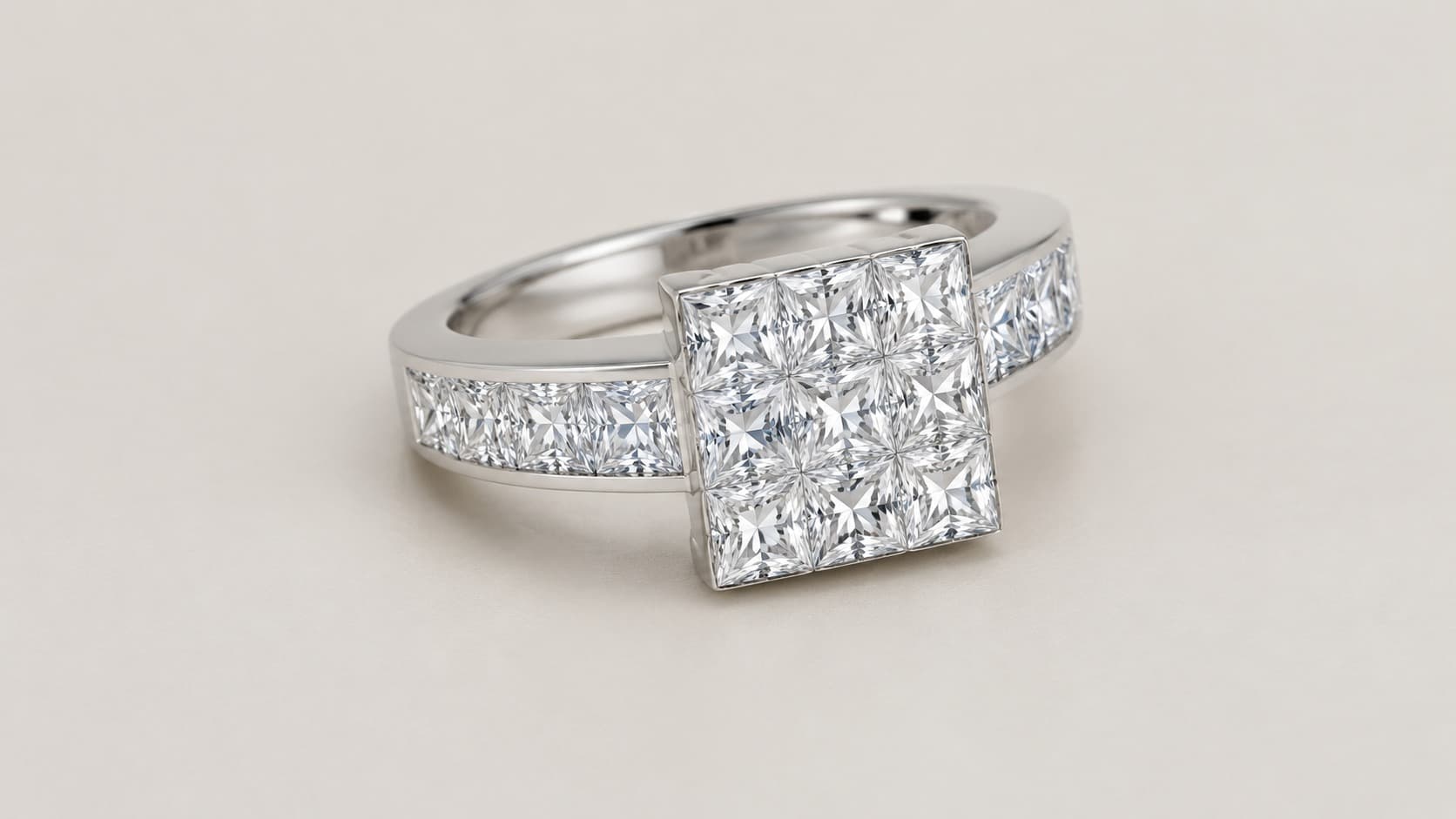
Certain high-end rings and bracelets share a strange feature: no metal is visible anywhere on them. No prongs, no claws, no little metal walls holding the stones in place. Just a smooth, continuous carpet of color, as if the gems are floating on their own. This is called invisible setting, and it is one of the most difficult techniques in all of jewelry making. It takes incredible patience, a steady hand, and a kind of engineering trick hidden just beneath the surface. The craftsmanship behind it explains why pieces made this way are treated almost like works of art rather than ordinary accessories.
What Is an Invisible Setting?
Invisible setting is a technique where gemstones are held in place by hidden metal rails instead of visible prongs or claws. From the front, the piece appears as a solid sheet of gemstones, packed tightly together with no gaps and no metal showing between them.
The trick sits underneath. Each stone is cut with tiny grooves on its sides, and those grooves slide onto thin metal rails that act like a track. Those rails measure less than two-tenths of a millimeter thick — thin enough that a stack of two ordinary printer pages is already wider. Because the rails are so thin and tucked beneath the stones, they disappear from view entirely once the piece is finished. Jewelers in the trade often call this “mystery setting,” since the finished piece genuinely looks mysterious — the stones appear to simply float in space.
A few different versions of this technique exist, built for different effects. The original flat version is sometimes called the traditional mystery set. A variation designed for translucent stones lets light pass through the gems for a glowing effect, while another uses marquise-shaped stones instead of square ones, and a third uses small drop-shaped pieces to create fringes that move and swing. Each variation uses the same hidden-rail principle underneath, just adapted to a different stone shape or visual goal.
How Jewelers Build an Invisible Setting
Every single stone gets custom-cut to fit a specific hidden rail, then slid into place one by one like tiles in a mosaic. Nothing about this process is fast or automated.
First, a jeweler designs a tiny framework of thin metal rails shaped to match the pattern of the finished piece. Then each gemstone — usually a ruby, sapphire, or diamond — gets shaped into a precise square or rectangle known as a calibré cut, and a groove is carved into its underside near the edge. That groove allows the stone to hook onto the rail without needing a prong on top. The stones are then slid into position one at a time, packed edge to edge, until the entire rail system is covered and no metal peeks through anywhere.
Because every stone has to be cut to fit its exact spot, no two stones in the piece are interchangeable, and cutting that groove into the edge of a gem is one of the hardest parts of the whole job — a slightly uneven groove, or a crack that forms while carving it, ruins the stone for this use entirely. This is also why invisible setting almost always calls for close teamwork between two different specialists: a gem cutter who shapes and grooves the stones, and a goldsmith who builds and fits the rail framework. Neither skill on its own is enough to finish the piece.
Invisible Setting’s Origin Story
A little-known Parisian jeweler, not a famous luxury house, built the first version of this technique. In 1929, a jeweler named Jacques-Albert Algier patented a method of holding a stone in place by carving a groove into its side and sliding it along metal rails, with no claws or collets needed.
Other big names noticed the idea soon after. Cartier picked up the method in the spring of 1933 and used it occasionally, though with a catalog already packed with Art Deco designs, the house never pursued it heavily. It was Van Cleef & Arpels that turned the technique into a signature. On December 2, 1933, Van Cleef & Arpels received a French patent for its own version, called Serti Mystérieux, or “Mystery Setting.” The house had the right people for the job too — co-founder Alfred Van Cleef had trained as a lapidary and could cut stones with his own hands, while his partner Julien Arpels had built his reputation around judging fine gems. Two decades after its 1906 founding, Van Cleef & Arpels was still fighting for standing among Paris’s older, more established jewelry houses, and mastering this uniquely difficult technique became part of how it carved out a name of its own.
For the first several years the technique only worked on flat surfaces, but that changed later in the decade. A follow-up patent secured in 1938 freed the stones from that flat plane, letting them wrap and bend around curved and sculptural forms for the first time — which opened the door to the flower-like, three-dimensional jewelry the house became famous for. Van Cleef & Arpels still leads this craft today, though it is not the only maison that uses it. Other brands, including Cartier, have patented similar settings of their own, but Van Cleef & Arpels remains the clear leader in how extensively it uses the technique.
Why Does Invisible Setting Cost More?
Invisible-set jewelry carries a high price for three connected reasons: it wastes a large amount of raw gemstone material, it eats an enormous number of skilled labor hours, and very few jewelers in the world can even perform the technique.
Cutting a stone to fit precisely onto a rail, with grooves carved into its edges, means a lot of the original rough stone gets cut away and lost. To end up with enough finished, correctly-grooved stones for one piece, a jeweler often has to start with roughly one and a half times that number in rough material, since so much is sacrificed in the cutting. The labor adds up just as fast: a single design can swallow upward of 300 hours of hands-on work before it’s finished, and only a handful reach completion in any given year. Few artisans ever learn the skill in the first place, so the work stays concentrated among a small handful of specialists around the world.
That rarity carries straight through to resale value. Pieces made with true mystery setting tend to sell for noticeably more at auction than similar jewelry made with ordinary prong or pavé settings, since buyers are paying for both the gemstones and the scarcity of the craftsmanship itself. Material waste, hundreds of hours of hand labor, and a tiny pool of qualified craftspeople together explain why these pieces sell for so much more than a comparable prong-set or pavé piece.
Pros and Cons of Invisible-Set Jewelry
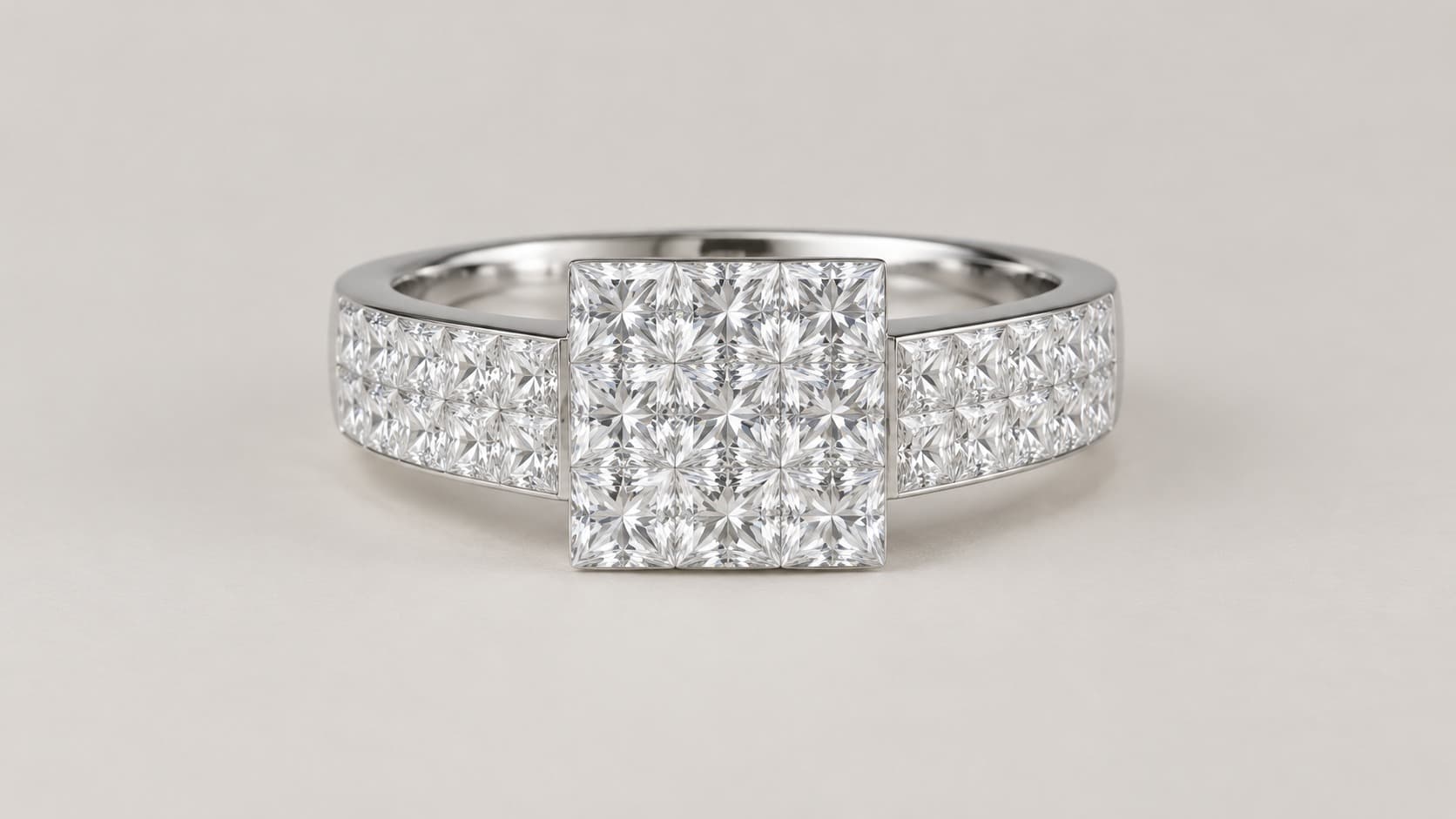
Invisible setting looks striking, but it is not the easiest style to live with day to day. Its advantages and drawbacks are closely tied to the same feature: the complete absence of visible metal.
The upside is purely visual and material. The technique produces a smooth, seamless wash of color with zero visible metal, giving the stones an almost liquid appearance. Because so few jewelers in the world can execute it, finished pieces carry real collectible value, and because every stone is custom-cut to one specific spot, the design can’t be replicated through mass manufacturing.
The downside is practical. Durability suffers for rough, everyday wear, since there are no raised prongs protecting the stone edges from impact. Resizing becomes difficult, since the rail framework is built to an exact shape and doesn’t stretch or shrink the way a simple band does. Repairs are neither cheap nor fast, since a damaged rail usually needs a specialist rather than a general jeweler.
A ring built with invisible setting behaves more like a single welded unit than a band with stones added on top, which is why stretching or shrinking its size at a jeweler’s bench is a far more delicate job than resizing an ordinary ring.
This combination is why invisible-set pieces are generally treated as special-occasion or heirloom jewelry rather than something worn to the gym or while doing yard work. The risk also isn’t the same across every type of jewelry. Rings take more daily impact than almost anything else worn on the body — they knock against doorframes, countertops, and steering wheels dozens of times a day — so invisible setting tends to hold up far better in earrings, pendants, and brooches, where the piece isn’t constantly bumping into hard surfaces.
True Invisible Setting vs. Imitations
A genuine invisible setting always has tiny grooves carved into the edges of each stone. A cheap imitation often just glues the stones together instead.
The term “invisible setting” gets used loosely outside of fine jewelry, especially in costume and fashion pieces, where designers borrowed the look without the underlying engineering. In those cases, stones are sometimes set into a channel and simply glued edge to edge rather than grooved and slid onto metal rails. From a short distance, a glued imitation can look convincing, since the main selling point of invisible setting — no visible metal — still holds true on the surface. But it isn’t built the same way, and it doesn’t hold up the same way either. Glue weakens over time, especially with exposure to heat, lotion, or perfume, while a true grooved rail system is a mechanical connection that doesn’t rely on an adhesive bond at all.
Jewelers selling the genuine technique can typically explain the grooved-and-rail construction without hesitation, since it is a specific, well-documented process. Vague answers about how a piece is held together, or a price that seems unusually low for the amount of gemstone coverage shown, are both signs that a piece may not be using the true technique.
How to Clean and Maintain Invisible-Set Jewelry
Invisible-set jewelry needs to stay away from hard knocks and ultrasonic cleaners, and any sign of looseness should go straight to a specialist rather than a general jeweler.
Ultrasonic cleaners are one of the biggest risks to this type of jewelry. These machines clean by vibrating rapidly, and that rapid shaking is exactly the kind of movement invisible setting can’t tolerate — a stone nudged even slightly out of its groove usually means a trip back to a specialist for re-setting, since there’s no prong to catch it in the meantime. A soft cloth and mild soap and water, applied gently with a soft brush, is a much safer way to clean the surface at home.
Invisible-set pieces hold up best when treated the way a fine watch is treated rather than a casual bracelet. Physical activity, cleaning with harsh chemicals, and sleeping while wearing the piece all put pressure and friction against hard surfaces, which is exactly what tends to loosen a stone over time. Any sign that a stone has shifted even slightly, or that the surface isn’t perfectly flush anymore, calls for a jeweler experienced specifically in invisible setting — not just any local jewelry repair shop, since the skill required to fix the rail system is specialized.
Invisible Setting vs. Other Popular Settings
Invisible setting stands apart from the settings found in most everyday jewelry, though a few share some of its logic.
| Setting Type | Is Metal Visible? | Durability | Typical Cost |
|---|---|---|---|
| Invisible (Mystery) Setting | No metal visible at all | Lower — no raised prongs for protection | Very high |
| Channel Setting | Thin metal borders top and bottom | Good — stones are protected on the sides | Moderate to high |
| Pavé Setting | Small visible beads of metal between stones | Moderate | Moderate |
| Prong Setting | Visible claws holding the stone | Good — classic, easy to repair | Low to moderate |
Channel setting is the closest cousin to invisible setting, and the two are sometimes confused. In a channel setting, individual stones sit lined up inside a narrow metal track, held by a continuous rim that runs along the top and bottom edges of the row rather than by individual claws or beads — which keeps metal from showing between the stones when the piece is viewed straight on. The difference from true invisible setting shows up at the outer edge of the row: a channel setting still leaves a thin strip of metal visible along that border, while invisible setting hides it completely, with no exposed metal anywhere on the piece.
Frequently Asked Questions
Is invisible setting the same thing as Mystery Setting?
Not exactly. “Invisible setting” is the general name for any technique that hides the metal rail system beneath the gemstones. “Mystery Setting,” or Serti Mystérieux, is the specific, trademarked version of this technique that belongs to Van Cleef & Arpels, so strictly speaking it should only describe that house’s pieces, even though the term often gets used more loosely in the trade.
Can any jeweler repair invisible-set jewelry?
Not usually. Because the hidden rail system is built to incredibly tight tolerances, repairing or resizing a piece requires a jeweler specifically trained in the technique. A general repair shop can accidentally damage the rails or lose a stone while working on a setting it isn’t familiar with.
Does invisible setting work with any gemstone?
In practice, it is almost always done with hard, durable stones like rubies, sapphires, and diamonds. Softer or more brittle stones are much more likely to crack or chip when a groove is carved into their edges, so jewelers rarely attempt invisible setting with delicate gem materials.
Why can’t invisible-set jewelry go in an ultrasonic cleaner?
The vibration from an ultrasonic cleaner can loosen the tiny connection between a gemstone’s groove and its metal rail. Because there are no prongs holding the stone as backup, even a small shift can cause a stone to fall out, making hand cleaning with a soft cloth the safer option.
Is invisible-set jewelry a good everyday choice?
Generally, no. Because there are no raised prongs to absorb bumps and knocks, invisible-set pieces are better suited to special occasions or careful, limited wear rather than daily use, where the risk of impact damage is much higher.
The Bottom Line
Invisible setting earns its reputation as one of jewelry’s most demanding techniques honestly: it takes a nearly-century-old idea, hundreds of hours of hand labor, and a tiny group of master craftspeople to pull off a look that hides all of its own engineering. That trade-off — extraordinary beauty in exchange for fragility, high cost, and specialist care — is exactly why these pieces are treated as heirlooms rather than daily wear. A piece built this way rewards careful handling and leaves the cleaning and repairs to someone who specializes in exactly this kind of setting.