Spiders make a lot of people jump, but on a ring or a pendant, that same little creature has meant something completely different for thousands of years. Long before spiders showed up on Halloween decorations, they were carved into royal Egyptian temples, woven into Native American origin stories, and worn by West African storytellers as a symbol of cleverness. A spider in jewelry isn’t really about fear at all — it’s about creation, patience, and the quiet kind of power that comes from building something intricate one thread at a time.
What Does a Spider Symbolize in Jewelry?
A spider in jewelry most commonly symbolizes creativity, patience, and fate — the idea of someone quietly weaving their own future one careful step at a time. It also stands for wisdom and cleverness in several cultures, and in gothic or alternative styles, it can lean into darker themes like mystery and mortality.
The reason a small eight-legged bug carries so much weight comes down to what it actually does. A spider doesn’t hunt by chasing anything down. It builds a structure, waits, and lets patience do the work. That behavior became a powerful metaphor almost everywhere spiders and humans crossed paths, which is part of why the symbol shows up in so many unrelated cultures without any of them copying from each other.
The exact meaning does shift depending on where the design comes from and how it’s styled. A spider inspired by Egyptian mythology carries a different weight than one styled after a British folk superstition, and a blackened gothic spider ring reads differently again. The next section breaks down what the symbol means culture by culture.
What Spiders Symbolize in Different Cultures
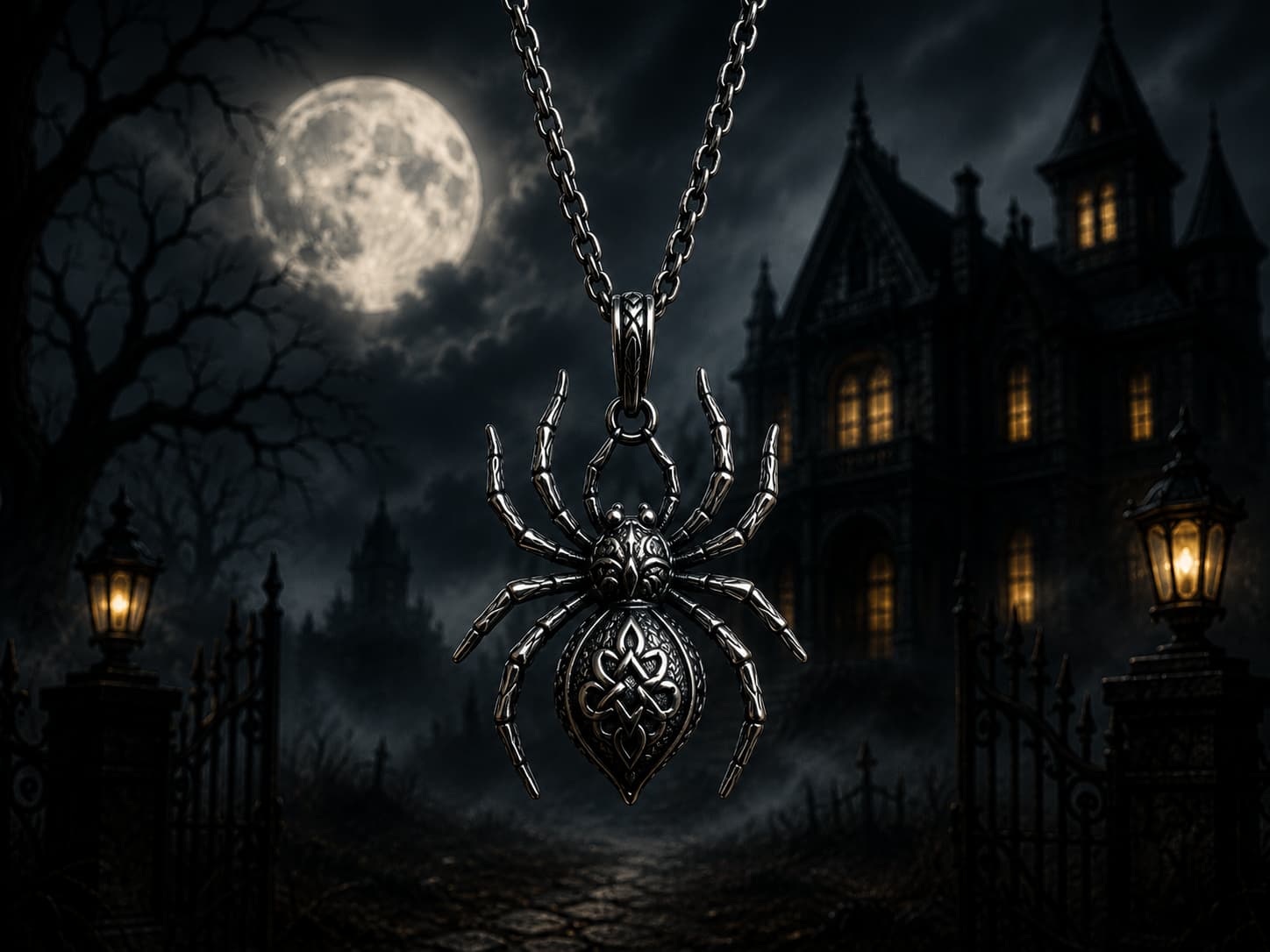
The spider shows up independently in the mythology and folklore of civilizations that never had contact with one another, which is part of what makes the symbol so interesting. Egypt, several Native American nations, West Africa, Greece, and China all developed their own spider traditions, and while the details differ, most of them circle back to the same core ideas: creation, wisdom, and fate.
Spider Meaning in Ancient Egypt
In ancient Egypt, the spider was tied to the goddess Neith, who was believed to have woven the universe itself into existence. Because of this, spiders in Egyptian belief carried associations with creation, fertility, and renewal rather than anything sinister.
Neith was one of the oldest deities in the Egyptian pantheon, worshipped as a creator goddess credited with weaving the universe into being. Since her role echoed the same act a spider performs when it builds a web, the two became linked in Egyptian religious symbolism. This is one of the earliest known examples of a culture treating the spider as a builder of order rather than a creature to fear.
Spider Meaning in Native American Culture
Across many Native American nations, the spider is honored as a wise and protective figure, most famously through Spider Grandmother or Spider Woman, a teacher who gave humans knowledge and the gift of weaving.
Among the Hopi, the Spider Grandmother is described as a powerful being who helped shape the world and taught balance between all living things. The Navajo tell a similar story about Spider Woman, who is credited with teaching people the art of weaving and is remembered as a guide and protector. Because of these stories, the spider in many Native American design traditions represents wisdom, creativity, and the deep connections between people, nature, and the spirit world — a meaning also echoed in the web-like design of the dreamcatcher.
Spider Meaning in West African Folklore
In West African, and later Caribbean, storytelling traditions, the spider is best known as Anansi — a trickster character famous for using intelligence rather than strength to outsmart bigger, more powerful rivals.
Anansi comes from Akan religion and folklore, where the character is associated with stories, wisdom, knowledge, wit, mischief, and trickery, almost always depicted as a spider. The Akan people of present-day Ghana used these stories to pass down lessons about cleverness winning out over brute force, and the tales traveled across the Atlantic with enslaved West Africans, keeping Anansi alive in Caribbean and African American storytelling for centuries. In jewelry, a spider inspired by Anansi leans into themes of intelligence, resourcefulness, and quiet resilience rather than anything frightening.
Spider Meaning in Greek Mythology
In Greek mythology, the spider comes from the tragic story of Arachne, a mortal weaver so talented that she dared to challenge the goddess Athena to a weaving contest, and was ultimately transformed into a spider as punishment.
Different versions of the myth disagree on the exact details, but the outcome is the same: Arachne’s incredible skill offends Athena, and she ends up spending eternity spinning thread as the very first spider. This is where the word “arachnid” actually comes from. In jewelry, this story gives the spider a meaning tied to talent, ambition, and the fine line between confidence and pride — a much more human, cautionary symbol than the fearsome creature people often assume it represents.
Spider Meaning in Chinese Culture
In Chinese folklore, a spider lowering itself down from above is considered a genuinely good sign, tied to a wordplay where the old term for spider sounds like the word for happiness or good fortune.
The positive meaning comes specifically from watching a spider descend from a high point on a thread of web, an image described in Chinese folklore as good luck or happiness falling from the sky. This isn’t just superstition without explanation — it comes from language itself, since the older name for spider sounds almost identical to a word meaning good fortune. A spider motif inspired by this tradition is meant to welcome good news, unlike the more ominous reading spiders sometimes get in Western pop culture.
Spider Jewelry in the Victorian Era
Spider jewelry had a real moment in Victorian England, when insect-themed pieces — including beetles, dragonflies, and spiders — became a genuine fashion trend rather than a niche or spooky choice. Jewelry modeled after these creatures was genuinely common, and some Victorian women even went as far as wearing live insects, sometimes decorated with small diamonds, on strings attached to their brooches.
Part of the reason spiders specifically caught on ties back to an old British folk belief that a spider landing on a person’s clothing meant money was on its way. Written references to this “money spider” superstition go back centuries, with old sayings describing a spider found on a person’s clothes as a sign of good fortune, and small spiders were commonly nicknamed “money spiders” for exactly this reason. Wearing a spider, in that light, wasn’t just decorative — it echoed a belief people already carried around with them in everyday life.
The Victorians were also fascinated by the natural world in general, and insects with intricate, symmetrical bodies fit right into the era’s love of detailed, nature-inspired design. Spider brooches from this period were prized for their craftsmanship, often rendered in gold, seed pearls, and gemstone accents to mimic the delicate look of a real web, with the level of detail treated as a mark of the jeweler’s skill.
The design has stayed relevant well past the Victorian period. In 2019, a British Supreme Court justice wore a large spider brooch while delivering the ruling that the prorogation of parliament was unlawful, and the piece briefly became a talking point of its own — a reminder that the symbol has always carried an undertone of quiet, patient authority.
Spider Jewelry in Gothic Style
In modern and gothic fashion, spider jewelry usually leans into a different mood than its historical meanings — focusing on mystery, edge, and a nod to darker romantic aesthetics rather than luck or creation myths.
This doesn’t cancel out the older symbolism; it just adds a layer on top of it. A silver spider ring can simultaneously reference the ancient idea of a weaver of fate while also just looking striking and a little dramatic, which is part of why the design has stayed popular in alternative and gothic jewelry for decades. Many wearers enjoy that double meaning — something with real depth underneath a design that also just looks bold.
Darker metals tend to define this style more than any single piece type. Oxidized silver and blackened finishes bring out the fine detail of a web or a spider’s legs far better than a bright polish does, which is why gothic spider jewelry rarely appears in high-shine gold.
Common Spider Jewelry Styles
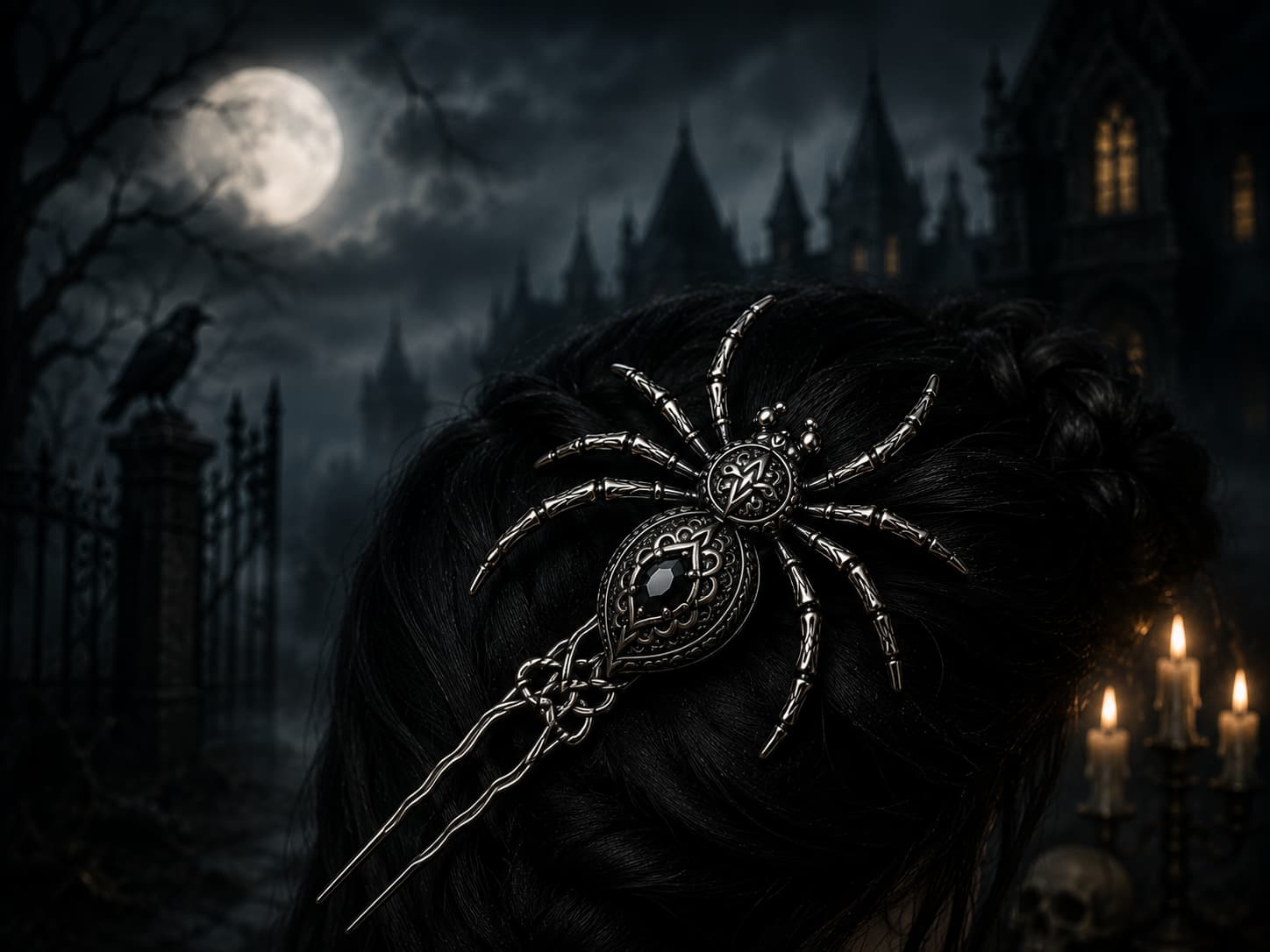
Not every piece of jewelry can carry a spider design equally well. A spider needs enough surface area to show its legs, body, and sometimes a web underneath it, so the format matters just as much as the metal or finish. That’s why certain types of jewelry have become the go-to choices for this style, while others are used mostly for smaller, simplified versions of the motif.
-
Rings: The most common format for gothic spider jewelry, since a raised, three-dimensional spider sits naturally across the band or as a larger centerpiece on top. Rings also give a designer the most room to work with, which is why the most detailed spider figures — full bodies, bent legs, sometimes even tiny gemstone eyes — usually turn up here rather than on smaller pieces.
-
Brooches and pins: A direct callback to the original Victorian insect-jewelry trend, brooches remain one of the most traditional homes for a spider design. Because a brooch is pinned rather than worn against the skin, it can support a larger, heavier piece than a ring or earring could comfortably hold, which is why antique and vintage-style spider brooches tend to be the most elaborate pieces in the category.
-
Pendants and necklaces: These usually take one of two approaches: a web design worn on its own as a symbol of structure and protection, or a smaller spider set to look like it’s suspended mid-drop on its own thread. The second version leans directly into the “spider descending” imagery found in several cultures, including the Chinese good-luck tradition, making it one of the more symbolically loaded choices even though the design itself is simple.
-
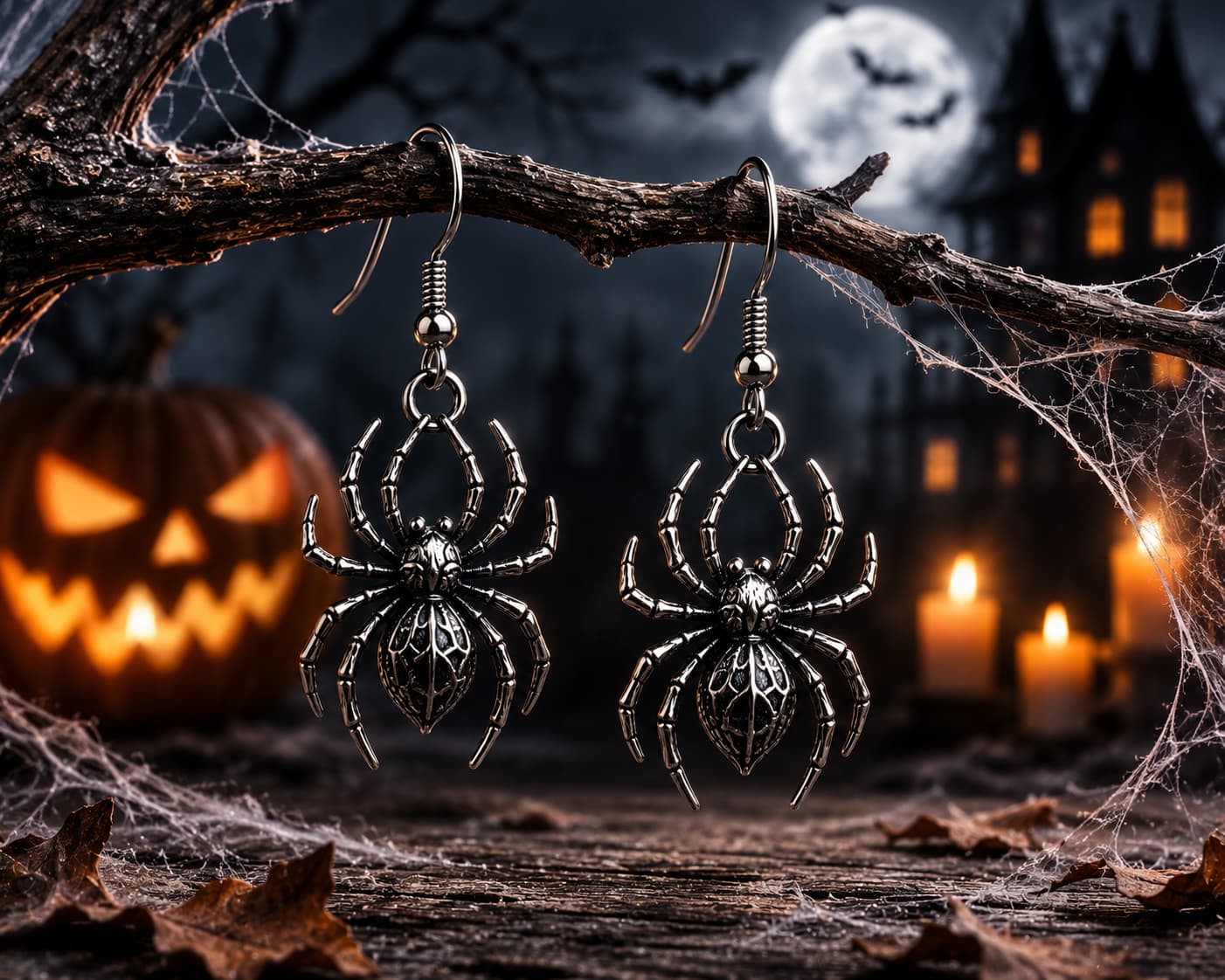
Earrings: Generally the smallest and simplest expression of the motif, since a full detailed spider rarely reads clearly at earring scale. Most gothic spider earrings favor a flat web outline, a single small spider silhouette, or a stud shaped like just the body, saving the more intricate leg-and-body detail for larger pieces like rings and brooches.
Frequently Asked Questions
Is spider jewelry only for Halloween?
No. While spiders are strongly associated with Halloween in Western pop culture, their meaning in jewelry goes back thousands of years and has nothing to do with the holiday. Historically, spider designs have represented creation, wisdom, and good fortune far more often than fear.
What does it mean to wear a spider necklace or ring?
It generally signals an appreciation for patience, creativity, and resilience, since the spider is best known for building something intricate and waiting rather than rushing. Depending on the design and the wearer’s own connection to it, it can also reference specific traditions like Anansi’s cleverness or the Chinese belief in a spider bringing good news.
Are spiders considered good luck or bad luck?
Both, depending on the culture. In Chinese folklore, English “money spider” superstition, and several Native American traditions, spiders are viewed as a positive or protective sign. In parts of Western folklore, spiders picked up a more negative reputation over time, largely tied to fear of the animal itself rather than any consistent old symbolism.
What’s the difference between a spider and a web symbol in jewelry?
A full spider design usually emphasizes the creature itself — its cleverness, patience, and creative power. A web-only design tends to focus more on the ideas of connection, structure, and protection, since a web represents something carefully built to hold everything together.
Is spider jewelry appropriate for everyday wear?
Yes. Smaller, simpler spider or web designs in silver or gold read as understated rather than costume-like, and work well as everyday pieces. Larger, more elaborate spider figures tend to be statement pieces better suited to occasions calling for a bolder look.
Conclusion
Spider symbolism turns out to be one of the more misunderstood stories in jewelry, since the fear most people associate with the animal itself rarely matches what the symbol has actually meant across history. From Neith weaving the Egyptian universe to Spider Grandmother teaching Native American communities the art of weaving, from Anansi’s cleverness in West African storytelling to the good-luck spider descending in Chinese folklore, the common thread — pun intended — is patience, creativity, and quiet strength. From a Victorian-style brooch to a modern gothic ring, wearing a spider connects the wearer to one of the oldest and most consistent symbols of building something meaningful, one careful thread at a time.