Swatch turned watches into something fun instead of something serious. For decades, buying a watch meant saving up for a heavy metal timepiece that lasted a lifetime. Swatch flipped that idea on its head with cheap, colorful, plastic watches that people could swap out like a pair of socks. That playful spirit never went away, and today the brand makes everything from three-dollar-feeling quartz pieces to genuine Swiss automatics, including collaborations with sister brands Omega and Blancpain that put a slice of real watchmaking history within reach of almost any budget.
How Swatch Watches Began in 1983
Swatch exists because Swiss watchmaking was in trouble. In the 1970s, cheap and accurate quartz watches from Japan and the United States were crushing Swiss brands, an event now known as the quartz crisis. Two of Switzerland’s biggest watch groups, ASUAG and SSIH, were losing money fast, and thousands of watchmaking jobs across the country were already gone.
A small team led by engineers Elmar Mock and Jacques Müller, working under Ernst Thomke at the movement-maker ETA, came up with a fix. Instead of the usual 91 parts inside a watch, they built one with only 51. Fewer parts meant the case and movement could be built as one sealed unit, which made the watch cheap to produce and impossible to repair, so it was treated as disposable. The name Swatch came from that idea: a contraction of “second watch,” marketed as a casual, almost throwaway accessory.
The first 12 Swatch models hit stores on March 1, 1983, priced around 39.90 to 49.90 Swiss francs each, cheap enough that people bought several and treated them like fashion accessories instead of investments. The gamble worked so well that one of those original 1983 designs now sits in the permanent collection of the Museum of Modern Art in New York, treated as a piece of industrial design rather than just a watch. That success helped fund the merger of ASUAG and SSIH that same year, which eventually became the Swatch Group, now the world’s largest watchmaker and the owner of Omega, Longines, Tissot, Blancpain, and several other brands.
The Bioceramic MoonSwatch Is Swatch’s Biggest Hit Ever
The MoonSwatch is a $260-to-$325 take on one of the most famous watches ever made, the Omega Speedmaster. Swatch and Omega, both part of the same parent company, teamed up to release 11 versions in March 2022, each one named after a planet or another body in our solar system.
The MoonSwatch broke the internet the day it launched, with lines wrapping around city blocks outside Swatch stores worldwide.
The case is made from Bioceramic, a material developed and patented by Swatch that mixes ceramic with a bio-based plastic derived from castor oil. It feels tougher and more premium than a normal plastic Swatch while staying light on the wrist. Every model runs on a simple battery-powered quartz movement, so there’s no winding involved, and demand has stayed strong for years: more than a million MoonSwatch units have sold since launch.
The collection has kept growing since 2022. Newer releases include chronographs with a moon phase function and a version featuring an earth phase display, a first for the watch industry, plus special editions tied to Snoopy’s long history with NASA space missions. They can only be bought in person at select Swatch boutiques, and stores generally limit purchases to one watch per person, per day, which is why resale prices online often run higher than retail.
The Scuba Fifty Fathoms Brings a Real Dive Watch Down in Price
This is Swatch’s second big collaboration, this time with sister brand Blancpain. Released on September 9, 2023, it celebrates the 70th anniversary of Blancpain’s Fifty Fathoms, one of the first true dive watches ever made. Five colors represent five oceans, each with a matching Bioceramic case around 42.3mm wide and roughly 91 meters of water resistance.
What makes this one special is the movement inside. Instead of a quartz battery, it runs on Swatch’s own Sistem51 automatic movement, a nod to Blancpain’s motto that it has never made a quartz watch since 1735. That means it winds itself through ordinary wrist movement, and it holds a 90-hour power reserve, which is unusually long. Each movement is even decorated with a different sea slug native to that watch’s ocean, and the Antarctic Ocean version includes a small window that changes color if water gets inside the case, a genuine safety feature Blancpain has used on real Fifty Fathoms watches since 1954.
The strap is a NATO-style band made from recycled fishing nets, matched with Bioceramic hardware. Retail price sat around $400 at launch, which is remarkable for a watch with a real automatic movement and a design tied to genuine diving heritage. Like the MoonSwatch, it’s sold only in physical Swatch stores.
How the Sistem51 Made Automatic Watches Affordable
Before the MoonSwatch existed, the Sistem51 was Swatch’s biggest engineering flex. Announced at Baselworld in 2013, it was the first mechanical watch movement ever assembled entirely by machines, with no human hands involved. It has exactly 51 components, built around a single central screw, and a 90-hour power reserve.
That number matters because most mechanical watches need at least twice as many parts, and some use more than 600. Fewer parts made it cheap to build, which is why it launched priced between 100 and 200 Swiss francs, barely more than a normal quartz Swatch. The original dial designs even leaned into the theme, showing a pattern of dots styled like a star map, with 19 of those dots representing the 19 jewels inside the movement. The movement itself is made from ARCAP, a copper-nickel-zinc alloy chosen for its strong resistance to magnetism, and the rotor can be seen spinning through a clear caseback.
For anyone looking to own a true self-winding Swiss watch without spending thousands, the Sistem51 remains one of the few honest ways to do it.
Swatch’s Everyday Watches: New Gent and Gent Bioceramic
Not every Swatch needs a celebrity collaboration to be worth wearing. The New Gent line is the brand’s bread-and-butter collection, and the Bioceramic version, first introduced in 2021, updates it with the same eco-friendly material used in the MoonSwatch. The material blends ceramic powder with bio-sourced plastic, giving the watch a smoother, lighter feel on the wrist compared to older plastic Swatches.
Sizing runs simple: New Gent Bioceramic models measure 41mm, while the smaller Gent Bioceramic sits at 34mm, giving a choice between a bigger or smaller watch face. Prices for these everyday pieces tend to land in the $65 to $100 range, depending on the design and market.
These are the watches people mean when they call a Swatch a fun, easygoing piece nobody stresses over. A scratch, a lost watch, or one handed down to a kid rarely draws much complaint, unlike a watch that costs thousands.
Swatch Essentials Is the Catalog Most People Actually Buy From
While New Gent sticks to one classic shape, Swatch Essentials is the opposite: a constantly rotating catalog of well over 100 designs at any given time, covering plain basics, patterned dials, and a handful of automatics, all sized and priced to work as a first or only watch. Swatch markets the line as pieces that can move from a casual outfit to a formal one without feeling out of place, which is why it’s the collection most people land in when they walk into a Swatch store without a specific model in mind.
Prices generally run from about $75 for the simplest solid-color designs up to $300 or more for the automatic and reflective-dial pieces near the top of the range. Because the lineup changes constantly, with older designs retiring and new ones added every few months, exact colorways come and go, but the pricing structure and the “goes with everything” positioning stay consistent.
1984 Reloaded Brings Back Swatch’s Own History
Swatch has been around long enough to raid its own archives, and the 1984 Reloaded collection does exactly that. It reissues five designs from 1984, Swatch’s second full year in business, remade in modern Bioceramic instead of the original plastic, and split across the same two case sizes as the New Gent and Gent lines.
This matters because it shows Swatch treating its own back catalog the way sneaker brands treat old shoe designs: something worth bringing back, not something to be embarrassed about. It’s a collection built for anyone drawn to the retro shapes and colors of the brand’s early days.
How Much Does a Swatch Watch Cost?
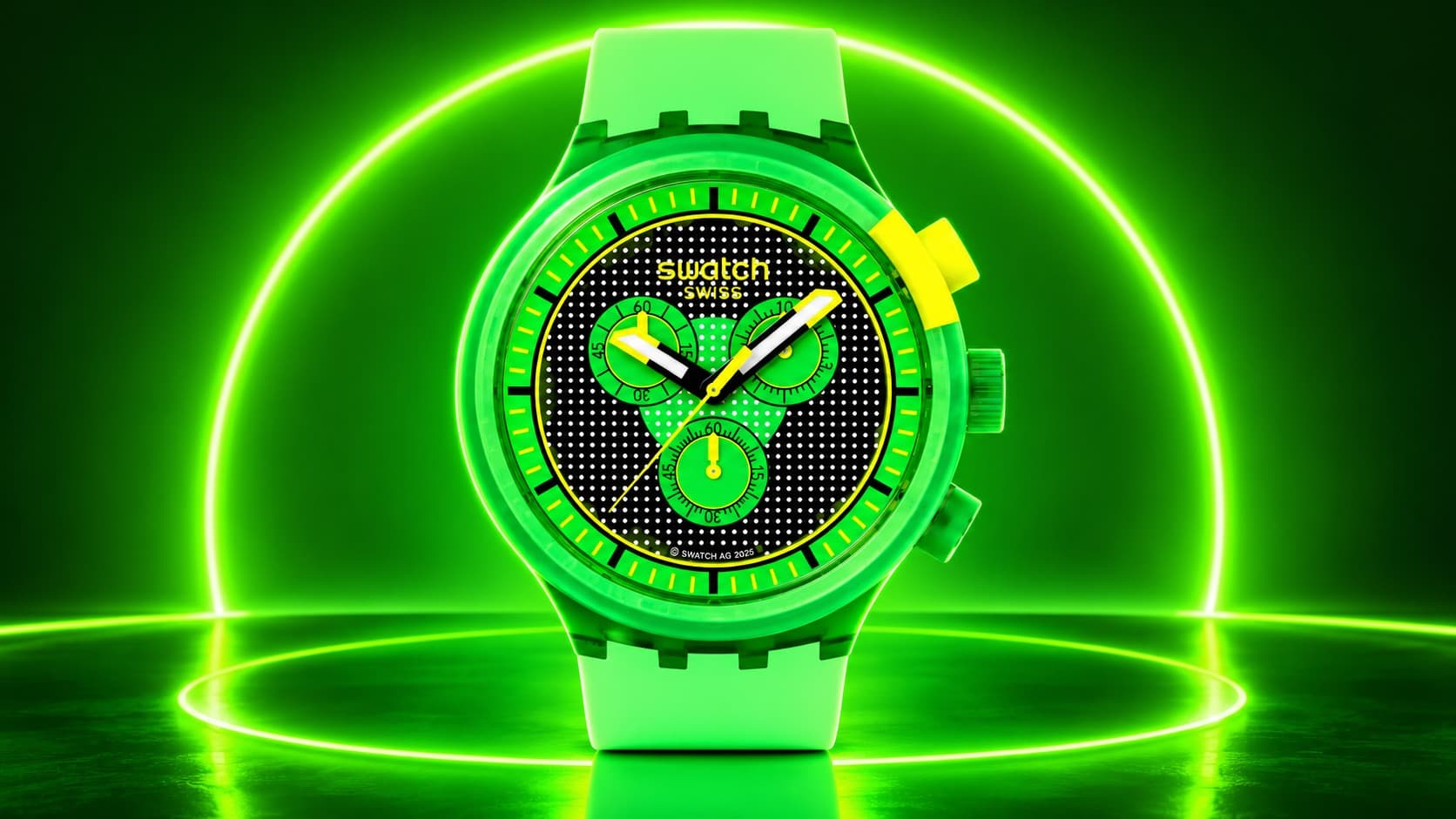
Most Swatch watches cost between $50 and $650, depending on the collection:
| Collection | Typical Price | Movement |
|---|---|---|
| New Gent / Gent Bioceramic | $65–$100 | Quartz |
| Swatch Essentials | $95–$320 | Quartz |
| Bioceramic MoonSwatch | $260–$325 | Quartz |
| Sistem51 automatic | $150–$335 | Automatic |
| Scuba Fifty Fathoms | ~$400 | Automatic |
Quartz models, the ones that run on a battery, are almost always the cheapest option. Automatic models cost more because the movement itself is more complex, even at Swatch’s simplified 51-part design.
Why Swatch Watches Stand Out From Other Brands
Swatch treats a watch like a fashion statement, not a lifetime purchase. Most traditional watch brands sell one watch meant to be kept forever. Swatch instead makes hundreds of designs a year and expects people to own several, swapping them the way someone might swap out a shirt.
That mindset comes straight from the brand’s founding, and it shows up clearly in its long history of working with artists. Back in 1986, pop artist Keith Haring designed a set of four limited-edition Swatch watches, turning the watch face into what Swatch later called “the world’s smallest canvas.” Those original Haring pieces are now considered rare collector’s items, and Swatch has revisited the partnership with his estate more than once since, most recently on a Mickey Mouse collection. Every collection since, from the plain New Gent line to the MoonSwatch, keeps that same idea alive: a watch can be playful, easygoing, and still well made.
Frequently Asked Questions
Are Swatch watches good quality?
Yes, for what they’re built to be. Quartz Swatch watches use reliable, accurate movements and are made to survive everyday bumps, splashes, and drops. They aren’t built to be repaired for decades like a mechanical luxury watch, but they hold up well for regular daily wear.
Is Swatch owned by a bigger company?
Swatch is part of the Swatch Group, the largest watchmaking company in the world, which also owns Omega, Longines, Tissot, Blancpain, and several other watch brands. That’s exactly why Swatch has been able to team up with Omega and Blancpain on affordable versions of their famous watches.
Do all Swatch watches run on batteries?
No. Most Swatch watches use quartz movements that need a battery, but the Sistem51 line and the Scuba Fifty Fathoms use Swatch’s own automatic movement, which winds itself from the motion of your wrist and never needs a battery.
Is the MoonSwatch a real Omega?
No. The MoonSwatch is made by Swatch, not Omega, and uses Swatch’s own quartz movement and Bioceramic case rather than Omega’s mechanical Speedmaster movement and steel case. It borrows the Speedmaster’s look and name recognition, but it is its own product at a much lower price.
What exactly is Bioceramic material?
Bioceramic is a case material Swatch developed and patented itself, made from roughly two-thirds ceramic and one-third bio-sourced plastic derived from castor oil. It’s used across newer collections, including the MoonSwatch, the Scuba Fifty Fathoms, and the updated New Gent line, because it feels smoother and more durable than older plastic Swatch cases while still being lightweight.
Can a Swatch watch handle swimming or showers?
It depends on the model. Many Swatch watches, including most MoonSwatch models, only carry light water resistance meant for splashes and rain, not swimming. The water resistance rating printed on the specific watch is the most reliable way to check, since this varies by collection.
The Bottom Line
Swatch built its entire identity on making watches that don’t take themselves too seriously, and that’s still true more than 40 years later. The New Gent and Essentials lines cover the fun, affordable everyday option for under $100. The Sistem51 delivers a slice of horological history at a friendly price, packing a real Swiss automatic movement into a watch that costs less than $200. And the Bioceramic MoonSwatch remains the collection most people are still talking about, the easiest way to own a piece of Speedmaster design without the Speedmaster price tag.