Most people go through life with one prescription for their eyes, but as we get older, many of us end up needing two: one for things far away, like a road sign, and one for things up close, like a menu or a phone screen. A bifocal lens solves that problem by fitting both prescriptions into a single piece of glass or plastic, so the wearer doesn’t have to carry around two separate pairs of glasses and keep swapping between them. It’s one of the oldest tricks in eyewear history, and it’s still used by millions of people today, even with newer lens technology on the market.
What Is a Bifocal Lens?
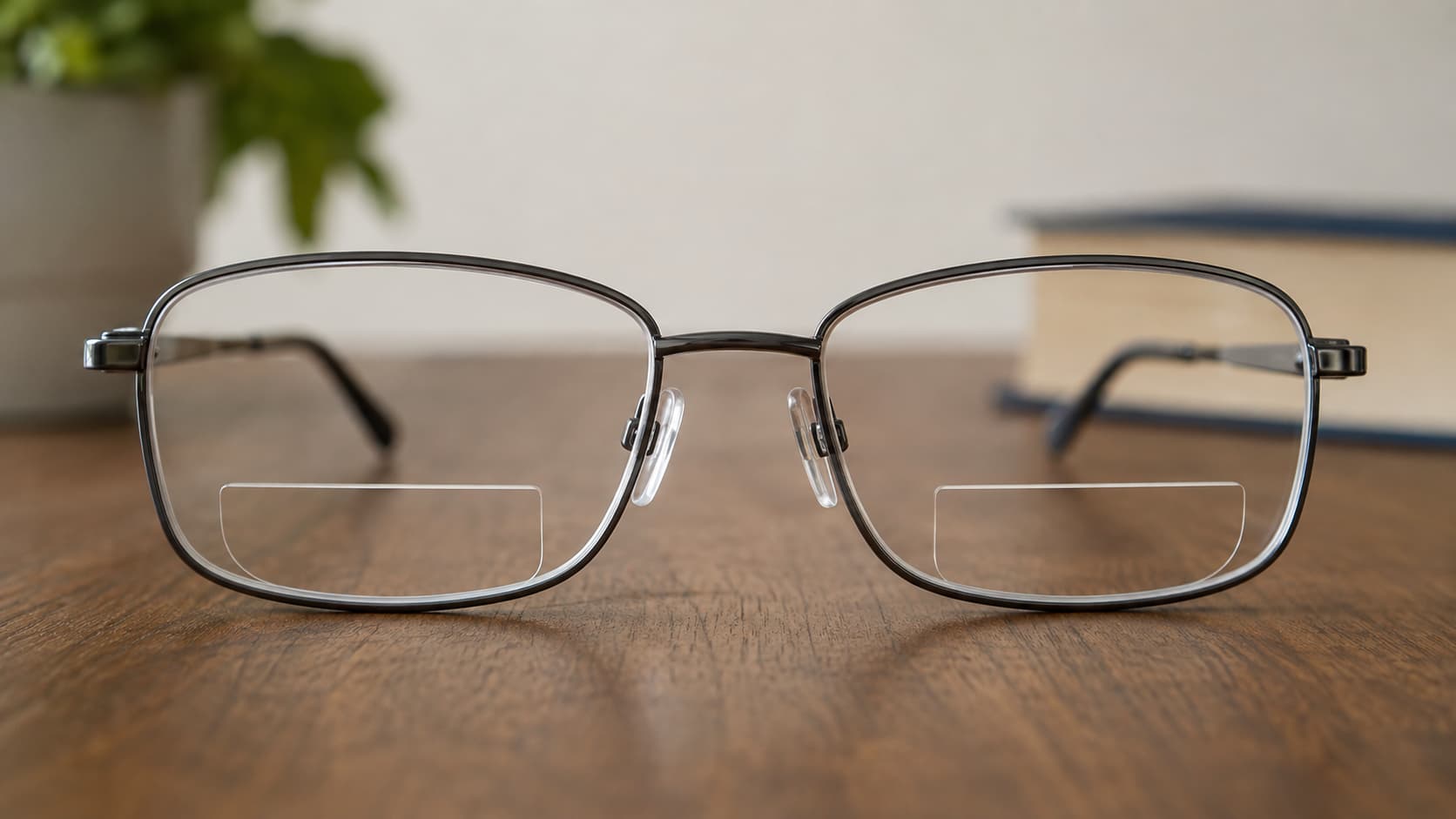
A bifocal lens is a single eyeglass lens that has two different focusing powers built into it, one for distance vision and one for close-up vision. The upper part of the lens is usually set for seeing things far away, while a smaller section near the bottom is set for reading, sewing, or anything else held close to the face.
This design exists because of a condition called presbyopia, which is the gradual loss of the eye’s ability to focus on nearby objects. Presbyopia almost always shows up with age, typically becoming noticeable somewhere in a person’s 40s, and it happens because the lens inside the eye stiffens over time and can’t change shape as easily anymore. Someone with presbyopia who also needs correction for nearsightedness or farsightedness can end up needing two different prescriptions just to function normally throughout the day, which is exactly the gap bifocals were built to close.
Early Signs of Needing Bifocal Lenses
The clearest early sign is holding books, menus, or a phone farther away than usual, just to bring the text into focus. That single habit is one of the most common tells that near vision is starting to slip, even while distance vision stays perfectly sharp.
A few other signs tend to show up around the same time: eye strain or a dull headache after reading or close-up work, needing brighter light to read comfortably, and blurry text at a normal reading distance that clears up the moment the material is moved farther away. These symptoms often get worse when tired or in dim lighting, which is why people sometimes notice them first at the end of a long workday.
None of these signs on their own confirm that bifocals specifically are the answer — an eye doctor still needs to check whether the issue is presbyopia, a separate refractive error, or something else entirely. But if someone already wears glasses for distance and starts noticing these patterns, it’s a reasonable signal that it’s worth booking an eye exam sooner rather than later.
How Does a Bifocal Lens Work?
A bifocal works by physically dividing the lens into two zones with different curvatures, so light bends differently depending on which part of the lens the eye is looking through. Looking through the top of the lens engages the distance prescription; dropping the eyes to look through the bottom segment switches to the reading prescription.
The line where the two zones meet is usually visible, often called the segment line or “seg line.” It sits at the bottom third of the lens and shows up as a small ridge or curve when the glasses are viewed from the side. The wearer doesn’t have to think about switching zones consciously — the eyes naturally drop down and slightly inward when focusing on something close, like a book on a table, and that motion lines the eyes up with the reading segment automatically.
The strength difference between the two zones is called the “add power,” and it shows up on a prescription simply as “ADD.” It’s the extra magnifying strength layered onto the distance prescription to make the lower segment work for close-up tasks, and it’s almost always written as a plus number, typically somewhere between +0.75 and +3.00. A higher add power generally means more advanced presbyopia, and it’s also why someone’s reading segment tends to get stronger every few years as they get older, even if their distance prescription barely changes.
Who Invented Bifocal Lenses?
Bifocal lenses are widely credited to Benjamin Franklin, who described the design in a 1784 letter, though the full history is a bit murkier than the popular story suggests. Franklin dealt with both nearsightedness and the reading difficulty that comes with age, and he grew tired of constantly switching between two separate pairs of glasses.
His solution, according to letters he wrote later in life, was straightforward: he had the lenses of his two pairs of spectacles cut in half and combined into a single frame, with one prescription on top and the other on the bottom. He mentioned in a letter to a friend that the design came in handy at the dinner table in France, letting him see his food and read the faces of the people talking to him at the same time, without swapping glasses back and forth. Notably, Franklin never patented the idea, or any of his other inventions, on the belief that useful discoveries should be shared freely rather than owned — bifocals actually went unpatented by anyone until 1836, decades after his death.
That said, historians have found evidence that split lenses of a similar kind may have existed even earlier, made by other opticians in London decades before Franklin’s letters describe his own version. Franklin was likely one of the first people to actually wear split bifocals regularly, and that habit is probably what tied his name to the invention so strongly. Either way, the basic idea he popularized barely changed for close to two centuries afterward.
Comparing Bifocals, Trifocals, and Progressive Lenses
These three lens types all exist to solve the same basic problem — needing more than one prescription in a single lens — but they go about it in different ways.
| Lens Type | Focusing Zones | Visible Line? | Best For |
|---|---|---|---|
| Bifocal | 2 (distance + near) | Yes | Simple far/near needs, no mid-range work |
| Trifocal | 3 (distance + intermediate + near) | Yes, two lines | Computer users who also need distance and reading correction |
| Progressive | Gradual, blended zones | No | People who want a smooth, natural-looking lens with no visible lines |
Trifocals
Trifocals add a third zone in between the distance and reading sections, meant for things at arm’s length, like a computer monitor or a car’s dashboard. They were developed after bifocals because a lot of wearers found there was an uncomfortable gap: things that were too close for the distance zone but too far for the reading zone came out blurry.
The trifocal was developed in 1827 by John Isaac Hawkins, a British-American inventor, roughly four decades after Franklin’s original bifocal design. Interestingly, Hawkins is also the person credited with coining the actual word “bifocal” and applying it to Franklin’s invention, years after Franklin himself was gone. Trifocals tend to be reserved for people with more advanced presbyopia, generally once the reading add power reaches around +2.00 or higher, since that’s the point where a middle zone starts making a noticeable difference.
Progressive Lenses
Progressive lenses do the same job as bifocals and trifocals, but instead of clear dividing lines, the prescription changes gradually from top to bottom. This means there’s no visible line on the lens, which many people prefer for how it looks. The trade-off is that progressive lenses have narrower usable zones off to the sides, so some wearers need a short adjustment period to get used to turning their head rather than just shifting their eyes.
The modern progressive lens dates back to 1959, when French engineer Bernard Maitenaz introduced the first commercially successful version after years of research. His motivation was fittingly personal: he disliked how abruptly the vision shifted in his own father’s bifocals and set out to design something smoother. That original lens laid the groundwork for the progressive designs opticians still fit today, even as the underlying optics have been refined considerably since.
Common Bifocal Lens Designs
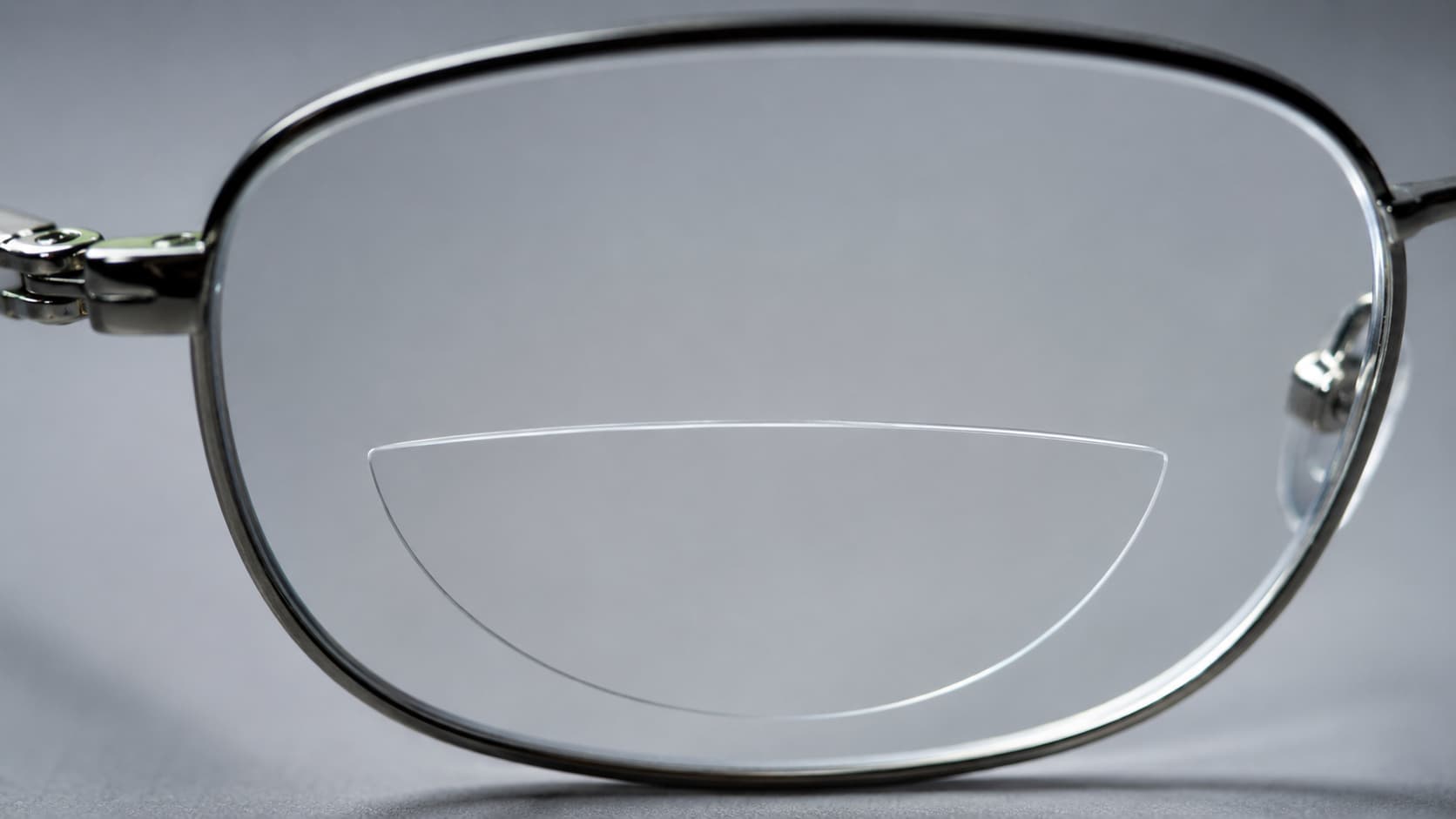
Not every bifocal looks the same. Opticians generally group them into a few common designs based on the shape of the reading segment.
- Flat-top (D-segment) bifocals – The reading section is shaped like a flat-topped half-moon or a “D” turned sideways, and it’s the most common style prescribed today because it offers a wide reading area with minimal visual distortion.
- Round-segment bifocals – The reading area is a small circle set into the lower part of the lens. This was closer to the original design style but has become less common.
- Executive (full-width) bifocals – The reading segment stretches across the entire width of the lens, giving the widest possible reading area. This style is sometimes called the “Franklin bifocal” since it most closely resembles his original split-lens design.
Of these, the flat-top style has become the industry default, and it’s commonly made in a 28-millimeter-wide segment, which strikes a balance between a generous reading area and a lens that still looks reasonably normal. Round segments and full-width executive lenses are still available, but they’ve become more of a specialty order these days rather than the standard option handed out at most eye exams.
Who Needs Bifocal Lenses?
Bifocal lenses are typically prescribed to people who have presbyopia along with an existing prescription for distance vision, most commonly adults over the age of 40. Someone who already wears glasses for nearsightedness or farsightedness is often the first to notice the added strain of presbyopia, since they’re already relying on their glasses throughout the day.
It’s worth noting that not everyone with presbyopia needs bifocals specifically. Someone who has perfect distance vision but struggles only with reading can often get by with simple reading glasses instead, since they don’t need a separate distance correction at all. Bifocals become useful specifically when both problems exist together.
Adults with presbyopia aren’t the only ones who end up wearing bifocals, either. Some young children are prescribed them for a completely different reason: a condition called accommodative esotropia, where the effort of focusing up close causes the eyes to cross inward. Rather than correcting blur, the stronger lower segment in a child’s bifocal reduces how hard their eyes have to work to focus on nearby objects, which in turn helps keep the eyes aligned during reading and other close tasks. It’s a good reminder that bifocals aren’t purely an “aging” lens — they’re really just a tool for managing two different focusing demands at once, whatever the underlying cause.
Getting Used to Wearing Bifocals
New bifocal wearers usually need a short adjustment period, often somewhere between a few days and a couple of weeks, before the lenses feel natural. During this time, it’s common to feel a little dizzy or to misjudge distances, especially on stairs, since the brain is learning to associate eye position with the right focusing zone.
Part of that adjustment comes from a specific effect called “image jump.” Because the reading segment is a separate zone with its own focusing power, the exact instant the eye crosses the seg line, whatever it’s looking at appears to hop slightly, rather than sliding smoothly into focus. It sounds alarming described that way, but in practice it’s a brief, subtle flicker that the brain quickly learns to ignore. Flat-top segments are designed to keep this effect to a minimum, which is part of why that style has become the standard choice — it’s not just about looks.
Adjustment tends to go faster with a few consistent habits. Moving the eyes rather than the head when shifting between distance and reading speeds up the process, and extra caution on stairs and curbs during the first week matters, since the lower part of the lens isn’t meant for looking down at the ground while walking. Wearing the glasses consistently, rather than switching back and forth with an old pair, also helps the brain adapt faster.
Can Sunglasses Have Bifocals?
Bifocal designs aren’t limited to everyday prescription glasses. Bifocal sunglasses exist for people who need both types of correction outdoors, whether that’s reading a menu at an outdoor café or checking a phone while at the beach, without having to carry a separate pair of readers along with their sunglasses. The same segment styles used in clear lenses — flat-top, round, or executive — are available in tinted or polarized versions as well.
The choice between a tinted lens and a polarized one matters more outdoors than it does indoors. A basic tint simply darkens the whole lens evenly, while a polarized lens filters out the specific type of glare that bounces off flat, reflective surfaces like water, pavement, and car hoods. For anyone who spends time driving, fishing, or generally out in bright conditions, polarization on top of a bifocal or reading segment tends to make a noticeable difference in comfort, on top of whatever near/far correction the lens is already providing.
Frequently Asked Questions
Is it easy to tell if someone is wearing bifocals?
Usually, yes. Most bifocal lenses have a visible line or curved edge near the bottom of the lens where the two prescriptions meet, which is one of the easiest ways to tell them apart from single-vision or progressive lenses.
Do bifocals take long to get used to?
Most people adjust within a few days to two weeks. The main challenges early on are usually judging distances on stairs and remembering to move the eyes rather than the whole head when switching focus.
What’s the difference between bifocals and reading glasses?
Reading glasses have a single prescription across the whole lens and are meant only for close-up tasks, while bifocals combine a distance prescription and a reading prescription in one lens so the wearer doesn’t need to switch glasses at all.
Are bifocals only for older adults?
They’re most commonly prescribed to adults over 40 because that’s when presbyopia typically develops, but age itself isn’t a requirement — anyone with both a distance and a near-vision correction need could be a candidate, depending on their eye doctor’s assessment.
Can bifocals be made with a tint or as sunglasses?
Yes. Bifocal prescriptions can be applied to tinted or polarized sunglass lenses, letting someone get both sun protection and near/far correction in a single pair.
Conclusion
Bifocal lenses solve a simple, practical problem: needing two different prescriptions without carrying around two different pairs of glasses. The design traces back to the 1780s and Benjamin Franklin’s split-lens spectacles, and while trifocals and progressive lenses have since offered more zones and smoother transitions, the core bifocal is still widely prescribed today because it’s straightforward, reliable, and easy for most wearers to adjust to. Anyone noticing blur at close range after years of clear distance vision is likely running into presbyopia, and a conversation with an eye doctor is the way to find out whether a bifocal, trifocal, or progressive lens fits their day-to-day needs best.