Picture someone standing at the edge of a swimming pool on a bright afternoon. With regular sunglasses, the water looks like a sheet of white light bouncing straight up. Put on a polarized pair, and suddenly the surface clears, revealing the tiles below. That single moment captures why these two types of lenses, which look almost identical on the shelf, behave so differently once the sun comes out.
What Does “Polarized” Mean?
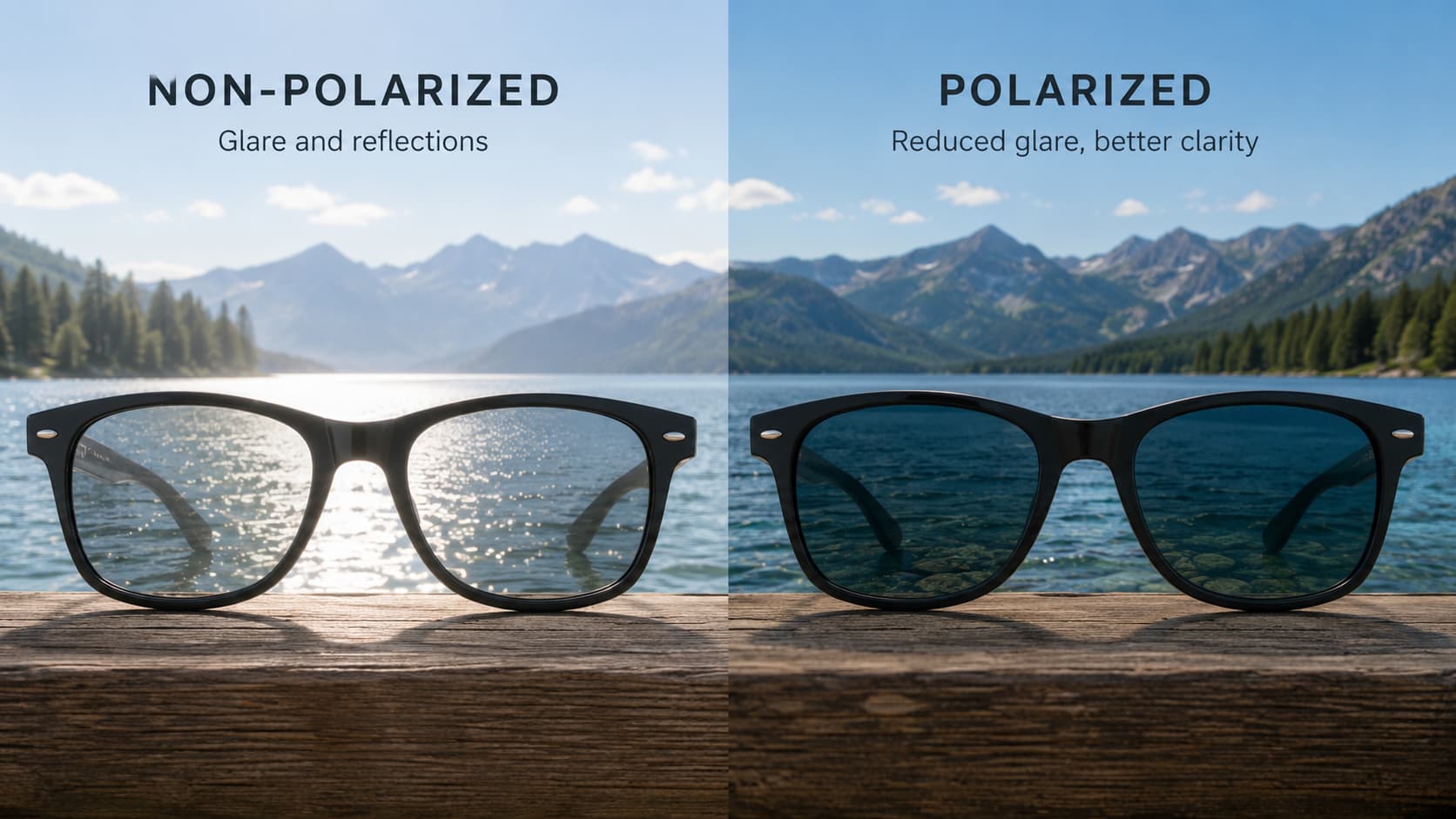
A polarized lens has a special filter built into it that blocks a specific kind of light called horizontal glare, while a non-polarized lens just makes everything darker without sorting the light at all. That filter is the entire difference between the two, and it changes how comfortable the eyes feel outdoors far more than the color or darkness of the lens does.
Understanding why requires knowing what glare actually is. Sunlight normally travels in waves pointing in every direction at once, like a bundle of spaghetti noodles all pointing different ways. When that light hits a flat, shiny surface — water, snow, a car hood, a wet road — most of those waves get absorbed or scattered, but the ones traveling side to side, horizontally, bounce straight back up in a concentrated beam. That bounced beam is glare, and it’s the reason a lake at noon can feel like staring into a flashlight.
A polarized lens has a super-thin chemical film laminated inside it, and that film is lined up like the slats of a window blind, standing upright. Vertical light waves slip through the gaps just fine, but horizontal waves, the glare, get blocked before they ever reach the eye. A non-polarized lens has no such filter. It’s essentially just tinted glass or plastic, dimming every wave of light equally, glare included, which is why the world still looks washed out and shiny through a regular pair of sunglasses.
Polarized lenses for eyewear date back to the 1930s, when the same light-filtering film used in early Polaroid camera filters was adapted into sunglass lenses. The physics hasn’t changed much since — modern polarized lenses use the same basic principle, just refined with better materials and manufacturing.
Do Both Types Block UV Rays?
Polarization and UV protection are two completely separate features, and a lens can have one, both, or neither. It’s one of the most misunderstood parts of sunglasses shopping: polarized lenses do not automatically block ultraviolet light.
UV protection comes from a different treatment or material added to the lens, usually listed on a sticker as “100% UV protection” or “UV400.” The “400” refers to a wavelength of 400 nanometers, and a true UV400 lens blocks essentially all UVA and UVB radiation up to that point. That coating, or built-in material property, blocks the invisible ultraviolet rays that can damage the surface of the eye and contribute to problems like cataracts over the years. Polarization, on the other hand, only deals with visible glare, the light that causes squinting. A cheap non-polarized pair with solid UV400 protection does more for long-term eye health than an expensive polarized pair with no UV coating at all.
The darkness of a lens has no bearing on how much UV it blocks. A very light, barely-tinted lens can carry full UV400 protection, while a nearly black lens might carry none at all if no UV treatment was ever applied. Some lens materials, like polycarbonate, block most UV rays naturally because of their chemical makeup, without needing any extra coating, while others, like basic plastic, need a UV treatment added during manufacturing or they won’t block it at all. That’s why the label matters more than the visual darkness of the lens.
UV protection is about eye health. Polarization is about comfort and clarity in bright light. The first matters every time; the second matters when it fits the activity.
Simple Ways to Test If Lenses Are Polarized

The fastest test is to look at a smartphone or computer screen while tilting the sunglasses, because polarized lenses will make the screen go dark or turn a rainbow color at certain angles, while non-polarized lenses won’t change at all. This happens because most digital screens already emit polarized light themselves, so stacking a polarized lens on top of a polarized screen at the wrong angle causes the two to cancel each other out, similar to crossing two window blinds over one another.
A second test involves a reflection off a shiny table, phone screen, or car window, rotated 90 degrees while watching it. A polarized lens will noticeably dim or erase the reflection while rotating; a non-polarized lens shows no change at all, since there’s no filter reacting to the angle of the light. Packaging and lens labeling will usually state “polarized” directly, but the rotation test remains the most reliable way to confirm it on a secondhand or unlabeled pair.
Optical shops use a related trick on purpose, holding two polarized lenses, or a polarized test card, against each other and turning one 90 degrees. At that angle, almost no light gets through, because the vertical filter on one lens and the vertical filter on the other end up crossed like an X, blocking nearly everything. It’s a clean demonstration of the underlying physics, and the same reason a strongly polarized lens held sideways against another one turns nearly opaque.
Situations Where Polarized Lenses Help Most
Polarized lenses shine in situations where sunlight bounces off a flat surface directly toward the eyes, and driving, fishing, boating, snow sports, and beach days are the classic examples. Anywhere light reflects — a lake, a snowfield, a wet highway — a polarized lens turns a squinty, straining view into a clear, sharp one.
- Driving — cuts the blinding glare that bounces off the hood of a car and wet asphalt, making hazards easier to spot.
- Fishing and boating — reduces glare off the water’s surface, cutting through the reflection instead of facing a wall of light.
- Snow sports — snow reflects a huge amount of visible glare, and polarization cuts that reflected brightness so the eyes strain less and the terrain looks clearer. Worth noting: the actual sunburn-like injury known as snow blindness is caused by UV radiation, not glare, so polarization alone doesn’t prevent it — that protection comes only from a genuine UV coating.
- General outdoor days — beaches, hikes, and anywhere the sun is strong benefit from the added contrast and reduced eye fatigue.
Anglers were among the earliest fans of polarized lenses, and for good reason: water reflects an enormous amount of horizontal glare, so without polarization the surface itself becomes a bright glare-sheet. Cut that glare and the surface often becomes transparent enough to reveal rocks, fish, or the riverbed below, a genuinely practical benefit rather than a marketing claim.
Situations Where Non-Polarized Lenses Work Better
Non-polarized lenses are the smarter pick in a handful of situations, mainly ones involving screens or subtle changes in surface texture. Because polarized lenses are designed specifically to block certain reflections, they can end up blocking information that’s actually needed for a clear view.
Pilots and some heavy machinery operators are often advised against polarized lenses because the lenses can make it harder to read certain instrument panels or LCD displays, some of which rely on reflected light patterns to function correctly. Skiers and snowboarders sometimes prefer non-polarized lenses too, since polarization can flatten the visual contrast between icy patches and packed snow, making terrain harder to judge at speed. The same logic applies to mountain biking, where reading the ground quickly matters more than eliminating glare. A strong tint without polarization gives brightness reduction without stripping out that visual detail.
Contrast-enhancing lens tints offer a middle ground, boosting color and detail without adding a polarizing filter. These work through the tint’s color composition rather than a filtering layer, sharpening the visual difference between a patch of ice and a patch of snow, without the screen-darkening effect that comes with polarization. They suit anyone who wants more than a plain tint without the trade-offs that come with a polarized filter.
Polarized or Non-Polarized: Key Differences
| Feature | Polarized Lenses | Non-Polarized Lenses |
|---|---|---|
| Blocks horizontal glare | Yes | No |
| Reduces overall brightness | Yes | Yes |
| Blocks UV rays | Only if UV coating is added | Only if UV coating is added |
| Best for water, snow, driving | Yes | Not ideal |
| Best for reading LCD/digital screens | Can distort or darken screens | No interference |
| Affects icy/snowy terrain contrast | Can flatten surface detail | No effect on contrast |
| Depends on lens darkness for UV protection | No — UV is a separate feature | No — UV is a separate feature |
| Typical price | Usually higher | Usually lower |
| First developed | 1930s | N/A (standard tinted lens) |
Frequently Asked Questions
Are polarized sunglasses always better than non-polarized ones?
Not always. Polarized lenses work better for glare-heavy situations like driving, water, or snow, but non-polarized lenses can be the safer choice for activities involving screens, instrument panels, or fast-changing terrain that requires reading every bit of surface detail.
Do polarized lenses cost more because they work better?
Polarized lenses typically cost more because they require an extra manufacturing step to laminate the filter into the lens, not because the base lens material is superior. The price difference reflects that added production process rather than better UV protection or durability.
Can polarized lenses damage the eyes?
No, polarized lenses don’t damage the eyes. The only real downside is that they can make certain LCD screens harder to read or slightly shift the perception of icy or wet surface textures, which is a visibility issue rather than a health risk.
Are polarized lenses necessary if sunglasses already have UV protection?
Not necessarily. UV protection and polarization solve two different problems, so a pair with strong UV protection but no polarization still protects the eyes from sun damage, it simply won’t cut glare off reflective surfaces the way a polarized lens does.
How can someone tell if their sunglasses are polarized?
Tilting them while looking at a smartphone screen or a reflective surface reveals it: if the image darkens or shifts noticeably at certain angles, the lenses are polarized, and if nothing changes no matter the rotation, they’re non-polarized.
Is a mirrored lens the same thing as a polarized lens?
No. Mirrored and polarized are separate features, just like UV protection, and a lens can carry either one, both, or neither. A mirrored coating is a reflective layer on the outside of the lens that reduces how much light enters, while polarization is the internal filter that specifically blocks horizontal glare. A mirrored lens without polarization looks shiny and reduces brightness, but it won’t stop the reflected glare off water or snow the way a polarized lens does.
Conclusion
Polarized and non-polarized lenses aren’t a matter of one being universally superior; they’re built to solve different problems. Polarized lenses block the specific horizontal glare that bounces off water, snow, and pavement, making them the clear pick for driving, fishing, boating, and long days in strong sun. Non-polarized lenses skip that filter, which actually makes them more practical for reading screens or judging tricky terrain at speed. The feature that matters more than either one, though, is UV protection, since that’s what actually keeps eyes healthy over the years — whichever style fits the day, that part should never be missing.