Almost every pair of sunglasses on a store shelf has a little sticker or tag somewhere that says “UV400,” and most shoppers trust it without knowing what it actually promises. That trust is usually well placed, but the label itself is doing more work than it looks like. It describes an exact point on the light spectrum, and understanding it changes how sunglasses should be judged entirely, since dark lenses and genuinely protective lenses aren’t always the same thing.
What Does UV400 Mean?
UV400 means the lenses block light with wavelengths up to 400 nanometers, which covers the entire range of UVA and UVB rays that reach the earth’s surface. In practical terms, that translates to roughly 99 to 100 percent of the ultraviolet light the eyes would otherwise be exposed to on a sunny day.
A nanometer is a tiny unit of measurement, about a billionth of a meter, and it’s used to describe the wavelength of light. Ultraviolet light sits just past the edge of what the human eye can see, in the range below 400 nanometers. When a lens is rated UV400, manufacturers are saying it filters out essentially everything in that dangerous zone before it can reach the eye.
UV400 isn’t a brand or a marketing gimmick. It’s a specific cutoff point on the light spectrum, and it happens to be the point where scientists say full protection begins.
The number 400 isn’t random either. It marks the exact border where invisible ultraviolet light ends and visible violet light begins, so a lens rated UV400 filters out every wavelength of ultraviolet the eye is capable of encountering, right up to the edge of visible light. Anything rated to a lower number, like 380 nanometers, still lets a narrow band of high-energy UV rays slip through, a gap researchers have paid closer attention to in recent years.
What’s the Difference Between UVA, UVB, and UVC Rays?
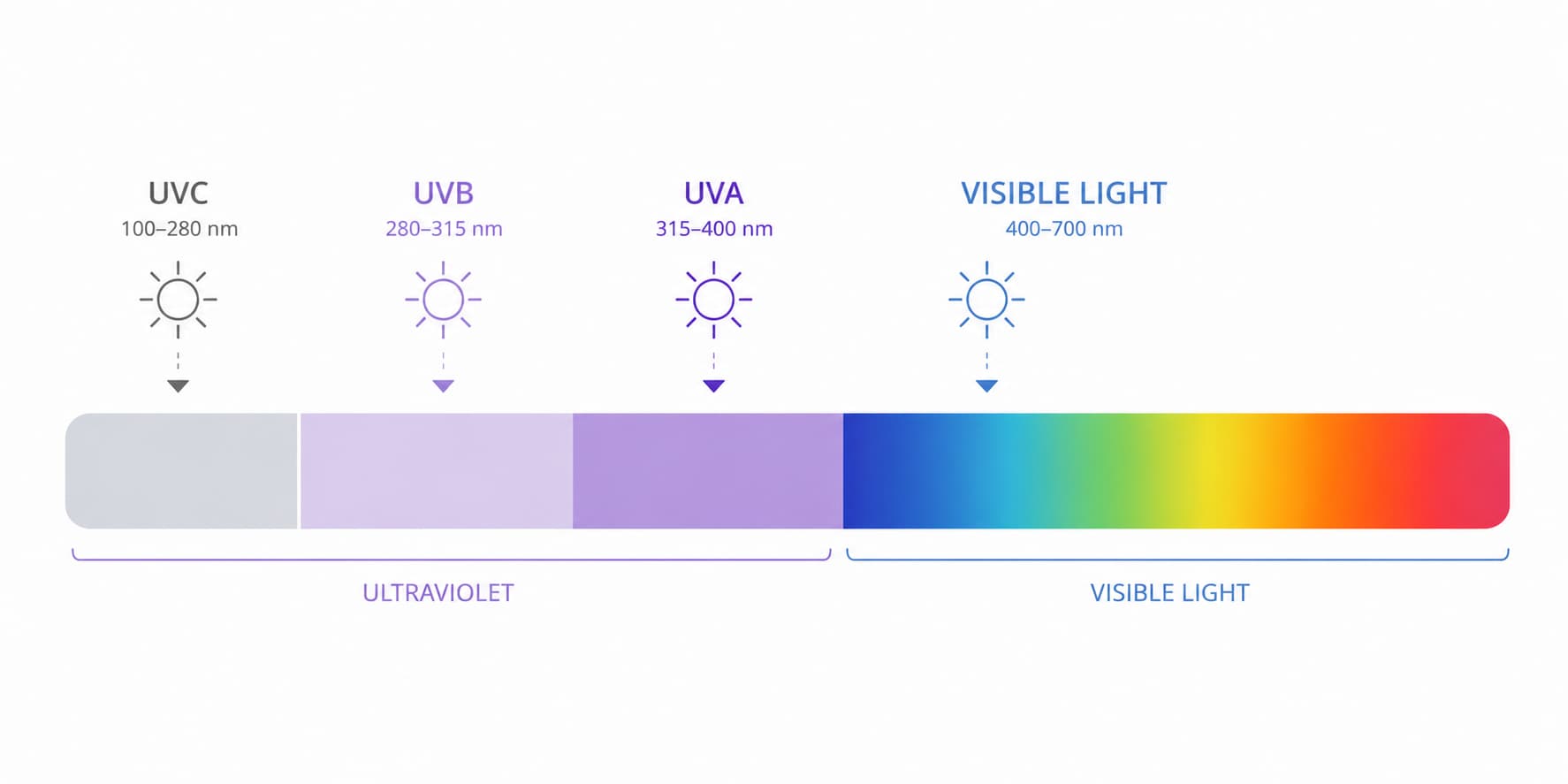
UVA rays run from about 315 to 400 nanometers, UVB rays run from about 280 to 315 nanometers, and UVC rays run from about 100 to 280 nanometers, but UVC never reaches the earth’s surface because the ozone layer absorbs it. That leaves UVA and UVB as the two types of ultraviolet light that actually reach the eyes outdoors, and UV400 protection is built to block both.
UVA rays have a longer wavelength and penetrate deeper, and they’re present in fairly steady amounts throughout the day and even through clouds. UVB rays carry more energy and are the main rays responsible for sunburn, and they’re strongest around the middle of the day. Over years of exposure, both types have been linked to eye conditions like cataracts and growths on the surface of the eye called pterygium, which is part of why eye doctors take UV exposure seriously even when the sun doesn’t feel that strong.
It’s worth knowing that not all UV exposure is treated as purely negative. Small, controlled amounts of UVB actually help the body produce vitamin D, which is why total sun avoidance isn’t the goal doctors recommend. The concern with sunglasses is specifically about the eyes, where the lens and retina don’t get any benefit from UV exposure the way skin does, so filtering it out there carries no real downside.
Do Darker Lenses Block More UV?
No, lens darkness and UV protection are two completely separate things, and a dark lens with no UV coating can actually be worse for the eyes than wearing no sunglasses at all. Tint controls how much visible light gets through, while UV protection is a separate chemical treatment or lens material that blocks invisible ultraviolet rays.
The extra risk comes from a simple physical reaction. When someone puts on dark, tinted lenses, their pupils naturally widen because less visible light is reaching them. If those dark lenses aren’t actually filtering UV rays, the now-wider pupils let in even more ultraviolet light than they would without any glasses on at all, which is exactly why a UV400 label matters more than how dark a lens looks in the mirror.
| Feature | What It Controls | Does It Affect UV Protection? |
|---|---|---|
| Lens tint/darkness | How much visible light gets through | No |
| UV400 rating | How much ultraviolet light gets blocked | Yes |
| Polarization | Glare from reflective surfaces like water or roads | No, not by itself |
Is UV400 the Same as 100% UV Protection?
Yes, UV400 and “100% UV protection” are generally used to mean the same thing, since both describe lenses that block ultraviolet wavelengths up to the 400 nanometer mark. Brands use one phrase or the other, or sometimes both together, but they’re pointing at the same standard rather than two different levels of quality.
That said, it helps to know that “UV protection” claims aren’t always regulated to the same standard everywhere. In the United States, for example, there’s no federal law setting a minimum UV-blocking percentage for sunglasses at all, which is why voluntary standards like ANSI Z80.3 exist to give the claim actual teeth. UV400 sits above the vague, unregulated version of the claim, which is why eye care organizations, including the World Health Organization, point to it as the benchmark worth looking for rather than trusting an unqualified “UV protection” label.
One label distinction matters for international shoppers: the CE mark used across the European Union. CE-marked sunglasses are certified under the standard EN ISO 12312-1, which guarantees protection only up to 380 nanometers, not 400. That’s a real, measurable gap rather than just a rounding difference, since it leaves a narrow band of UV wavelengths between 380 and 400 nanometers unfiltered. A pair of sunglasses can carry a CE mark and still not be labeled UV400, so the two marks aren’t automatically interchangeable even though shoppers sometimes assume a CE stamp covers everything.
Besides UV400, What Else Should You Check?
Yes, two other systems are commonly used alongside UV400 to describe overall sunglasses quality: ANSI Z80.3 in the United States and the EN ISO 12312-1 filter categories used internationally. Both cover more than UV protection alone, including how much visible light a lens lets through and how well the frame holds up to impact.
ANSI Z80.3, set by the American National Standards Institute, requires certified sunglasses to block at least 99 percent of UVB rays and also tests things like lens strength and how accurately colors like traffic lights come through the tint. The international EN ISO 12312-1 standard instead sorts lenses into five filter categories, numbered 0 through 4, based on how much visible light they block, with category 0 being nearly clear and category 4 reserved for extremely bright environments like glaciers. Neither of these numbering systems replaces UV400. They exist to describe how dark or durable a lens is, while UV400 is the separate figure that tells you specifically about invisible ultraviolet filtering.
Does Polarized Mean UV Protected?
No, polarized lenses and UV protection are unrelated features, and a polarized lens doesn’t automatically block ultraviolet light unless it’s also treated or manufactured with UV400 protection. Polarized lenses work by filtering out horizontal glare, the kind that bounces off flat surfaces like water, snow, or a car hood, which makes them great for driving or being near open water.
Because polarization and UV protection solve two different problems, quality sunglasses brands typically build both into the same lens rather than forcing a choice between them. When comparing pairs, the label or product description should list both terms separately instead of letting one imply the other.
How Can You Check If Sunglasses Really Have UV400 Protection?
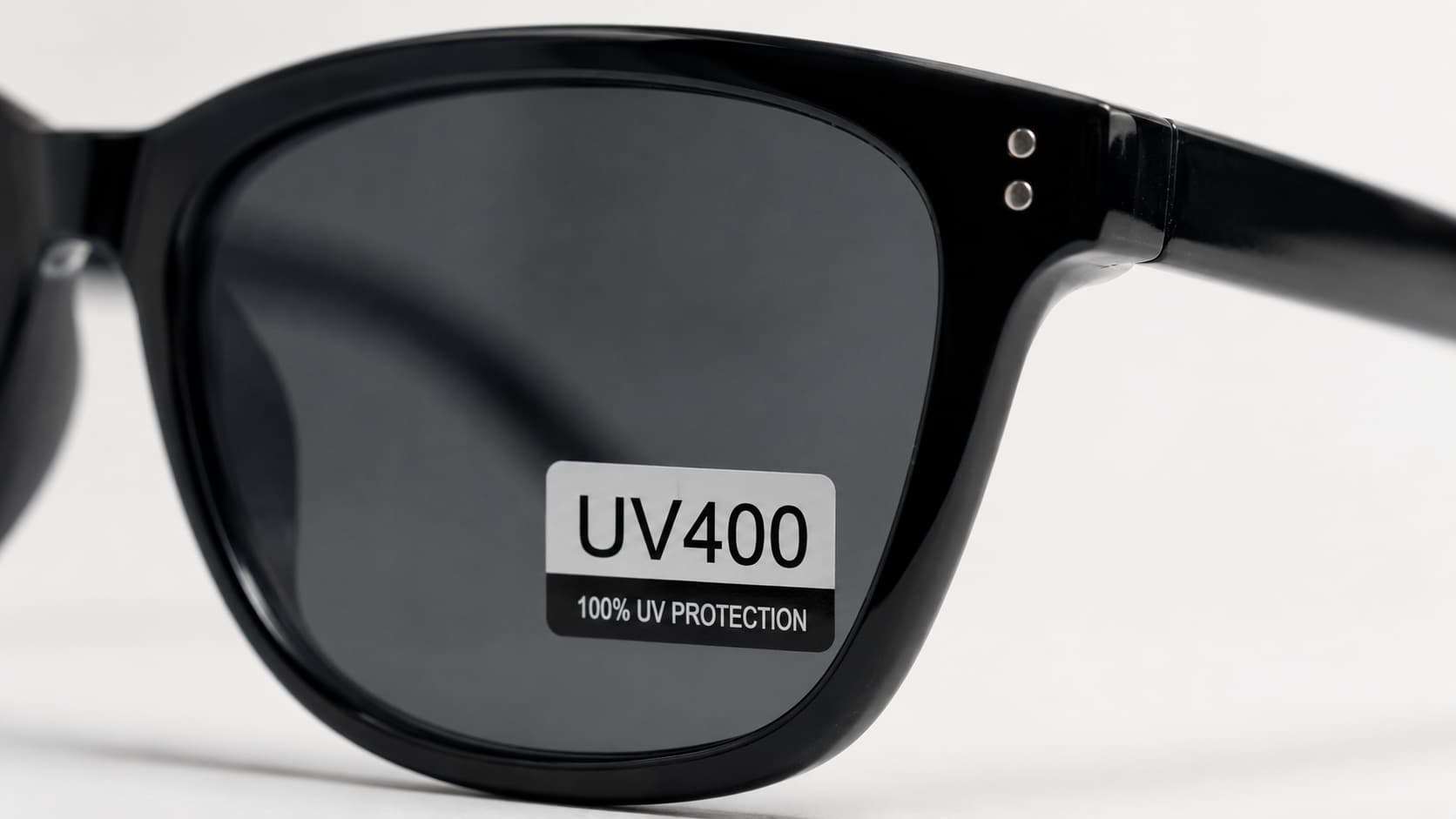
The most reliable way is to look for a UV400 label on the lens sticker, tag, or product packaging, since UV protection can’t be judged just by looking through the lens or holding it up to a window. Reputable brands print this information directly on the sunglasses or in the product listing, and it should specify either “UV400” or “100% UV protection.”
A pair with no UV information listed anywhere is reasonably treated as a fashion accessory rather than genuine eye protection. Opticians and some vision centers also have equipment that can measure a lens’s actual UV blocking ability, a useful option for an older or unlabeled pair that’s already sitting in a drawer.
A few checks make comparison shopping faster and more reliable:
- The words “UV400” or “100% UV protection” printed on the lens, tag, or listing.
- “UV protection” with no number attached, which is a vague claim worth treating with caution rather than trusting outright.
- Whether a CE mark is paired with a separate UV400 claim, since CE alone only confirms protection up to 380 nanometers.
- Whether polarization is listed alongside UV protection as two separate features, rather than one being assumed from the other.
Frequently Asked Questions
Do all sunglasses have UV400 protection?
No, not all sunglasses include UV400 protection, and some inexpensive or purely decorative pairs offer little to no ultraviolet filtering at all. The only way to know for sure is to check the label or product listing rather than assuming based on price or how dark the lenses look.
Can clear glasses have UV400 protection?
Yes, clear lenses can absolutely be treated or manufactured with UV400 protection, since the coating or lens material used to block UV light doesn’t need to be tinted to work. This is why some clear prescription and safety glasses still protect against sun damage even though they look completely see-through.
Is UV400 protection permanent, or can it wear off?
It depends on how the protection was applied. UV blocking built directly into the lens material, like polycarbonate, generally lasts for the life of the lens, while a UV coating applied only to the surface of a cheaper lens can wear down over time from scratches, heat, or cleaning.
Do kids need UV400 sunglasses too?
Yes, and arguably even more than adults, since children’s eyes have clearer lenses that let more ultraviolet light reach the retina than an adult eye does. A meaningful share of a person’s lifetime UV exposure happens during childhood and teenage years, simply because kids spend more time outdoors, which makes UV400-rated sunglasses during outdoor activities a habit worth starting early.
Does snow or water increase how much UV protection is needed?
Yes, reflective surfaces like snow, sand, and water can bounce additional UV rays into the eyes on top of what’s coming directly from the sun, and snow in particular can reflect back a large share of incoming UV light. Extreme, unprotected exposure in these conditions can lead to a temporary but painful sunburn of the eye’s surface called photokeratitis, sometimes known as snow blindness, which is one more reason UV400 sunglasses or goggles matter on bright snowy or reflective days even when it feels cool outside.
Does UV400 protection also block blue light?
No, UV400 and blue light filtering are two different things, even though both get grouped together in casual conversation about “screen protection” or “eye strain.” UV400 blocks invisible ultraviolet wavelengths below 400 nanometers, while blue light sits just above that, in the visible range around 400 to 500 nanometers, so a lens needs a separate blue light filter or coating to address it.
Conclusion
UV400 comes down to one clear idea: it’s a lens rated to block ultraviolet light all the way up to 400 nanometers, which covers essentially all of the UVA and UVB rays capable of reaching the eyes. That number matters far more than how dark a lens looks, how much a pair costs, whether it carries a CE mark, or whether it’s also polarized, since none of those things guarantee UV protection on their own. When choosing sunglasses, the tag reading “UV400” or “100% UV protection,” not the tint or the price, is the detail that actually decides how protected the eyes will be.