At any Indian wedding, one small but powerful detail hangs from the bride’s neck: a string of black beads paired with gold. This is the mangalsutra, one of the oldest and most emotionally loaded pieces of jewelry still worn today. It is not just decoration. It is a promise, a shield, and a piece of family history all strung onto a single thread, and its origins explain why so many women still choose to wear one every single day of their married life.
What Is a Mangalsutra?
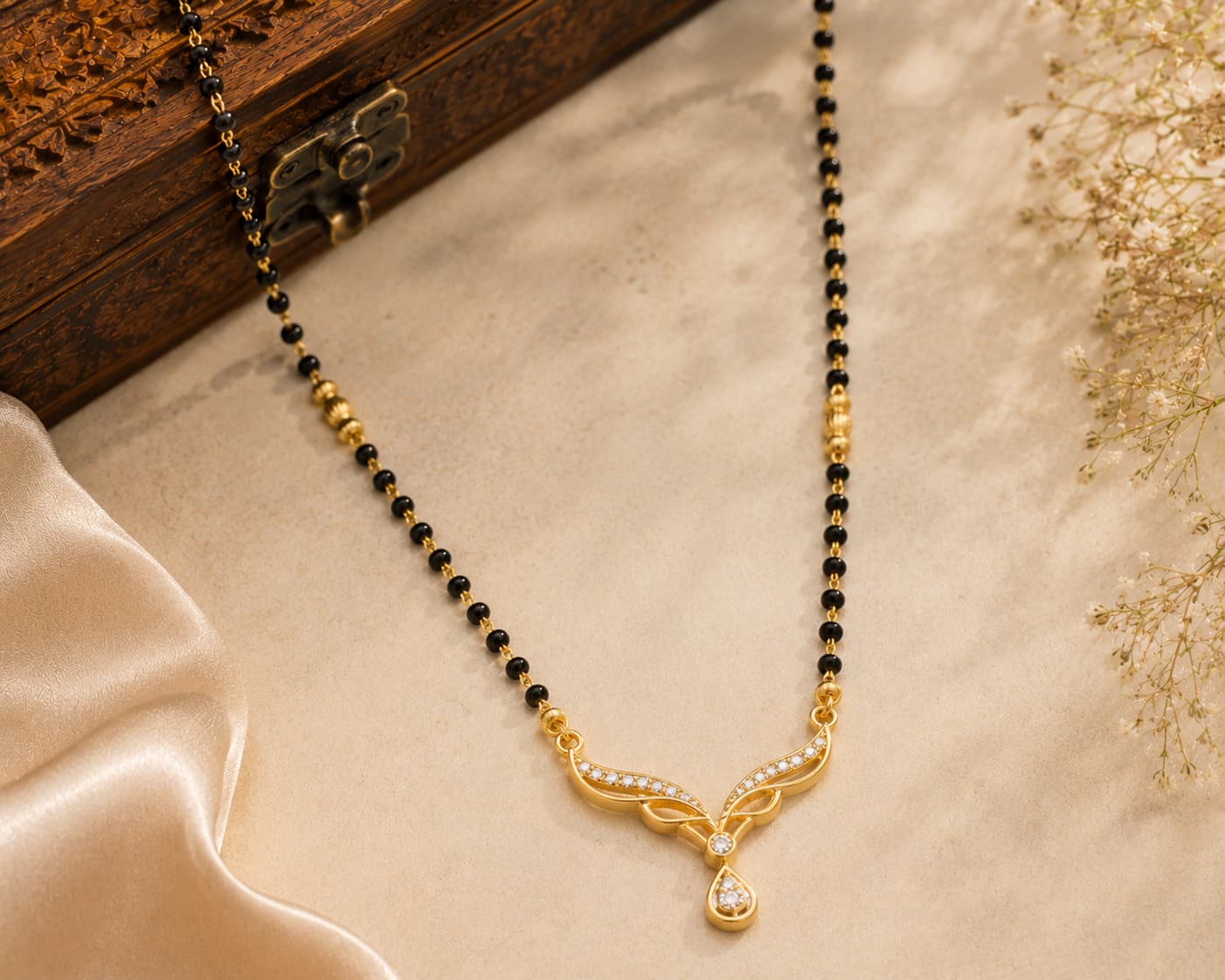
A mangalsutra is a sacred necklace, traditionally made of black beads and gold, that a groom ties or places around his bride’s neck during a Hindu wedding ceremony. Its name is built from two Sanskrit roots: “mangal” carries the sense of something auspicious or blessed, while “sutra” refers to a thread or cord. Strung together, the word describes exactly what the object is meant to be: a blessed thread.
Unlike a Western wedding ring, which is worn by both partners, the mangalsutra is worn only by the wife. It marks her as married, but the beliefs behind it go much deeper than a simple status symbol. Many families see it as a form of ongoing protection for the marriage itself, meant to guard the couple’s bond, ward off misfortune, and keep the relationship strong. It is treated with a kind of reverence that few other jewelry items receive; some women avoid removing it even to bathe or sleep, and losing one is often considered a bad omen rather than just an inconvenience.
Where Did the Mangalsutra Come From?
The mangalsutra traces back to ancient India, with roots that most historians place somewhere in the Vedic period, well over two thousand years ago. Early versions were nothing like the gold pieces sold today; they were simple cords made from plant fiber or cotton, sometimes dyed yellow with turmeric.
Turmeric held its own symbolism in early Indian culture. It was considered purifying and protective, which is part of why the very first marriage threads were colored with it rather than left plain.
Historical texts and literature from the Sangam period, an era of classical Tamil writing that most scholars date to somewhere between 300 BCE and 300 CE, mention a sacred thread tied around a bride’s neck as part of marriage customs. Archaeologists have also pointed to necklaces made of small black beads linked with gold found at Indus Valley sites such as Mohenjo-daro and Harappa, suggesting that stringing black beads with metal for ceremonial or protective reasons is an extremely old practice in the region, even if its direct link to today’s mangalsutra is debated among scholars.
Over the centuries, the plain thread slowly transformed. Communities began adding black glass beads for their believed protective qualities, then gold, then pendants shaped like coins, deities, or family symbols. By the time the mangalsutra reached the form recognized today, it had absorbed centuries of regional customs, religious beliefs, and artistic tradition.
Why Are the Beads Black?
The black beads are considered a protective element, believed by tradition to absorb negative energy directed at the wearer and her marriage. In Indian cultural belief, black is strongly associated with deflecting the “evil eye”, a concept found across many cultures where envious or ill-wishing glances are thought to bring bad luck.
This is why the black beads are usually placed closest to the front of the necklace, resting near the throat or upper chest, rather than tucked toward the back. The idea is that they act almost like a small barrier, standing guard right at the front where they are most visible and, symbolically, most effective. Paired with gold, which culturally represents wealth, purity, and good fortune, the result is a necklace built from two materials chosen specifically to work together: one to protect, one to bless.
Even the number of beads can carry meaning, though the exact count is really a matter of family and regional custom rather than a fixed rule. Some designs use 9 beads on either side to represent the Navagraha, the nine celestial bodies in Hindu astrology, while others favor 21, 51, or 108, a number widely considered sacred across Hindu tradition. In Maharashtra, the chain is sometimes described using two specific terms: “nirgun,” where the strand is made entirely of black beads, and “shagun,” where two gold beads are looped in after every nine black ones. Neither version is considered more correct than the other; it typically comes down to what a particular family has always done.
What Does the Gold Represent?
The gold in a mangalsutra symbolizes prosperity, strength, and social standing, and historically it also functioned as a woman’s personal financial security. In many households, the mangalsutra was not just symbolic gold sitting in a jewelry box; it was gold a woman owned outright and could rely on in times of financial hardship, since property and inheritance laws did not always favor women in earlier centuries.
That practical role adds another layer to the piece. It was simultaneously a spiritual object, a marker of identity, and, quietly, a financial safety net that belonged to her alone.
Different Types of Mangalsutra Designs
No, mangalsutra designs vary enormously across India, and the differences often reveal exactly which region or community a woman’s family comes from. While the pairing of black beads and gold is close to universal, the pendant shape, the number of beads, and even the name of the piece change dramatically from one state to the next.
| Region | Common Name | Distinguishing Features |
|---|---|---|
| Maharashtra & Gujarat | Vati Mangalsutra | Two small hollow gold cups (vatis), said to represent Shiva and Shakti |
| Tamil Nadu | Thali or Thaali | Flat gold pendant, often shaped like a leaf or temple motif, originally tied on a turmeric-dyed thread |
| Andhra Pradesh & Telangana | Bottu / Pustelu | Two gold discs, one traditionally from the groom’s family and one from the bride’s, separated by beads |
| Karnataka | Kaasula Necklace | Gold coin-style pendants, sometimes imprinted with the goddess Lakshmi |
| Coorg (Karnataka) | Karthamani Pathak | A gold coin pendant encircled by a cobra motif, worn as part of a two-piece set |
| Kerala (Syrian Christian) | Minnu | Gold pendant with 13 beads arranged in a cross, tied with threads pulled from the bride’s wedding sari |
Because of this variation, it is common for older relatives or jewelers in India to be able to identify someone’s home region just by glancing at the style of mangalsutra she is wearing. Some names even change again within the same region depending on language: in Telugu-speaking areas alone, the piece may be called mangalasutramu, pustelu, maangalyamu, or Ramar thaali, depending on the community and local dialect.
Is the Mangalsutra Only Worn in India?
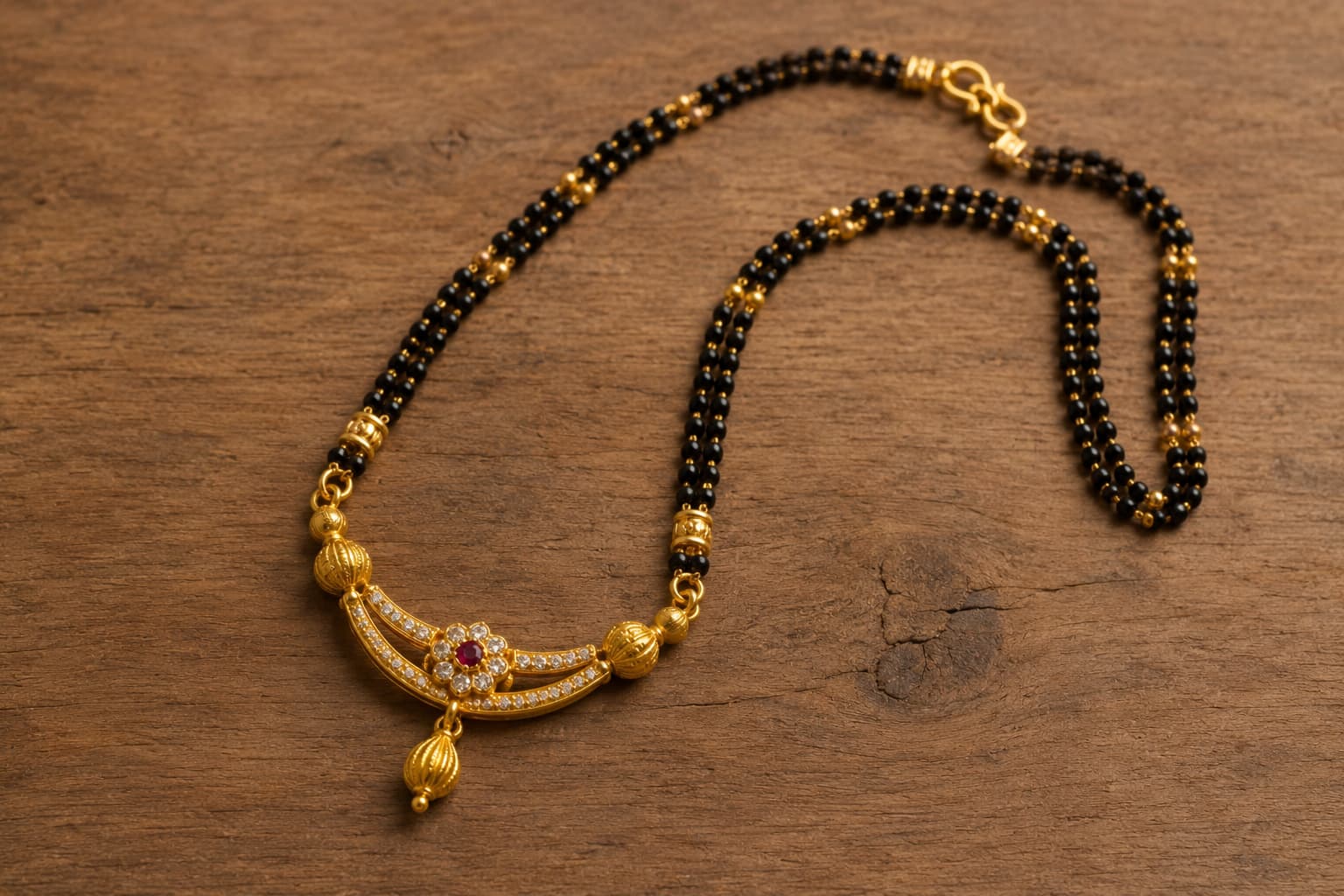
The mangalsutra is worn primarily by Hindu women in India, but the tradition also extends to Hindu communities in Nepal, Sri Lanka, and among the Indian diaspora in countries like the United States, the United Kingdom, and Malaysia. Wherever Hindu families have settled, the ceremony of tying the mangalsutra has largely traveled with them, even as the exact style of the necklace has adapted to local tastes and available materials.
Not every region within India shares an identical version of the tradition, either. Bengali brides, for example, traditionally do not wear a mangalsutra at all; married status there is instead shown through red and white bangles called shakha pola. Kashmiri Pandit brides follow a different path as well, marking marriage not with a mangalsutra but with the dejhoor, a gold ornament worn through a piercing in the upper ear rather than around the neck. This is a good reminder that “Indian tradition” is really a patchwork of many distinct regional customs, not one single practice.
How Has the Mangalsutra Changed in Modern Times?
Today’s mangalsutras range from heavy, traditional bridal pieces to slim, minimalist chains meant for daily wear with everyday clothing. As more women work outside the home and want jewelry that fits a modern wardrobe, jewelers have responded with lighter designs, diamond accents, and shorter chains that sit closer to the collarbone instead of the long, heavy versions once common for formal wear.
Some younger women now treat the mangalsutra less like a strict religious obligation and more like a personal choice, choosing when and how often to wear it based on comfort or occasion rather than tradition alone. Others still follow the older customs closely, wearing it without exception from their wedding day forward. Both approaches exist side by side in India today, and neither is considered more “correct” than the other; it largely comes down to family expectations and personal belief.
Newer formats have also entered the picture. Mangalsutra-inspired bracelets, built from the same black-and-gold combination but worn on the wrist instead of the neck, have become popular with women who want the symbolism without a chain showing above their collar at work or in Western outfits. It is a good example of how a centuries-old tradition keeps finding new physical forms while holding onto its original meaning underneath.
Frequently Asked Questions
Can an unmarried woman wear a mangalsutra?
Traditionally, no. The mangalsutra is meant to be given by a groom to his bride during the wedding ceremony, so wearing one beforehand goes against the custom’s original meaning. Some modern jewelry brands sell mangalsutra-style necklaces as general fashion pieces, but within traditional practice, the necklace is reserved for married women.
What do the knots in a mangalsutra symbolize?
In many traditions, the thread is tied in three knots by the groom, each said to represent a different value: commitment to the marriage, respect for the partner, and dedication to a shared future together. The exact meaning of each knot can vary by community and family custom.
Why is the mangalsutra tied around the neck instead of worn as a ring?
The neck sits close to the heart, which culturally reinforces the idea of an emotional and spiritual bond rather than just a physical marker. It also made the mangalsutra highly visible in daily life, serving as a constant, public signal of marital status in a way a ring worn on the hand does not always achieve.
Is it disrespectful for someone outside the culture to wear a mangalsutra as fashion?
This is a genuinely debated topic. Some people see it as appreciation of a beautiful tradition, while others view it as taking a deeply religious and personal symbol out of its intended context. Because the mangalsutra carries real spiritual weight for many Hindu families, it is worth approaching thoughtfully rather than treating it as a purely decorative trend.
What happens to a mangalsutra if a marriage ends?
Practices differ by family and region. Some widows or divorced women choose to stop wearing the mangalsutra as a reflection of their changed status, while others keep it as a personal keepsake. There is no single rule that applies to everyone, and the decision is generally a deeply personal one shaped by family, community, and individual belief.
The mangalsutra has survived thousands of years precisely because it manages to hold onto its original purpose while still adapting to the moment. It began as a plain cord meant to protect a new bride, grew into a piece built from black beads and gold with layers of regional meaning, and now exists in forms ranging from heavy ceremonial pieces to slim everyday chains. Whatever shape it takes, the thread running through all of it is the same one it started with: a small, wearable symbol meant to carry love, protection, and commitment for a lifetime.