The moonphase watch represents one of horology’s most enchanting complications, displaying the lunar cycle’s progression through a small aperture on the watch dial. This celestial feature has captivated watch enthusiasts for centuries, combining practical astronomical information with artistic beauty. While modern life rarely requires us to track lunar phases, moonphase watches continue to fascinate collectors and everyday wearers alike. Whether you’re curious about the intricate mechanics behind this complication or considering adding one to your collection, understanding moonphase watches opens a window into both ancient timekeeping traditions and modern horological craftsmanship.
What Is a Moonphase Watch?
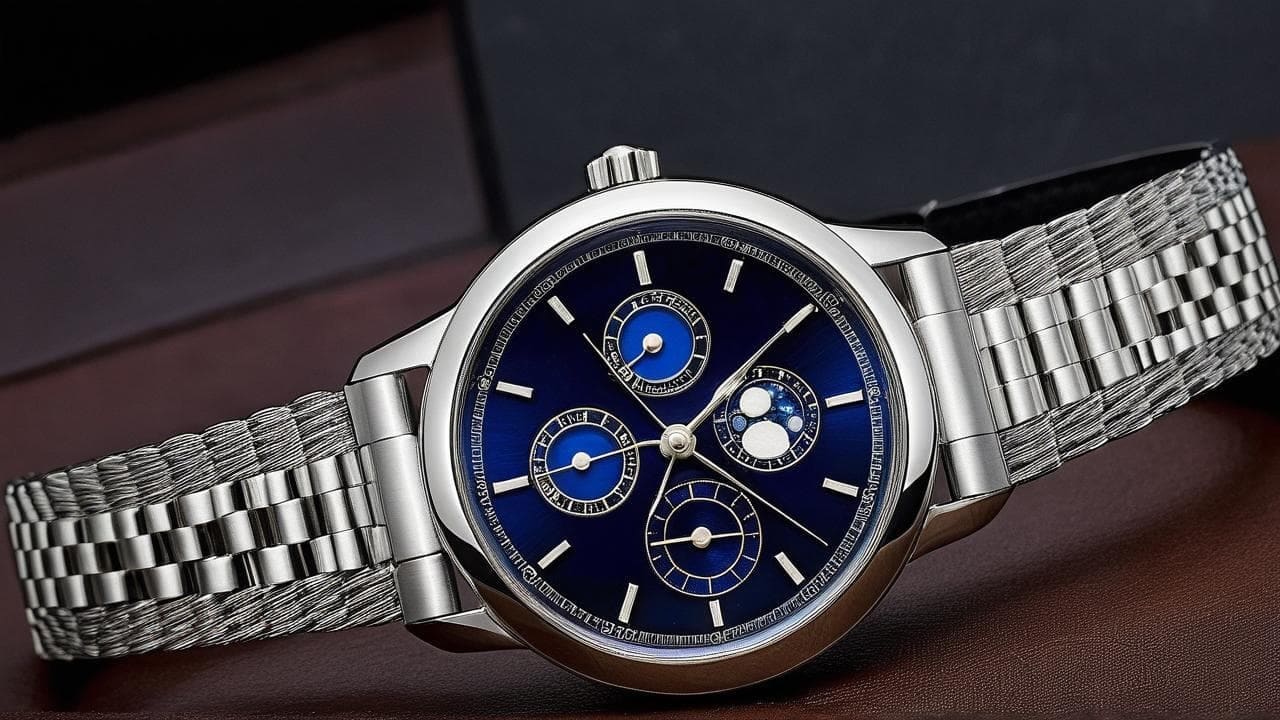
A moonphase watch is essentially a timepiece that displays the current phase of the moon through a special window on the watch face, tracking the lunar cycle as it progresses from new moon to full moon and back again over approximately 29.5 days. This complication transforms your wrist into a personal astronomical instrument, showing the same moon phases visible in the night sky. The feature typically appears as a small semicircular aperture with a rotating disc underneath that reveals different portions of painted moon imagery, creating the illusion of the moon waxing and waning just like in nature.
- A moonphase complication is a mechanical feature that shows which phase of the moon is currently visible in the sky. The display typically appears as a small aperture with a rotating disc underneath that shows different portions of a painted moon image, creating a miniature representation of what you’d see when looking up at the actual night sky.
- The moonphase mechanism uses a gear train connected to the watch’s main movement that advances a moon disc once every 24 hours. This disc has two moon images painted on it, positioned 180 degrees apart, and as it slowly rotates beneath the aperture, it creates the realistic progression of lunar phases over the standard 29.5-day cycle.
- In watchmaking terms, any function beyond basic timekeeping is called a “complication,” and the moonphase is considered one of the more poetic and visually appealing complications available. Unlike purely practical complications like chronographs that measure elapsed time, moonphase displays serve both aesthetic and astronomical purposes.
- The moonphase complication adds significant visual interest to a watch dial, often featuring beautifully decorated moon faces, starry backgrounds, or artistic interpretations of the night sky. Many watchmakers use this complication as an opportunity to showcase their artistic skills through hand-painted details, mother-of-pearl backgrounds, or precious metal applications.
- Modern moonphase watches range from highly accurate astronomical instruments that require adjustment only once every 122 years to more affordable fashion-focused versions that prioritize aesthetics over precision. Regardless of their accuracy level, these watches represent humanity’s enduring desire to understand and track the cosmos.
Understanding what makes a moonphase watch special goes beyond its basic function—it’s about appreciating the intersection of mechanical engineering, astronomical knowledge, and artistic expression. These watches represent humanity’s ancient fascination with celestial movements translated into modern wearable form. Whether you’re drawn to the technical complexity, the romantic symbolism, or simply the beautiful aesthetics, moonphase watches offer a unique way to carry a piece of the cosmos on your wrist while maintaining precise timekeeping functionality.
How Moonphase Watches Work
The moonphase mechanism operates through a carefully calibrated gear system that mimics the moon’s actual 29.5-day orbital cycle, using mechanical precision to replicate celestial timing in miniature form. At its heart lies a beautifully simple yet ingenious concept: a disc with two identical moons painted on it rotates beneath the dial, controlled by a 59-tooth driving wheel that advances one notch every 24 hours. This creates the illusion of the moon waxing and waning through a small aperture, just as it appears in the night sky.
- The true lunar cycle lasts 29 days, 12 hours and 44 minutes, or 29.53 days, which watchmakers simplify to 29.5 days for mechanical purposes. This disc is moved by a 59-tooth gear that advances one notch every 24 hours, creating a system where the disc completes one full rotation every 59 days, showing two complete lunar cycles.
- The mechanism uses a mechanical finger attached to the driving wheel to advance the disc once per day. This finger, connected to the watch’s gear train, pushes against the teeth of the moonphase disc with each daily advancement, ensuring perfect synchronization with the passage of time.
- The most common moonphase aperture is shaped like a semicircle with 2 bumps on the sides called a “bosom,” designed to represent Earth’s silhouette as it blocks portions of the moon from view. As the painted moon disc slowly rotates beneath this aperture, different portions become visible, creating the visual effect of lunar phases.
- The moonphase disc moves so slowly that its daily advancement is barely perceptible to the naked eye, unlike the sweeping motion of seconds hands. Two moons are used on each disc because after a single 29.5-day lunar cycle is over, the second moon appears in the aperture, ensuring continuous operation without gaps.
- Some luxury manufacturers implement more precise systems using 135-tooth driving wheels instead of the standard 59-tooth version. These watches will be off by one day after 122 years instead of 2.5 years, representing a remarkable improvement in mechanical accuracy.
The beauty of the moonphase mechanism lies in its elegant simplicity and remarkable accuracy considering its purely mechanical nature. While the basic 59-tooth system creates a small error that accumulates over time, the mechanism successfully captures one of humanity’s oldest methods of tracking time in a form you can wear on your wrist. The moonphase complication represents the perfect marriage of astronomical knowledge and mechanical engineering, transforming the complex orbital mechanics of celestial bodies into a beautifully simple gear train.
Types of Moonphase Watch Displays
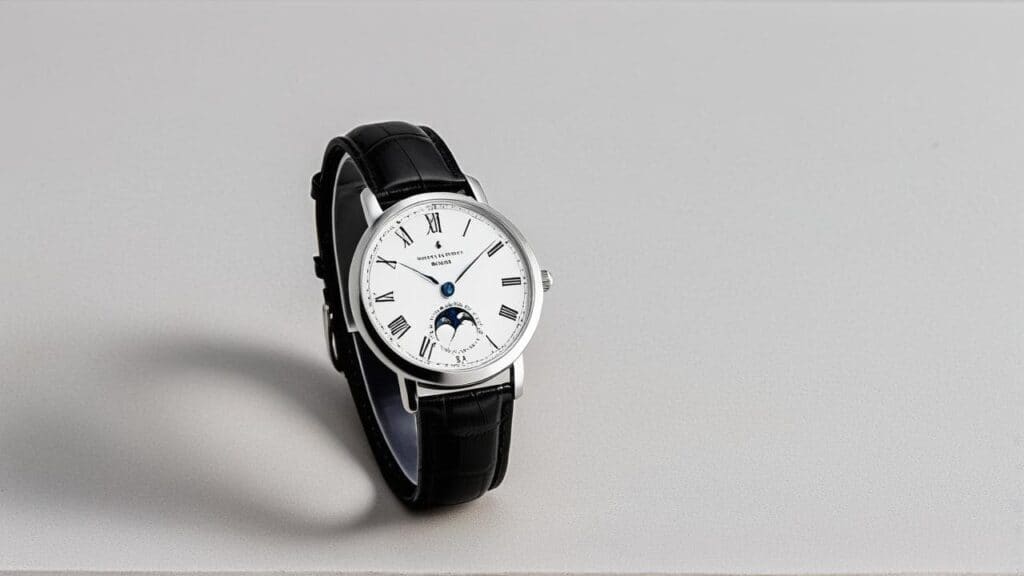
Moonphase displays come in several distinct styles, each offering a different way to visualize the lunar cycle on your wrist. The two most common styles are the bosom moonphase and the radial moonphase, though innovative watchmakers have created unique variations that push the boundaries of traditional moonphase design. Understanding these different display types helps you choose the style that best suits your aesthetic preferences and practical needs.
- Traditional Bosom Moonphase: The bosom moon phase is the most common style in which you can see the parts of the moon that are currently visible in the night sky on the watch dial. A crescent-shaped aperture represents the moon phase, with the curved edges creating the classic moonphase look that most people recognize. The name “bosom” comes from the curved shape of the aperture, which resembles a feminine silhouette.
- Radial Moonphase Display: The radial moonphase watch uses an indicator hand to track the lunar cycle, though the mechanism that drives it is the same as the bosom moonphase. Instead of showing the moon through an aperture, this style features a dedicated subdial with moon phase indicators around the circumference, and a hand points to the current phase.
- Astronomical Moonphase: These ultra-precise moon-phase displays track the actual lunar cycle with near pinpoint accuracy, requiring adjustment just once every 122.6 years. Some luxury manufacturers have created even more accurate versions, with mechanisms accurate for 1,000 years or more, representing the pinnacle of mechanical achievement.
- Simplified/Fashion Moonphase: Fashion or simplified moonphase watches prioritize visual appeal over mechanical accuracy, often using quartz movements with programmed moon displays. These watches typically feature decorative moon displays that focus on aesthetics, sometimes incorporating colorful backgrounds or creative interpretations of the traditional aperture design.
- Full Moon Display: Some watchmakers show the entire moon disc rather than just a portion through an aperture. Arnold & Son, for example, creates watches where the moonphase display takes up a significant portion of the dial, creating a dramatic visual impact that emphasizes the complication.
- Unique Artistic Interpretations: Innovative manufacturers like De Bethune, MB&F, and Greubel Forsey have created more creative approaches with their moonphase watches, using overlapping discs, three-dimensional moons, or unconventional display methods that challenge traditional moonphase presentations.
The variety in moonphase display types reflects both the evolution of watchmaking technology and the diverse preferences of watch enthusiasts. While purists often prefer the traditional bosom design for its classical elegance, others appreciate the precision of radial displays or the ultimate accuracy of astronomical moonphases. Regardless of the display type you choose, each style successfully captures the romantic essence of lunar timekeeping while offering its own distinct character and charm.
History of Moonphase Watches
The moonphase complication boasts one of the longest and most fascinating histories in all of horology, tracing its roots back thousands of years to humanity’s earliest attempts to understand and track celestial movements. The concept of tracking phases of the Moon dates back as early as Ancient Greece with the Antikythera mechanism, which was used to predict astronomical positions, eclipses, and even the dates of the Olympic Games. This ancient bronze device, dating from around 150 BC, represents one of humanity’s first sophisticated attempts to mechanically reproduce astronomical cycles.
- Ancient Origins: The Antikythera mechanism from 150 BC contains one of the oldest watch complications, created to show the annual movement of the sun and moon and predict eclipses. This remarkable device functioned as the world’s first known analog computer, using a complex system of bronze gears to track multiple astronomical cycles simultaneously. No one was able to match this complication for nearly 2000 years.
- Medieval and Renaissance Development: During the Renaissance, astronomical clocks were usually built inside cathedrals, displaying the orbit of the known planets and the phases of the Moon along with time and calendar information. These magnificent timepieces served both practical and spiritual purposes, helping communities coordinate religious observances while demonstrating the divine order of the heavens through mechanical precision.
- Transition to Personal Timepieces: In the 16th century, the moonphase complication began appearing in standalone clocks, such as complex grandfather clocks built in Germany and England. Soon after, it was adapted on a smaller scale to be incorporated into pocket watches. Moon phases appeared in their final form in Germany in the 1700s, using the semi-circular space above rectangular dials to show one half of a disc with two moons on it.
- First Wristwatch Implementation: In 1925, Patek Philippe introduced the world’s first perpetual calendar wristwatch in the form of Reference 97975, which included a moon phase display among other indicators. This landmark achievement established Patek Philippe as the pioneer of wristwatch complications and set the standard for luxury moonphase watches that continues today.
- Early Adoption by Major Brands: Other early adopters of wristwatches with moonphase indicators included Rolex, LeCoultre (before it became Jaeger-LeCoultre), Audemars Piguet, and Vacheron Constantin. Rolex introduced its own interpretation in 1949 with the Reference 8171, a triple-date watch nicknamed the “Padellone” due to its large 38mm case size for the era.
- Modern Evolution: By the time moonphase complications reached wristwatches, they were no longer necessary for practical timekeeping, but their allure illustrated our continued fascination with the cosmos. Today’s moonphase watches serve as mechanical poetry, bridging ancient astronomical knowledge with modern precision engineering.
The evolution of moonphase watches reflects humanity’s enduring fascination with celestial mechanics and our desire to carry the cosmos on our wrists. What began as practical astronomical instruments for navigation and agriculture transformed into symbols of horological artistry and mechanical mastery. The moonphase complication continues to captivate watch enthusiasts precisely because it connects us to something larger than mere timekeeping, ensuring that this oldest of complications remains relevant and cherished in contemporary horology.
Reasons to Choose Moonphase Watches
The appeal of moonphase watches extends far beyond their practical function, combining aesthetic beauty, mechanical artistry, and emotional connection in ways that few other complications can match. A moonphase watch is not only a functional timekeeping instrument but also a work of art that captures the beauty and mystery of the celestial world. While modern technology has rendered lunar tracking less essential for daily life, these timepieces continue to captivate collectors and enthusiasts for reasons that transcend mere utility.
- Aesthetic Appeal and Craftsmanship: The beautiful depiction of the lunar cycle on the watch dial adds whimsy to the timepiece. Luxury watch brands create moon phase watches in various styles, with many presenting realistic depictions of the Moon and others offering artistic presentations. The modern appeal has more to do with the fact that moonphase complications are just really cool looking, as if your wristwatch is telling you a story.
- Connection to Natural Cycles: Owning a moonphase watch connects you to centuries of horological tradition and astronomical knowledge, representing humanity’s quest to understand and mechanically reproduce celestial movements. We might schedule meetings according to the sun’s daily trajectory, but it’s the moon that reigns over the month itself, determining important events like birthdays and celebrations.
- Conversation Starter and Social Appeal: One of the reasons why moon phase watches have become such iconic dress watches is due to their timeless design. The classic circular dial, often with Roman numerals, and the moon phase display provide a simple yet elegant look that complements formal attire. Wearing such a piece of fine art sparks curiosity and admiration from others and serves as a conversation starter.
- Investment Potential: Many moon phase watches from the world’s best watch brands appreciate in value over time, especially limited edition releases. Building such a collection ensures you can potentially sell watches for higher values later. The investment potential of quality moonphase watches makes them attractive to collectors who appreciate both their aesthetic appeal and long-term value retention.
- Historical Significance: The significance of moon phase watches extends beyond their practical applications and aesthetic appeal. These timepieces serve as a connection to our past, a celebration of human ingenuity, and a reminder of our enduring fascination with the cosmos. This historical depth adds meaning to the ownership experience that goes beyond simple timekeeping.
- Mechanical Complexity: For watch enthusiasts who appreciate horological complications, moonphase watches offer a perfect balance of mechanical sophistication and visual appeal. The intricate gear trains and precise engineering required to accurately track lunar cycles demonstrate the pinnacle of traditional watchmaking skills.
The choice to buy a moonphase watch ultimately reflects personal values and interests that extend beyond practical timekeeping needs. Whether you’re drawn to the mechanical complexity, the artistic beauty, the historical significance, or the investment potential, a moonphase watch offers something that digital devices and basic timepieces simply cannot provide. These complications represent the perfect fusion of technical achievement and emotional appeal, making them ideal for individuals who appreciate craftsmanship, value tradition, and seek timepieces that tell stories beyond mere hours and minutes.
How Accurate Are Moonphase Watches?
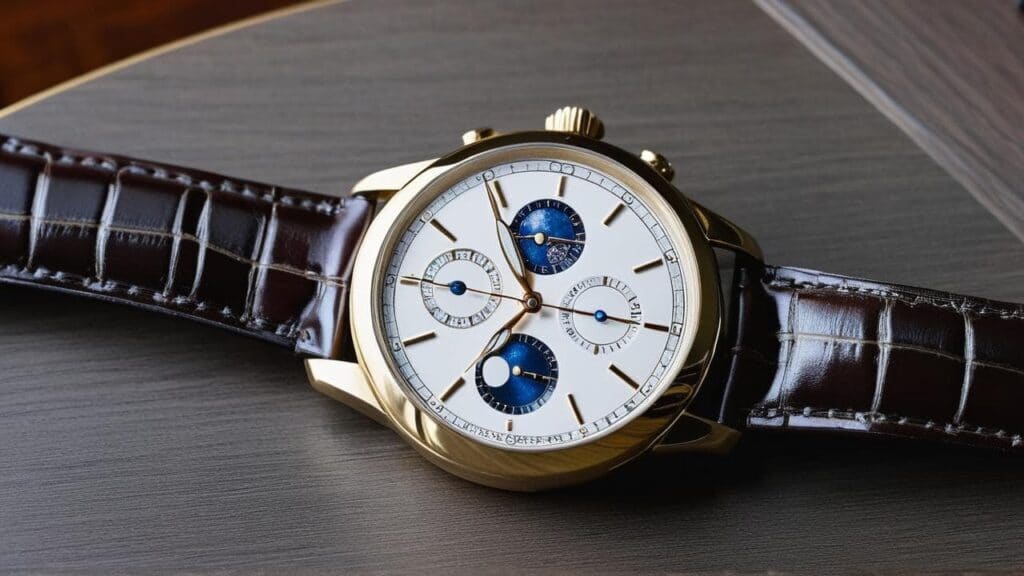
The accuracy of moonphase watches varies dramatically depending on the complexity of their gear systems, ranging from basic models requiring adjustment every few years to ultra-precise mechanisms that remain accurate for millennia. The standard accuracy for a wristwatch’s synodic month (moon phase period) is generated by a gear wheel featuring 59 teeth that advances by one tooth per day, which provides a little over two and a half years of accuracy before the indication is off by one full day. Understanding moonphase accuracy helps you choose the right watch for your needs and expectations.
- Standard 59-Tooth Accuracy: The lunation displayed by an ordinary moon phase watch corresponds to 29.5 days when in reality a lunation lasts 29 days, 12 hours, 44 minutes and 2.8 seconds (29.53 days). This means your watch is missing out on 0.03 days every month, and you’ll have to adjust the watch every two years and seven and a half months for a full day to prevent it from falling behind.
- Astronomical Moonphase Precision: The next step was for watchmakers to make a system with a finer-toothed gear, boasting 135 teeth exactly. With this new, more precise moon phase mechanism, many higher end watches have been able to bump that 2.5-year accuracy up to 122.5 years. These ultra-precise moon-phase displays track the actual lunar cycle with near pinpoint accuracy.
- Factors Affecting Accuracy: Several factors affect the long-term accuracy of any moonphase mechanism, including the precision of the gear ratios, the quality of manufacturing tolerances, and the overall timekeeping accuracy of the base movement. Even the most accurate moonphase watch becomes meaningless if the underlying timekeeping mechanism gains or loses significant time.
- Ultra-Precision Achievements: Andreas Strehler released the Sauterelle à Lune Perpétuelle at Baselworld 2014, creating the watch with the most accurate moon phase ever at that time. In 2024, IWC Schaffhausen shattered all records with its new Portugieser Eternal Calendar, which has a moon phase that will be accurate for 45 million years.
- Practical Implications: For standard 59-tooth mechanisms, manually adjusting your moon phase watch every three years will be enough to keep it running smoothly and accurately. This level of accuracy, while requiring periodic adjustment, remains perfectly adequate for most users who appreciate the complication primarily for its aesthetic and romantic appeal.
- High-End Standards: The 122-year accurate models have become the de facto standard on high quality watches because they represent more than a lifetime of accuracy, much more than enough for the average consumer. This astronomical moonphase standard has become the benchmark for luxury watches.
The practical implications of moonphase accuracy depend largely on your intended use and personal preferences. While ultra-precise moonphases may offer accuracy measured in millennia, they represent achievements in mechanical engineering rather than practical necessities. The pursuit of precision for its own sake is a big part of what makes watchmaking interesting, and whether you choose a basic, astronomical, or ultra-precise moonphase watch, the beauty lies not just in the accuracy but in the mechanical poetry of gears and wheels working together to capture the celestial dance of our lunar companion.
Best Moonphase Watch Brands & Models
The world of moonphase watches spans from affordable entry-level models to ultra-luxury masterpieces, with leading brands offering distinct interpretations of this celestial complication across various price segments. Most luxury watch brands include moonphase watches in their collections, with each manufacturer bringing its own design philosophy, technical approach, and artistic vision to moonphase complications. Understanding the strengths and characteristics of different brands helps you choose a moonphase watch that aligns with your aesthetic preferences, budget, and quality expectations.
- Patek Philippe: Remains the undisputed king of moonphase complications, having created the first wristwatch perpetual calendar with moonphase in 1925. The Patek Philippe Nautilus 5712/1A has the moonphase cleverly integrated inside the date dial with a gradient blue face and steel bracelet. The Annual Calendar 5396 and 5205 models showcase rose gold cases with comprehensive calendar functions. The Patek Philippe 4947 offers sophisticated ladies’ options in white gold. For the ultimate luxury, the Celestial 6102P features a star chart and costs well into six figures.
- A. Lange & Söhne: Has established itself as a master of precise astronomical complications, particularly known for highly accurate 122.6-year moonphase mechanisms. The Lange 1 Moon Phase in 38.5mm features the innovative day/night indicator disc behind the moonphase, available in white gold, pink gold, and platinum. The Grand Lange 1 Moon Phase offers a larger 41mm case option. The Little Lange 1 Moon Phase provides a more compact 36.8mm option, often with diamond-set bezels. The Datograph Perpetual Tourbillon combines moonphase with chronograph, perpetual calendar, and tourbillon complications.
- Jaeger-LeCoultre: Offers comprehensive and accessible luxury moonphase options across multiple collections. The Master Ultra Thin Moon (reference Q1368480) features a blue dial in a svelte 39mm case. The Master Calendar presents sophisticated designs with day, date, month, and moonphase displays. The Reverso Tribute Calendar offers the unique duo-face functionality with moonphase on one side. The Duomètre à Quantième Lunaire provides high-precision dual-wing movement technology.
- Omega: Brings sportier interpretations, most notably the Speedmaster Moonphase (reference 304.23.44.52.13.001) which combines the space exploration heritage with realistic moon imagery including an astronaut’s footprint. The Speedmaster Professional Moonphase maintains the classic Moonwatch aesthetic while adding the lunar complication at 12 o’clock alongside chronograph functions.
- Mid-Range Excellence: Frederique Constant Classic Moonphase Date Manufacture offers Swiss quality around $4,095 with their in-house FC-716 movement, available in silver-gray, midnight blue, and English green dials. Longines Master Collection Moonphase provides excellent value around $2,800 in multiple dial colors including black, silver, and blue. The Longines Flagship Heritage Moonphase comes in distinctive beige, anthracite, and green variants for a more vintage aesthetic.
- Accessible Swiss Options: Zenith Elite Moonphase features their refined Caliber 692 in a thin 9mm case perfect for dress watch use. Tissot Carson Premium Moonphase offers Swiss quartz reliability with moonphase functionality at under $400. Blancpain Villeret Moonphase provides haute horlogerie finishing at more accessible prices than Patek Philippe.
- Budget-Friendly Choices: Orient Star Contemporary offers mechanical moonphase movements at attractive prices with various dial configurations. Citizen Eco-Drive Moonphase provides solar-powered reliability with moon tracking functions. Christopher Ward C1 Moonphase features an oversized moonphase display that dominates the dial for dramatic visual impact.
- Discontinued but Notable: Rolex Cellini Moonphase (reference 50535) in Everose gold represented Rolex’s only modern moonphase until discontinuation in 2023, now available primarily on the pre-owned market for around $20,000-25,000.
The diversity of moonphase watch brands ensures that this captivating complication remains accessible across various price points and aesthetic preferences. Whether you’re drawn to the ultimate prestige of Patek Philippe’s Nautilus or Annual Calendar models, the technical precision of A. Lange & Söhne’s Lange 1 series, the comprehensive offerings from Jaeger-LeCoultre’s Master collection, the space-age appeal of Omega’s Speedmaster Moonphase, or the accessible luxury of Frederique Constant and Longines, the moonphase complication offers something special for every type of watch enthusiast, making it one of the most democratic yet distinguished complications in all of horology.
Reading Moonphase Watch Displays
Reading a moonphase watch requires understanding the basic lunar cycle and interpreting the visual display through the aperture or subdial on your timepiece. The lunar cycle encompasses the various phases of the moon as it orbits the Earth, including new moon, waxing crescent, first quarter, waxing gibbous, full moon, waning gibbous, last quarter, and waning crescent. While this might seem complex at first, moonphase watches typically simplify the display to show the most recognizable phases in an intuitive visual format.
- Understanding the Four Primary Phases: There are really only four phases you need to know. The new moon occurs when the moon and sun are in alignment and no moon is visible to us. The “first quarter” is when the right-hand side of the moon is illuminated. Next comes the “full moon” when the entire surface is lit up. Then it moves to the “last quarter” when the left-hand side is visible. These primary phases represent the key points that most moonphase watches emphasize.
- Reading the Direction of Movement: If your moonphase watch is set correctly, you’ll track the moon as it appears from behind the Earth on the left and eventually disappears on the right. This also lets you know if the Moon is coming or going (waxing or waning). The terms “waxing” and “waning” describe the moon’s apparent growth and shrinkage - waxing when the shape is thickening from new to full moon, and waning when thinning.
- Interpreting the Bosom Display: Most commonly, the moonphase is displayed through a crescent-shaped aperture to identify the waxing and waning phases of the Moon. This is known as a ‘bosom’ moonphase watch, where two identical moons sit on a disc under the watch dial. The curved edges of the aperture create the illusion of Earth’s shadow blocking portions of the moon, showing only the illuminated portion visible in the actual night sky.
- Reading Radial Displays: For radial moonphase displays, reading becomes straightforward as you simply look at where the pointer indicates around the subdial. These displays typically feature symbols or markings around the circumference representing different phases, with a hand pointing to the current lunar state. Some advanced models include the age of the moon (days since the last new moon) or tidal information.
- Understanding Moon Age: Some moonphase watches measure the age of the moon as the number of days since the last New Moon. The time between these 2 moons is shown in increments of 1-29.5 days on the dial, providing additional astronomical information beyond just the phase appearance.
Reading a moonphase watch becomes intuitive once you understand that the display mimics exactly what you would see when looking up at the night sky. A moon phase watch shows the current phase of the moon as you see it above, with the miniature version in the watch traveling around just like our orbiting companion. The beauty of a well-designed moonphase complication lies in its ability to compress the vastness of astronomical cycles into a comprehensible, wrist-worn format that connects you to the same celestial rhythms that have guided humanity for millennia.
How to Care for Moonphase Watches
Proper care and maintenance of your moonphase watch ensures both the longevity of the complication and the accuracy of its astronomical display. The safest thing you can do is follow a brand’s instructions within a manual, and you can always enlist a watchmaker at a boutique or authorized dealer to assist you. Moonphase watches require slightly more attention than simple time-only pieces due to their additional mechanical complexity, but with proper understanding and regular care, these celestial timepieces can provide decades of reliable service.
- Setting the Moonphase Correctly: Before setting the moon phase complication, pull out the crown and turn the hands to the 6:30 position as a precaution, in case their position might damage the movement when you set the moon phase. The reason this step is crucial is to ensure you understand the nuances of setting your particular moonphase complication, including any danger zones where you should not adjust it. Always consult your watch manual for specific instructions.
- Using Lunar Calendars for Accuracy: To set your moonphase watch accurately, you’ll need to reference a lunar calendar to determine the current phase of the moon. You can find lunar calendars online easily. Once you know the phase of the Moon, rotate the disc so that the full Moon appears in the middle of the window, then count the days since the last full moon and advance the display accordingly.
- Regular Accuracy Checks: Moonphase watches are precise instruments, but slight adjustments may be necessary over time to account for the actual lunar cycle. Periodically check the phase of the moon using a lunar calendar and make any necessary corrections to keep your watch in sync. For most standard moonphase watches, you’ll need adjustment every 2-3 years.
- Professional Servicing Considerations: While many moonphase watches will have a similar setting process, it’s best to be sure before you find yourself staring at a hefty service bill. When servicing moonphase watches, qualified watchmakers must properly disassemble, clean, and reassemble the additional gear trains that drive the lunar display. This typically makes servicing more expensive than simple three-hand watches.
- Daily Care and Storage: Like all mechanical watches, moonphase timepieces benefit from regular wearing or use of a quality watch winder to keep lubricants moving and the mechanism properly exercised. It’s better to wait till the full moon day to set the moon phase of the watch, as this provides the clearest reference point for accurate setting.
- Avoiding the Danger Zone: Avoid adjusting the moonphase complication during the “danger zone” hours (typically 9 PM to 3 AM) when the mechanism may be in the process of changing, which could cause damage. This is when the watch’s calendar functions are often advancing, and interference could harm the delicate gear trains.
Caring for your moonphase watch rewards you with years of reliable astronomical timekeeping and continued appreciation for this ancient complication. Reading and setting a moonphase watch adds a delightful dimension to timekeeping, allowing you to stay connected with the celestial rhythms of the universe. The investment in proper care ensures that your moonphase watch continues to capture the poetry of lunar cycles while maintaining the mechanical precision that makes such complications possible.
Conclusion
The moonphase watch represents one of horology’s most enduring and romantic achievements, successfully bridging the gap between ancient astronomical knowledge and modern mechanical artistry. From its origins in the Antikythera mechanism over two millennia ago to today’s ultra-precise complications accurate for millions of years, the moonphase complication continues to captivate watch enthusiasts and casual wearers alike. These timepieces offer something that digital devices and basic watches simply cannot provide: a tangible, mechanical connection to the celestial rhythms that have guided humanity throughout history.
Understanding moonphase watches—from their basic 59-tooth mechanisms to astronomical-grade complications, from affordable entry-level models to prestigious luxury pieces—opens up a world of horological appreciation that extends far beyond mere timekeeping. Whether you’re drawn to the technical complexity of gear trains, the romantic symbolism of lunar cycles, the artistic beauty of well-executed displays, or the investment potential of quality pieces, moonphase watches offer something special for every type of enthusiast. The diversity of brands and styles ensures that this captivating complication remains accessible across various price points and aesthetic preferences.
A moonphase watch is more than just a timepiece—it’s a mechanical poem written in gears and springs, a wearable piece of astronomical history, and a daily reminder that even in our modern age, we remain connected to the same moon that has guided explorers, inspired lovers, and marked time for countless generations before us. In an increasingly digital world, these mechanical marvels serve as reminders of human ingenuity and our enduring desire to capture the universe’s grandest cycles in wearable form.