Patek Philippe is a name that gets whispered with a strange kind of reverence in the watch world, and for good reason. Founded in Geneva in 1839, it is the last major watch brand still owned by the family that has run it for generations, and it has spent nearly two centuries building a reputation for hand-finishing, mechanical ingenuity, and watches that are meant to be handed down rather than replaced. That reputation is what draws so much curiosity toward the brand, from seasoned collectors debating the finer points of a particular movement to newcomers simply trying to understand what separates a Nautilus from a Calatrava, and the history behind each collection explains most of that mystique.
The History of Patek Philippe
Patek Philippe began in 1839 as a partnership between Polish watchmaker Antoine Norbert de Patek and watchmaker François Czapek, originally making pocket watches for Polish nobility living in exile after Patek fled political unrest in Poland. The company traded under the name Patek, Czapek & Cie for its first six years, but the partnership between the two men was never a comfortable one, and it dissolved in 1845.
In 1844, while attending an industrial exhibition in Paris, Patek crossed paths with French watchmaker Jean Adrien Philippe, who had recently been recognized there for inventing a keyless winding and hand-setting system, a real breakthrough at the time, since pocket watch owners previously had to carry a separate key just to wind their watch or set the time. Patek brought Philippe into the company not long after the Czapek partnership ended, and the business was renamed Patek & Cie before finally settling on Patek, Philippe & Cie in 1851, the name (minus a comma dropped in 2009) it still carries today.
The two men turned out to be an unusually productive pairing. In 1845 they patented the modern principle of the minute repeater, a mechanism that chimes out the time on demand using tiny gongs inside the case. In 1851, the company won a medal for excellence at the London International Exhibition, and Queen Victoria herself bought a pendant watch from Patek Philippe at that same exhibition. That royal attention helped the brand’s reputation spread quickly among European nobility, and in 1868 Patek Philippe built what’s widely credited as the first Swiss wristwatch, a piece commissioned by the Hungarian Countess Koscowicz. In 1863, the brand became the first to fit a tourbillon, a rotating cage mechanism designed to improve accuracy, into one of its watches. Antoine Patek died in 1877, but by then the company had already filed dozens of the more than 100 patents it would eventually register.
The early twentieth century brought more milestones, including the first wristwatch with a perpetual calendar in 1925 and the first wrist chronograph in 1927. But the company’s real turning point came in 1932, when the Stern family purchased Patek Philippe during the depths of the Great Depression. That single decision is why Patek Philippe still exists as an independent, family-run business today, at a time when almost every other historic Swiss watch brand has been absorbed into a large corporate group. The Stern family commissioned the Calatrava that same year to give the struggling company a dependable seller, and the following decades produced some of the brand’s most celebrated vintage references, including the 1950s-era 2526 (Patek’s first automatic Calatrava) and the 2499 perpetual calendar chronograph, still regarded by many collectors as one of the finest watches the brand has ever made. Four generations of Sterns later, the family still runs the company.
Why Patek Philippe Is So Respected
The short answer: independence, in-house movements, and an enormous amount of hand-finishing that most other brands skip or automate.
Because Patek Philippe has stayed privately owned since 1932, the company can make slow, expensive decisions without answering to outside shareholders, like taking nine months to two years to fully hand-finish a single watch. Patek Philippe also designs and builds the vast majority of its own movements (the mechanical engine inside the watch) rather than buying them from an outside supplier, and many models carry internal finishing standards, like polished bevels and hand-applied stripe patterns on the metal parts, that are only visible once the case back is removed.
Patek Philippe holds a long history of building “supercomplications,” a term for watches with an extraordinary number of functions packed into one case, dating back to a 24-complication pocket watch made in 1933 for American collector Henry Graves Jr.
The brand has also historically driven a lot of watchmaking “firsts,” including early work on the perpetual calendar and the tourbillon mechanism inside a wristwatch, which is a rotating cage designed to improve accuracy by counteracting the effects of gravity. All of this is why the phrase “you never actually own a Patek Philippe, you merely look after it for the next generation” gets repeated so often in the watch world; the brand has spent nearly two centuries building watches meant to survive that long.
Patek Philippe Watch Collections to Know
Patek Philippe organizes its watches into a small number of distinct collections rather than churning out dozens of similar models, and each one has its own personality and history.
| Collection | Introduced | Style | Best Known For |
|---|---|---|---|
| Calatrava | 1932 | Round, hand-wound or automatic dress watch | Understated design, trades close to retail |
| Nautilus | 1976 | Steel/gold integrated-bracelet sports watch | Long waitlists, huge resale premiums |
| Aquanaut | 1997 | Rubber-strap sports watch | Everyday durability, strong resale demand |
| Grand Complications | Ongoing | Perpetual calendars, repeaters, tourbillons | The brand’s most advanced mechanical engineering |
| Twenty~4 | 1999 | Geometric or round women’s watch | Patek’s dedicated women’s line |
Calatrava: The Watch That Defined the Dress Watch
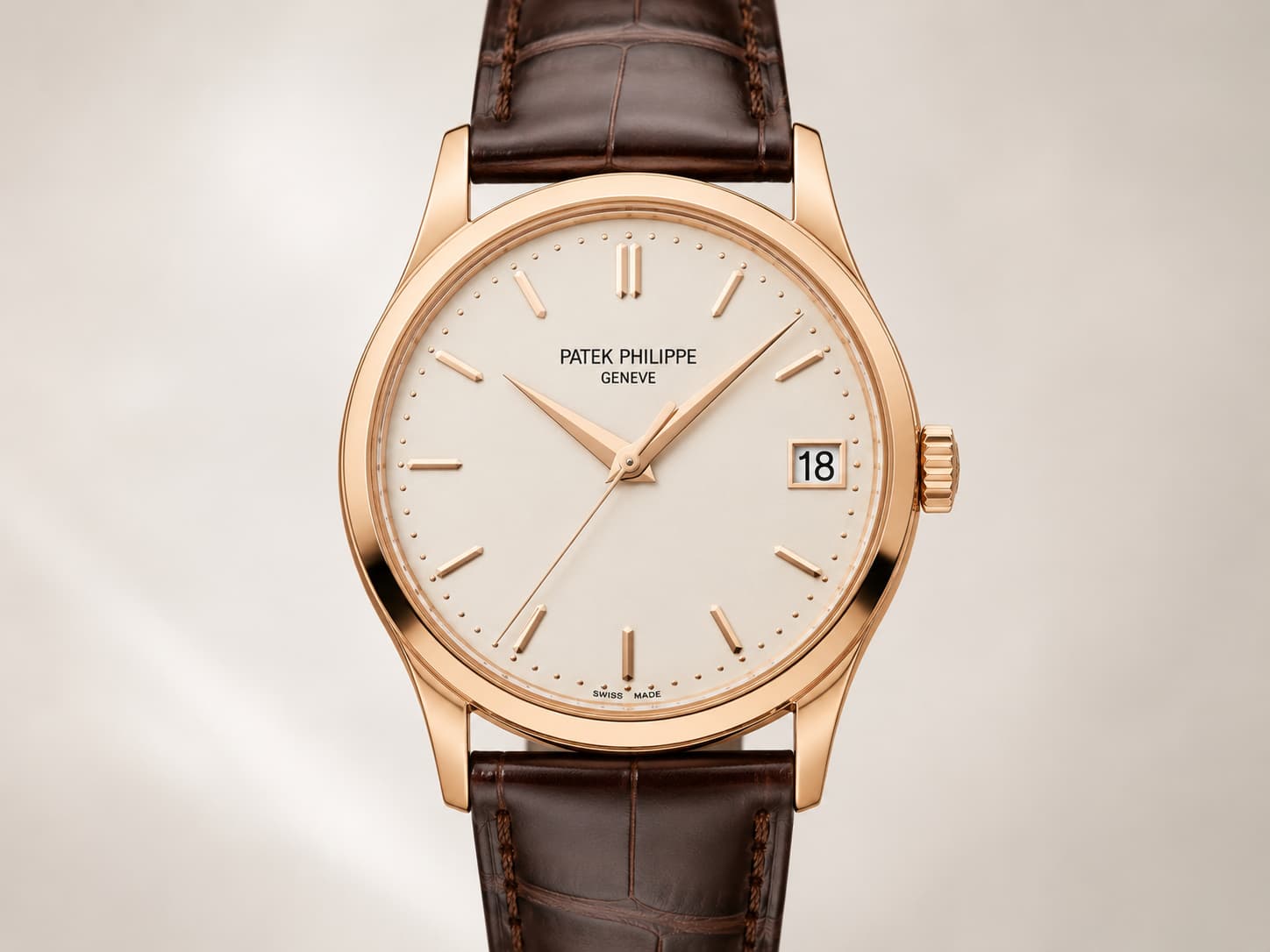
The Calatrava is a simple, round watch with clean lines and no unnecessary decoration, and it became the blueprint that almost every dress watch made since has copied in some way.
The story starts in 1932, the same year the Stern family bought Patek Philippe. The company needed a watch that could sell reliably during the Great Depression, so it created Reference 96: a 31mm, hand-wound, gold watch with a flat bezel, straight lugs, and a dial stripped down to just hour markers and hands. There was no chronograph, no rotating bezel, nothing extra. The idea was that a watch’s beauty comes from proportion and restraint, not from adding more stuff to it.
That philosophy stuck. Decades of Calatrava references followed, including the 2526 in the 1950s, which was Patek’s first automatic (self-winding) Calatrava, and eventually today’s 5196 and 5227 references, which are the direct descendants of that original 1932 design. Vintage Reference 96 watches are now genuinely collectible, with plain examples selling for a few thousand dollars and rare dial variations reaching well over $100,000 at auction. Unlike Patek’s sports watches, the Calatrava usually trades at or close to its retail price on the secondary market, since demand and supply are more balanced.
Nautilus: The Steel Sports Watch That Started a Craze
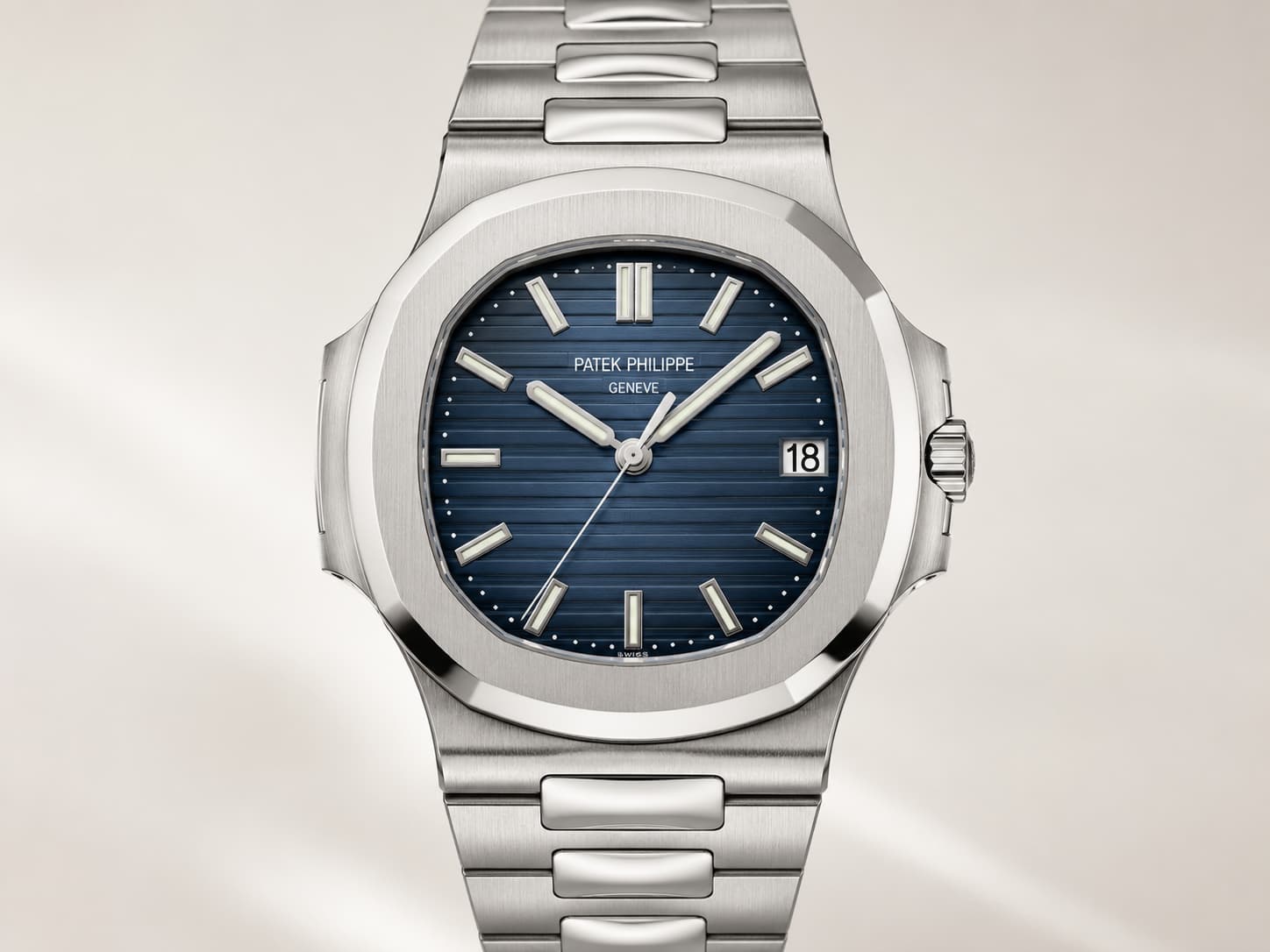
The Nautilus is a steel sports watch with a distinctive porthole-shaped case and horizontal ridges on the dial, and it is the single watch most responsible for making steel Patek Philippe watches wildly expensive to buy today.
Designer Gérald Genta reportedly sketched the Nautilus in 1972 after being inspired by a ship’s porthole, and it launched in 1976 with an integrated bracelet that flowed directly into the case. At the time, a steel sports watch selling at a luxury price was a strange idea, since steel was normally the cheap option. Genta had already designed a similar concept for Audemars Piguet’s Royal Oak a few years earlier, and together the two watches essentially invented the “luxury steel sports watch” category that is now hugely popular across the whole industry.
The most famous modern version, Reference 5711, was introduced in 2006 and became so popular that waiting lists stretched for years. Patek Philippe officially discontinued the steel 5711 in 2021, a decision the brand’s president explained was meant to prevent the company from becoming known for just one watch. That move backfired in terms of controlling hype: prices for used 5711s spiked immediately after the announcement, at one point trading for triple or more their original retail price, before settling down somewhat as the initial frenzy cooled. Patek Philippe followed the steel 5711 with the 5811, a similar-looking Nautilus made in white gold instead of steel, and the closest thing to a steel “sporty” Nautilus still in the regular catalog today is the 5726, which adds an annual calendar and moonphase display.
Aquanaut: A More Casual Everyday Option
The Aquanaut is Patek Philippe’s rubber-strap sports watch, built to be tougher and more casual than the Nautilus while still carrying the same in-house craftsmanship.
It launched in 1997 as a slightly more affordable, more rugged sibling to the Nautilus, featuring a case with rounded edges and eight sides and a grippy, textured rubber strap that Patek Philippe nicknamed “Tropical.” For its first decade, it lived somewhat in the Nautilus’s shadow, but demand for it picked up sharply around 2010 and has stayed strong since. The steel Aquanaut, reference 5167A, has an official retail price in the tens of thousands of dollars, but like other steel sports Pateks, it regularly resells for two to three times that amount because production numbers stay limited compared to demand. It is often recommended for owners who want genuine Patek Philippe craftsmanship in something that can be worn day to day, from the office to the outdoors, without the extra caution a delicate gold dress watch would require.
Grand Complications: Patek’s Most Advanced Watches
Patek Philippe’s Grand Complications collection is where the brand shows off its most advanced mechanical watchmaking, including perpetual calendars, chiming mechanisms, and tourbillons.
A “complication” is watchmaker language for any function beyond simply telling the time and date. A perpetual calendar, for example, automatically knows how many days are in each month (including February in a leap year) without needing to be manually adjusted for decades. A minute repeater chimes out the time on tiny gongs inside the case, entirely mechanically, with no battery involved.
The absolute peak of this collection is the Grandmaster Chime, first released in 2014 for Patek Philippe’s 175th anniversary. It packs 20 complications into a double-sided case that can be flipped to show either the time or the calendar. One unique stainless steel version of the Grandmaster Chime, made for the 2019 Only Watch charity auction, sold for roughly $31 million, making it the most expensive watch ever sold at auction. That is an extreme, one-of-a-kind example rather than a standard boutique offering, but it shows how far Patek Philippe is willing to push mechanical complexity.
Twenty~4: Patek Philippe’s Women’s Watch
The Twenty~4 collection was Patek Philippe’s first line designed specifically as a women’s watch, launched in 1999 with clean, geometric cases meant to pair easily with everyday and formal outfits alike.
Early Twenty4 models leaned toward a more rectangular, art-deco-inspired shape, often set with diamonds, and were originally offered with quartz movements for accuracy and low maintenance. Over time the collection expanded to include round cases and mechanical automatic movements as well, giving buyers more choice depending on whether they want a classic jewelry-watch look or something closer to the brand’s mechanical sports watches. Within Patek Philippe’s current lineup, some Twenty4 references sit among the brand’s more accessible entry points.
What to Consider When Buying a Patek Philippe
The biggest factor in buying a Patek Philippe isn’t really “which features to look for,” the way it might be with a more mainstream watch brand — it’s understanding waitlists, authentication, and how a given collection behaves on the market.
- Collection first, model second. The choice between a quiet dress watch (Calatrava, Twenty~4) and a sports watch (Nautilus, Aquanaut) matters more than any specific reference number early on, since the two categories behave very differently in terms of availability and price.
- Waitlists are real, especially for steel sports models. Authorized boutiques often have long waiting lists for the Nautilus and Aquanaut, and walking in and buying one off the shelf the same day is rare. Calatrava and Twenty~4 models are generally far easier to purchase directly.
- Authentication matters on the secondary market. Because Patek Philippe watches carry such high resale value, they are frequently targeted by counterfeiters. Buying through an authorized dealer, or having a reputable independent watchmaker verify a pre-owned piece, is the safest way to confirm a watch is genuine.
- Papers and box affect value. A Patek Philippe sold with its original box, warranty papers, and any extra straps or links generally holds its value better and is easier to resell later than a “watch-only” example.
Resale Value of Patek Philippe Watches
Patek Philippe has one of the strongest resale reputations in the entire watch industry, but that reputation applies unevenly across its different collections.
Steel sports watches are where the biggest price swings happen. The discontinued Nautilus 5711, for example, had an original retail price around $30,000–$35,000 and has traded for well over $100,000 on the secondary market at various points since its discontinuation in 2021, though prices have cooled somewhat from their 2022 peak. The Aquanaut 5167A shows a similar pattern on a smaller scale, commonly reselling for two to three times its retail price. Dress watches like the Calatrava behave very differently: because Patek Philippe produces enough of them to meet demand, they typically sell close to their original retail price rather than at a big premium.
It’s worth being cautious about treating any watch purely as a financial investment. Prices can also fall, as seen with some perpetual calendar references that have depreciated from their original retail price over time. The safest way to think about it is that a small number of specific references, mostly limited-production steel sports models, have historically appreciated strongly, while the rest of the catalog behaves more like a well-made object that happens to hold its value reasonably well rather than a guaranteed money-maker.
Patek Philippe Maintenance Tips
A Patek Philippe is a precision mechanical instrument, and a few simple habits go a long way toward keeping it running accurately for decades.
Mechanical watches, including most Patek Philippe models, should be serviced by a qualified watchmaker roughly every three to five years, even if the watch seems to be running fine, since the tiny amounts of oil inside the movement dry out over time. Automatic (self-winding) models will stop if left unworn for a couple of days, so owners with multiple watches sometimes use a watch winder to keep an automatic piece running between wears, though this is a matter of convenience rather than necessity. Manual-wind models, like many Calatrava references, need to be wound by hand roughly once a day.
Extreme temperature changes, strong magnets (including modern smartphone speakers and laptop magnetic closures), and hard knocks are the most common everyday threats to a mechanical movement’s accuracy. Most steel and gold Patek Philippe watches can handle everyday splashes, but water resistance ratings vary significantly by model, so it’s worth checking a specific reference’s rating before swimming or showering with it. Keeping the watch in a dry place, wiping it down after wear, and avoiding at-home attempts to open the case back are simple habits that protect both the movement and the watch’s resale value.
A few basic tools make day-to-day upkeep easier, and none of them are complicated or expensive. A soft, lint-free microfiber cloth is enough to wipe away fingerprints, dust, and skin oils after each wear, and it’s gentler on the case and crystal than any household fabric. A lined watch box, or even a simple soft pouch, keeps the case and bracelet from picking up scratches when the watch isn’t being worn, and a small silica gel packet stored alongside it can help absorb excess moisture in humid climates. For automatic models that get worn irregularly, a quality watch winder can keep the movement running and the calendar functions (on models that have them) from needing to be reset every time the watch sits for a couple of days, though this is purely a convenience and not something the watch needs to stay healthy. Best avoided at home is anything abrasive, like polishing cloths meant for silver jewelry, or do-it-yourself ultrasonic cleaning, since both can damage finishing or seals that are best left to a professional.
Frequently Asked Questions
Is Patek Philippe more expensive than Rolex?
Generally, yes. Entry-level Patek Philippe watches start well above entry-level Rolex prices, and Patek’s most complicated pieces can cost hundreds of times more than a typical Rolex, largely because of the extra hand-finishing and lower production numbers involved.
Why is the Patek Philippe Nautilus so hard to buy?
Patek Philippe intentionally produces the Nautilus in limited numbers each year, and demand has consistently outpaced that supply for over a decade. Authorized dealers often have long waiting lists, and the steel 5711 model was discontinued entirely in 2021, which made existing examples even scarcer.
What is the most expensive Patek Philippe watch ever sold?
A unique stainless steel Grandmaster Chime, reference 6300A-010, sold for roughly $31 million at the 2019 Only Watch charity auction in Geneva, making it the most expensive watch ever sold at auction.
Does Patek Philippe make watches for women?
Yes. The Twenty~4 collection, launched in 1999, was designed specifically with women in mind, and several references across the Calatrava, Nautilus, and Aquanaut lines are also offered in smaller case sizes aimed at female wearers.
Who owns Patek Philippe?
The Stern family has privately owned Patek Philippe since 1932, making it the last major independent, family-owned watch manufacturer based in Geneva.
Conclusion
Patek Philippe’s lineup covers a lot of ground, from the understated Calatrava that started as a Depression-era survival strategy, to steel sports watches like the Nautilus and Aquanaut that turned into some of the most sought-after objects in the entire watch industry, up to the Grand Complications and Grandmaster Chime that represent the outer edge of what a mechanical watch can do. What ties all of it together is the same thing that has defined the brand since 1839: independence, in-house engineering, and a willingness to spend far more time on finishing than almost any competitor. Understanding those differences, and how each collection behaves once purchased, is really the key to understanding why people talk about Patek Philippe the way they do.