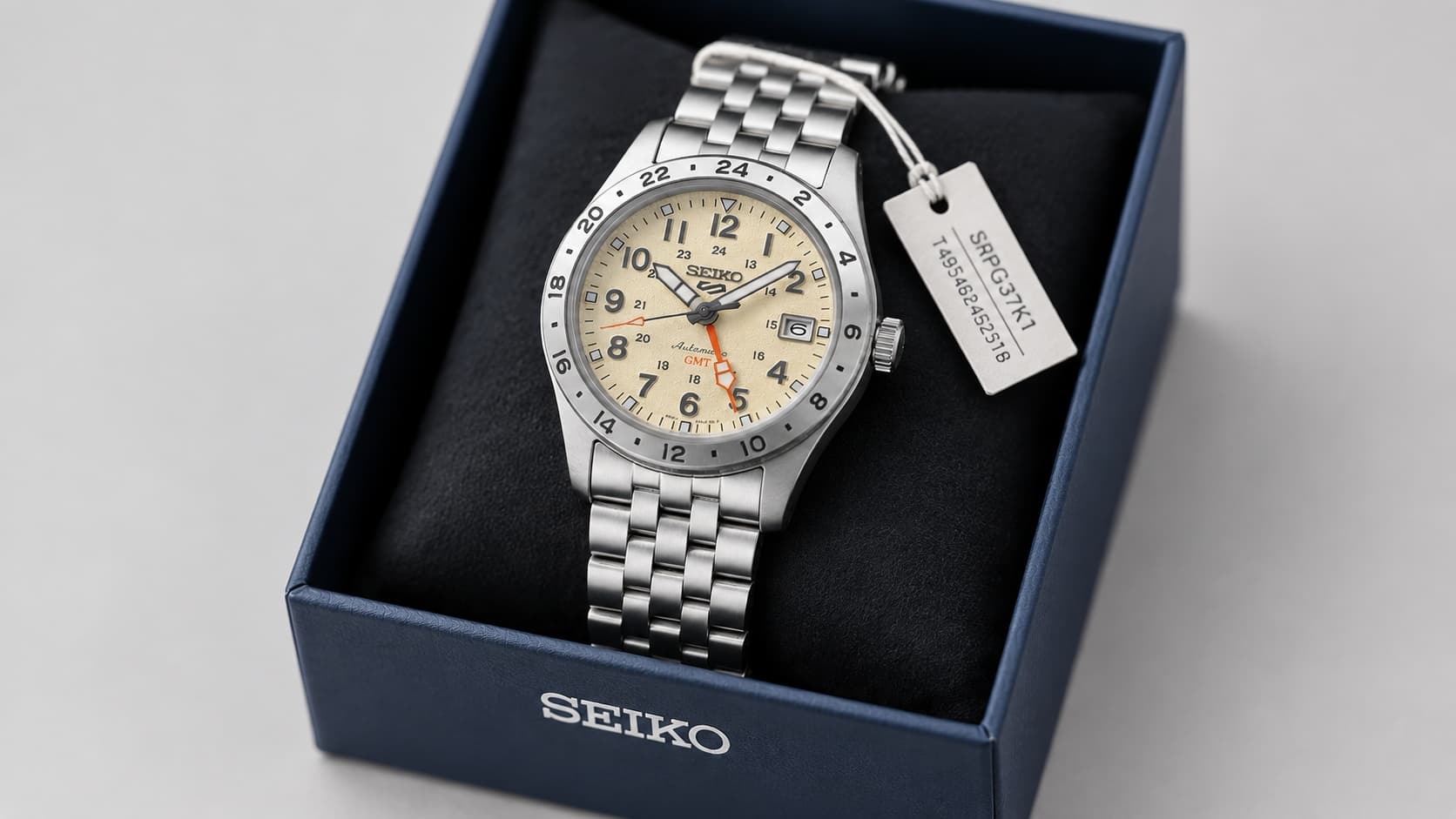
Seiko has been making watches since 1881, and somewhere along the way it became one of the only watch companies on Earth that can design, build, and finish every single part of a watch under its own roof. That matters more than people realize, because it means a $150 Seiko and a $15,000 Grand Seiko both come from the same family tree of engineering, not from two different companies pretending to be related. The catalog is enormous, spanning affordable everyday automatics to hand-finished luxury pieces, and each collection carries its own history, price range, and purpose.
Best Seiko 5 Sports Models and Why They’re Popular
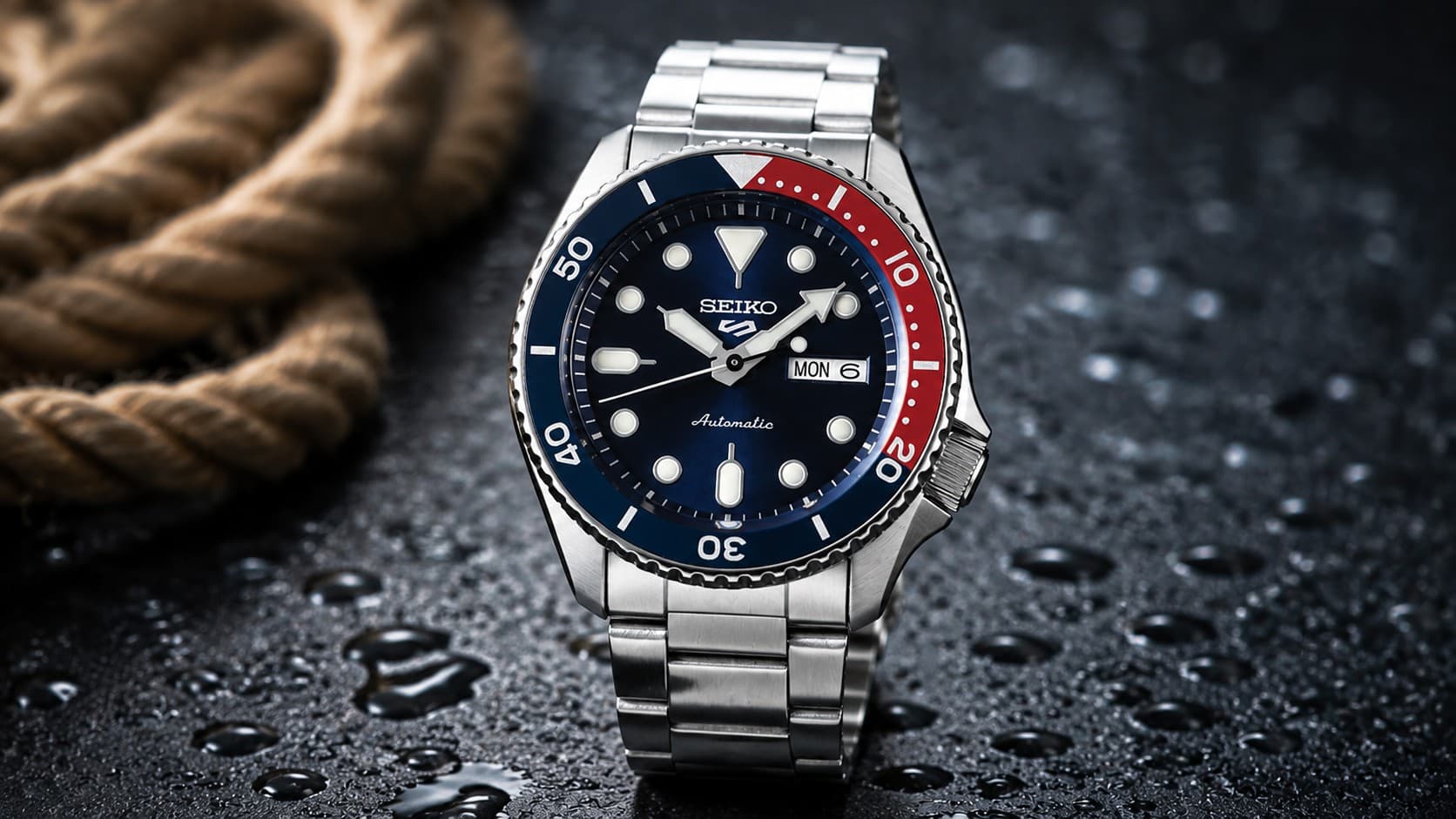
The Seiko 5 Sports is the easiest way to own a real mechanical watch without spending real money, with most models priced between roughly $250 and $500. It runs on a self-winding movement, meaning ordinary wrist motion keeps it powered, so there’s no battery to replace and no manual winding needed with regular wear.
The line traces back to 1963, when Seiko introduced the original Sportsmatic 5 and built it around five specific features: an automatic movement, a day and date shown in one window, a recessed crown at the 4 o’clock position, water resistance, and a sturdy case and bracelet. That’s actually where the “5” in the name comes from — not the price, not a model number, but those five original attributes. Nearly every 5 Sports made since has kept that formula, which is part of why the line has stuck around for more than sixty years.
Modern 5 Sports watches are organized into five style families — Sports, Suits, Specialist, Street, and Sense — so the design ranges from rugged dive-inspired pieces to slim, dressier options. Most current models use the 4R36 caliber, a movement with roughly 41 hours of power reserve, meaning it keeps running for about a day and a half once removed from the wrist. Because parts and servicing are widely available and the movement is simple and well understood, it’s also one of the easier watches to have repaired almost anywhere in the world.
The 5 Sports SKX Series is the family’s best-known name, a modern continuation of the beloved SKX007 dive-style watch that collectors long asked Seiko to bring back. Seiko refreshed this series in 2025 with new references, and the current lineup still centers on that same tough, no-nonsense dive-watch shape, priced generally around $400 for strap versions and slightly more on steel bracelets. Many of the dive-styled Seikos seen on people’s wrists that aren’t marketed as serious dive tools trace back to this series.
Watch collectors often recommend a 5 Sports as the first “real” watch someone buys, specifically because it teaches a wearer what they like — dial size, weight, bracelet feel — before committing serious money to something else.
Best Seiko Prospex Watches for Diving and Adventure
Prospex is Seiko’s dedicated line for divers, pilots, and anyone who needs a genuinely tough tool watch, and it traces back to a real letter from a professional diver in 1965. That diver reported that existing watches were failing at depth, so Seiko’s engineers built a proper response: Japan’s first true diver’s watch, now known by collectors as the 62MAS, with 150 meters of water resistance and a design built for reliability over decoration.
That original watch was tested during the Japanese Antarctic Research Expedition between 1966 and 1969, which is about as harsh a proving ground as a watch can get. Seiko kept pushing the diving line forward after that, eventually developing saturation divers rated to 600 meters with titanium cases built to survive the extreme pressure changes of deep-sea work. Today’s Prospex collection covers everything from modern reissues of that 1965 original to serious professional dive watches, along with pilot and field watch designs under the same umbrella.
Water resistance in Prospex models typically ranges from 100 meters up to 300 meters or more, and current dive models commonly use in-house movements like the 6R35 or the higher-grade 8L35, both offering multi-day power reserves. For anyone who swims, snorkels, or dives, or simply wants a watch built to survive rough outdoor use, this is the collection designed specifically for that purpose.
What Makes a Watch a “Real” Diver’s Watch
A genuine diver’s watch needs to meet specific technical standards, not just look rugged. It has to have a water resistance rating suited to actual diving (typically 100m or more), a unidirectional rotating bezel to track dive time safely, high-contrast markers that stay readable in low light, and a case built to resist magnetism and shock. Many of Seiko’s higher-end Prospex divers are built to meet ISO 6425, the international standard that governs what can legally be called a diver’s watch, which is different from a “diver-style” watch that only borrows the look without meeting the standard.
Within Prospex, the Marinemaster line sits at the top as the flagship diver series, built around Seiko’s most advanced dive-specific movements and finished with mirror-polished edges designed to avoid snagging on diving equipment. The price gap between an entry-level Prospex diver and a Marinemaster can run well over $1,000, despite both sharing the same basic diving pedigree.
Seiko Presage: Best Dress Watches from Seiko
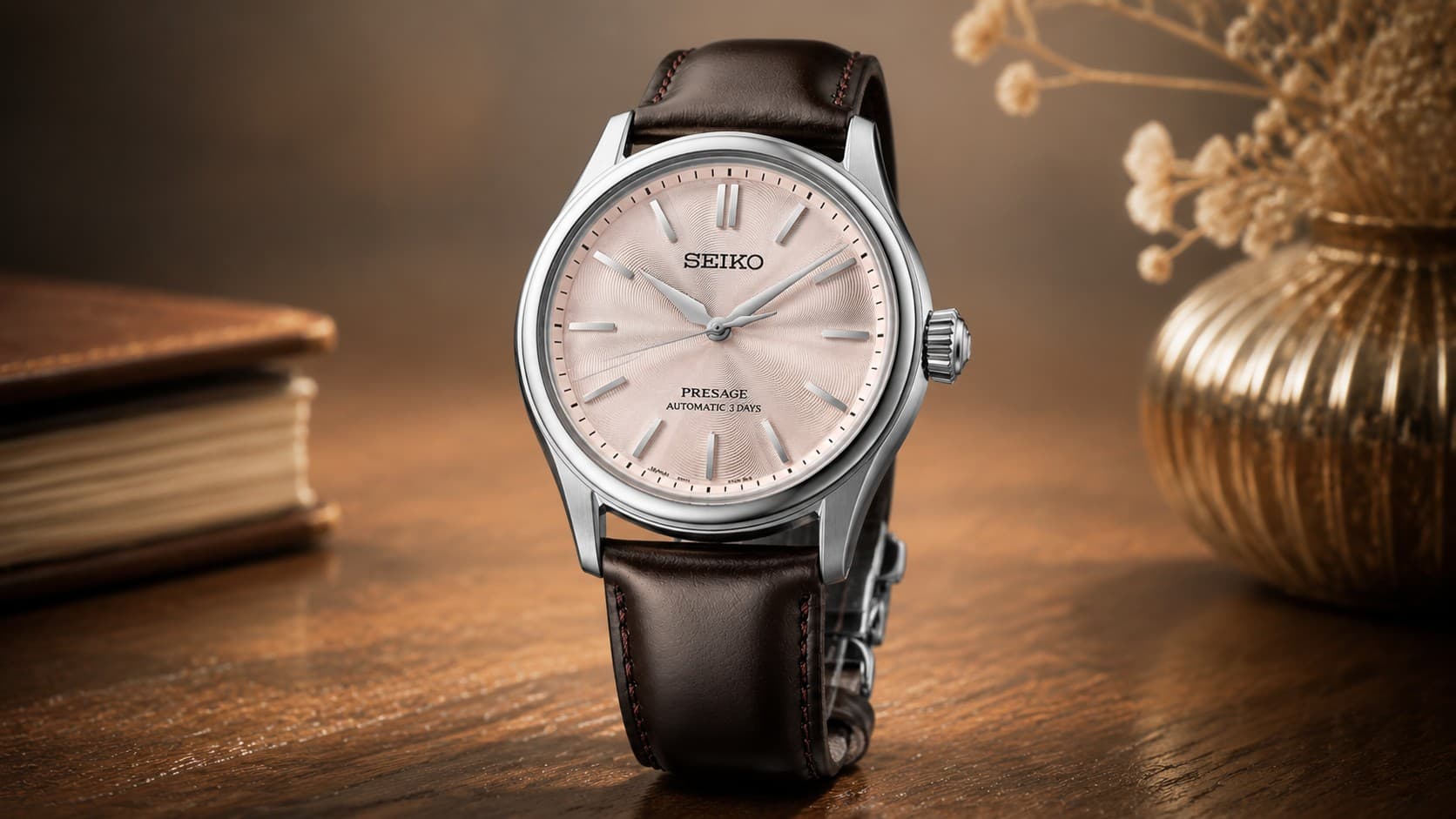
Presage is Seiko’s line built around classic dress-watch styling and traditional Japanese craftsmanship techniques, usually priced from around $400 up to over $1,000 depending on the model. Instead of chasing sport-watch toughness, Presage leans into things like enamel dials, hand-applied lacquer finishes, and textures inspired by traditional crafts such as Arita porcelain and Kiriko cut glass.
Many Presage models use Seiko’s 6R series or 4R series automatic movements, which offer around 41 to 72 hours of power reserve depending on the specific caliber. The line is aimed at elegant, understated mechanical watches rather than sporty ones, the kind that pair naturally with a suit. It sits in an interesting spot in Seiko’s lineup: more refined and detail-oriented than the 5 Sports, but still far more affordable than Grand Seiko.
The best-known family within Presage is Cocktail Time, first introduced in 2010 and folded into the Presage name in 2017. Each model in the series takes its dial color and texture from a specific cocktail, with sunburst lacquer dials meant to catch light the way a drink catches light in a glass — a light blue “Cool” dial, a golden “Star Bar” dial, and dozens of others that have followed since. Above that sit the Prestige-tier Presage pieces, which use genuine enamel or hand-painted Arita porcelain dials, techniques with roots going back centuries in Japanese craft traditions, though these naturally cost more than the sunburst-dial models.
Seiko Astron: The World’s First Quartz Watch
Seiko didn’t just make a good quartz watch — it invented the entire category. In December 1969, Seiko released the original Astron, the world’s first quartz wristwatch, and it completely reshaped what the watch industry thought was possible for accuracy. Mechanical watches, even excellent ones, can drift by several seconds a day, while quartz movements measure time using the vibration of a quartz crystal and stay accurate to within seconds a month.
That launch triggered what’s often called the “Quartz Crisis” of the 1970s and 80s, a period when cheaper, more accurate quartz watches from Japan put serious pressure on traditional Swiss mechanical watchmaking. The modern Astron line has evolved into something even more advanced: GPS Solar technology, which syncs a watch’s time and time zone automatically using GPS satellite signals, powered entirely by light hitting the dial. That eliminates both battery changes and manual time-zone adjustment during travel, something no mechanical watch, however expensive, can actually do.
Grand Seiko: Technically a Different Brand, But Still Seiko’s Family Tree
Grand Seiko is, technically, no longer “a Seiko.” Since Baselworld 2017, it has been presented as a fully separate, standalone luxury brand, with its own name at 12 o’clock on the dial instead of Seiko’s. Before that, it had operated as Seiko’s top-tier line since 1960, sold almost exclusively in Japan until it launched internationally in 2010.
Despite the separation, Grand Seiko remains part of the same corporate family (Seiko Watch Corporation), and it still shares core engineering roots with mainline Seiko, including the Spring Drive technology developed in-house. Spring Drive is a genuinely unusual hybrid: it’s mechanically wound like a traditional automatic watch, but it uses a quartz-regulated glide wheel instead of a ticking escapement, so the seconds hand sweeps in one continuous, silent motion instead of ticking. Grand Seiko watches currently range from around $2,200 to well over $60,000, positioning the brand as a genuine rival to Swiss houses like Omega and Breitling rather than a budget alternative.
Grand Seiko’s case finishing is done using Zaratsu polishing, a mirror-flat technique adapted from traditional Japanese sword-making that creates distortion-free surfaces and crisp, sharp edges instead of the slightly rounded polish most brands use. That same attention shows up in the dials, many of which are modeled directly on natural scenery near Seiko’s studios in Japan. The famous “Snowflake” dial takes its texture from the winter scenery around Seiko’s Shinshu studio in Nagano, where the surrounding mountains sit blanketed in snow for much of the year, and later dials like “White Birch” and “Omiwatari” carried the same idea forward, each one turning a specific piece of Japanese landscape into a dial pattern that shifts and catches light differently depending on the angle.
Comparing the Main Seiko Collections
| Collection | Typical Price Range | Best For | Key Feature |
|---|---|---|---|
| Seiko 5 Sports | $250–$500 | First automatic watch, everyday wear | Simple, durable 4R36 automatic movement |
| Prospex | $400–$1,500+ | Diving, outdoor use, tool-watch fans | Real dive certification, high water resistance |
| Presage | $400–$1,200+ | Dress occasions, craftsmanship lovers | Traditional Japanese finishing techniques |
| Astron | $1,000–$3,000+ | Frequent travelers, tech-minded buyers | GPS Solar time-zone syncing |
| Grand Seiko | $2,200–$60,000+ | Luxury buyers, serious collectors | Spring Drive movement, hand-finishing |
How to Choose the Right Seiko Watch
The right Seiko depends far more on daily use than on what looks impressive in photos. Someone buying their first mechanical watch on a modest budget is usually better served by a 5 Sports than by stretching for a Presage they’d be nervous to wear. Someone who swims, surfs, or works outdoors gets genuine functional value from a Prospex diver that a dress watch simply can’t offer. And someone shopping in the true luxury tier should understand that a Grand Seiko is, on paper, a separate brand from the Seiko name they may already know, even though the craftsmanship lineage runs directly through it.
Movement type matters as much as collection name. Automatic watches (5 Sports, Prospex, Presage, most Grand Seiko mechanical models) need regular wrist time or a watch winder to stay running, while quartz and Spring Drive pieces (Astron, some Grand Seiko models) hold their accuracy with far less day-to-day attention.
Warranty coverage is a practical factor as well. Seiko backs its watches with a three-year limited warranty (Grand Seiko offers up to five years), but that coverage only applies when a watch is purchased through an authorized dealer with a properly filled-out warranty card. A watch bought through an unauthorized “grey market” seller, even if it’s completely genuine, generally won’t be covered if something breaks. This matters most for Grand Seiko and higher-end Prospex pieces, where servicing costs are higher and warranty coverage carries real financial weight.
Frequently Asked Questions
Are Seiko watches actually good quality?
Yes. Seiko is one of only two watch companies in the world, alongside Rolex, that designs, manufactures, and assembles essentially every component of its watches in-house rather than outsourcing parts to other suppliers. That level of vertical integration is normally associated with far more expensive brands.
What’s the difference between Seiko and Grand Seiko?
They’re technically separate brands as of 2017, even though Grand Seiko began as Seiko’s top-tier line in 1960 and both remain owned by the same parent company. Seiko covers accessible, mass-market watches, while Grand Seiko focuses entirely on high-end, hand-finished luxury pieces priced well into the thousands of dollars.
Which Seiko is best for a beginner?
The Seiko 5 Sports is generally the best starting point, since it’s affordable, widely available, easy to get serviced, and built around a simple, reliable automatic movement that’s been refined since 1963.
Do Seiko watches hold their value?
Some do, particularly limited editions and older vintage references like the original 62MAS-inspired divers, but most mainstream Seiko models are priced for everyday wear rather than as investment pieces. Grand Seiko and rare Prospex limited editions are the exceptions most likely to hold or grow in value over time.
What does “automatic” mean on a Seiko watch?
An automatic watch winds itself using a weighted rotor that spins with natural wrist movement, storing energy in a spring instead of relying on a battery. Most Seiko automatics keep running for around 40 to 72 hours after being taken off, depending on the specific movement.
Where are Seiko watches actually made?
It depends on the collection. Grand Seiko and Prospex’s top-tier models are made entirely in Japan, mainly at the Shizukuishi and Shinshu studios, while many 5 Sports and entry-level Prospex models are assembled at Seiko’s own facilities in Malaysia, with movement components also produced in Singapore. The model number offers a quick clue: watches ending in “J” were assembled in Japan, while those ending in “K” were assembled elsewhere, though every location follows the same Seiko quality standards regardless of where final assembly happens.
How accurate are Seiko watches?
It depends entirely on the movement type. The 4R36, Seiko’s common entry-level automatic caliber used in most 5 Sports models, is factory-rated at -35 to +45 seconds per day, though many individual watches run noticeably tighter than that in practice. Higher-grade mechanical calibers used in Presage and Prospex tighten that range considerably, while quartz movements are far more precise, and Astron’s GPS Solar watches self-correct via satellite signal so they stay effectively exact.
Conclusion
Seiko’s real strength isn’t any single watch, it’s the range: a $250 5 Sports and a $50,000 Grand Seiko both trace back to the same 1881 workshop and the same commitment to building everything in-house rather than buying parts off the shelf. The 5 Sports remains the smartest entry point for a dependable everyday automatic. Prospex earns its place for anyone who needs a watch that can survive real water and real abuse. And where craftsmanship and prestige matter more than budget, the path leads to Grand Seiko, a brand that grew up inside Seiko before becoming something entirely its own.