Almost any jewelry shop carries at least one ring, pendant, or bracelet covered in loops that twist over and under each other with no clear start or finish. These are Celtic knots, and people have been wearing them for well over a thousand years because the pattern itself tells a story. A line that never breaks and never ends is a simple, powerful way to talk about the things that matter most in life: love that lasts, family bonds, faith, and the idea that life keeps going in cycles rather than stopping in a straight line.
Where Do Celtic Knots Come From?
Celtic knots did not start with the Celts, which surprises a lot of people. Historians trace the earliest interlace designs to Roman mosaic floors, with examples dating back roughly seventeen hundred years, well before Irish monks ever picked up the style. From there the technique spread across an enormous stretch of the ancient and medieval world, showing up independently in Islamic geometric art, Byzantine church decoration, Coptic textiles from Egypt, and Ethiopian manuscript painting, which suggests that weaving unbroken lines together was an idea many separate cultures landed on for their own reasons.
The knots became linked with Ireland and the Celts a bit later, once local artists picked up the style and made it their own. Craftsmen working between roughly 2000 BC and 500 AD were already shaping metal into decorative designs, and by the early medieval period, Celtic artists had turned interlace into something distinctly theirs, full of spirals, animals, and endless loops. This period, running from around 700 to 900 AD, is often called the golden age of Celtic art, and it is when the interlace style really matured into the dense, complicated patterns people picture today.
Christianity reached Ireland in the fifth century, and rather than replacing the older Celtic art style, it absorbed it. Monks folded knotwork into their religious manuscripts, most famously in the illuminated pages of the Book of Kells, and stone carvers cut the same patterns into the tall High Crosses that still stand across the Irish countryside today. That blending is exactly why a single knot can carry both a pagan and a Christian meaning at once, neither one canceling out the other.
It is also worth knowing that the phrase “Celtic knot” itself is a fairly modern label. Interest in the style faded for centuries before it was deliberately revived in the 1800s, during what historians call the Celtic Revival, when Irish artists and jewelers began reproducing ancient designs found on old brooches and manuscripts to reconnect with a national identity. Almost everything sold as “Celtic knot jewelry” today, including the names given to specific knots, traces back to that 19th-century revival as much as it does to the original medieval craftsmen.
Celtic knots are often called “endless knots” for a simple reason: a finger traced along the line will never find a beginning or an end. That single detail is the root of almost everything the design is believed to symbolize.
What Do Celtic Knots Symbolize?
At their core, Celtic knots stand for continuity, connection, and eternity, ideas that come directly from the unbroken line itself. The common thread running through Celtic myth and spirituality is a sense of neverendingness, interconnectedness, and universal harmony. Because the pattern loops back into itself instead of stopping, it became a natural way to represent things that people wanted to describe as permanent, like loyalty, family ties, or a soul that continues after death.
There is also a protective side to the symbolism that is easy to miss. Scholars who study surviving pieces like the Tara Brooch describe the interlace as apotropaic, an old term for objects and patterns that were trusted to keep bad luck or evil away from whoever carried them. That belief may connect to another odd habit found across Celtic art: the carvers rarely left any bare metal or stone showing, packing every last corner with pattern instead. Art historians have a name for that instinct to avoid empty space, horror vacui, and one theory is that filling every gap was less about decoration and more about making sure no space was left open for something unwanted to slip through.
It is worth being upfront about something here too: nobody wrote down an official rulebook explaining exactly what each ancient knot meant. The lack of hard evidence makes it almost impossible to pin down the exact meaning behind many of these designs with total certainty. Much of what we associate with specific knots today comes from centuries of tradition, folklore, and reasonable guesswork based on where and how a design was used. That does not make the symbolism less meaningful, it just means the meanings evolved over a long stretch of time rather than being invented all at once.
Types of Celtic Knots and Their Meanings
Not every Celtic knot looks the same, and the differences matter. Jewelry makers usually work from a set of recognized patterns, each carrying its own layer of meaning on top of the general idea of eternity.
Trinity Knot (Triquetra)
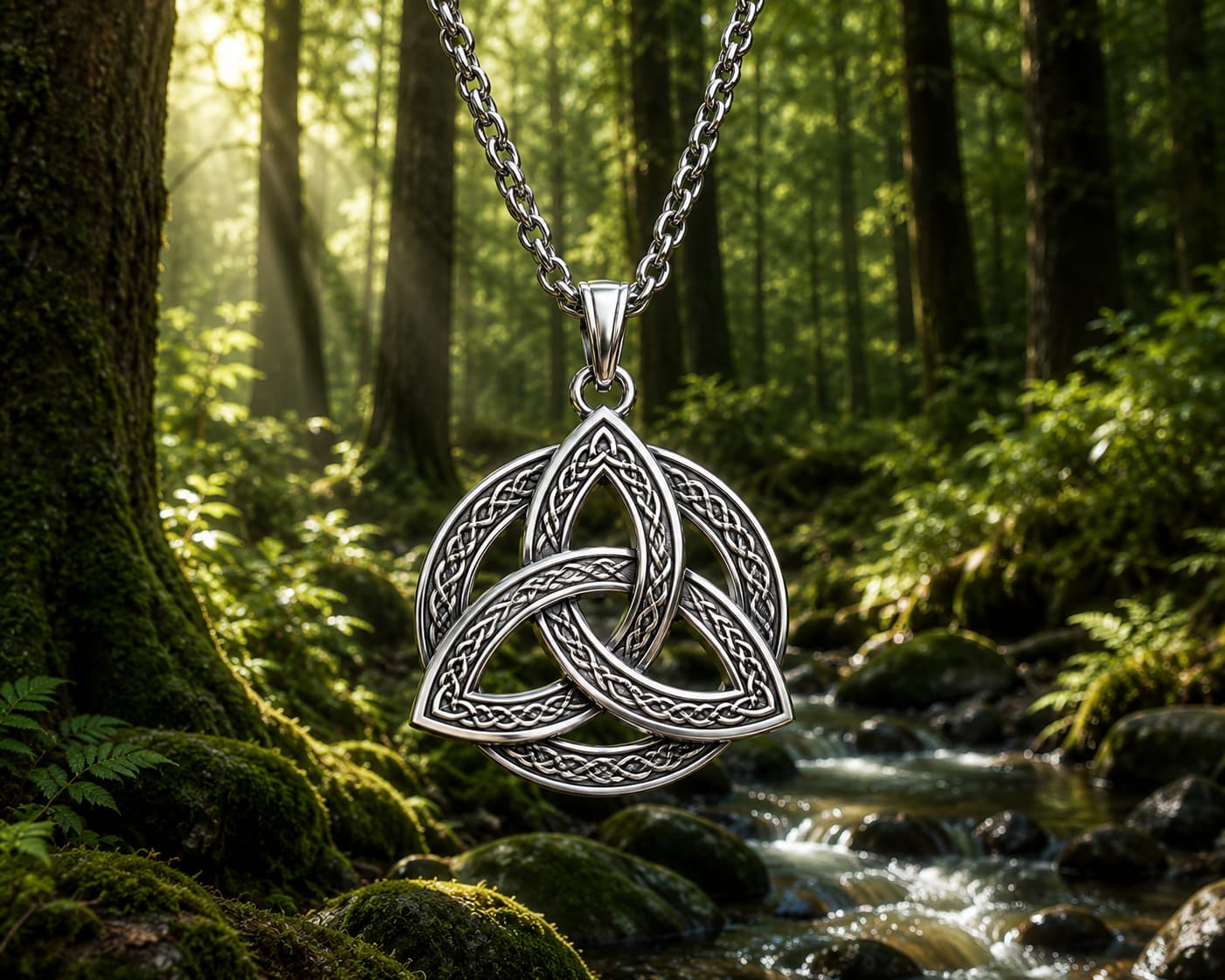
The Trinity knot is the most recognized Celtic symbol used in jewelry today, and most people have seen it somewhere even without knowing its name. Three arcs loop through one another with no clear starting point, and the same shape goes by several different names depending on the source, including triquetra, trefoil knot, and triskele. In Christian tradition it is usually read as a symbol of the Holy Trinity, Father, Son, and Holy Spirit joined as one continuous form. But the shape almost certainly existed as a pagan symbol first, and some people still connect it to the three-part cycle of life, death, and rebirth rather than, or alongside, its religious meaning.
Dara Knot
The Dara knot takes its name from the Irish word doire, meaning oak tree, and its tangled shape is meant to echo the dense root system of an oak rather than the simpler three-arc design of the Trinity knot. Because oak trees were treated as sacred in Celtic culture, standing for strength, endurance, and wisdom, this knot has come to represent inner strength and staying grounded even when life gets complicated. Unlike the Trinity knot or shield knot, the Dara knot is generally considered a modern design rather than a pattern that survives from ancient Celtic art, though it was deliberately created in that same visual tradition and draws its meaning from genuine, much older Celtic beliefs about oak trees.
Celtic Love Knot (Serch Bythol)
This design is exactly what it sounds like: a knot built to represent romantic love that does not run out. Seen quickly, the shape can almost pass for a bird in flight, but look closer and it turns out to be two Trinity knots overlapped side by side. That doubling is generally read as two individual souls merging into a single, unbroken form, which is why the design became such a natural fit for couples. It shows up often in wedding bands and anniversary jewelry, since a shape with no visible seam or ending point is an easy way to represent a relationship meant to last for good.
Celtic Shield Knot
The shield knot looks noticeably different from the others because it has four distinct corners instead of three arcs, usually enclosed within a ring. The design predates the Celts by a wide margin; researchers have traced similar four-cornered interlace back to the ancient Fertile Crescent region long before it ever reached Ireland or Britain. Once Celtic artists adopted the shape, it picked up a reputation as protective imagery, with a common belief holding that the pattern could turn away evil spirits or misfortune, which is one reason it is said to have been placed near wounded soldiers on the battlefield. That protective association is still the main reason people choose the shield knot today, generally over romantic or spiritual alternatives.
Solomon’s Knot
Despite the name, Solomon’s knot did not originate in Celtic art, but it was adopted into the tradition and used widely. Within Celtic culture specifically, the two-loop pattern is typically interpreted as a symbol of a person’s connection to the divine, rather than a bond between two people. Because of that, it tends to show up on jewelry meant to express faith or spiritual grounding rather than romance or family ties.
Celtic Spiral Knot
Spirals are actually older than the interlace patterns most people associate with “Celtic knots.” Single and double spirals were common back in the Neolithic period, well before knotwork as we know it developed. The common reading of a spiral is growth and journey, with the winding line representing the path from birth, through life, to death, and often back around to rebirth. Because the interpretation is loose, plenty of people simply take it to mean personal growth or an ongoing journey rather than anything tied strictly to Celtic mythology.
Celtic Sailor’s Knot
This one has a more practical backstory than most. Structurally it is one of the plainest Celtic knots, built from just two strands looped through four points, and that simplicity is also what makes it unusually sturdy as an actual, physical knot rather than just a drawing. That has led to a fairly reasonable theory that real sailors invented the pattern for tying rope long before it became a decorative motif. Its meaning followed the same logic: sailors are thought to have adopted it as a symbol of the people waiting for them on land, so today it is generally associated with friendship and loyalty that holds steady across distance.
Celtic Motherhood Knot
Unlike the others on this list, the motherhood knot is a modern addition rather than an ancient design. It is a relatively recent invention, not an ancient Celtic knot, but it has become popular anyway because it fills a gap: a specifically maternal symbol within the Celtic knot family, usually given as a gift to mark the birth of a child or to represent the bond between a parent and their children.
Celtic Knots in Jewelry Making
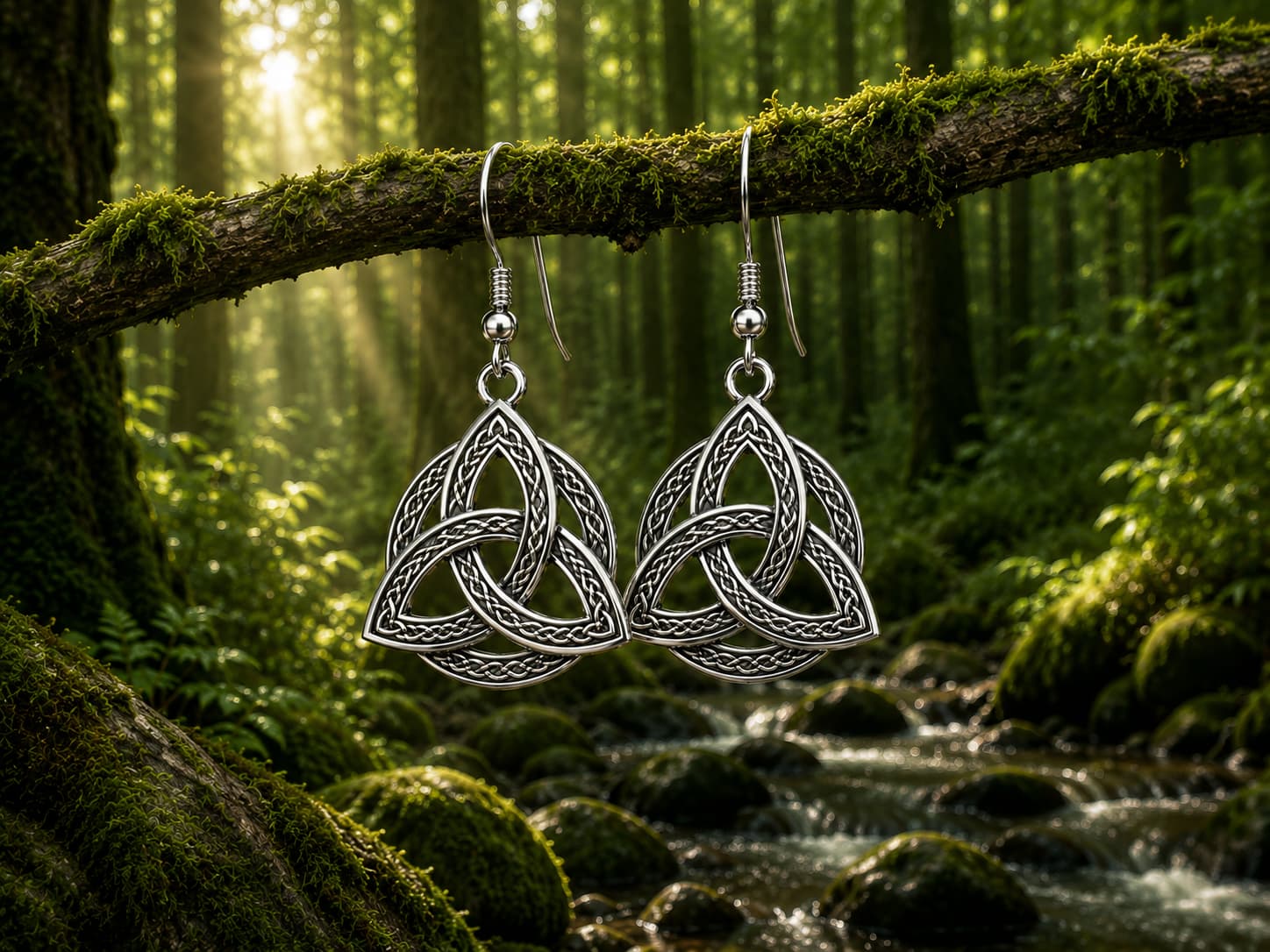
Knotwork did not start out on rings and pendants. It first appeared on large, practical objects like brooches, which Celtic men and women used to fasten heavy cloaks at the shoulder or chest. The most famous surviving example is the Tara Brooch, an extraordinarily detailed silver-gilt piece made in Ireland in the early eighth century and decorated on both sides with tiny interlace panels, filigree, and cast animal shapes. It was not just decoration either; brooches like this one signaled the wearer’s wealth and rank, so the more elaborate the knotwork, the higher the status it announced.
Along with brooches, Celtic craftsmen worked knot and spiral patterns into torcs, which were rigid metal neck rings, and later into stone High Crosses and the metal fittings on religious objects like chalices. The techniques were genuinely difficult: filigree work involved twisting extremely thin wires of gold or silver into patterns and soldering them onto a base, while chip-carving cut the design directly into cast metal. When Celtic knot jewelry disappeared from everyday fashion for several centuries, it was the rediscovery of pieces like the Tara Brooch in the 1800s that sparked the Celtic Revival and brought knotwork back into rings, brooches, and pendants, this time made for a much wider audience than Celtic nobility.
Picking a Celtic Knot for Jewelry
The fastest way to choose is to work backward from the feeling the piece is meant to carry. Someone celebrating a marriage or long relationship usually gravitates toward the love knot, while someone marking a personal milestone, like recovering from a hard year, might connect more with the Dara knot’s message of strength. A few starting points:
- For a romantic relationship, the Celtic love knot or a paired Trinity design is the traditional pick.
- For motherhood or a new baby, the motherhood knot is built specifically for that.
- For spirituality or faith rather than a relationship, Solomon’s knot or the Trinity knot carry that meaning more directly.
- For protection or resilience, the shield knot or Dara knot fit best.
Where the knot sits on the jewelry matters too, since different pieces have carried different meanings by tradition. Rings are the most symbolically loaded option because a knot worn on the hand, especially on the ring finger, has long been tied to commitment and partnership, which is why the love knot and Trinity knot show up so often on wedding and engagement bands. Pendants and necklaces sit closer to the heart, so they are commonly chosen for knots tied to protection or personal identity, like the shield knot or Dara knot, since the wearer keeps that meaning close rather than displaying it outward. Earrings and bracelets tend to be the most flexible, chosen more for how the design looks day to day than for a specific symbolic occasion.
None of these rules are strict. Because so much of Celtic knot symbolism developed through tradition and personal interpretation rather than a fixed ancient text, choosing a design simply for how it looks, and letting the meaning grow over time, is just as reasonable an approach.
Frequently Asked Questions
Do Celtic knots have religious meaning?
Some do and some don’t. The Trinity knot and Solomon’s knot both picked up strong Christian associations over time, tied to the Holy Trinity and divine union, but many Celtic knots, including the shield knot and spiral knot, trace back to pre-Christian, pagan roots focused on nature, protection, and the cycles of life.
What is the difference between a Celtic knot and a Celtic cross?
A Celtic knot is an interlacing pattern with no clear beginning or end, while a Celtic cross combines that knotwork with the shape of a cross, usually featuring a circle where the arms meet. The cross carries a more explicitly Christian meaning, though its exact origins are debated among historians.
Is it disrespectful to wear a Celtic knot without Irish heritage?
Generally, no. Celtic knots are widely worn and gifted by people without Irish or Celtic ancestry, and the jewelry industry treats them as a design tradition rather than a closed cultural symbol. That said, understanding the meaning behind a specific knot before choosing it is worthwhile, since the imagery carries real historical and spiritual weight for many people.
Which Celtic knot is best for a wedding ring?
The Celtic love knot is the most traditional choice for wedding and engagement jewelry because its interwoven, unbroken design is specifically associated with two people joined for life. The Trinity knot is also a common alternative, especially for couples who want the design to double as a nod to faith.
Can Celtic knots be combined in one piece of jewelry?
Yes, and it is quite common. Many rings and pendants blend two or more knot patterns, such as a Trinity knot layered with a spiral, to combine meanings, for example strength and love together, into a single design.
Conclusion
Celtic knots earned their staying power the honest way: not through marketing, but through more than a thousand years of people finding a pattern that says something words struggle to capture. Whether it is the three-arc Trinity knot pointing to faith, the tangled Dara knot standing for strength, or the paired loops of a love knot representing two lives joined together, each design carries a specific, traceable idea even though the exact ancient meanings were never written down in one place. Knowing the difference between these patterns turns a piece of Celtic jewelry into something that can actually be read and understood, rather than simply admired as artwork.