Ganesh jewelry is one of the most recognizable spiritual accessories in the world, worn by millions of people who want a small piece of wisdom, luck, and calm close to their skin. The elephant-headed figure shows up on pendants, earrings, and bracelets in dozens of countries, not just in India, because his story and his symbols speak to something almost everyone deals with: obstacles. Understanding what each part of his image means turns a piece of jewelry into something with real weight behind it, rather than just a nice shape hanging from a chain.
What Does Ganesh Jewelry Symbolize?
Ganesh jewelry mainly symbolizes wisdom, the removal of obstacles, and new beginnings. In Hindu tradition, Ganesha is called upon before starting something important, like a new job, a wedding, or a big trip, because he is believed to clear the path ahead. That is why so many people choose to wear him rather than just display him in a home shrine.
Beyond that single big idea, Ganesh jewelry carries several smaller meanings tied to his physical features. Each part of his body, from his ears to his belly, stands for a different life lesson. That layered symbolism is a big reason his image has stayed popular in jewelry design for so long.
Who Is Ganesh (Ganesha)?
Ganesha is one of the most widely worshipped deities in Hinduism, known as the remover of obstacles and the god of wisdom and new beginnings. He is usually shown with a human body and the head of an elephant, which makes him instantly recognizable even to people who know little else about Hindu mythology.
He is traditionally described as the son of the god Shiva and the goddess Parvati. Britannica notes that several different stories describe how he was born, including one version where Parvati shapes him out of cloth and asks Shiva to bring him to life. His popularity has also spread beyond strict religious practice, appearing in art, home decor, and jewelry across many cultures today.
His name is also a clue to who he is. “Ganesha” combines two Sanskrit words: gana, meaning a group or troop, and isha, meaning lord or master, so the name roughly translates to “lord of the troops” or “lord of the attendants.” He also goes by several other names that show up on jewelry and in prayers, including Ganapati, Vinayaka, and Vighnaharta, which means “remover of obstacles.” His reach also goes beyond Hinduism, since he is respected and worshipped in some Buddhist and Jain communities as well, which partly explains why his image travels so easily across different cultures and jewelry markets.
The Story Behind His Elephant Head
The most well-known version of the story explains that Parvati wanted company while her husband was away and fashioned a son out of material taken from her own body — different tellings describe it as clay, sandal paste, or the dirt she washed off while bathing. She brought the boy to life and set him to guard her door during a bath. When Shiva returned unannounced and the boy refused to let him in, not recognizing his own father, an angry Shiva cut off the child’s head.
To undo the damage and calm Parvati’s grief, Shiva sent his followers out to bring back the head of the first animal they found resting with its head pointed north, a direction tied to wisdom in Hindu belief. That animal turned out to be a young elephant, and once its head was fitted onto the boy’s body, he was brought back to life as Ganesha. Different regions and traditions tell slightly different versions of this myth, but the elephant head is consistently tied to the idea of gaining deep intelligence and a fresh start after a hard event.
The Meaning Behind Each Ganesh Feature
Jewelry designers rarely draw Ganesha as a random shape. Nearly every feature on his body is included on purpose because it stands for a specific quality, so wearing the full figure is really wearing a small collection of lessons at once.
The Elephant Head: Wisdom and Big-Picture Thinking
The elephant head represents wisdom, strong memory, and the ability to think in a bigger, calmer way than most people manage day to day. Elephants are known for being intelligent and patient animals, so giving Ganesha this head was a way of saying he thinks clearly even when things get chaotic.
On a pendant, this is usually the first thing anyone notices, and it sets the tone for the rest of the design. It is the reason Ganesh jewelry is popular with students and people starting new careers, since both situations call for clear thinking.
The Big Ears: Listening More Than Talking
Ganesha’s large, fan-shaped ears stand for the value of listening carefully rather than rushing to speak. The idea is simple: someone who listens well tends to make smarter decisions than someone who only talks.
Jewelers often exaggerate the ears slightly in pendant designs to keep this detail visible even in small pieces. It is a small design choice with a clear message attached to it.
The Trunk: Being Strong and Gentle at the Same Time
The trunk is one of the most flexible parts of an elephant’s body, strong enough to move heavy objects yet gentle enough to pick up something tiny and delicate. In Ganesh symbolism, this dual ability represents adaptability, the skill of staying strong under pressure while still being gentle with people.
Many pendant designs curve the trunk in different directions, and some believers say the direction it curves changes the pendant’s meaning slightly, though this varies by tradition and is not treated as a strict rule everywhere.
The Small Eyes: Focus on What Matters
Ganesha is often shown with small, narrow eyes compared to the rest of his features. This is meant to represent focus and the ability to concentrate on a single goal instead of getting distracted by everything happening nearby.
It is a quieter symbol than the trunk or the ears, but jewelers who take the design seriously make sure the eyes are still clearly carved or engraved, since leaving them out would remove part of the meaning.
The Large Belly: Accepting Both Good and Bad
Ganesha is usually shown with a round, large belly, which stands for the ability to accept and digest all of life’s experiences, both the good ones and the difficult ones, without losing balance. It is less about food and more about emotional steadiness.
This feature is a reminder that a calm, grounded life is not about avoiding hard moments, but about handling them without falling apart.
The Broken Tusk: Sacrifice for a Bigger Purpose
One of Ganesha’s most distinctive features is a single broken tusk, which he is often shown holding in one of his hands. Hindu tradition offers more than one explanation for it, and the accounts don’t fully agree: some versions tie the broken tusk to the same period when his head was first replaced, while a more widely repeated story says Ganesha snapped off his own tusk to use as a writing tool when the sage Vyasa needed help recording the epic poem Mahabharata without pausing.
The broken tusk has come to represent sacrifice and the willingness to give something up for a greater good. The Mahabharata connection ties it to knowledge and dedication as well, since the missing piece became the very tool used to preserve one of Hinduism’s great texts.
The Mouse (Mushika): Staying Humble
Ganesha’s vehicle, a small mouse called Mushika, is a favorite detail for jewelers who want to add extra meaning without adding size. It represents humility, the idea that even a powerful, wise god chooses to travel using one of the smallest creatures around.
Even a big god rides a small mouse — a reminder that ego has no real place in true wisdom.
This contrast between Ganesha’s size and the tiny mouse is one of the most repeated lessons in Ganesh symbolism, and it shows up frequently in pendants and charm bracelets aimed at younger wearers.
The Four Arms: What Each Hand Is Holding
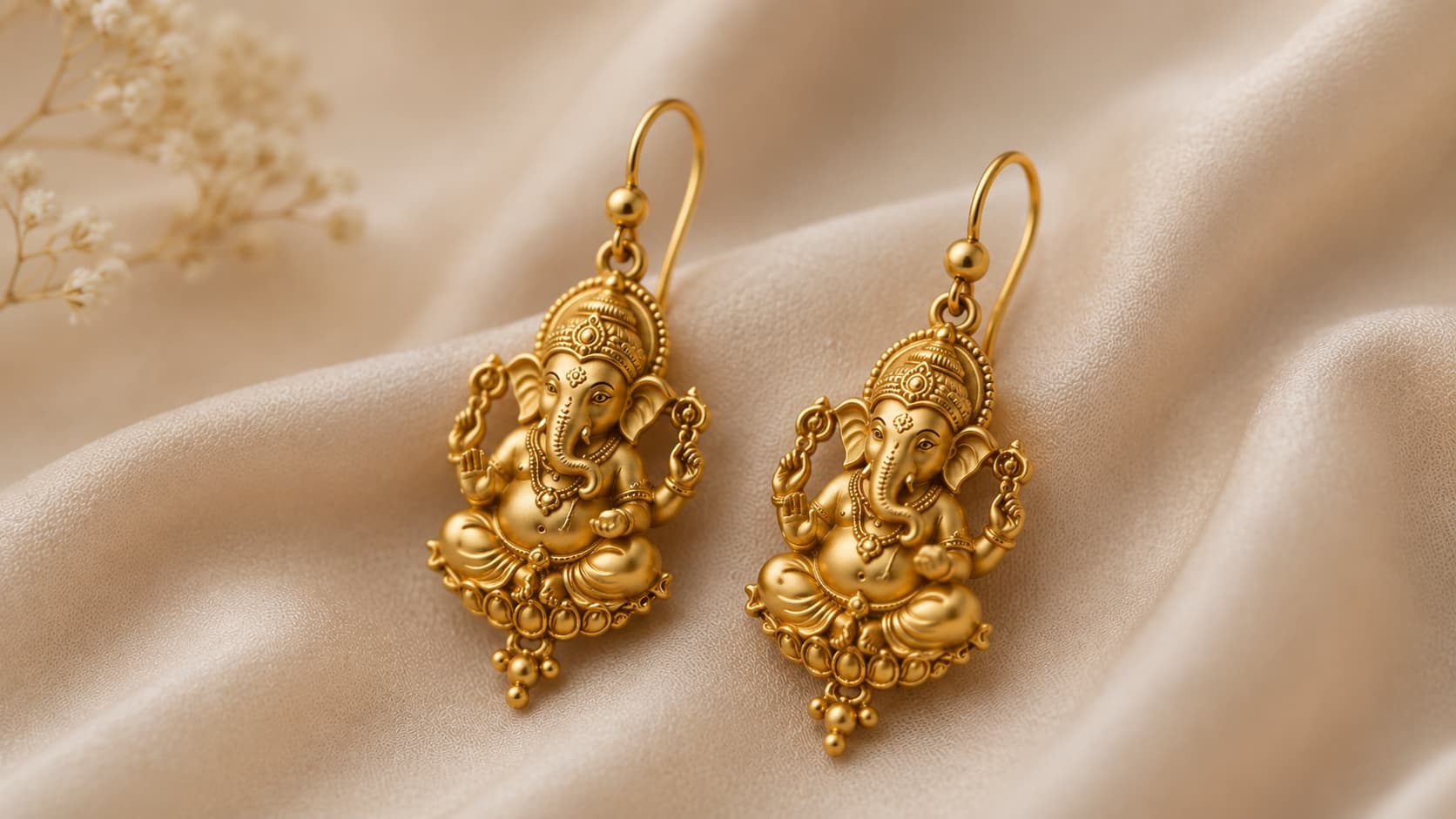
Classical images of Ganesha usually give him four arms, and each hand holds something with its own meaning. This detail is more common on larger pendants and statues than on tiny earrings, simply because there is more room to carve the detail clearly.
Two of his hands typically carry tools rather than comforting objects. An axe, known as a parashu, is meant to cut through bad habits and attachments a person needs to release, while a rope or noose, called a pasha, stands for reining in the mind so it isn’t dragged around by every passing impulse.
The other two hands carry a gentler message. One usually holds a modak, a sweet dumpling traditionally made from coconut and jaggery, standing in for the reward that follows real effort rather than the reward itself. The remaining hand is typically held open with the palm facing outward, a pose known as abhaya mudra, which loosely translates to “do not be afraid” and is read as a sign of protection.
Common Types of Ganesh Jewelry
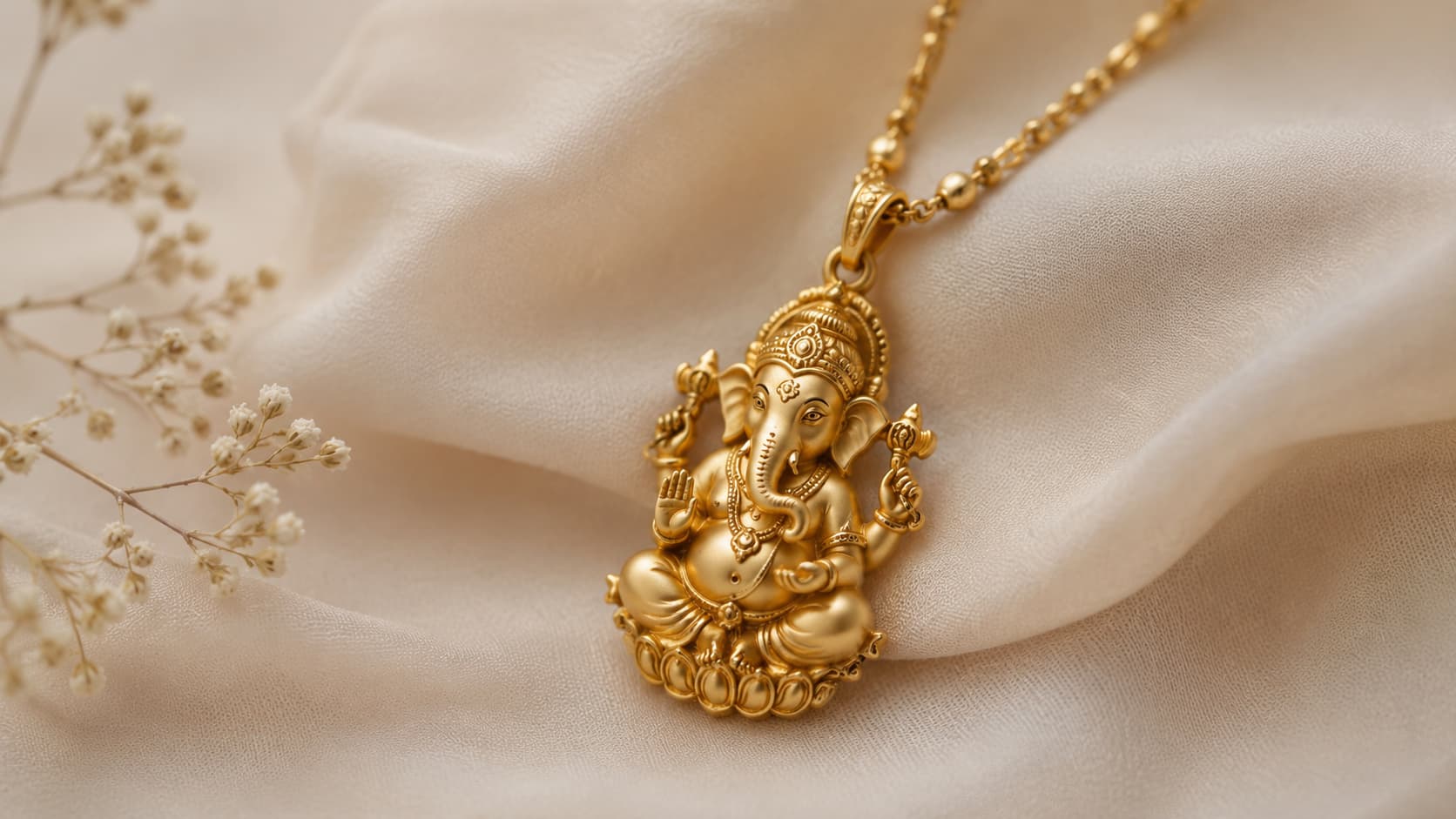
Ganesh imagery appears across nearly every jewelry category, not just pendants. Each format tends to be worn for slightly different reasons.
- Pendants and lockets — the most common form, usually worn close to the heart and often given as gifts for new jobs, weddings, or graduations
- Earrings — a subtler option, often featuring a simplified version of Ganesha’s face or trunk
- Bracelets and bangles — frequently include a small Ganesha charm alongside other beads or symbols
- Rings — less common, but growing in popularity, usually with a compact, simplified engraving
- Brooches and pins — traditionally used to decorate festival clothing, especially during religious celebrations
A popular variation is the “Om Ganesh” design, which pairs the sacred Om symbol with Ganesha’s figure on the same pendant. Om represents the sound believed to be the vibration of the universe in Hindu tradition, so combining it with Ganesha brings together two of the most recognized symbols in Hinduism into one piece.
Materials Commonly Used in Ganesh Jewelry
Ganesh jewelry is made in a wide range of materials, and the choice usually comes down to budget, occasion, and personal taste rather than strict religious rules.
| Material | Common Use | Typical Occasion |
|---|---|---|
| Gold (various karats) | Pendants, lockets | Festivals, weddings, gifts |
| Sterling silver | Pendants, charms | Everyday wear |
| Diamond or gemstone-accented gold | Statement pendants | Special occasions, formal wear |
| Rose gold or white gold | Modern minimalist pendants | Everyday and gifting |
Gemstones are sometimes added not just for decoration but because certain stones carry their own symbolism, such as courage or clarity, which is meant to layer on top of Ganesha’s own meaning. These are usually set into the crown, belly, or background of the pendant rather than replacing any of his features.
Best Times to Wear Ganesh Jewelry
Ganesh jewelry is worn year-round by many people, but it becomes especially popular around Ganesh Chaturthi, the festival celebrating his birth. This festival falls on the fourth day of the Hindu calendar month of Bhadrapada, which typically lands somewhere between August and September, and it runs for up to ten days.
The festival ends with a ritual called Visarjan, where a clay idol of Ganesha that was welcomed into the home or a public space is carried out and immersed in a river, lake, or the sea. The idea behind Visarjan is that Ganesha’s visit has come to an end and he is returning home, with the clay dissolving back into the earth it came from, symbolizing the same cycle of creation and letting go that shows up throughout his story. Ganesh Chaturthi grew into the large public festival it is today largely because of Lokmanya Bal Gangadhar Tilak, a leader in the Indian independence movement who, in 1893, encouraged communities to celebrate together in public rather than only at home, turning it into a shared cultural event as well as a religious one.
Outside of the festival, people commonly choose to wear or gift Ganesh jewelry at the start of something new, such as beginning a new job, opening a business, moving into a new home, or starting school. The idea of “clearing the path” is closely tied to fresh starts, which is why it shows up so often at these life moments rather than being reserved for one single event.
Can Anyone Wear Ganesh Jewelry?
There is no strict rule limiting who can wear Ganesh jewelry, and it is worn by people from many different backgrounds, not only practicing Hindus. Many wearers are drawn to the symbolism of wisdom, patience, and overcoming obstacles even if they do not follow Hindu religious practices closely.
That said, many wearers choose to treat the image with a certain amount of respect, since it represents a real, actively worshipped deity rather than a purely decorative motif. A simple way to show that respect is understanding what the symbol actually means before wearing it.
How to Clean and Store Ganesh Jewelry
Caring for a Ganesh pendant depends mostly on the metal it’s made from rather than the imagery itself. Gold and silver pieces should be kept away from harsh chemicals like chlorine and perfume, wiped clean with a soft cloth, and stored separately from other jewelry to avoid scratches.
Many wearers also choose to remove the pendant before swimming or heavy exercise, less because of any rule and more out of a habit of treating the piece carefully. Basic jewelry care rules that apply to any pendant apply here too, so nothing about a Ganesha design requires special cleaning products.
Frequently Asked Questions
Does Ganesh jewelry have to be gold to be meaningful?
No. The material does not change the symbolism behind the design. Silver, gold, and even simple beaded versions all carry the same meaning, since the meaning comes from the imagery itself, not the metal it’s made from.
Is it disrespectful for a non-Hindu to wear Ganesh jewelry?
Generally, no, since Ganesha is widely worn and admired by people outside strict religious practice. Being aware of what the symbol means and treating the piece with basic care and respect is usually seen as enough.
What does it mean if the trunk curves to the left versus the right?
Some traditions suggest a left-curving trunk represents a gentler, more approachable energy, while a right-curving trunk is seen as more powerful and is sometimes reserved for more formal worship. This belief is not universal, though, and many jewelry designs don’t follow it strictly.
Can Ganesh jewelry be worn every day?
Yes, daily wear is common and is not considered disrespectful. Many people choose a simple, durable pendant specifically because they want to keep the symbol with them consistently rather than only for special occasions.
What is the difference between Ganesh and Ganesha?
They refer to the same deity. “Ganesha” is the more complete Sanskrit form of the name, while “Ganesh” is a shortened version commonly used in everyday speech and in product names, including jewelry.
Conclusion
Ganesh jewelry carries more meaning than its size might suggest, with nearly every feature on his figure, from the elephant head down to the small mouse at his feet, standing for a specific idea like wisdom, humility, or sacrifice. Whether it’s worn daily as a personal reminder or brought out specifically for Ganesh Chaturthi and other new beginnings, the appeal comes from the same place it always has: a wish for a clearer path and a steadier mind. Knowing the story behind the symbol turns the piece from decoration into something with real intention behind it.