A watch that slides around your wrist or digs into your skin is more than just annoying. It can throw off how the watch sits, make the crown or clasp dig into your hand, and honestly just ruin the whole point of wearing something nice. The good news is that resizing a watch band is one of the simplest repairs a normal person can do at home, as long as you know which type of band you have and use the right small tool for the job. Shortening, extending, or adding holes across the most common band types is straightforward once the right method is matched to the right material, and the watch can finally sit where it should.
Signs Your Watch Band Is Too Loose or Too Tight
A watch band is too loose if it slides past the wrist bone or spins around your arm during normal movement. A band that’s too tight will leave a red mark, feel like it’s pinching, or make it hard to slide a finger underneath comfortably.
A good rule of thumb: you should be able to fit one finger snugly between the band and your wrist. If two fingers fit easily, the band is loose. If you can’t fit any finger at all, it’s too tight and could restrict blood flow over time. Most people wait too long to fix this because they assume it needs a professional. In reality, the fix usually takes less than 20 minutes.
Keep in mind that wrist size isn’t fixed all day. Wrists naturally swell a little in hot weather or after exercise, and shrink slightly in the cold or first thing in the morning. If your watch only feels tight in summer or loose in winter, that’s normal fluctuation rather than a sign the band was sized wrong. Aim to check the fit at a normal, resting point in your day rather than right after a workout.
How Do You Measure Your Wrist for a Watch Band?
Wrap a flexible tape measure, or a thin strip of paper, snugly around your wrist bone and mark or note the circumference in millimeters. This number tells you roughly where to start before you remove a single link or punch a single hole.
Most adult watch bands measure roughly between 160mm and 240mm in total length once sized, though exact figures vary by brand and style. Women’s watches typically fall in the 165mm to 200mm range, while men’s watches usually run from 185mm to 240mm. If your measured wrist size sits near the middle of the band’s total range, expect to remove or add only a small amount to get a comfortable fit. If it’s near either end of that range, you may need to adjust more than usual, or the band may not be a good match for your wrist at all.
Tools You’ll Need for DIY Watch Band Resizing
You need different tools depending on whether your band is metal, leather, rubber, or fabric. For metal bracelets, you’ll want a link removal tool or a simple pin pusher along with needle-nose pliers. For leather, rubber, or nylon straps, a leather hole punch and sometimes a spring bar tool are enough.
The main tools and what each one actually does:
- Spring bar tool – a small forked or pointed tool used to compress the spring-loaded bar that attaches the strap to the watch case. Needed for almost any strap swap, not just resizing.
- Link pin removal tool – pushes the small connecting pins out of a metal bracelet so links can be added or removed.
- Needle-nose pliers – helps grip and pull loose pins that don’t fully pop out on their own.
- Leather or rubber hole punch – creates a clean, round new hole in a strap instead of a jagged one.
- Mini screwdriver set – needed if your bracelet uses tiny screws instead of push pins to hold links together.
Most of these tools cost very little and are sold together in basic watch repair kits, usually for well under $20. A spring bar tool is the single most useful item to own, since it’s needed for almost every strap change, whether you’re resizing, replacing, or just swapping styles. If you don’t already own tools and don’t wear watches often, some jewelers and repair shops will do a basic resize for a small fee instead.
Metal Watch Band Resizing
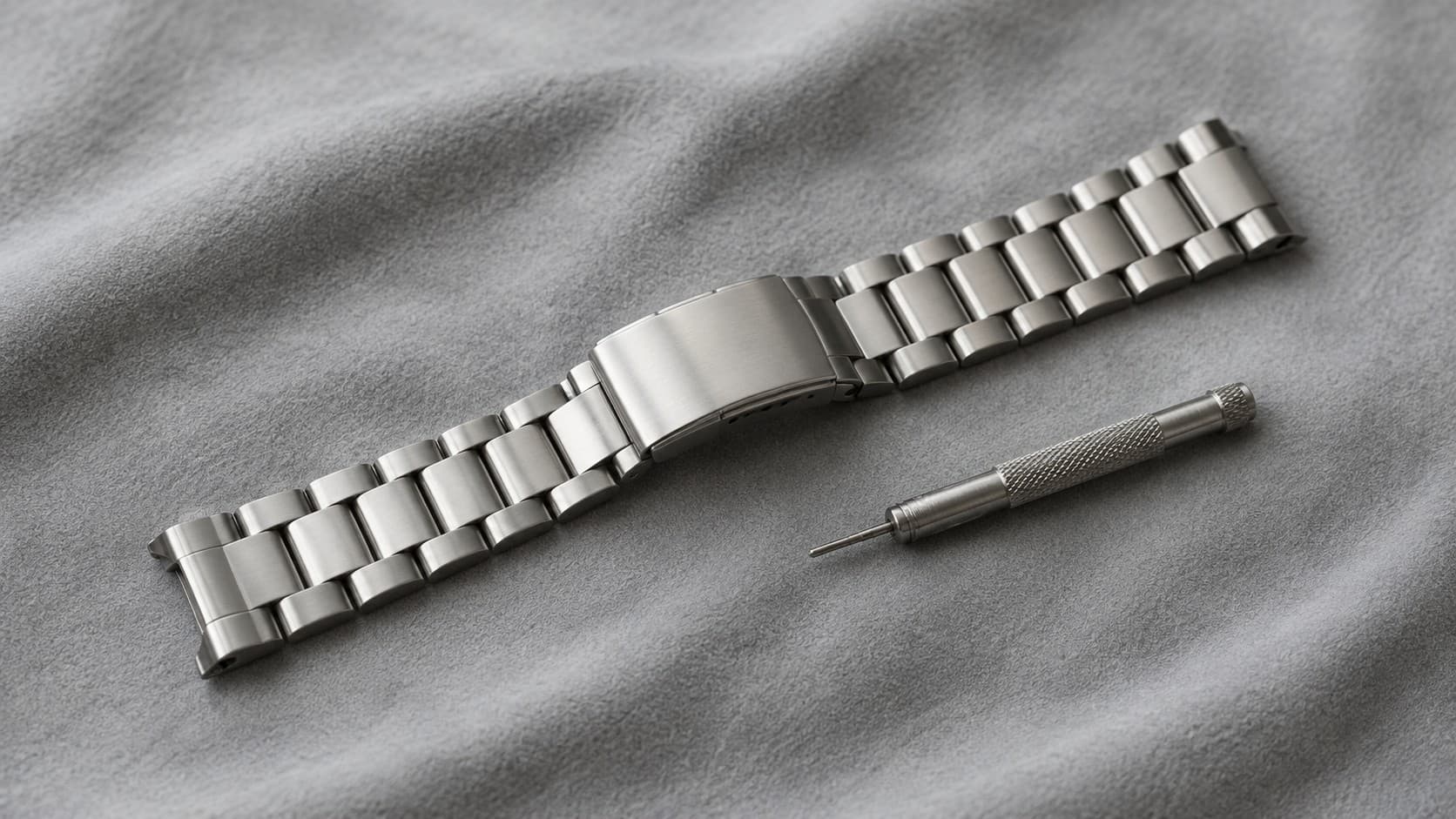
You resize a metal watch band by removing or adding links using a pin removal tool, following the small arrows stamped on the underside of the bracelet. These arrows show which direction the connecting pins need to be pushed out.
The full process breaks down into a few steps:
- Put the watch on your wrist and pinch the band to figure out roughly how many links need to come out.
- Flip the band over and look for small arrows on the inside of each link. These tell you which way to push the pin.
- Place the band in a link holder or on a stable, padded surface so it doesn’t slide around while you work.
- Line up the pin tool with the arrow and gently push. If the pin resists, a light tap with a small hammer usually does the trick — never force it.
- Remove pins evenly from both sides of the clasp so it stays centered on your wrist. If you need to remove an odd number of links, take one extra from the side without the clasp.
- Reconnect the band by pushing the pin back through the remaining links until it sits flush.
Some bracelets use screw-style links instead of push pins. If your band has a tiny screw head visible on the side of each link, you’ll need a mini screwdriver instead of a pin tool. Check before you start hammering anything.
Some watch bands use U-shaped pins instead of straight pins, and these can’t be pushed out the same way as regular split or screw-type pins — you’ll know you have this type if there aren’t small gaps on the side of the band for a pin to pass through. If that’s the case, it’s worth looking up a video specific to your band style before attempting removal, since forcing the wrong tool can bend the link.
If removing one full link makes the band too loose but leaving it in makes it too tight, look for a half-link on your bracelet. Some higher-end bracelets include one thinner link, roughly half the width of a standard link, built specifically for fine-tuning the fit between whole-link sizes. Not every band has one, but if yours does, it’s worth using before deciding the fit is a lost cause.
When to Resize It Yourself vs. Visit a Jeweler
You can safely resize most metal bands yourself with basic tools and a steady hand. But if you’re not confident, professional resizing is quick and affordable, and jewelers handle it constantly. A jewelry store or watch counter usually charges somewhere in the $10 to $15 range for the job, though pricing swings by shop and region, so it’s worth calling ahead. Buy the watch from a high-end brand’s boutique, and the first sizing is frequently thrown in with the purchase at no extra charge.
If you do it yourself, work over a soft cloth or towel. The pins are tiny and easy to lose, and they can fly further than you’d expect once they pop free.
Leather Watch Strap Resizing
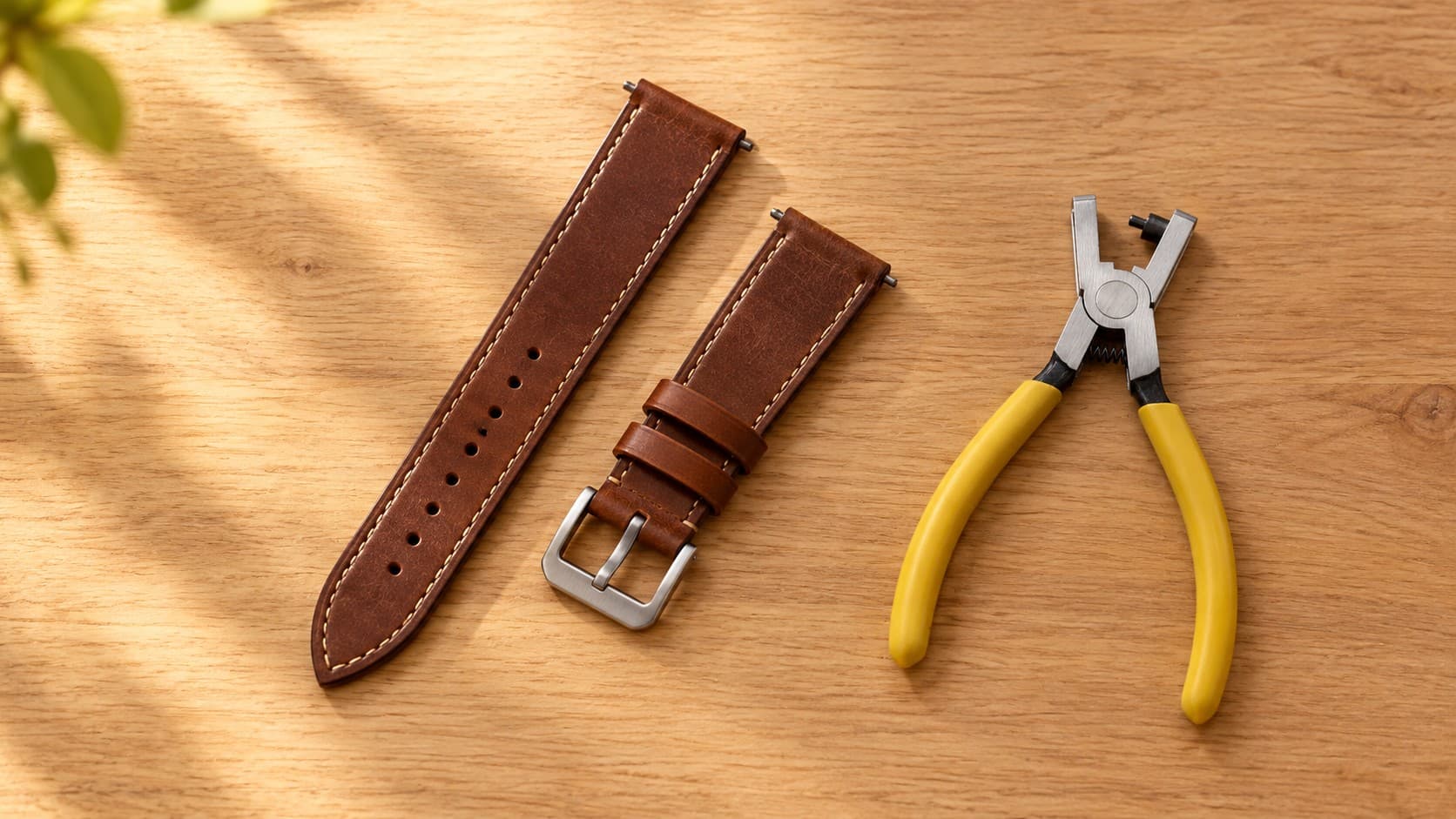
You resize a leather watch strap by punching a new hole rather than cutting the material. Leather straps already come with several holes, so first try buckling it on the next hole in either direction before doing anything permanent.
If none of the existing holes fit well, the process looks like this:
- Measure the gap between two existing holes on the strap so your new hole matches the same spacing.
- Mark the spot with a pencil or fine marker where the new hole should go.
- Use a leather hole punch (a rotary punch or a simple punch plier both work) to create a clean, round hole. Avoid using a knife or scissors, which leave ragged edges that tear over time.
- Test the fit before finishing, and smooth any rough edges with fine sandpaper if needed.
For fabric straps like NATO or nylon bands, punching is trickier because the material frays. Nylon straps will fray at the edges when punched, and some people carefully seal the cut fibers with light heat from a soldering iron, though this should only be attempted with caution. If you’re not comfortable with that step, it’s safer to buy a properly sized nylon strap instead of punching one.
Warranty Concerns When Resizing a Watch Strap
Adding a hole to a leather or rubber strap can void the warranty on the strap itself, but usually does not affect the watch’s movement or case warranty. Manufacturers typically only guarantee the strap against defects, not against modifications you make yourself.
If your watch is under warranty and you’re unsure, check the manufacturer’s documentation first, or have a jeweler make the adjustment so it’s documented as professional work rather than a DIY change.
Silicone Watch Band Resizing
You resize a rubber or silicone watch band the same way you resize leather: by using a different existing hole or punching a new one with a sharp, clean hole punch. Rubber holds up well to punching since it doesn’t fray like fabric.
The one thing to watch for is thickness. Rubber straps are often thicker than leather, so make sure your punch tool is rated for the material or you may end up with a ragged, oversized hole that lets the buckle pin slip loose over time.
It’s also worth checking how the strap curves near the lugs before punching anything. Thicker rubber and silicone straps sometimes sit slightly proud of the case where they meet the watch head, and a new hole placed too close to that curve can make the strap sit unevenly once buckled. Punching a hole a few millimeters further from the curve, in line with the existing holes, usually solves this.
Mesh Watch Band Resizing
You resize a mesh watch band by sliding the clasp to a different position along the mesh itself, without removing any material. Most mesh and Milanese-style bands need only a small flathead screwdriver or a similar flat edge to pop the clasp open, which is what makes this one of the easiest band types to adjust.
To do it, position the small tool in the notch on the underside of the clasp and use it as a lever to pry the mechanism loose from the mesh. Slide the whole clasp forward or backward to a tighter or looser spot, then press it back down so it locks into one of the mesh’s natural grooves. Because you’re not cutting or removing anything, you can readjust a mesh band as many times as you want, which makes it a good option for anyone whose wrist size changes with the seasons.
How to Resize a Deployment Clasp Watch Band
You adjust a deployment clasp by sliding the strap through the clasp mechanism itself, without removing any links or material. Many deployment clasps have a small range of built-in adjustment, which is the easiest fix available for minor sizing tweaks.
Some clasps have preset micro-adjustment holes or notches that move by hand with no tool at all, while others hold the strap in place with a small spring pin that needs a fingernail, paper clip, or spring bar tool to release. Either way, this works for adjustments of a centimeter or less. Anything larger usually still requires removing links from the bracelet itself.
Resizing Methods Compared by Band Type
Each band type calls for a different approach, tools, and level of commitment:
| Band Type | Method | Tools Needed | Reversible? |
|---|---|---|---|
| Metal bracelet | Remove or add links | Pin removal tool, pliers | Yes, if links are kept |
| Leather | Punch a new hole | Hole punch | No, hole is permanent |
| Rubber / silicone | Punch a new hole | Hole punch | No, hole is permanent |
| Nylon / NATO | Punch a sealed hole | Hole punch, heat source | No, hole is permanent |
| Mesh / Milanese | Slide the clasp | Small flathead screwdriver | Yes, fully reversible |
| Deployment clasp | Slide within clasp | Often none, sometimes a small pin tool | Yes, fully reversible |
Frequently Asked Questions
Can I resize a watch band without any tools?
Not safely for most metal bands, since the pins are held tightly in place and need a proper tool to avoid scratching the case or bending the links. Leather and rubber straps are more forgiving, and a basic hole punch or even a heated needle in a pinch can work for a temporary fix.
How many links should I remove from my watch band?
Remove enough links so that one finger fits snugly between the band and your wrist, and split the number evenly between both sides of the clasp whenever possible. If you’re unsure, start by removing one link at a time and testing the fit before continuing.
Will resizing my watch band damage it?
Resizing done carefully with the correct tool will not damage a watch band or void the warranty on the watch’s movement or case. Damage typically only happens from using the wrong tool, forcing a stuck pin, or working on a hard surface that scratches the case.
What do I do with the extra links I removed?
Keep the removed links and pins in a small labeled bag or container. If you ever sell the watch or need to loosen the band again later, having the original links saves you from buying replacements.
Can I resize a smartwatch band myself?
Yes, most smartwatch bands use quick-release pins or standard buckle holes and resize the same way as traditional watch bands. Some fitness bands use a stretchy or magnetic clasp instead, which usually doesn’t need resizing at all since it flexes to fit.
The Bottom Line
Resizing a watch band comes down to knowing your band’s material and using the matching tool: a pin removal tool and patience for metal bracelets, a hole punch and careful measuring for leather or rubber, and often no tools at all for deployment clasps. Most people can handle this at home in well under half an hour, and the payoff is a watch that finally sits correctly instead of sliding around or pinching your wrist. If a pin won’t budge or a link feels like it’s about to bend, that’s the moment to stop and let a jeweler finish the job — it’s a small cost next to the risk of damaging a watch you actually like wearing.