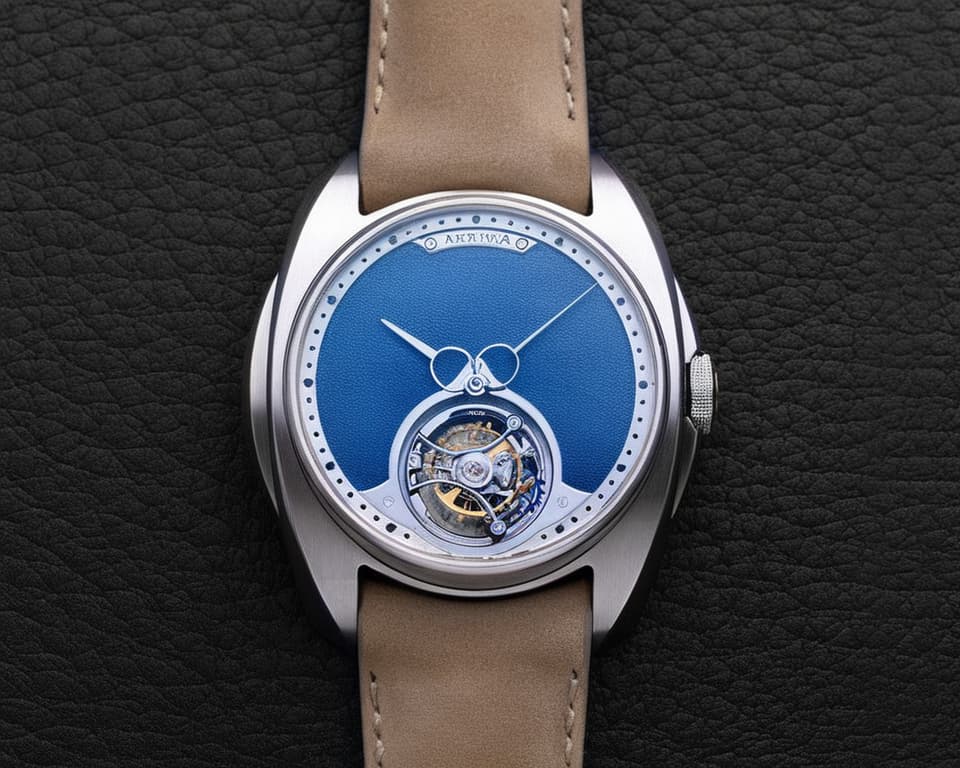
Akrivia is one of the smallest watch brands in the world, and also one of the most respected. Founded by a young watchmaker who once took apart his father’s watches just to see how they worked, the brand now sits alongside names like F.P. Journe and Philippe Dufour in conversations about the very best of independent Swiss watchmaking. Fewer than 40 watches leave the workshop each year, each one built almost entirely by hand in a small atelier tucked into Geneva’s old town. For anyone curious about high-end horology, Akrivia is a name worth understanding, even if owning one isn’t in the cards for most people.
Akrivia’s History and Founder
Akrivia was founded in 2012 in Geneva by Rexhep Rexhepi, a watchmaker who was only 25 years old at the time. He had already spent over a decade learning the craft at some of the most respected names in the industry, and he wanted to build watches that reflected his own ideas instead of someone else’s.
Rexhepi was born in 1987 in Zheger, a small village in Kosovo. His father had already relocated to Switzerland for work, and on his visits home young Rexhepi would get his hands on his father’s watches, prying them open just to see what made the parts move. He joined his father in Geneva as a child, at around 11 or 12 depending on the source, and a few years later, at 14 or 15 depending on the source, he began an apprenticeship at Patek Philippe, one of the most prestigious watch companies in the world.
He was talented enough to be offered a full-time job, but in 2007 he chose to join BNB Concept, a company that designed complicated movements for other watch brands. Within a year, he was put in charge of the workshop. He then moved to F.P. Journe, where he was trusted with assembling some of that brand’s most complicated pieces. That experience, working directly under one of the most celebrated independent watchmakers alive, clearly left a mark on how Rexhepi would later run his own company.
In 2012, he struck out on his own and founded Akrivia. The name comes from a principle in the Eastern Orthodox Church that means strict, careful adherence to established rules, a fitting name for a brand built on precision. Growth was slow at first. It wasn’t until 2018, when Akrivia released the Chronomètre Contemporain and won the Men’s Watch Prize at the Grand Prix d’Horlogerie de Genève (GPHG), watchmaking’s most prestigious awards show, that the brand truly took off. Today, Akrivia is owned and run by Rexhepi and his wife Odile, who manages the business side, alongside a small team that has grown to around 20 people, including Rexhepi’s brother Xhevdet.
Akrivia’s Signature Features
Akrivia watches stand out because nearly every part of every watch is designed, finished, and assembled by hand in-house, by a small team rather than a factory. That level of hands-on craftsmanship is rare even among luxury watch brands, and it’s the main reason collectors pay close attention to what Rexhepi releases.
Most large watch brands, even expensive ones, outsource at least some parts to specialist suppliers. Akrivia does the opposite. Rexhepi and his team design their own movements from scratch, decorate them by hand using traditional techniques like hand-beveling and hand-hammering, and often assemble an entire watch from start to finish with a single watchmaker responsible for the whole build. This is closer to how watches were made a century ago than how most modern luxury watches are produced.
A handful of specific details have come to define the brand’s reputation:
- One watchmaker, one watch. Rather than passing a movement between different specialists on an assembly line, a single watchmaker typically builds, finishes, and regulates an entire piece from start to finish, so the watch reflects one person’s hand throughout.
- Hand-hammered dials. Several AK-series watches use a technique where the gold dial is hammered by hand to create a dimpled, light-catching surface, a slow, difficult process that very few brands still practice.
- A “philosophical” detail at 12 o’clock. Rexhepi has said that each Akrivia caliber is designed around a meaningful element placed at the top of the dial: the column wheel on the AK-01, the strike hammer on the AK-03, and so on. It’s a small design habit, but it shows how deliberately each movement is laid out rather than just packed with parts.
- Grand feu enamel dials. The Chronomètre Contemporain line uses grand feu enamel, a centuries-old technique where powdered glass is fired onto the dial at extremely high heat, prized for its depth of color and durability compared to painted dials.
- Optional chronometer certification. Some Chronomètre Contemporain models can be sent to the Besançon Observatory in France, an independent body that tests and certifies exceptional timekeeping accuracy, for an additional certificate on request.
- A dedicated case partner. Since 2019, Akrivia has worked closely with Jean-Pierre Hagmann, a legendary case maker with decades of experience supplying some of the finest names in Swiss watchmaking, which helps explain the unusually high quality of Akrivia’s case construction for such a small brand.
Another thing that sets Akrivia apart is scale, or rather the lack of it. The brand makes fewer than 40 watches a year, compared to the thousands or even hundreds of thousands produced by bigger luxury names. That scarcity, combined with genuinely excellent finishing that experts like Philippe Dufour and Kari Voutilainen have praised, and two wins of the GPHG’s Men’s Watch Prize (2018 and 2022), has made Akrivia one of the most sought-after names in independent watchmaking within just over a decade of its founding.
Top 10 Best Akrivia Watches
Akrivia’s lineup, taken roughly in the order it was released, traces a clear line from the brand’s first watch in 2013 to its most recent high-profile collaboration. The design language shifts noticeably along the way, moving from the bold, technical AK series toward the quieter, classical Chronomètre Contemporain line, with the brand’s most ambitious complications landing at different points in between. Prices and production numbers reflect original launch figures where publicly available, since Akrivia rarely discloses current pricing and most models move through waitlists rather than fixed list prices; figures originally quoted in Swiss francs have been converted to approximate USD at recent exchange rates.
1. AK-01 Tourbillon Chronographe Monopoussoir
The AK-01 answers a simple question: what was Rexhepi’s very first watch? Released in 2013, a year after the brand launched, it combined a tourbillon with a monopusher chronograph, an ambitious pairing of complications for a debut piece. Rexhepi wanted his first watch to prove he could handle serious complexity right out of the gate, rather than easing into the market with something simple, and it set the tone for the entire early AK series: bold, technical, and finished to a standard that immediately caught the attention of serious collectors and fellow watchmakers.
| Spec | Detail |
|---|---|
| Year released | 2013 |
| Case size | 42.5–43mm, 12.9mm thick |
| Case material | Steel, titanium, or red gold |
| Movement | Manual-wind, in-house caliber |
| Power reserve | 100 hours |
| Complications | 60-second tourbillon, monopusher chronograph, power reserve indicator |
| Production | Limited to around 10 pieces |
| Launch price | Roughly $176,000 (steel) / $220,000 (red gold) |
2. AK-02 Tourbillon Heure Minute
The AK-02 answers what a simplified, time-only Akrivia tourbillon looks like. Released in 2014, it strips things back to just hours, minutes, and a tourbillon regulator, letting the finishing and case design take center stage. Many collectors consider the AK-02 one of the best-finished tourbillon watches in its price category, and arguably in categories well above it too, thanks in part to its solid gold dial that’s often hand-hammered to create a subtly dimpled, light-catching texture using nothing but a hammer and a steady hand.
| Spec | Detail |
|---|---|
| Year released | 2014 |
| Case size | Approx. 43mm, 12.9mm thick |
| Case material | Steel, titanium, or gold |
| Movement | Manual-wind tourbillon caliber |
| Complications | Tourbillon regulator, hours, minutes |
| Dial | Often hand-hammered solid gold |
| Production | Small, limited series |
3. AK-03 Tourbillon Chiming Jump Hour
The AK-03 answers what happens when Rexhepi adds a chime to the mix. Released in 2014, this model combined a tourbillon with a jumping hour display and a striking mechanism, making it one of the more mechanically ambitious pieces in the early AK lineup. Chiming complications are considered among the hardest things to build in watchmaking, since the sound has to be tuned precisely and the mechanism has to fit into an already crowded case, and tackling this so early in the brand’s history says a lot about Rexhepi’s confidence from his years at BNB Concept and F.P. Journe.
| Spec | Detail |
|---|---|
| Year released | 2014 |
| Movement | Manual-wind, in-house caliber |
| Complications | Tourbillon, jumping hour display, chiming/striking mechanism |
| Notable detail | Strike hammer positioned at 12 o’clock on the dial |
| Production | Very limited, made to order |
4. AK-04 Tourbillon Régulateur
The AK-04 answers what a “regulator” style dial looks like on an Akrivia tourbillon. Released in 2015, it separates the hour, minute, and seconds displays onto different sub-dials instead of stacking them on a single central axis, a layout borrowed from precision pocket watches and clocks. This regulator display isn’t just for looks, since it historically made it easier for watchmakers to read the time with more precision, and on the AK-04 it also gives the dial a distinctive, technical appearance that fans of the brand recognize instantly.
| Spec | Detail |
|---|---|
| Year released | 2015 |
| Movement | Manual-wind tourbillon caliber |
| Complications | Tourbillon, regulator-style hour/minute/seconds display |
| Case material | Steel, titanium, or gold options |
| Production | Very limited, made to order |
5. AK-05 Tourbillon Barrette-Miroir
The AK-05 answers what the second generation of the AK collection looked like. Released in 2016, it introduced a new case shape and dial treatment while keeping the tourbillon at the heart of the watch, marking a shift in Akrivia’s design language. “Barrette-Miroir” refers to the mirror-polished bar elements used in the dial construction, a detail that shows off the kind of hand-finishing Akrivia is known for, and by this point the brand had built enough of a reputation that each new AK release was closely watched by the small but growing community of independent watch collectors.
| Spec | Detail |
|---|---|
| Year released | 2016 |
| Movement | Manual-wind tourbillon caliber |
| Complications | Tourbillon with mirror-polished “barrette” dial elements |
| Case material | Steel, titanium, or gold options |
| Production | Very limited, made to order |
6. AK-06
The AK-06 answers what happens when Akrivia drops the tourbillon entirely. Released in 2017 on the brand’s fifth anniversary, it was the first Akrivia watch without one, focusing instead on an openworked dial that shows off the power reserve and hand-setting mechanism. Rexhepi has said that winding a watch is one of the most personal moments a wearer has with their timepiece, since it’s the point where human energy is transferred into the movement, and the AK-06 leans into that idea with a dial-free design that puts the power reserve indicator and its gearing on full display.
| Spec | Detail |
|---|---|
| Year released | 2017 |
| Case size | 41mm, 9.9mm thick |
| Case material | Steel, titanium, rose gold, or platinum |
| Movement | Manual-wind, single barrel |
| Power reserve | 100 hours |
| Complications | Power reserve indicator, hacking seconds with zero-reset |
| Launch price | From approx. $98,000 (steel) |
7. Rexhep Rexhepi Chronomètre Contemporain (RRCC)
The Chronomètre Contemporain answers what a more classical, restrained Akrivia looks like. Released in 2018, it moved away from the chunkier, tool-watch-inspired AK series toward a slim, 38mm three-hand dress watch inspired by 1940s officers’ watches. This is arguably the single most important watch in Akrivia’s history: it won the Men’s Watch Prize at the 2018 GPHG, the first time any Akrivia watch had even made a finalist shortlist, and it’s widely credited with turning Rexhepi from a respected up-and-comer into one of the most talked-about independent watchmakers alive.
| Spec | Detail |
|---|---|
| Year released | 2018 |
| Case size | 38mm, 9.5mm thick |
| Case material | Rose gold or platinum |
| Movement | Manual-wind caliber RR01 |
| Power reserve | Approx. 100 hours |
| Dial | Grand feu enamel, white or black |
| Award | GPHG Men’s Watch Prize, 2018 |
| Production | 25 pieces per metal |
| Launch price | Approx. $69,000 (rose gold) / $72,000 (platinum) |
8. Rexhep Rexhepi Chronomètre Contemporain II (RRCC II)
The Chronomètre Contemporain II answers what a from-scratch rebuild of the RRCC looks like on the inside. Released in 2022 after three years of development, it kept the classical look of the original but replaced the movement with a completely new construction using twin barrels and twin going trains. This new architecture separates the going train that keeps time from the one that drives the seconds hand, allowing for a hacking, zero-reset deadbeat seconds function, and it won Akrivia its second GPHG Men’s Watch Prize in 2022, making Rexhepi one of very few independent watchmakers to win the category twice.
| Spec | Detail |
|---|---|
| Year released | 2022 |
| Case size | 38mm |
| Case material | Rose gold or platinum |
| Movement | Manual-wind, twin barrel, twin going train |
| Water resistance | 100 meters |
| Dial | Grand feu enamel |
| Award | GPHG Men’s Watch Prize, 2022 |
| Production | Around 50 pieces per metal |
| Launch price | Approx. $155,000 |
9. LVRR-01
The LVRR-01 answers what happens when a legacy fashion house and an independent watchmaker team up on something serious. Released in 2023, this was a genuine collaboration between Louis Vuitton and Rexhepi, combining a tourbillon, a minute repeater, and a monopusher chronograph in Louis Vuitton’s signature drum-shaped Tambour case. Collaborations like this are unusual for a brand as small as Akrivia, and the LVRR-01 showed that Rexhepi’s engineering could be trusted with a major maison’s most recognizable case design without losing the atelier’s own identity.
| Spec | Detail |
|---|---|
| Year released | 2023 |
| Case | Louis Vuitton Tambour case, platinum |
| Movement | Manual-wind, in-house caliber |
| Complications | Tourbillon, minute repeater, monopusher chronograph |
| Dial | Dual-display layout |
| Collaboration | Louis Vuitton x Rexhep Rexhepi |
| Pricing | Not publicly disclosed |
10. Rexhep Rexhepi Chronomètre Contemporain “Only Watch” Edition
This model answers what a truly one-of-a-kind Akrivia looks like. Built as a unique piece for the Only Watch charity auction, a biennial event where top watchmakers donate one-off creations to raise money for medical research, it featured a hand-hammered enamel dial, a finishing technique not used anywhere else in the Chronomètre Contemporain line. Only Watch pieces are never sold at retail and exist as single examples, and for a brand like Akrivia, being invited to contribute alongside giants like Patek Philippe and Audemars Piguet is itself a marker of how far the brand has come in just over a decade.
| Spec | Detail |
|---|---|
| Basis model | Rexhep Rexhepi Chronomètre Contemporain |
| Production | Unique piece (1 of 1) |
| Dial | Hand-hammered grand feu enamel |
| Sold through | Only Watch charity auction |
| Availability | Not sold at retail |
Things to Consider Before You Buy
The biggest thing to consider when buying an Akrivia is simply availability, since the brand makes fewer than 40 watches a year and demand far outweighs supply. Most models are effectively allocated to existing clients or come with long waitlists, so buying new usually isn’t as simple as walking into a boutique and picking a watch off a shelf.
Beyond availability, it helps to think about what style of Akrivia actually fits your taste. The AK series has a bolder, more technical, tool-watch feel with openworked or hand-hammered dials, while the Chronomètre Contemporain line leans classical and restrained, closer to a traditional dress watch. These are genuinely different personalities within the same brand, and it’s worth handling both in person if possible before deciding which direction appeals to you.
Budget matters too, and not just the sticker price. Because Akrivia watches are hand-built with limited production, servicing needs to go through the brand or an authorized specialist, and turnaround times can be longer than with larger manufacturers that have bigger service departments. It’s also worth factoring in that buying secondhand, especially at auction, often means paying well above the original retail price given how quickly these watches have appreciated.
Akrivia produces around 30 to 40 watches per year across its entire lineup, a fraction of what most luxury watch brands release in a single week.
How to Buy Akrivia Watches
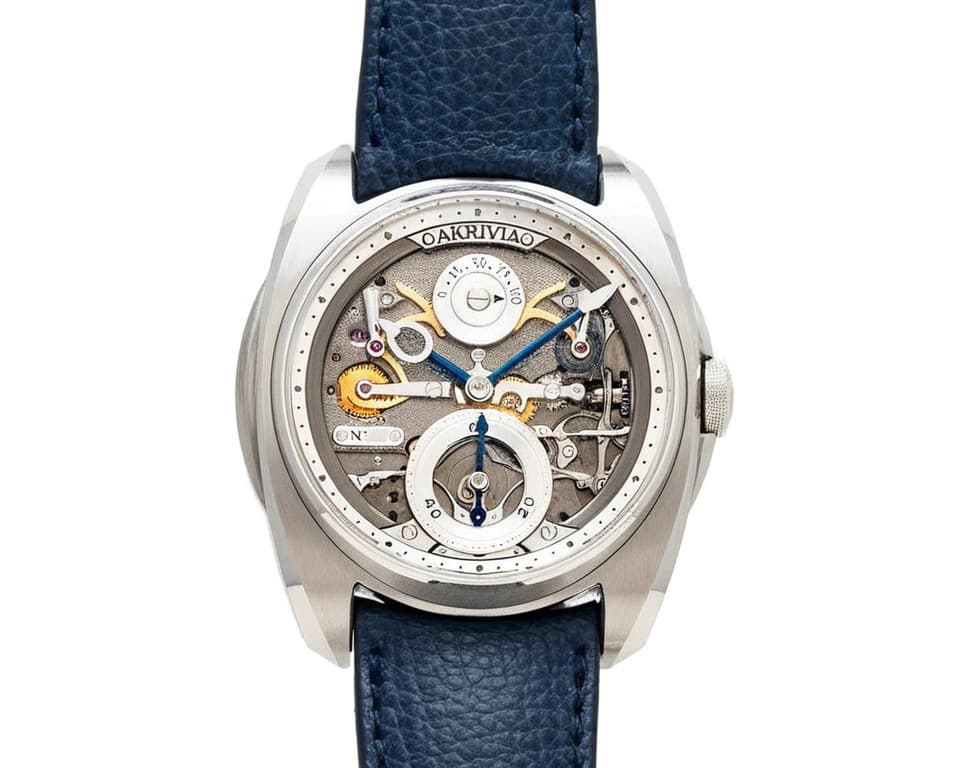
New Akrivia watches are sold directly through the brand’s Geneva workshop and through a small, carefully selected group of authorized retailers around the world, rather than through a wide dealer network. A Collected Man, based in London, is one of the few officially authorized Akrivia retailers and stocks both new and pre-owned pieces from the brand, alongside detailed information on each model. Because of the brand’s tiny production numbers, retailers like this work primarily through waitlists and personal introductions rather than walk-in sales, so getting on a list early and building a relationship with the boutique matters more than it would with a larger brand.
For buyers who aren’t already established collectors with a relationship to the brand, the more realistic path to owning an Akrivia is often the secondary market, through reputable pre-owned dealers or established auction houses. Phillips, through its Bacs & Russo watch department, has handled several of the most significant Akrivia sales to date, including record results for early AK-series pieces and the Chronomètre Contemporain, and its auction records are a useful public reference point for what specific models have actually sold for. Buying secondhand also means the watch is available immediately rather than requiring a wait, though prices on the resale market are frequently far above what the watch originally cost at retail.
Whichever route you take, it’s worth doing extra diligence given how much money is involved. Confirm full provenance, ask for servicing history, and if buying secondhand, work with a dealer or auction house that offers authentication and some form of guarantee, since Akrivia’s small production and lack of a public retail price list makes it easier for inflated or misrepresented listings to slip through on unofficial resale sites.
Akrivia Watches as an Investment
Akrivia watches have shown some of the strongest resale performance of any independent watch brand in recent memory, largely because production is so limited and demand has grown so quickly. In May 2023, a Rexhep Rexhepi Chronomètre Contemporain sold at a Phillips auction in Hong Kong for roughly $929,000, close to 15 times its original retail price from just five years earlier, and it was the first time that particular model had ever appeared at auction. Public auction records also show an AK-01 Tourbillon Chronographe Monopoussoir selling for over $1.2 million at a Phillips sale in late 2024, and an AK-06 reaching close to $3.9 million at a Phillips sale in May 2026, both dramatically above their original launch prices.
That kind of result isn’t guaranteed for every Akrivia watch and shouldn’t be treated as typical of the broader watch market, but it does illustrate how much collector interest has built around Rexhepi’s work, especially pieces tied to GPHG wins or made in very limited numbers. Watches from the early AK series, the award-winning Chronomètre Contemporain models, and rare collaborations like the LVRR-01 tend to command the strongest premiums when they do appear at auction, and results are often described by watch industry outlets as “beating estimate” by a wide margin, a sign that public pre-sale estimates have consistently lagged behind what collectors are actually willing to pay.
Buying a watch purely as an investment is always risky, since values can be unpredictable and depend heavily on collector taste, which changes over time. Akrivia’s strong track record so far comes from genuine scarcity and widely respected craftsmanship rather than marketing, which is a healthier foundation than many other “investment watch” stories in the industry, but it’s still not a guarantee of future performance, and past auction results are not a promise of what any individual watch will fetch in the future.
Maintenance Tips for Akrivia Watches
Akrivia watches need the same basic care as any fine mechanical watch: regular winding if worn irregularly, protection from strong magnets and hard knocks, and servicing on a schedule recommended by the brand, typically every few years depending on how often the watch is worn. Because these are hand-built, low-production pieces, servicing should go through Akrivia directly or an authorized service partner rather than a general watch repair shop.
Given the complexity of many Akrivia movements, especially tourbillon and chiming models, servicing can take longer and cost more than with mass-produced watches, simply because replacement parts often need to be hand-made rather than pulled from a supply shelf. It’s worth budgeting for both the cost and the wait time well in advance, and asking the brand or retailer directly what a full service typically involves for the specific model you own.
Because nearly every Akrivia watch is manual-wind rather than automatic, a watch winder serves no real purpose for this brand. A soft microfiber cloth is more useful day to day, gently wiping fingerprints and dust off the case and crystal after wearing, since anything more abrasive can dull polished surfaces or scratch sapphire crystal over time. A dedicated watch box or case with individual cushioned slots also protects the case from knocks when it’s not being worn and keeps it away from dust.
Humidity and temperature swings are the enemy of any fine watch, so storing it somewhere stable, away from direct sunlight, radiators, or damp bathrooms, makes a real difference over the years. Small silica gel packets placed inside a watch box or safe can help absorb excess moisture in humid climates. If the watch has a leather strap, an occasional light leather conditioner appropriate for fine leather goods can help prevent the strap from drying out and cracking, though this should be done sparingly and kept away from the dial and case.
It’s also worth keeping the original box, papers, and any accompanying documentation in good condition. For watches at this level, a complete set with clear provenance meaningfully affects both insurance value and eventual resale value.
Frequently Asked Questions
Akrivia’s small size and quiet, waitlist-driven way of doing business means a lot of basic questions about the brand rarely get answered on a typical product page, from how the company operates to why the watches cost what they do.
Is Akrivia a real luxury watch brand?
Yes. Akrivia is a genuine independent Swiss watchmaker founded in 2012 by Rexhep Rexhepi, and it has won the Grand Prix d’Horlogerie de Genève’s Men’s Watch Prize twice, in 2018 and 2022, one of the most respected awards in the entire watch industry.
How many watches does Akrivia make each year?
Akrivia produces roughly 30 to 40 watches per year, a very small number compared to most luxury watch brands, since nearly everything is designed and assembled by hand in the brand’s Geneva atelier.
Who founded Akrivia?
Akrivia was founded by Rexhep Rexhepi, a watchmaker born in Kosovo in 1987 who trained at Patek Philippe, BNB Concept, and F.P. Journe before starting his own brand in 2012 at the age of 25.
Why are Akrivia watches so expensive?
Akrivia watches are expensive because of extremely limited production, extensive hand-finishing, and movements designed and built almost entirely in-house rather than sourced from outside suppliers, all of which drive up both the cost to make each watch and demand from collectors.
Can you just buy an Akrivia watch new?
It’s difficult. Because Akrivia makes so few watches each year, most new pieces are allocated to existing clients or waitlisted through the brand and its small network of authorized retailers, so many buyers end up purchasing on the secondary market instead.
Conclusion
Akrivia’s story is really the story of one watchmaker’s stubborn commitment to doing things the hard way, by hand, in small numbers, without cutting corners. From the technically loaded AK series to the award-winning Chronomètre Contemporain line and ambitious projects like the LVRR-01, Rexhep Rexhepi has built a brand that earns its reputation through craftsmanship rather than marketing. That approach has made Akrivia genuinely difficult to buy new and increasingly valuable on the resale market, but more than that, it’s made the brand a reference point for what independent watchmaking can achieve when scale is sacrificed for quality.