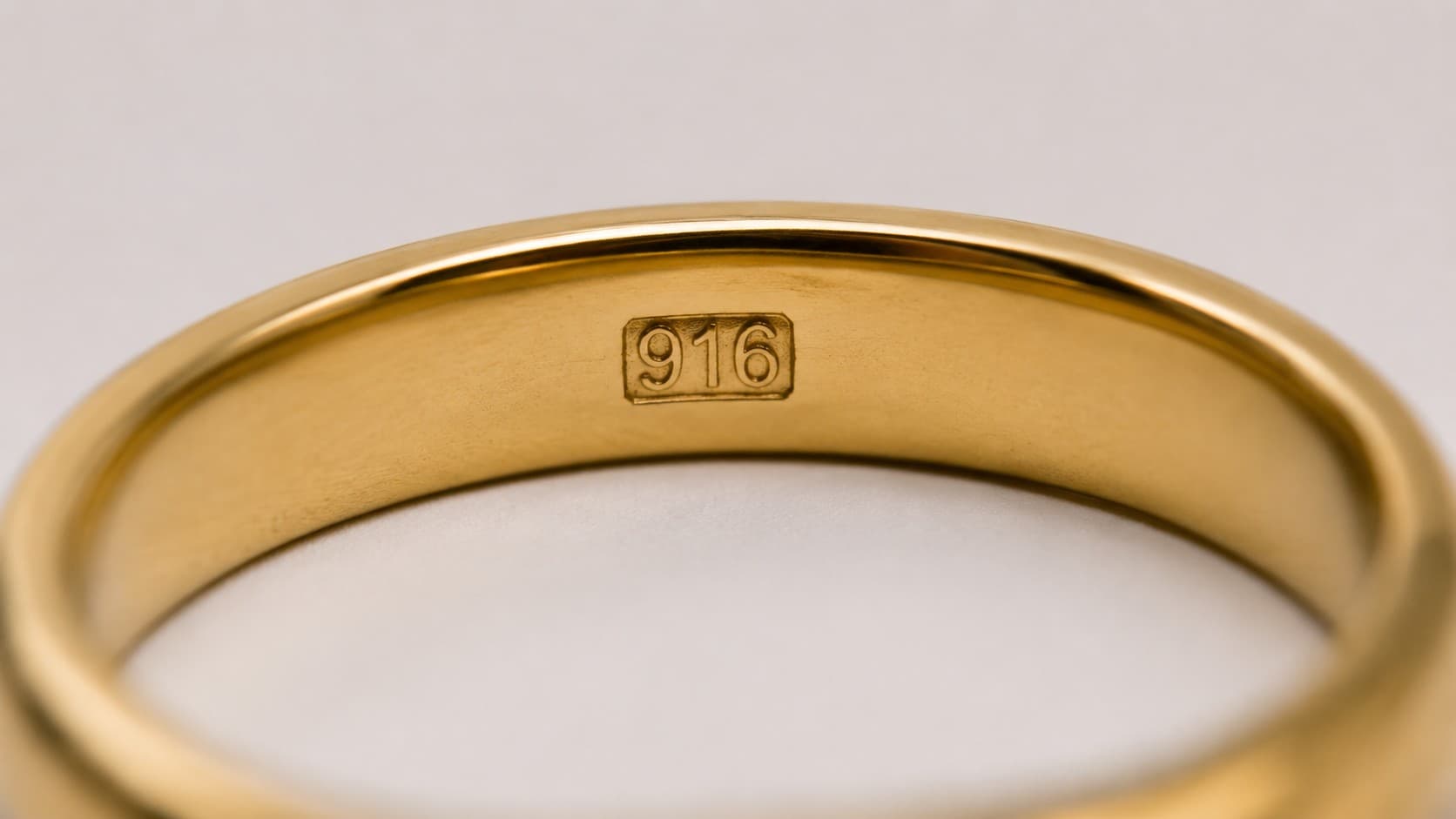
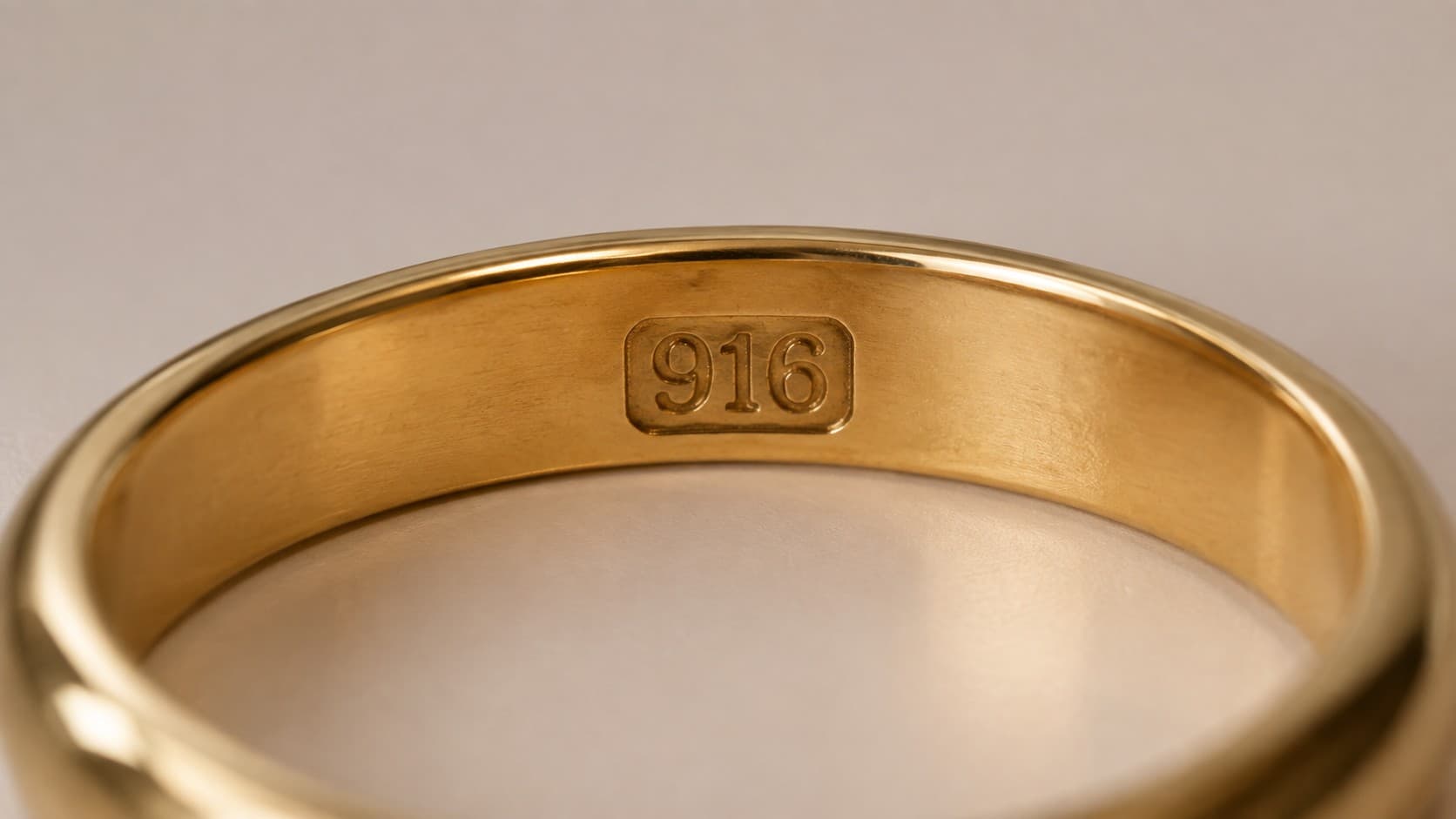
Inside most gold rings, chains, and bangles sits a tiny stamped number, often 916, easy to miss unless someone looks closely. That small mark carries real information. It states exactly how much pure gold the piece contains, a detail that matters for gift buyers, people inspecting an inherited piece, or anyone simply trying to understand what’s sitting in a jewelry box. A stamp that looks like a meaningless string of digits is actually one of the most useful clues a piece of jewelry can offer.
What Does 916 Mean on Gold?
A 916 stamp means the piece is 91.6% pure gold. The remaining 8.4% consists of other metals mixed in to make the gold stronger.
The number works like a ratio out of 1,000. In 1,000 grams of this gold alloy, 916 grams would be pure gold, and the other 84 grams would be metals such as copper or silver. Jewelers call this the “millesimal fineness” system, a purity scale measured out of 1,000 rather than out of 24. A 999 stamp signals almost pure gold, while a 375 stamp signals a much lower gold content.
Is 916 the Same as 22K Gold?
Yes, 916 gold and 22K gold describe the exact same purity. The two labels simply come from different measuring systems.
Gold purity gets measured in two common ways. The karat system splits gold into 24 parts, and a piece with 22 of those 24 parts as pure gold is labeled 22K. The millesimal system expresses that same fraction as a number out of 1,000. Dividing 22 by 24 produces 0.9167, or 91.67% pure gold, a figure hallmarking bodies round down to the standard 916 stamp rather than up, so a certified piece never tests below its stated purity. A piece marked “22K” and a piece marked “916” therefore contain identical amounts of gold.
Both labels describe identical gold content. The difference comes down to which measuring convention a region’s jewelers and regulators have adopted.
Why Some Countries Use 916 Instead of 22K
Different regions developed different gold-marking traditions over time, and neither system is more accurate than the other. The split reflects local regulation and custom rather than quality.
The United States, Canada, and the United Kingdom mostly rely on karat stamps, so jewelry from those markets tends to show 10K, 14K, or 18K. Much of South Asia, the Middle East, and Southeast Asia, including India, the United Arab Emirates, Malaysia, and Singapore, uses the numeric fineness system instead, which explains why 916 appears so frequently on jewelry from those regions. In many of these markets, 22K gold is also the traditional standard for wedding and festival jewelry, prized for its rich, deep yellow tone.
In India, this reflects law rather than habit. Since 2021, gold jewelry sold there has been required to carry an official hallmark from the Bureau of Indian Standards (BIS), and since 2023 that hallmark has also included a six-digit code known as a HUID (Hallmark Unique Identification). A compliant piece today carries three marks together: the BIS triangle logo, the purity number such as 916, and the unique HUID code, which can be checked through the BIS Care app to confirm which jeweler sold the piece and when it was tested. The United Kingdom operates a comparable but older system through government-approved assay offices, which independently test and stamp gold before it can legally be sold at a stated purity.
What Metals Are Mixed Into 916 Gold?
Jewelers add small amounts of other metals, typically copper and silver, to make gold durable enough for everyday wear. Pure gold on its own is too soft to hold up well as jewelry.
A ring made from 999 (24K) gold would bend and scratch easily under normal daily use, from keys in a pocket to a simple handshake. Copper and silver strengthen the metal while barely altering its color, since 91.6% remains an extremely high concentration of gold. This balance is part of why 22K gold became a favored choice for rings, bangles, and necklaces meant to last for decades, since it keeps the warm gold tone while holding up better than pure gold would.
The exact ratio of copper to silver within that remaining 8.4% shifts the final shade. A blend leaning more on copper produces a warmer, slightly reddish-yellow tone, while more silver produces a paler, cooler yellow. Neither version changes the number stamped on the piece, since 916 measures gold content alone, not the composition of the alloy metals.
Signs of a Genuine 916 Gold Stamp
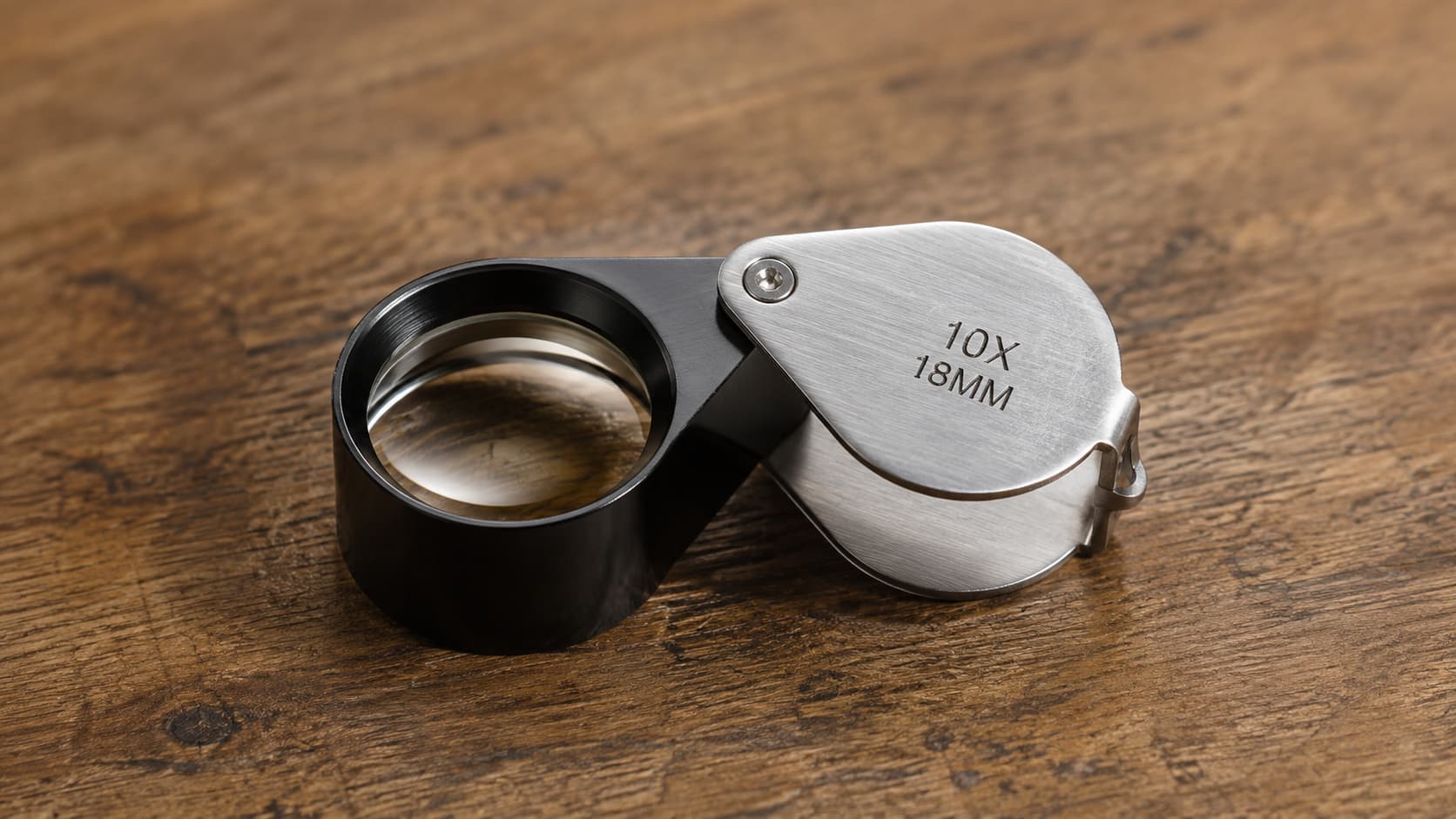
Close inspection under good lighting or a magnifying glass is the fastest way to check a stamp. A genuine 916 mark is small, clean, and typically sits alongside other markings.
Look at the Stamp Itself
Genuine hallmarks are crisp rather than blurry or uneven. Legitimate pieces often carry a maker’s mark or an assay office symbol next to the “916,” since many countries legally require gold above a certain weight to be tested before stamping. Numbers that look shaky, doubled up, or oddly spaced call for a closer look from a professional jeweler.
Jewelry purchased in India after 2021 should show three marks together rather than the number alone: the BIS triangle logo, the “916” purity grade, and a six-character HUID code. A missing HUID, or a code that fails to match any record, is a warning sign worth raising with the seller.
Check the Color and Weight
Genuine 22K gold has a deep, warm yellow color noticeably richer than 14K or 18K gold. It also tends to feel heavier for its size than fake or plated pieces, since gold is a dense metal. A piece that feels unusually light for its size may not contain the gold its stamp claims.
Try a Simple Magnet Test
Gold is not magnetic, making a strong magnet a quick first check. A piece that pulls or sticks to the magnet likely contains enough non-gold metal, such as iron or nickel, to raise suspicion. This test alone cannot confirm purity, since some counterfeit pieces avoid magnetic metals entirely, but it catches obvious fakes quickly.
Professional verification relies on tools a magnet cannot replace. Acid testing applies a drop of acid to a small scratch, which reacts differently depending on gold purity, while XRF (X-ray fluorescence) testing uses a machine that reads a piece’s exact metal composition without causing any damage. A licensed jeweler or assay office can run either test within minutes for a piece where certainty matters.
Should You Wear 22k Gold Daily?
916 gold suits pieces meant to last for years, though it is softer than lower-karat options such as 14K or 18K. That trade-off shapes how well a piece holds up depending on how often it gets worn.
Because 22K gold contains less alloy metal, it scratches and dents more easily than 14K or 18K jewelry, which carry more hardening metal. Many 22K pieces are therefore reserved for special-occasion jewelry, such as wedding sets, rather than pieces worn during workouts or manual labor. Its value holds up strongly regardless, since a higher gold percentage means more actual gold weight per gram.
916 Gold vs Other Gold Stamps
Every gold stamp follows the same purity logic at a different percentage.
| Stamp | Karat | Gold Purity |
|---|---|---|
| 375 | 9K | 37.5% |
| 417 | 10K | 41.7% |
| 585 | 14K | 58.5% |
| 750 | 18K | 75% |
| 916 | 22K | 91.6% |
| 999 | 24K | 99.9% |
Higher numbers correspond to both greater gold content and a richer color. Lower numbers such as 375 and 417 hold up better against daily wear and cost less, while higher numbers such as 916 and 999 offer a purer, warmer gold tone but demand more careful handling.
Tips for Maintaining 22k Gold Jewelry
Because 916 gold is softer than lower-karat pieces, a little extra care preserves it well. Storing it separately from other jewelry prevents scratches from harder metals or gemstones.
Removing 916 gold jewelry before swimming, cleaning with chemicals, or engaging in physical activity reduces the risk of bending, since the high gold content leaves it more vulnerable than harder alloys. A soft cloth and mild soapy water clean it safely, while harsh jewelry cleaners can be too abrasive for the softer surface. With reasonable care, 22K gold jewelry can last for generations, which explains its common presence in family heirlooms.
Frequently Asked Questions
Is 916 gold real gold?
Yes. A genuine 916 stamp confirms the piece is 91.6% pure gold, making it real, high-purity gold rather than a fake or gold-plated item.
Can 916 gold turn skin green?
This is very unlikely. Skin discoloration usually comes from the small amount of copper or other metals in lower-karat gold reacting with sweat, and since 916 gold contains so little alloy metal, this reaction is rare.
Is 916 gold more valuable than 18K gold?
Gram for gram, yes, since it contains a higher percentage of pure gold, the most valuable component of the metal. Overall price still depends on a piece’s weight, craftsmanship, and current gold market prices.
Does 916 gold scratch easily?
It scratches more easily than lower karats such as 14K or 18K, since it contains less hardening alloy. This is a normal characteristic of high-purity gold rather than a sign of a defective piece.
Is 916 gold suitable for daily wear?
It can be worn daily, though it shows wear faster than lower-karat jewelry. Many buyers reserve 22K pieces for special occasions and choose 14K or 18K for daily wear to reduce scratching.
Conclusion
A 916 stamp is not a random string of digits pressed into metal. It states plainly that 91.6% of a piece is pure gold, the same purity known as 22K under the karat system. Once that single number is understood, it becomes easy to compare against 375, 585, 750, or 999 stamps, judge whether a piece suits daily wear or special occasions, and recognize the warning signs of a fake through a close look and a simple magnet test. A tiny stamp, read correctly, turns into a clear and reliable account of exactly what a piece of jewelry is made of.