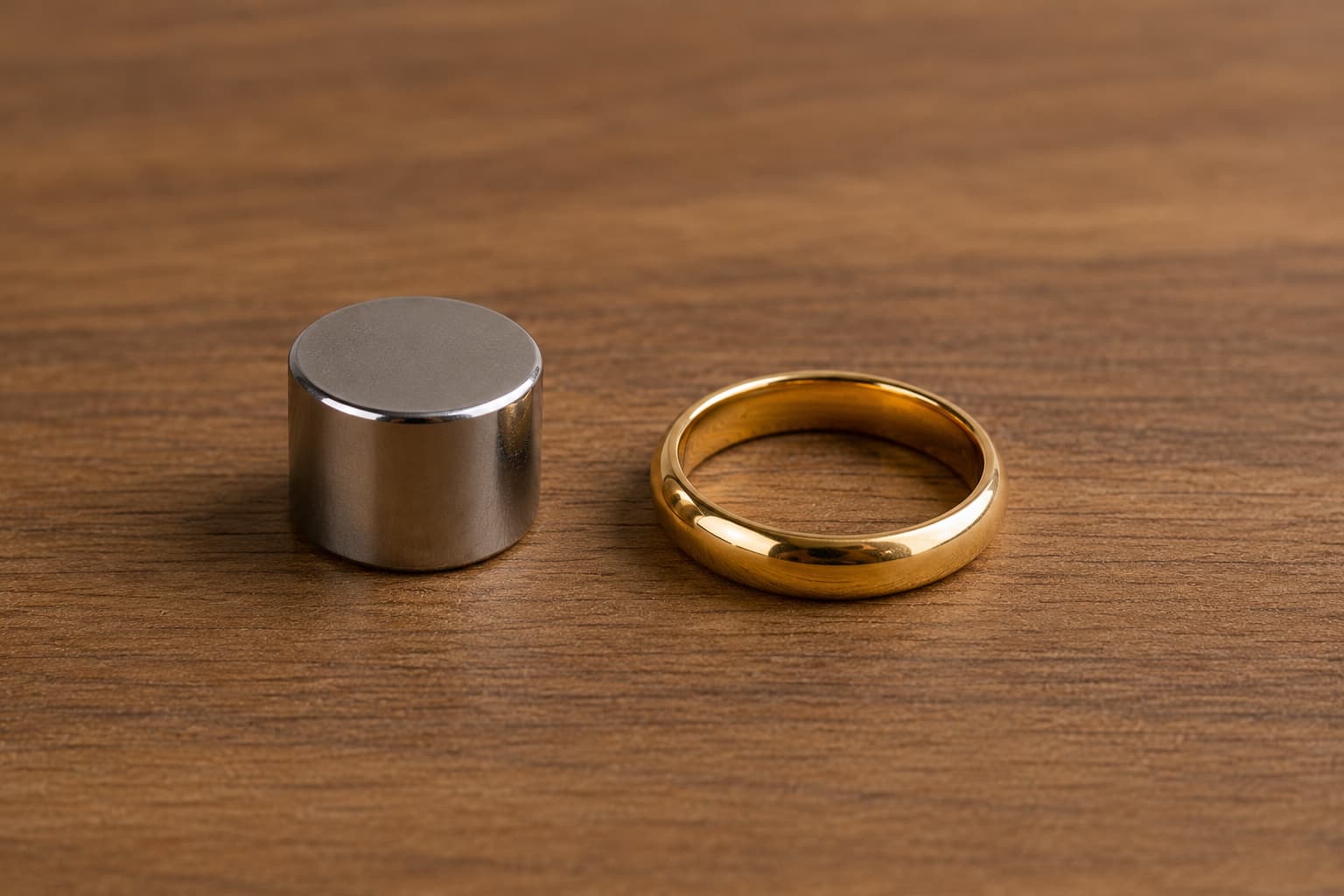
Holding a magnet up to a ring or chain is one of the oldest tricks people use when they want to know if their gold is real, and it has become even more popular thanks to videos showing the “test” in a few seconds flat. The idea sounds simple: real gold won’t stick to a magnet, so if jewelry jumps toward one, something is wrong. That basic idea is true, but the full story is a lot more complicated, and trusting a magnet alone can lead to the wrong conclusion about a piece that might actually be genuine, or worse, give a fake piece a false pass.
Does Real Gold Stick to a Magnet?
Pure gold is not magnetic at all, and it will not move or react in any way when a strong magnet is brought close to it. Gold belongs to a small group of metals that scientists call “diamagnetic,” which means it actually pushes away from a magnetic field ever so slightly rather than being pulled toward one, though this repelling effect is far too weak to ever be felt or noticed by hand.
This is different from metals like iron, nickel, steel, and cobalt, which are ferromagnetic and get pulled toward a magnet strongly enough to notice immediately. Because a lot of cheap fake jewelry is made by coating one of these magnetic metals with a thin layer of gold color or gold plating, a magnet can sometimes catch these obvious fakes in seconds. That’s the whole basis of the test, and it’s why it has stuck around for so long as a kitchen-table trick.
Other metals share gold’s non-magnetic behavior too, including silver, platinum, copper, brass, and aluminum. That overlap is exactly what makes the test tricky, since a piece failing to react to a magnet only narrows down the possibilities rather than confirming gold specifically.
How the Magnet Test Is Done Properly
A strong magnet held within about half an inch of a piece of jewelry, watched closely for any pulling, tugging, or movement, is the basic version of the test. Because gold carries no magnetic properties of its own, a genuine piece shouldn’t pull noticeably toward the magnet at all.
A proper version of the test involves a few extra steps that most people skip.
- A strong magnet, not a fridge magnet, is required. A regular refrigerator magnet is too weak to reveal much of anything. Neodymium magnets, also sold under the name rare earth magnets, generate a pull strong enough that testing guides commonly describe them as many times more powerful than a standard magnet, which is why they’re the go-to choice for this kind of check.
- The item should be moved away from any magnetic surfaces. Setting the piece on a flat wooden or plastic table, away from metal surfaces or other magnets, keeps the result accurate.
- The magnet should be brought close slowly. Starting with the magnet a short distance away, around a quarter inch, and easing it in gradually gives a clearer read than pressing it straight against the piece.
- A pull or tug signals a reaction. A genuine reaction looks like a small tug or a visible shift of the item toward the magnet. Faint static or nothing at all is the result expected from real gold.
- Multiple spots need testing, not just one. Clasps, hooks, and jump rings on necklaces and bracelets are sometimes made from a different, cheaper metal than the rest of the piece, so passing the magnet over the whole item matters more than testing the centerpiece alone.
Spring-ring clasps often have a tiny steel spring hidden inside, even on necklaces where the chain itself is genuine gold. A reaction at that one spot doesn’t mean the whole piece is fake; it’s usually just the mechanical spring doing what springs do, which is why testing several spots on the same item gives a much clearer picture than testing just one.
A magnet only reveals what a piece of jewelry probably isn’t. It can’t confirm what it actually is.
Why the Magnet Test Can Be Wrong
The biggest problem with this test is that a lot of fake gold is made from metals that aren’t magnetic either, so it passes the test without being real gold at all. Common counterfeit materials such as brass and copper share gold’s lack of attraction to a magnet, meaning a piece can sail through the magnet test and still be completely fake underneath its gold-colored coating.
There’s also the opposite problem: real gold jewelry can sometimes fail the test even though it’s genuine. This happens because pure 24 karat gold is too soft to make durable jewelry, so gold used in rings, chains, and bracelets is almost always mixed with other metals to make it stronger. Some of those strengthening metals, including nickel and, less commonly, cobalt or zinc, carry their own magnetic pull, and that pull can show up in the finished piece even though the gold inside is entirely real, especially at lower karats where less of the piece is pure gold. White gold illustrates this well, since its pale color usually comes from blending in nickel, and because nickel is one of the few naturally magnetic metals, a faint tug during testing doesn’t necessarily point to a fake.
A “fail” doesn’t always mean fake, and a “pass” doesn’t always mean real. That’s why jewelers treat the magnet test as a first screening step rather than a final verdict.
The karat of the gold matters too, since karat is simply a measure of how much of the piece is actually gold versus other metals mixed in. Higher-karat gold sits closer to pure and almost never reacts to a magnet, while lower-karat gold leaves more room for a magnetic metal to slip into the alloy.
| Gold type | Approx. gold content | Typical magnet reaction |
|---|---|---|
| 24K | ~99.9% gold | None |
| 18K | 75% gold | Usually none |
| 14K | 58.5% gold | Occasionally a faint pull |
| 10K | 41.7% gold | More likely to show a faint pull |
| White gold | Varies by karat | Faint pull possible due to nickel content |
A faint pull on a 10K piece still isn’t proof of anything on its own; it’s simply a reflection of how much alloy metal sits inside lower-karat gold.
More Reliable Ways to Test Gold
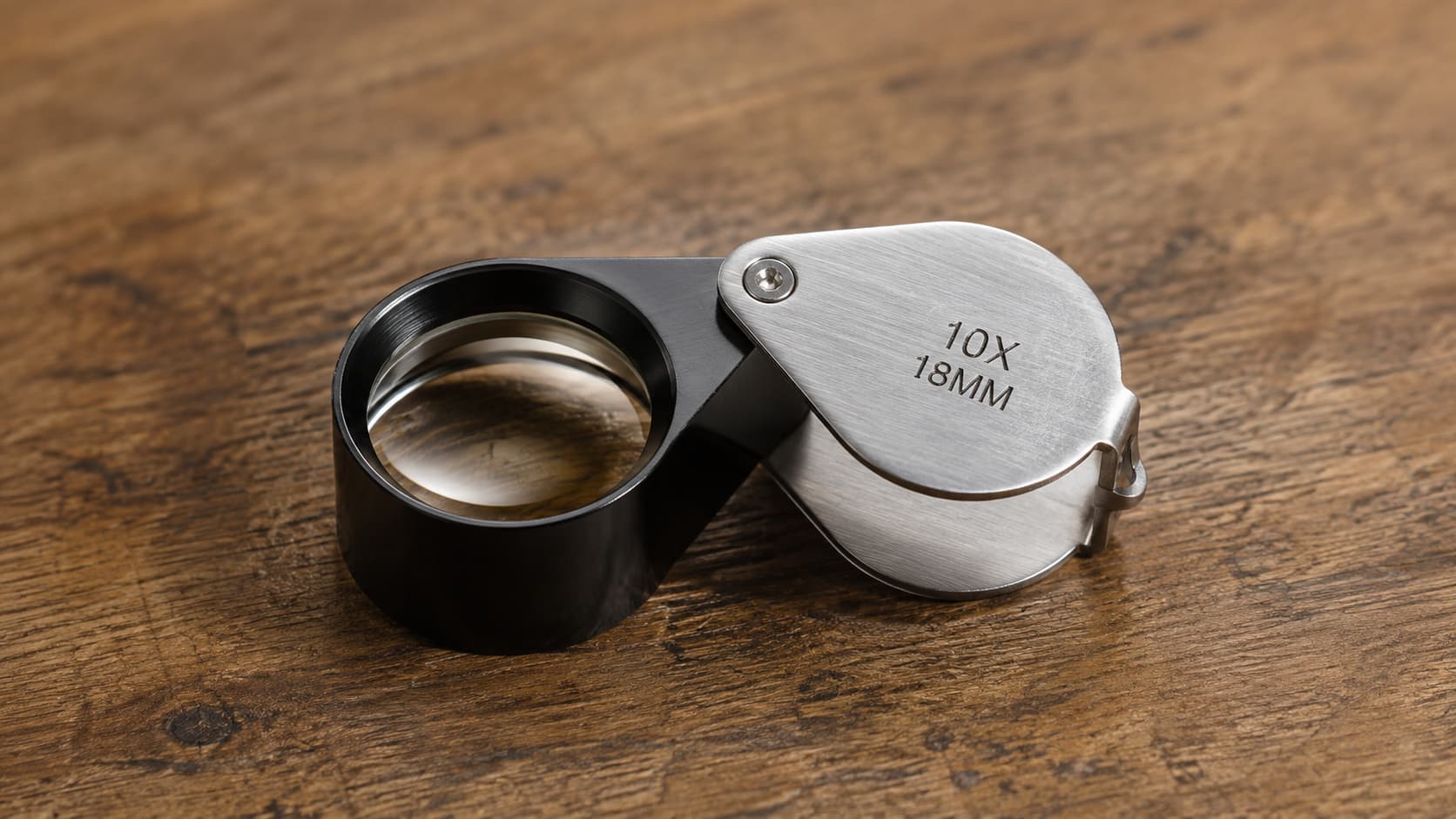
A visual check of the hallmark stamp is the fastest confirmation available, since legitimate gold jewelry is almost always stamped somewhere with its purity. A small engraved number such as 14K or 18K is the standard marking jewelers use, typically tucked inside a ring band or hidden near a clasp where it’s easy to overlook without a magnifying glass. A stamp alone isn’t bulletproof either, since counterfeiters can and do fake these numbers on convincing-looking pieces, so it works best as a first clue rather than the final word.
A visual check only goes so far, and a handful of other methods offer far more certainty than a magnet ever can. Acid testing is one of the more dependable at-home options: touching a drop of nitric acid to the metal and watching how the surface responds gives a fairly clear read on how much actual gold the piece contains, and affordable testing kits are sold online for various karat levels. Electronic conductivity testers offer a non-destructive middle ground, sending a small electrical signal through the metal and comparing how it conducts against known gold readings, at a cost above a magnet but well below professional lab equipment.
Weight and density checks work because gold packs more mass into the same amount of space than most of the metals used to imitate it, so a counterfeit piece often feels lighter than a genuine one of the same size. Pure gold has a density of about 19.3 grams per cubic centimeter, so weighing a piece and dividing that weight by the volume of water it displaces produces a number that can be compared against that figure, with a larger gap pointing toward a fake or a lower karat than claimed. Professional spectrum analysis, known as XRF testing, sits at the top of the reliability scale: the machine fires X-rays at the piece, and every element inside responds by giving off its own distinct energy signature, which the equipment reads to map out exactly what the metal contains and at what purity. This method can even reveal whether a piece is gold-plated and estimate how thick that plating is, without damaging the jewelry in the process.
For anything valuable, like an inherited ring or an expensive purchase of uncertain origin, a local jeweler or an accredited gem lab can run these more precise tests, often quickly and for a modest fee.
Common Mistakes People Make With the Magnet Test

The most common mistake is reaching for whatever magnet happens to be on the fridge instead of a proper strong magnet. A weak magnet can miss a magnetic reaction entirely, creating a false sense of confidence that a piece is real when it was simply never tested properly in the first place.
Another frequent slip-up is testing only one small spot, usually the main body of a ring or the center of a pendant, and stopping there. Clasps and jump rings can be made from a different metal than the rest of a piece, so a single test point can lead to the wrong conclusion either way.
The biggest mistake of all is treating “no reaction” as proof of real gold. Plenty of non-magnetic metals, including brass, copper, and aluminum, pass a magnet test just as easily as genuine gold does. Pairing the magnet check with a visual hallmark inspection and one additional reliable method closes that gap.
Other red flags are easy to miss while attention is fixed on the magnet. Green or black discoloration where a piece has worn down, a bendable or unusually light feel for its size, and stamps that look freshly added or oddly placed are all signs worth noting alongside any magnet test.
Frequently Asked Questions
Can a magnet damage gold jewelry?
A standard magnet test doesn’t damage gold jewelry, though neodymium magnets are strong enough that they should be handled carefully around fingers and other magnets, since they can pinch skin or shatter if they snap together too fast.
Does 14k or 10k gold react to a magnet?
It can. Lower-karat gold contains a higher percentage of other metals mixed in to strengthen it, and depending on which metals were used in that particular alloy, a slight magnetic pull is possible even though the piece is genuine.
Is white gold magnetic?
Sometimes, because many white gold alloys include nickel to achieve their pale color, and nickel is a magnetic metal, so a faint pull doesn’t automatically signal a fake.
What is the single best home test for gold?
No single home test is perfect on its own, but combining a hallmark check with an acid test kit gives a much clearer picture than the magnet test alone, since a magnet can only rule out obvious fakes rather than confirm authenticity.
Is a magnet test enough proof from a seller?
Not on its own. A magnet is built to serve as a fast first pass, not a definitive verdict on authenticity, so a seller relying on it alone hasn’t actually proven anything about the gold’s purity.
Does professional gold testing cost a lot?
Not usually. Most local jewelers and pawn shops run a quick acid or electronic test for free or for a small fee, typically taking only a few minutes without damaging the piece.
The magnet test earns its popularity because it’s fast, free, and genuinely useful for catching obviously fake jewelry built around an iron or steel core. But because real gold alloys can sometimes react to a magnet, and because plenty of convincing fakes are made from non-magnetic metals like brass or copper, the test can only ever rule things out rather than confirm them. A magnet works best as a first quick check, followed by a hallmark inspection, a weight comparison, or a proper acid or XRF test before any piece that actually matters gets trusted based on the result.