Celestite, with its ethereal blue hue reminiscent of clear skies and tranquil waters, has captivated gemstone enthusiasts, collectors, and metaphysical practitioners for centuries. This remarkable mineral, whose very name derives from the Latin word for “celestial,” presents a fascinating study in both geology and human fascination with beautiful natural formations. The delicate crystal combines scientific importance, aesthetic beauty, and cultural significance, making it a subject worthy of exploration for anyone interested in the mineral world.
What is Celestite?
Celestite is a strontium sulfate mineral with the chemical formula SrSO₄, most famous for its delicate pale blue to sky-blue coloration that gives it an almost otherworldly appearance. This remarkable crystal belongs to the barite mineral group and typically forms in sedimentary environments where it crystallizes into stunning orthorhombic structures that can range from small clusters to massive geodes. While most people recognize celestite by its characteristic blue hue, it actually comes in several color variations depending on its formation conditions and trace elements.
- Celestite’s chemical composition consists of 56.4% strontium oxide (SrO) and 43.6% sulfur trioxide (SO₃), making it an important source of strontium in commercial applications beyond its value as a collector’s item.
- While the signature color is pale blue, celestite can also be found in colorless, white, yellow, green, and rarely red-brown varieties, with the coloration typically resulting from trace elements or impurities within the crystal structure.
- The mineral ranks between 3 and 3.5 on the Mohs hardness scale, making it relatively soft compared to many gemstones and explaining why it’s rarely used in everyday jewelry despite its beauty.
- Celestite crystals have perfect cleavage in one direction and good cleavage in two others, meaning they can easily break along flat planes when handled roughly, requiring careful handling by collectors.
- This mineral has a vitreous to pearly luster when polished and displays a white streak when tested, regardless of the crystal’s color, which is one method used to help identify it.
- Celestite belongs to the orthorhombic crystal system, typically forming tabular or prismatic crystals that create stunning geometric clusters resembling frozen water formations.
- Though similar in appearance to some blue varieties of calcite, barite, or topaz, celestite can be distinguished by its specific gravity (3.95-3.97) and its reaction to flame tests, where it produces a distinctive crimson-red flame characteristic of strontium compounds.
Throughout history, celestite has been treasured not only for its striking appearance but also for its relatively uncommon occurrence in nature. While not as rare as some gemstones, high-quality specimens with well-formed crystals and vibrant, consistent coloration are highly valued by collectors. The crystal’s name perfectly captures its essence - a piece of the heavens brought down to earth in mineral form.
How Celestite Crystals Form in Nature
The formation of celestite offers a fascinating glimpse into geological processes that unfold over millions of years beneath the earth’s surface. This mineral typically develops in sedimentary environments where specific chemical conditions allow strontium and sulfate ions to come together and crystallize. Understanding how celestite forms helps explain why certain regions have become famous for producing exceptional specimens and why the crystal structures exhibit their characteristic appearances.
- Celestite primarily forms in sedimentary environments through the evaporation of mineral-rich water in cavities within limestone, dolomite, or clay deposits, where slow crystallization allows for the development of well-defined crystal structures.
- The mineral frequently occurs in geodes, which are hollow rock formations that have allowed the crystals space to grow inward toward the center, creating spectacular “crystal caves” that can range from hand-sized specimens to enormous chambers large enough for people to enter.
- Celestite deposits are often associated with sulfate and carbonate rocks in marine environments, where strontium concentrated in ancient seabeds can crystallize under the right pressure and temperature conditions.
- The largest and most commercially significant celestite deposits occur in Madagascar, Mexico, the United Kingdom, Poland, Turkey, and the United States, with each location producing crystals with slightly different characteristics.
- The formation process typically requires a gradual lowering of temperature and pressure, allowing the mineral to crystallize slowly over time, which explains why well-formed specimens usually come from stable geological environments.
- Celestite sometimes forms as a secondary mineral in hydrothermal veins, where hot, mineral-rich solutions circulate through rock fractures and deposit crystals as they cool.
- In some locations, celestite can be found replacing fossils, where the original organic material has been dissolved and replaced molecule by molecule with the mineral, creating fascinating specimens that preserve ancient life forms in crystalline form.
Geologists value celestite not only for its beauty but also because its presence can indicate specific environmental conditions during formation, making it useful for understanding the geological history of an area. The processes that create celestite deposits require particular combinations of minerals, pressures, and temperatures, explaining why significant deposits are relatively uncommon despite the abundance of strontium in Earth’s crust. This relative scarcity, combined with celestite’s stunning appearance, contributes to its value among mineral collectors and its significance in the world of natural sciences.
Celestite Physical Properties

The physical properties of celestite make it both distinctive and identifiable among the vast array of minerals found in nature. These properties not only determine its appearance and how it can be used but also explain why collectors must handle and store specimens with particular care. Understanding celestite’s physical characteristics helps in both appreciating its beauty and ensuring its preservation as part of a collection.
- Celestite has a Mohs hardness of 3 to 3.5, making it considerably softer than quartz (7) and even calcite (3.5), which means it can be scratched relatively easily and requires gentle handling to prevent damage.
- The mineral has a specific gravity of 3.95-3.97, noticeably heavier than common minerals like quartz (2.65) and calcite (2.71), which can help in identification when comparing similar-looking blue crystals.
- Celestite typically crystallizes in the orthorhombic system, forming tabular, prismatic, or sometimes fibrous crystal structures that often create stunning geometric arrangements within geodes or cavities.
- The crystal exhibits a vitreous (glass-like) to pearly luster on crystal faces, which can become particularly striking when specimens are properly cleaned and displayed under good lighting.
- One of celestite’s most defining characteristics is its perfect cleavage in one direction and good cleavage in two others, meaning it tends to break along flat planes rather than in irregular patterns when stressed.
- While the signature pale blue color comes from trace elements including calcium and potassium, completely pure celestite is actually colorless, with variations in trace minerals creating the range of colors from blue to white, yellow, and rarely red-brown.
- Celestite is slightly soluble in water and acids, which explains why specimens found in wet environments may show signs of natural etching and why collectors should avoid cleaning them with acidic solutions.
- Under shortwave ultraviolet light, some celestite specimens exhibit fluorescence, glowing with a white, cream, or occasionally pale blue color that can be used as another identifying characteristic.
These physical properties combine to make celestite both a beautiful collector’s item and a fascinating subject for scientific study. The delicate nature of the mineral, particularly its relatively low hardness and perfect cleavage, explains why large, undamaged specimens command higher prices and why they must be handled with care. At the same time, these properties create the very features that make celestite so appealing – its glassy luster, perfect crystal formations, and ethereal blue color that seems to capture the essence of the sky.
Celestite Deposits Around the World
Celestite deposits occur in specific geological settings around the world, with some locations becoming famous for producing specimens of exceptional quality, size, or distinctive characteristics. The distribution of celestite provides insight into both geological processes and the mining industry that has developed around this beautiful mineral. While not extremely rare, significant deposits of high-quality celestite are limited to certain regions where the geological conditions have been just right.
- Madagascar has become renowned for producing some of the world’s largest and most spectacular celestite specimens, with crystals exhibiting especially vibrant blue coloration and impressive geometric formations that can reach massive sizes.
- The island of Sicily, particularly in the sulfur-rich regions near Agrigento and Catania, has historically yielded exceptional celestite specimens associated with sulfur deposits and ancient evaporite formations.
- In North America, significant deposits exist in Put-in-Bay, Ohio, where some of the largest celestite geodes in the world have been discovered, including crystals weighing hundreds of pounds that now reside in major museums.
- The United Kingdom contains important deposits in Bristol and around Yate, where celestite was once commercially mined for its strontium content used in industrial applications, though many of these mines are now depleted.
- Mexico’s Chihuahua region produces distinctive celestite specimens with a slightly darker blue color than those found in Madagascar, often forming in association with barite in limestone cavities.
- Poland contains major commercial deposits that have been industrially mined for the mineral’s strontium content, though these operations focus more on quantity than specimen quality for collectors.
- Northwest Africa, particularly Morocco and Algeria, yields celestite specimens with unique brownish or reddish tints due to iron oxide inclusions, creating distinctive variations sought by serious collectors.
- China has emerged as a significant celestite producer in recent decades, with notable deposits in Guangdong Province yielding both industrial-grade material and collector-quality specimens.
The global distribution of celestite is directly tied to specific geological processes and conditions that allow for the concentration of strontium and the formation of these distinctive crystals. Interestingly, the quality, color intensity, and crystal formation style can vary significantly between regions, making it possible for experienced collectors to often identify a specimen’s origin based on its appearance. Commercial mining for industrial strontium has actually made many collector-quality specimens available as byproducts of larger operations, though concerns about sustainability and the depletion of the finest deposits have led to increasing values for museum-quality examples from classic localities.
Common Uses of Celestite
Beyond its obvious appeal as a collector’s specimen, celestite serves numerous practical and commercial purposes that might surprise those who know it only as a beautiful blue crystal. The mineral’s unique chemical composition, particularly its high strontium content, makes it valuable in various industries, while its aesthetic qualities ensure its continued popularity in decorative applications. Understanding these diverse uses helps appreciate why celestite mining continues to be economically important in several regions around the world.
- Celestite serves as the primary source of strontium for industrial applications, with approximately 300,000 tons mined annually worldwide for commercial purposes beyond specimen collection.
- The electronics industry relies on strontium derived from celestite for manufacturing cathode ray tubes, ferrite magnets used in speakers and small motors, and various electronic components that benefit from strontium’s properties.
- Pyrotechnics and fireworks incorporate strontium compounds extracted from celestite to produce the distinctive crimson-red color in firework displays, as strontium produces this vibrant hue when heated.
- The glass industry uses strontium from celestite to improve the optical properties of specialty glass, including products like television screens, optical glass, and some types of radiation-shielding glass.
- Ceramic manufacturing incorporates strontium compounds derived from celestite to improve the electrical insulation properties of ceramic materials used in electronic components.
- The medical field utilizes the luminescent properties of strontium aluminate (derived from celestite) in emergency lighting and watch dials, while also using strontium isotopes in certain medical imaging procedures.
- Celestite specimens themselves have become significant in the home décor market, with larger geodes and crystal clusters being polished and sold as decorative pieces for interior design, sometimes commanding thousands of dollars for exceptional examples.
- The metaphysical community values celestite for meditation, energy work, and as a decorative element in spaces dedicated to relaxation and spiritual practices, creating another commercial market for the mineral.
The diversity of celestite’s applications demonstrates how a single mineral can play roles in fields ranging from heavy industry to personal spirituality. While industrial uses consume the largest quantities of celestite by far, the higher per-pound value lies in specimen-quality crystals sold to collectors and decorative markets. This dual market structure has influenced mining operations, with some focusing on bulk extraction for industrial uses while others carefully extract display-quality specimens that are individually prepared for collectors. As with many natural resources, concerns about sustainability have emerged, particularly regarding the extraction of the finest specimen-quality material from finite deposits.
Can Celestite Be Used in Jewelry?
Despite its breathtaking beauty, celestite presents significant challenges for jewelry makers, explaining why genuine celestite jewelry remains relatively uncommon compared to jewelry featuring other blue gemstones like sapphire, aquamarine, or blue topaz. Understanding these limitations helps collectors make informed decisions when purchasing celestite jewelry and explains why such pieces require special care and consideration to maintain their beauty over time.
- Celestite’s relatively low hardness of 3-3.5 on the Mohs scale makes it highly susceptible to scratches and abrasion, limiting its suitability for rings, bracelets, or other jewelry pieces exposed to daily wear and potential impacts.
- The perfect cleavage characteristic of celestite means it can split along defined planes when subjected to sharp impacts or pressure changes, creating a significant risk of damage in everyday jewelry applications.
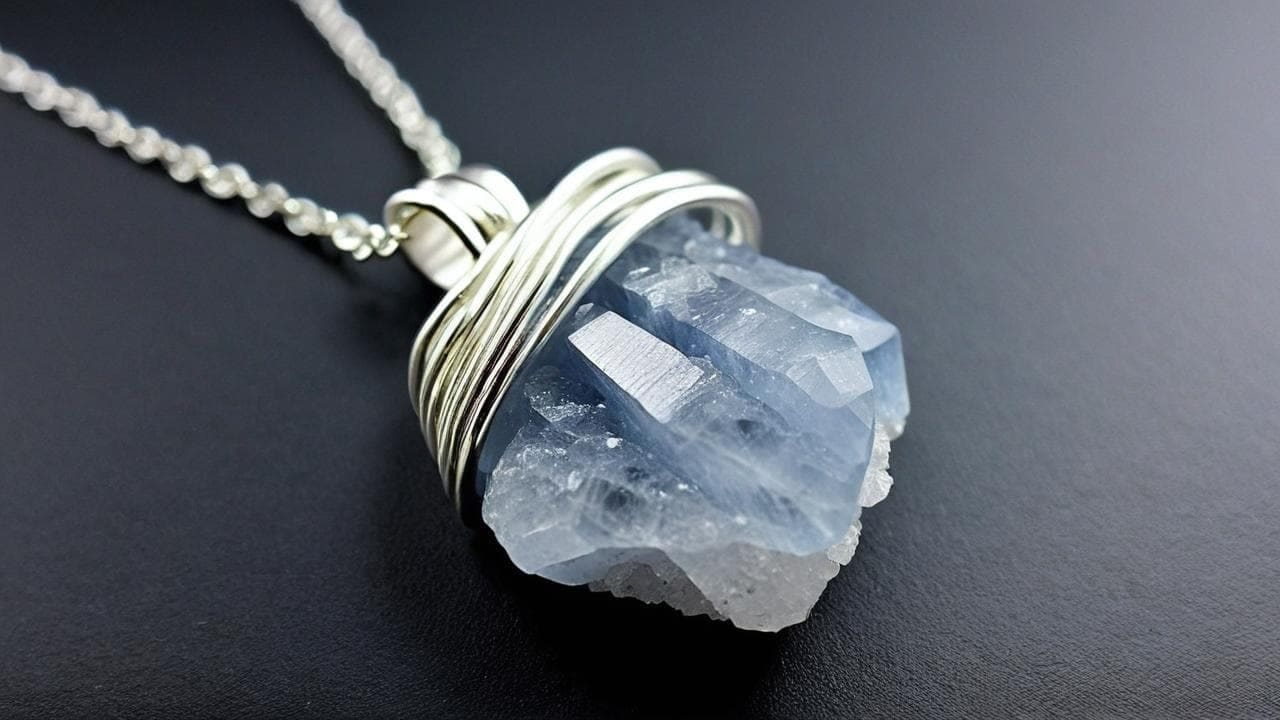
- Genuine celestite jewelry typically features protective settings that minimize exposure to impacts, such as pendants, earrings, or carefully designed brooches where the stone faces less risk of direct contact with hard surfaces.
- Some jewelers work with small celestite crystals in their natural form rather than cutting them, creating designs that showcase the crystal’s natural beauty while reducing the risk of damage during the cutting and polishing process.
- Celestite’s slight water solubility makes it unsuitable for jewelry that might be exposed to excessive moisture or perspiration, explaining why proper celestite jewelry should be removed before swimming, showering, or engaging in vigorous physical activity.
- The delicate color of celestite can fade with prolonged exposure to strong sunlight, meaning jewelry pieces should be stored away from direct light when not being worn to preserve their characteristic blue hue.
- Due to these limitations, many pieces marketed as “celestite jewelry” actually contain more durable blue stones that resemble celestite, such as blue topaz or aquamarine, making authentication important for collectors seeking genuine specimens.
- For those determined to own genuine celestite jewelry, custom pieces created by lapidaries specializing in fragile gemstones offer the best combination of beauty and reasonable durability, though they require careful handling and occasional professional maintenance.
The challenges of creating durable celestite jewelry have made genuine pieces relatively rare and typically more expensive than their appearance alone might suggest. The craftsmanship required to successfully work with this delicate material demands specialized skills and experience. For serious collectors, this rarity can add to the appeal, creating a niche market for celestite jewelry that emphasizes the stone’s natural beauty while acknowledging its limitations. Those who choose to invest in genuine celestite jewelry purchase not just a beautiful accessory, but a piece that requires mindful wearing and represents the jeweler’s skill in working with one of nature’s more delicate creations.
Metaphysical Uses of Celestite
Throughout history, celestite has accumulated a rich tapestry of metaphysical associations and spiritual significance across various cultures and belief systems. While scientific evidence for these properties remains absent, the cultural and historical importance of these beliefs offers fascinating insight into how humans have interpreted and valued this striking blue mineral. These traditional associations continue to influence how many people collect and use celestite today, particularly in metaphysical and spiritual practices.
- Celestite’s name itself reflects ancient associations with the heavens, derived from the Latin “caelestis” (celestial), and many traditions consider it a stone that facilitates connection with angelic or higher realms of consciousness.
- In crystal healing traditions, celestite is frequently associated with the throat and third eye chakras, believed to enhance communication abilities and promote clarity of thought and expression.
- Many practitioners use celestite in meditation practices, placing it in their environment or holding it while meditating, based on the belief that it creates a calming energy conducive to achieving deeper meditative states.
- Sleep and dream work represents another common metaphysical application, with celestite often placed near the bed to supposedly promote restful sleep and enhance dream recall or lucid dreaming experiences.
- Numerous crystal healing traditions associate celestite with stress reduction and anxiety relief, suggesting that its calming blue color and energy can help balance emotional states during challenging times.
- Some spiritual traditions, particularly those focused on energy work, believe celestite can help clear blockages in the upper energy centers of the body, facilitating better energy flow and spiritual awareness.
- In certain folklore traditions, celestite has been associated with success in creative endeavors and artistic expression, supposedly helping the user access inspiration and translate it into tangible creative works.
- Contemporary metaphysical communities often recommend celestite for creating sacred spaces dedicated to spiritual practice, suggesting that larger specimens can influence the energetic quality of an entire room.
While scientific evidence does not support these metaphysical properties, the cultural significance of these beliefs has real historical importance and continues to influence how people interact with celestite today. For many collectors, these traditional associations add an additional dimension of meaning and connection to their specimens beyond purely aesthetic or scientific appreciation. The calming blue color of celestite likely contributes to many of these associations, as humans have long connected blue hues with tranquility, peace, and the vastness of sky and sea – a psychological response that transcends specific cultural beliefs about the stone’s properties.
How to Identify Real Celestite

Correctly identifying celestite can sometimes challenge even experienced collectors, as several other minerals can present similar appearances. Learning to distinguish genuine celestite from look-alikes not only helps prevent disappointing purchases but also deepens appreciation for the mineral’s unique characteristics. Both simple field tests and more sophisticated laboratory methods can help confirm a specimen’s identity with increasing degrees of certainty.
- The distinctive pale blue color represents celestite’s most recognizable feature, though color alone isn’t definitive since blue barite, blue calcite, and some varieties of aquamarine can appear similar to the untrained eye.
- Celestite crystals typically form in orthorhombic tabular or prismatic shapes, often creating distinctive clusters of parallel or slightly radiating crystals with perfect cleavage faces that reflect light uniformly.
- A simple hardness test can help differentiate celestite (3-3.5) from harder blue minerals like aquamarine (7.5-8) or topaz (8), as celestite can be scratched with a copper coin while these harder minerals cannot.
- Celestite’s specific gravity of 3.95-3.97 makes it noticeably heavier than similar-looking minerals like blue calcite, providing another clue when comparing specimens of similar size.
- Under shortwave ultraviolet light, many celestite specimens will fluoresce white or cream-colored, offering another identification method that can be performed without damaging the specimen.
- The flame test provides one of the most reliable field identification methods – a small fragment of celestite placed in a flame will produce a distinctive crimson-red color characteristic of strontium compounds.
- Celestite shows no reaction to cold dilute hydrochloric acid, unlike blue calcite which will vigorously fizz when acid is applied, providing a simple differential test between these sometimes similar-appearing minerals.
- For definitive identification of challenging specimens, techniques such as X-ray diffraction analysis or scanning electron microscopy combined with energy-dispersive X-ray spectroscopy can provide conclusive results by determining crystal structure and elemental composition.
For collectors, developing the ability to identify celestite becomes part of the enjoyment of the hobby, combining scientific knowledge with practical experience. While laboratory tests provide the most definitive answers, most experienced collectors learn to recognize celestite through a combination of visual characteristics, simple field tests, and familiarity with how celestite typically presents from various localities. The distinctive association of celestite with other minerals in its forming environment, such as gypsum, calcite, and sulfur, can also provide contextual clues that help confirm identification when examining specimens in their natural matrix.
How to Care for Celestite
Proper care of celestite specimens requires understanding the mineral’s physical vulnerabilities to prevent damage and maintain its beauty over time. Due to its relatively soft nature, perfect cleavage, and sensitivity to certain environmental conditions, celestite demands more careful handling than many other collector minerals. With appropriate care, however, specimens can maintain their beauty indefinitely, making them lasting additions to any collection.
- Store celestite specimens in a cool, dry environment away from direct sunlight, as prolonged sun exposure can gradually fade the blue color that makes these crystals so desirable.
- Handle celestite with clean, dry hands and avoid excessive touching of the crystals, as oils from skin can dull the luster over time and potentially cause subtle surface damage to this relatively soft mineral.
- When cleaning is necessary, use only a soft, dry brush to remove dust, avoiding water or chemical cleaners that could damage the mineral due to its slight water solubility and reactivity with certain chemicals.
- For display purposes, place celestite specimens in closed display cases whenever possible to minimize dust accumulation and reduce the need for cleaning, while also protecting from accidental impacts.
- Never use ultrasonic cleaners or steam cleaning methods on celestite, as the vibrations and heat can cause fracturing along cleavage planes and potentially destroy the specimen.
- When transporting celestite, wrap specimens individually in soft, non-abrasive materials like acid-free tissue paper, then place in padded containers with minimal movement potential to prevent damage during transit.
- Keep celestite specimens away from other harder minerals in your collection to prevent scratching, ideally storing different hardness minerals in separate compartments or display areas.
- Maintain stable temperature and humidity conditions for your collection, as sudden changes can potentially stress the crystal structure, particularly in larger specimens where different parts might expand or contract at different rates.
Proper care of celestite represents an investment in preserving both the specimen’s beauty and its value. The time and attention required to maintain these delicate crystals properly reflects their special nature and the geological rarity that created them in the first place. Many collectors find that establishing good handling and storage protocols for their more delicate specimens, including celestite, becomes an integral part of their collecting practice, deepening their appreciation for the unique properties of each mineral in their collection. With appropriate care, celestite specimens can be enjoyed for generations, their ethereal blue beauty undiminished by time.
Conclusion
Celestite stands as a remarkable example of nature’s ability to create objects of extraordinary beauty through simple geological processes. From its formation in ancient sedimentary environments to its diverse applications in modern industry and collection, this heavenly blue mineral continues to captivate people across cultures and disciplines. Its distinctive pale blue crystals, forming in geometric patterns that seem almost architectural in their precision, represent millions of years of slow, patient growth beneath the earth’s surface before emerging into human hands.
For collectors, celestite offers an accessible yet genuinely beautiful addition to mineral displays, with specimens ranging from affordable small clusters to museum-quality geodes that command significant investment. For scientists, it provides insights into geological processes and the behavior of strontium in natural systems. For those drawn to the metaphysical, it represents a centuries-old tradition of human connection to the mineral kingdom through cultural and spiritual practices.
Though relatively delicate compared to many gemstones, with proper care, celestite specimens can maintain their beauty indefinitely. This care requirement itself reminds us of the temporary nature of human stewardship over these ancient formations – we are merely brief caretakers of minerals that have existed for millions of years before us and may continue to exist long after. Whether appreciated for its scientific significance, its aesthetic beauty, or its cultural associations, celestite truly lives up to its celestial name – a piece of the heavens captured in crystalline form.