Put on a pair of 3D glasses at the movies and the screen suddenly seems to have depth — objects pop out toward the audience, backgrounds stretch away, and the scene feels like it has real space inside it. None of that is actually happening on the flat screen itself. What’s really going on is a clever bit of trickery aimed straight at the brain, using nothing more than lenses, light, and the fact that two eyes never see the exact same picture at the same time. Once the trick is understood, it’s hard not to be a little impressed by how simple the physics behind it really is.
Why 3D Glasses Create the Illusion of Depth
3D glasses work by feeding a slightly different image to the left eye and the right eye at the same time, which is exactly what happens naturally when looking at anything in real life. The brain is used to combining those two slightly offset pictures into one image with depth, a process scientists call stereopsis, which lets humans judge distance and space with impressive precision. 3D glasses hijack this system by making sure each eye only sees the image meant for it, even though both images are sitting right on top of each other on the same screen.
A person’s two eyes sit a few centimeters apart, so each eye naturally captures the world from a slightly different angle. Because of that horizontal separation, each eye grabs a slightly different image, and the brain compares those differences — called binocular disparity — to build one picture with a sense of depth. Movies and games can’t physically move a screen to create that separation, so instead they print or project two versions of the same scene, shifted slightly apart, onto the same screen at the same time. The glasses’ entire job is sorting out which version goes to which eye.
Glasses accomplish that sorting through one of three methods: color filtering, light polarization, or rapid shutter timing. Each is a completely different piece of technology, but all three are solving the identical problem — get image A to the left eye, get image B to the right eye, and never let the two mix.
What Are Anaglyph 3D Glasses (the Red and Blue Ones)?
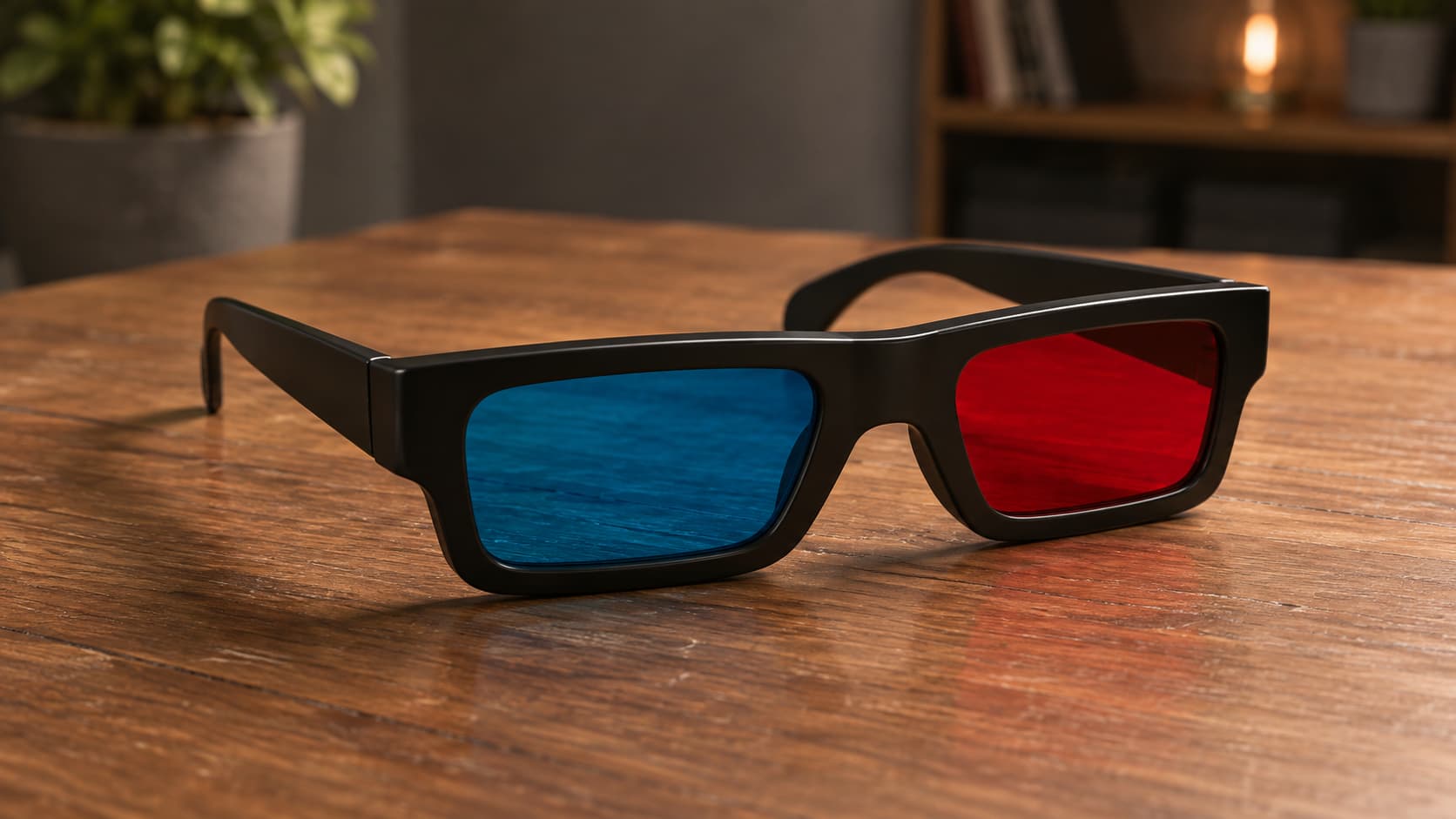
Anaglyph glasses are the classic red-and-cyan paper glasses, and they work by using colored lenses to block out everything except one specific color channel per eye. The red lens and the cyan lens act as filters that separate the image meant for each eye, since the movie or picture itself was printed as two overlapping images — one drawn in red tones, one in cyan tones — that are intentionally offset from each other.
The red lens blocks the cyan-toned image and lets the red-toned image through, while the cyan lens does the opposite. Each eye ends up seeing only its own slightly shifted picture, and the brain fuses the two into a scene with depth. It’s a brilliantly cheap solution because it needs no batteries, no special screen, and no electronics — just two pieces of colored plastic.
The tradeoff is picture quality. Because the images are built out of color channels rather than full color, anaglyph 3D tends to wash out true colors and can cause ghosting, where a faint double image leaks through to the wrong eye. This is why anaglyph glasses show up mostly in novelty items, comic books, and old-school 3D movies rather than modern cinemas.
Anaglyph is also the oldest of the three technologies by a wide margin. The process of splitting an image into two color channels was patented back in 1891, and it reached the public in 1922 with The Power of Love, generally regarded as the first 3D feature film ever shown to an audience. That’s roughly three decades before polarized glasses became common and closer to fifty years before shutter glasses existed in any usable form.
Anaglyph is the oldest commercial 3D technology still recognized today, and it’s the version most people picture when they hear “3D glasses” — even though theaters mostly moved away from it decades ago.
What Are Polarized 3D Glasses (the Gray Ones From the Movies)?
Polarized glasses are the gray-tinted plastic glasses handed out at most movie theaters, and they work by only letting light waves vibrating in one specific direction pass through each lens. Instead of filtering by color, polarized lenses allow light waves to pass through in only one direction, so each eye ends up seeing a slightly different image.
Making this work takes more than a single projector pointed at the screen. Two images are projected onto the same screen at the same time, each passed through its own polarizing filter set at a different angle, and the glasses use matching filters so each eye only receives the image polarized in that same direction. The left lens accepts light polarized in one direction, and the right lens accepts light polarized in the opposite direction, so the two overlapping projections get sorted back out once they reach the glasses.
Because polarized glasses preserve full color, they look far more natural than anaglyph glasses, and they’re comfortable enough to wear through a two-hour movie. The catch is that they only work with a compatible polarized screen or projector setup, which is why a pair can’t simply be used at home with a regular television.
Not all polarized glasses are built the same way, either. Most multiplex chains use a system called RealD, which relies on circularly polarized light — the light spirals in one direction or the other rather than staying on a flat plane — and this design keeps working reasonably well even when a viewer tilts their head to the side. IMAX theaters, on the other hand, more commonly use linear polarization, which is simpler and cheaper to produce but is far more sensitive to head angle, since even a slight tilt can dim or double the image. That’s also why the two systems aren’t interchangeable: RealD glasses generally won’t sort the image correctly in an IMAX theater, and vice versa.
What Are Active Shutter 3D Glasses?
Active shutter glasses use battery-powered lenses that physically go dark and clear dozens of times per second, timed perfectly with the screen, so each eye only sees its intended frame. The system works by presenting the image meant for the left eye while blocking the right eye’s view, then instantly switching to present the right-eye image while blocking the left eye, repeating so quickly the brain never notices the gaps.
Inside each lens sits a thin liquid crystal layer that can switch between transparent and opaque almost instantly when it receives an electrical signal. Each eye’s lens contains this liquid crystal cell, which becomes opaque or transparent depending on the signal it receives, and a small receiver in the glasses’ frame keeps that switching in perfect sync with the television or projector, usually using an infrared or Bluetooth signal.
Because each eye gets a full, uninterrupted frame rather than half the resolution or a filtered color range, shutter glasses generally produce the sharpest, most accurate 3D image of the three technologies. That quality comes at a cost, though — they need batteries or charging, they’re heavier on the face, and they’re noticeably more expensive to manufacture than a pair of plastic anaglyph or polarized lenses.
A less obvious requirement sits on the display side: the screen itself has to run at double its normal refresh rate to make this work. If a movie plays at a standard 60 frames per second, the display actually has to output 120 frames per second — 60 for the left eye and 60 for the right eye — so that after the glasses cut that number back in half for each eye, nothing looks like it’s stuttering. Older or lower-end TVs that can’t hit those higher refresh rates simply aren’t capable of running active shutter 3D properly, no matter how good the glasses themselves are.
Comparing the Three Types of 3D Glasses
Anaglyph, polarized, and active shutter glasses split images through three different mechanisms, and each comes with its own tradeoffs in cost, color accuracy, and equipment requirements, summarized below.
| Feature | Anaglyph (Red/Cyan) | Polarized (Gray) | Active Shutter |
|---|---|---|---|
| How it splits images | Color filtering | Light wave direction | Rapid on/off blocking |
| Color accuracy | Poor, washed out | Good, close to natural | Best, full color |
| Needs power | No | No | Yes (battery/charging) |
| Needs special screen | No | Yes | Yes (compatible display) |
| Typical cost | Very cheap | Cheap | Most expensive |
| Sensitive to head tilt | No | Sometimes (linear type only) | No |
| Common use today | Novelty, print, old films | Movie theaters, IMAX | Home theater, gaming |
Why Do Some People Feel Sick or Get Headaches Wearing 3D Glasses?
3D-related headaches and nausea usually come down to a specific mismatch inside the visual system known as the vergence-accommodation conflict. Normally, when a person focuses on something up close, their eyes rotate inward and their eye muscles adjust focus by the exact same amount, since both actions are triggered by how far away the object actually is. A 3D screen breaks that link: the eyes are told to converge toward an object that appears close or far away, while the focusing muscles stay locked onto the flat screen sitting a fixed distance away. The brain has to reconcile two signals that don’t match, and for a lot of people that mismatch shows up as eye strain, headaches, or a queasy feeling after twenty or thirty minutes.
Depth perception also isn’t only about the two flat images the eyes capture — the visual system also depends on both eyes moving together so their lines of sight land on the same object, and then fusing those two views into one. When a 3D effect is exaggerated, poorly calibrated, or the glasses don’t fit quite right, that fusion process has to work even harder on top of the vergence-accommodation mismatch, which is part of why some movies or games feel far more uncomfortable in 3D than others.
Some people also have naturally weaker binocular vision to begin with, which affects how well this whole system works even outside of watching 3D content. People with conditions like lazy eye or strabismus have a harder time with stereopsis specifically because their brain is working with two images of noticeably different quality, so 3D effects that look impressive to most viewers may look flat, blurry, or genuinely uncomfortable to someone with those conditions. If 3D content consistently causes discomfort in a particular viewer, it’s less about the glasses being faulty and more about how that person’s eyes and brain are processing the mismatched images.
What Happened to Home 3D Technology?
3D TVs largely disappeared because manufacturers stopped making them, and that happened for a simple reason: almost nobody was using the feature. Nearly every major TV brand raced to add 3D screens to their lineups in the early 2010s after the massive success of Avatar, but by 2016 the last of the major manufacturers, including LG and Panasonic, had quietly stopped producing them altogether.
A few problems piled up at once. There was barely any 3D content to actually watch beyond a handful of blockbuster movies, so buying a 3D-capable TV meant paying extra for a feature with almost nothing to use it on. On top of that, the active shutter glasses required for most home 3D setups were expensive, needed regular charging, and left plenty of viewers finding them uncomfortable or headache-inducing during longer viewing sessions. Around the same time, 4K resolution and HDR arrived and gave every single thing on screen — not just a rare 3D movie — a genuinely sharper, richer look without asking viewers to wear anything at all, which made those upgrades a far easier sell.
3D hasn’t vanished from every screen, though. Movie theaters have kept it around because polarized glasses are cheap to produce and hand out in bulk, and the technology still shows up in specific places like theme park rides, some laptops and handheld gaming devices, and glasses-free displays that skip the eyewear entirely.
Frequently Asked Questions
Can 3D glasses from one movie theater be used at a different theater?
It depends on the technology. Polarized glasses generally work across different theaters and even different movies, since most cinemas use a similar polarization standard, but they won’t work at home on a regular TV without a compatible polarized screen. Active shutter glasses, on the other hand, are usually paired to a specific brand of television or projector and won’t sync properly with a different, incompatible system.
Do 3D glasses work on any TV or computer screen?
No. Polarized and active shutter 3D glasses only work with a screen or projector built to support that specific 3D technology — the display has to be capable of showing the two offset images correctly for the glasses to sort them out. Anaglyph glasses are the exception, since they work with any red-and-cyan image, including printed pictures, without needing a special screen at all.
Why do old 3D glasses use red and blue instead of full color?
Anaglyph glasses rely on color channels to separate the left-eye and right-eye images, and red combined with cyan (a blue-green shade) happen to sit far enough apart on the color spectrum that cheap colored plastic lenses can filter them out cleanly. Full color 3D wasn’t possible with this method because the technology depends on sacrificing color information to do the separating, which is exactly why anaglyph pictures always look tinted rather than true to life.
Is active shutter 3D better than polarized 3D?
In terms of raw image sharpness and color accuracy, yes — active shutter glasses generally deliver a crisper picture because each eye gets a complete, full-resolution frame instead of sharing the screen’s resolution between two overlapping images. Polarized glasses still hold their own for comfort and cost, though, since they’re lighter, don’t need batteries, and are the reason movie theaters can hand out hundreds of pairs a night without worrying about charging them.
Why do 3D glasses stop working properly when the head is tilted?
It depends on the type of polarized glasses. Older linear-polarized systems, which some IMAX theaters still use, are cut to accept light at one very specific angle, so tilting the head rotates that angle out of alignment and dims or blurs the image. Most standard multiplex theaters now use circularly polarized glasses instead, which hold up fine even with a noticeable head tilt. Active shutter glasses aren’t affected by tilting at all since they work through timing rather than angle, and the same goes for anaglyph glasses, since color filtering has nothing to do with head angle.
Can 3D glasses be worn over regular prescription glasses?
Most polarized and active shutter 3D glasses at theaters are designed to fit over a standard pair of prescription glasses, since theater-issued glasses use larger frames specifically for that purpose. Thicker prescription frames can still make the fit feel bulky or press uncomfortably on the sides of the head, which is why frequent 3D viewers often buy their own clip-on polarized lenses or prescription-ready active shutter glasses instead. Anaglyph glasses, being lightweight paper or plastic, are usually the easiest of the three to wear over existing glasses without any real discomfort.
Is there such a thing as 3D without wearing any glasses?
Yes, it’s called autostereoscopic or “glasses-free” 3D, and it works by building the eye-separating trick directly into the screen instead of into a pair of glasses. The most well-known example is the original Nintendo 3DS, which used a technique called a parallax barrier — a layer of precisely spaced slits placed over the display that blocks certain pixel columns from one eye while letting the other eye see them, and vice versa. The tradeoff is that these screens usually only work from one fixed viewing position or “sweet spot,” which is part of why the technology has mostly stayed limited to handheld devices and small displays rather than TVs.
Conclusion
3D glasses all chase the same goal through three very different methods: anaglyph glasses use color to split the image, polarized glasses use the angle of light waves, and active shutter glasses use split-second timing and battery power. Anaglyph remains the cheapest and least accurate, polarized strikes the balance movie theaters have relied on for decades, and active shutter delivers the sharpest picture at the highest cost and complexity — which is also exactly why the format struggled to survive in living rooms once cheaper, glasses-free upgrades like 4K and HDR came along. Whichever pair ends up on a viewer’s face today, whether at a theater or a museum exhibit, the real work is happening inside the viewer’s own head — the glasses are just making sure each eye gets fed a different half of the illusion so the brain can stitch the depth back together itself.