A five-dollar pair of sunglasses from a gas station display slides on, and the world instantly looks darker and more comfortable. An hour later, the eyes feel tired and a dull headache sets in for no clear reason. That reaction isn’t random. It comes down to lenses that were never built to handle real sunlight in the first place, and the mechanics behind it explain why the discomfort — and the potential damage — has little to do with price and everything to do with what a manufacturer left out.
What Cheap Sunglasses Get Wrong
Cheap sunglasses often cause eye strain and discomfort because they darken vision without properly blocking UV rays, while their lenses are frequently made from lower-grade plastic that bends light unevenly. The eyes end up working overtime to compensate, and in some cases the lenses let in more harmful light than wearing no sunglasses at all. The problem usually isn’t the price tag itself — it’s what the manufacturer left out to hit that price.
Two separate mechanisms are at play: what the lens lets through (UV radiation), and what the lens does to the image (optical distortion). Cheap eyewear frequently fails at both.
Why Darker Isn’t Always Safer
Dark lenses without real UV protection can trick the pupils into opening wider, letting in more damaging light than wearing nothing at all.
The pupil, the black circle in the middle of the eye, acts like a camera aperture. In bright light, it shrinks to limit how much light gets in. Dark sunglasses trick the eyes into acting as though they’re in a low-light environment, so the pupils widen instead of staying contracted. If the lens is genuinely blocking UV rays, that’s not a problem, since the harmful wavelengths never reach the eye in the first place. But if the lenses don’t actually filter UV, that wider pupil can let in more radiation than the eye would have received unprotected.
Eye doctors sometimes call this the “darkness fallacy” — the tint fools people into assuming a lens is protective, when tint and UV filtering are two completely separate features that have nothing to do with each other.
This isn’t just about a slightly annoying afternoon. Long-term UV overexposure is linked to cataracts, a leading cause of blindness worldwide, along with pterygium (sometimes called “surfer’s eye”) and possibly certain eyelid cancers. None of that happens from one unprotected trip outside — it’s the accumulated effect of years of inadequate protection that raises the risk. That’s exactly why the pupil-dilation trap matters: it’s not a one-time discomfort, it’s a habit that compounds over decades with every wrong pair worn in bright sun.
Is This Danger Overstated?
Recent research suggests the pupil-dilation risk is real, but smaller than headlines often suggest — and a different factor matters even more.
A 2024 study published in the peer-reviewed journal Scientific Reports actually ran the numbers on this. The researchers modeled how much UV light reaches the eye with and without sunglasses, accounting for both pupil size and how much of the surrounding scene the eye can see (called the field of view). Their results showed pupil dilation alone doesn’t play as big a role as commonly assumed — the field of view mattered far more, up to several times more than pupil size. Still, there was one meaningful exception: lenses that blocked less than about 86% of UVA rays came out slightly worse than going bare-eyed, according to the study’s modeling. In other words, the old warning wasn’t entirely wrong, just oversimplified — the real danger zone is specifically lenses that are dark and clearly under-protective, not merely inexpensive.
Either way, a lens’s actual protection has little to do with how dark it looks, and everything to do with whether it’s labeled and verified for UV blocking.
Small, Flat Frames Let Light Sneak in From the Sides
It’s not just the lens. The shape and size of the frame itself controls how much UV light reaches the eye, and this is the factor the 2024 study found mattered even more than pupil dilation.
Light doesn’t only strike the eyes head-on. It bounces off pavement, water, sand, and the ground, then enters from the sides, above, and below the lens — areas a small, flat, close-cropped frame does nothing to cover. Research published in Photochemical & Photobiological Sciences found that frame geometry is a major factor in how much UV exposure actually reaches the eye, with wraparound and goggle-style frames offering near-total protection by minimizing this peripheral leakage. Some estimates suggest that up to 20% of a person’s total UV exposure comes in through the sides of standard, non-wraparound frames.
This is where cheap sunglasses often quietly cut corners in a way that has nothing to do with the lens tint. Smaller frames allow peripheral light to reach the eye, reducing both comfort and protection, while wraparound and oversized frames block light from the sides, top, and bottom of the lens area. Making a frame smaller and flatter is cheaper to mold and ship, so budget eyewear tends to skew toward minimal coverage — which means even a pair with a genuinely good UV400 lens can still leave the eyes more exposed than a larger, closer-fitting frame would.
Blurry, Wavy Lenses Strain the Eye Muscles
Cheap lenses are often not ground with the same precision as quality ones, so the image reaching the eye is slightly warped, forcing the eye muscles to constantly refocus to compensate.
This is a manufacturing issue, not a UV issue. Good sunglass lenses are what optometrists call “optically correct” — light passes through them without bending in odd directions. Poorly manufactured lenses can have subtle waves, ripples, or inconsistencies that force the eyes to keep refocusing, and that constant micro-adjustment is what leads to headaches, eye strain, and fatigue over the course of a day. The effect usually isn’t noticeable in the first five minutes of wearing a pair — it’s the kind of problem that builds up gradually, the way a mildly uncomfortable shoe only starts to hurt after a few miles of walking. Distorted lenses force the eye muscles to constantly compensate for the visual inaccuracy, and while the effect might not register right away, an hour of driving or being outside in them can bring on eye fatigue or a dull headache.
Even the frame itself can contribute. Cheap sunglasses sometimes have warped lenses, mismatched lens sizes, or uneven coloring between the left and right eye, none of which becomes obvious until a pair has been worn for a few hours.
At its worst, this shows up as what optical professionals sometimes call the “Coke bottle effect.” Inexpensive lenses made from lower-grade material can cause objects in the field of view to visibly shift side to side or up and down as the eyes move across the lens, similar to looking through the curved glass of an old soda bottle. It’s most noticeable with cheap safety glasses and no-name sunglasses that use molded plastic instead of properly ground lens material, since molding is faster and cheaper but far less precise than grinding a lens to an exact optical curve.
How to Test Lens Quality in 10 Seconds
The American Academy of Ophthalmology recommends a quick check that takes about ten seconds:
- Hold the sunglasses at arm’s length, one eye closed.
- Look through a single lens at a straight edge — a door frame, floor tile, or brick wall works well.
- Move the glasses slowly from side to side, then up and down.
- Watch how the line behaves.
With high-quality lenses, the line stays straight and unwavering throughout. If it bends, wiggles, or warps, the lenses are optically inferior. That means the eyes are likely doing extra work every time the sunglasses are worn, whether or not it registers in the moment.
Cheap Frames Can Literally Fall Apart
Budget frames often cut corners on hinges and impact resistance, which affects both comfort and basic safety, not just how long the sunglasses last.
In the United States, sunglass lenses are required to meet the FDA’s impact-resistance rule, tested by dropping a small steel ball onto the lens from height to make sure it doesn’t shatter. This standard exists specifically to prevent eye injuries if something hits the lens, whether that’s a rock kicked up while biking or an elbow at a crowded pool. Reputable manufacturers build to this standard as a baseline; the cheapest imported pairs sometimes skip it entirely.
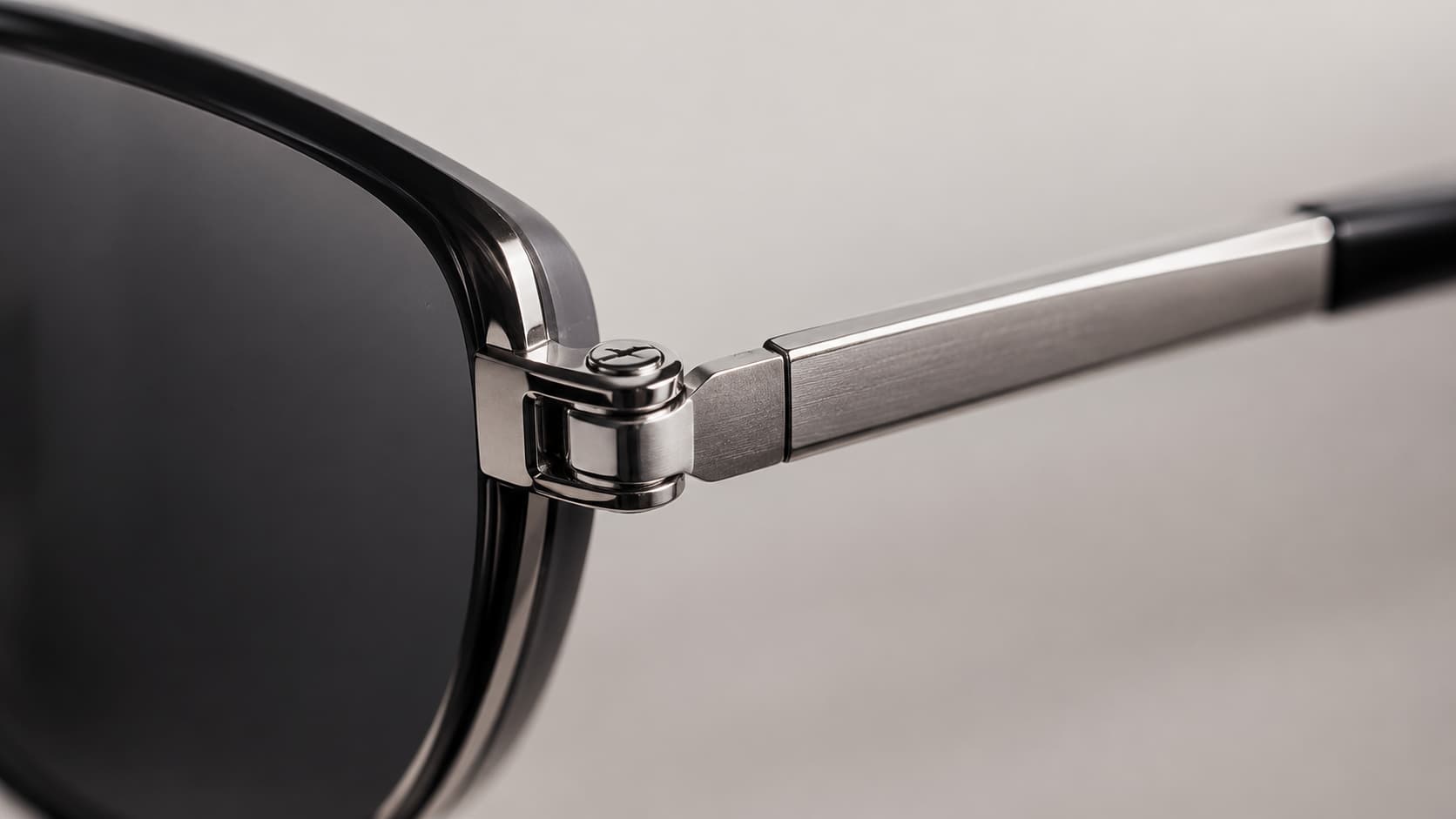
Hinges matter too, and not just for durability. A loose or wobbly hinge means the frame doesn’t sit evenly on the face, which changes how light enters around the edges of the lens and can force more squinting than a properly fitted pair would require. A hinge that already wobbles on day one is a strong sign the rest of the build quality won’t hold up either.
There’s also a bigger-picture reason to be cautious with sunglasses bought from unverified sellers. Research examining sunglasses sold across various markets found that buying from unregulated sources significantly raises the odds of getting a pair with a UV filter that doesn’t actually meet the standard printed on the label. A “UV protection” sticker isn’t a guarantee — it’s a claim, and claims are only as reliable as the source selling them.
What to Look For: UV400 Protection
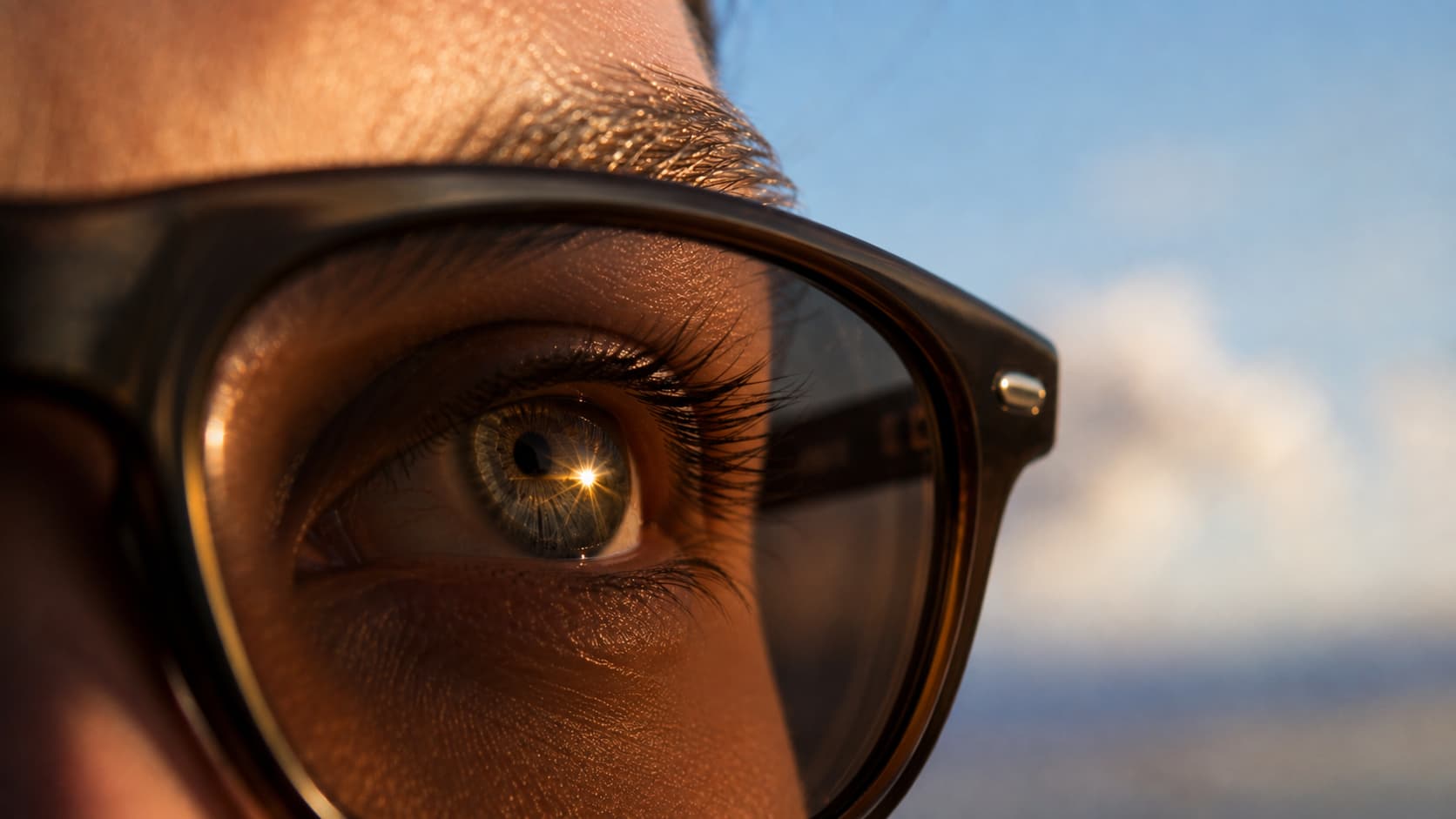
UV400 is a labeling standard indicating a lens blocks light up to 400 nanometers, which covers essentially all UVA and UVB rays — the two types that damage eyes over time.
Sunglasses labeled UV400 or 100% UVA/UVB protection block 99 to 100% of harmful UV light up to 400 nanometers, and that label is the one worth looking for rather than assuming a dark tint is doing the same job. A sticker that simply says “UV protection” without a percentage or the UV400 designation is far less trustworthy, since it isn’t tied to a specific, verifiable standard. The color of the lens — brown, gray, green, mirrored — has no bearing on UV filtering whatsoever; that’s determined entirely by the coating or material used to make the lens, not its shade.
The “UVA and UVB” part of the label isn’t just fine print, either — the two behave differently once they reach the eye. UVB rays carry more energy and are mostly absorbed by the cornea, the eye’s clear outer layer, which is why overexposure causes the sharp, sunburn-like pain of photokeratitis. UVA rays carry less energy but travel deeper into the eye, and because that damage builds up painlessly over decades, it’s considered the primary driver behind cataracts. A lens that only filters one of the two is doing half the job, which is exactly why UV400 — covering both — is the label worth looking for rather than a generic “UV protected” claim.
Children need this more than adults do, not less. A child’s eyes let more UV light reach the retina than an adult’s do, which is one reason eye doctors treat early sunglasses habits as more than just a cute accessory choice. For sunglasses bought for a child, the UV400 label matters at least as much as it does for an adult pair — arguably more.
How to Spot Good Sunglasses vs. Bad Ones
| What to Check | Signs of a Weak Pair | Signs of a Solid Pair |
|---|---|---|
| UV protection | Vague “UV protection” claim, no percentage | Clearly labeled UV400 or 100% UVA/UVB |
| Frame coverage | Small, flat frame with visible gaps at the temples | Larger or wraparound-style frame that sits close to the face |
| Lens clarity | Lines bend during the tile/door-frame test | Lines stay straight when the lens moves |
| Tint evenness | Blotchy, patchy, or mismatched left/right tint | Consistent, even color across both lenses |
| Hinges | Loose, gritty, or wobbly after light use | Smooth, snug movement that holds up over time |
| Impact resistance | No mention of testing standards | Meets recognized impact-resistance standards |
Frequently Asked Questions
Can cheap sunglasses actually be worse than not wearing any?
Yes, in a specific scenario: if the lenses are dark enough to make the pupils widen but don’t genuinely block UV light, more radiation can reach the eye than if nothing were worn at all. This isn’t true of every inexpensive pair, only ones that are dark without real UV filtering, so the label matters more than the price.
Does a darker lens mean better protection?
No. Tint darkness and UV protection are entirely separate features controlled by different parts of the manufacturing process. A very light lens can have full UV400 protection, while a nearly black lens can have none at all. The safest approach is checking for a UV400 label rather than judging by how dark the lens looks.
Why do cheap sunglasses cause tired eyes after a while?
This is usually caused by optical distortion in the lens rather than UV exposure. If the lens isn’t ground evenly, the eye muscles have to constantly refocus to compensate, and that ongoing effort is what shows up as fatigue or a dull headache after an hour or two.
Are polarized lenses the same as UV-protective lenses?
No, and this is a common mix-up. Polarization reduces glare bouncing off flat surfaces like water, roads, or snow, which improves comfort and visibility, but it says nothing about whether UV rays are being blocked. A lens can be polarized without offering meaningful UV protection, so the two features need to be checked separately.
Can UV exposure cause harm in just one day, or does it only build up over years?
Both, actually. Short-term overexposure can cause photokeratitis, sometimes called snow blindness, which brings pain, redness, tearing, and light sensitivity that usually clears up within a day or two. The more serious risks — cataracts and other long-term conditions — come from repeated exposure over years, so a single day without protection is unlikely to cause lasting harm, but making a habit of it is where the real risk builds.
Is it worth spending more on sunglasses, or is that just marketing?
Price alone isn’t a reliable signal — plenty of expensive fashion sunglasses skip real UV protection, while some inexpensive pairs have genuine UV400 labeling. What’s worth paying for is verified UV400 protection and optical clarity, both of which can be checked with the tile-line test rather than relying on the price tag alone.
The Bottom Line
Cheap sunglasses don’t hurt the eyes because they’re inexpensive — they cause problems because they often skip the things that actually matter: verified UV filtering, a frame that actually covers the eye area, and precisely ground, distortion-free lenses. A dark tint with no real UV protection can trick the pupils into letting in more light than they should, a small flat frame can leave the sides of the eyes exposed no matter how good the lens itself is, and warped lenses force the eye muscles into constant, tiring refocusing that might not register consciously until the headache sets in. The fix isn’t necessarily spending more money; it’s checking for a genuine UV400 label, noting how much of the eye area the frame actually covers, and running the simple straight-line test before buying, so the sunglasses are actually doing the job they’re meant to do.