A pair of sunglasses rarely breaks all at once. Usually it starts small — a hinge that feels a little wobbly, a scratch you notice when the sun hits the lens just right, or a nose pad that keeps sliding off. Most of these problems have simple fixes you can try at home before spending money on a new pair or a trip to the optician, and knowing which repairs actually work (and which ones are just internet myths) can save both your glasses and your wallet.
Can Scratched Sunglasses Lenses Be Fixed?
Light, shallow scratches can sometimes be made less visible with polishing, but deep scratches usually can’t be removed completely. This is because most sunglasses lenses are made from plastic (polycarbonate or CR-39) with a hard coating on top, and once a scratch cuts through that coating, no amount of polishing brings the surface fully back to new.
A mild toothpaste-and-cloth polish, or a dedicated plastic lens polishing kit, can smooth out the edges of shallow scratches and reduce glare, making “less visible” often good enough. Rubbing gently in small circles with a soft microfiber cloth, rinsing with lukewarm water, and checking progress often works best — pressing too hard or using an abrasive material can grind the coating down further and make things worse. Deeper scratches, or ones that catch a fingernail, are usually permanent, and a scratch sitting directly in the line of sight generally calls for a lens replacement rather than living with distorted vision.
Quick tip: Test any polishing method on a small, less noticeable part of the lens first. Some coatings react badly to certain products, and a good lens can be ruined by trying to fix a small mark.
The lens material itself also affects how scratches happen in the first place. Polycarbonate, the most common lens material today, is lightweight and impact-resistant but softer than glass, so it scratches more easily. Glass lenses resist scratching far better but are heavier and can shatter on impact, which is why they’re less common in everyday sunglasses. Lenses that scratch unusually easily are often simply reflecting the properties of that material rather than a handling issue.
For anti-reflective or mirrored coatings specifically, an optician can sometimes strip the damaged coating off entirely and reapply a fresh one, which is a professional process using equipment most people don’t have at home. This tends to cost less than replacing the whole lens and is worth asking about if the scratch is only in the coating layer rather than the lens material underneath.
How Do You Fix Loose Hinges on Sunglasses?
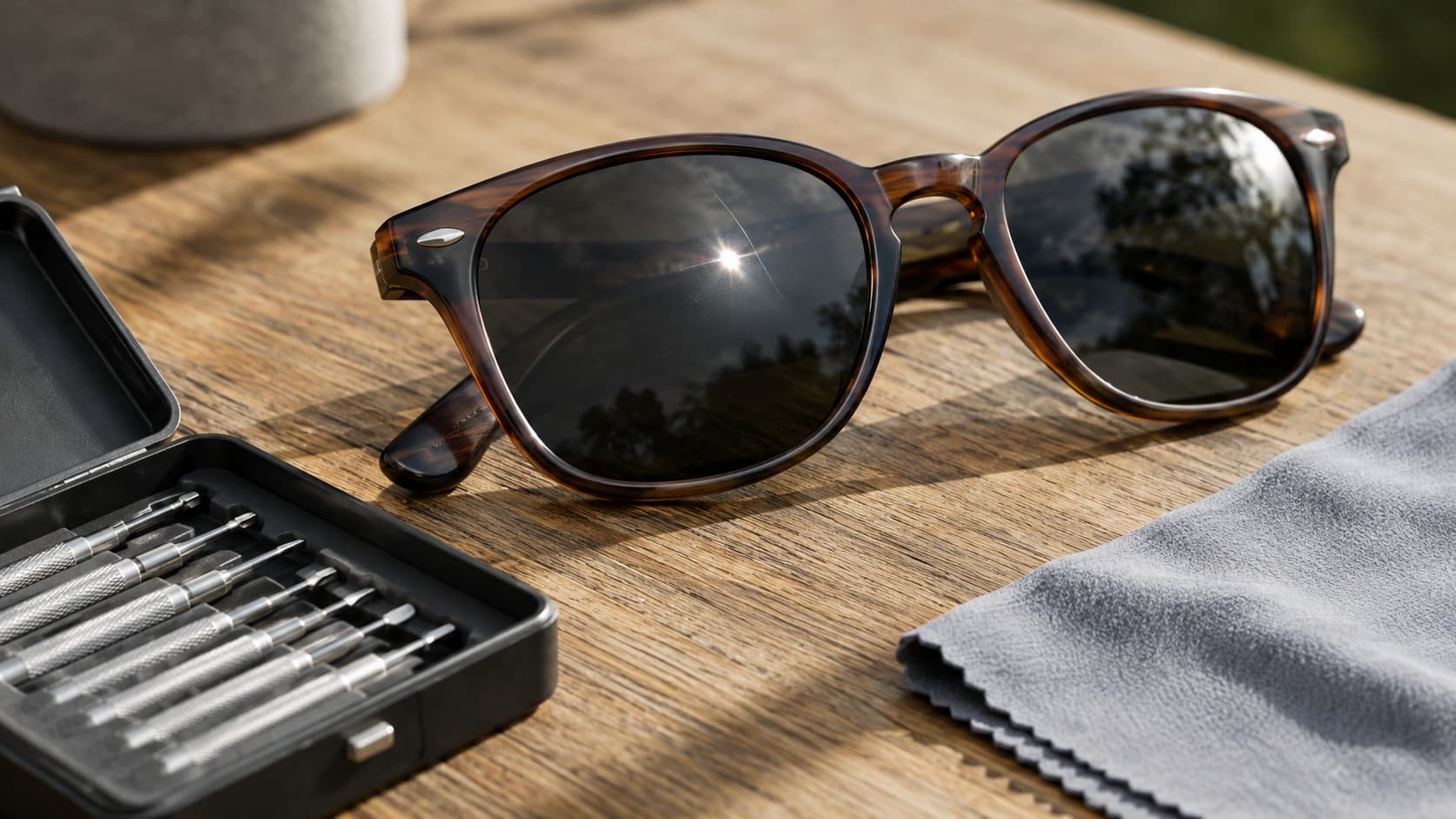
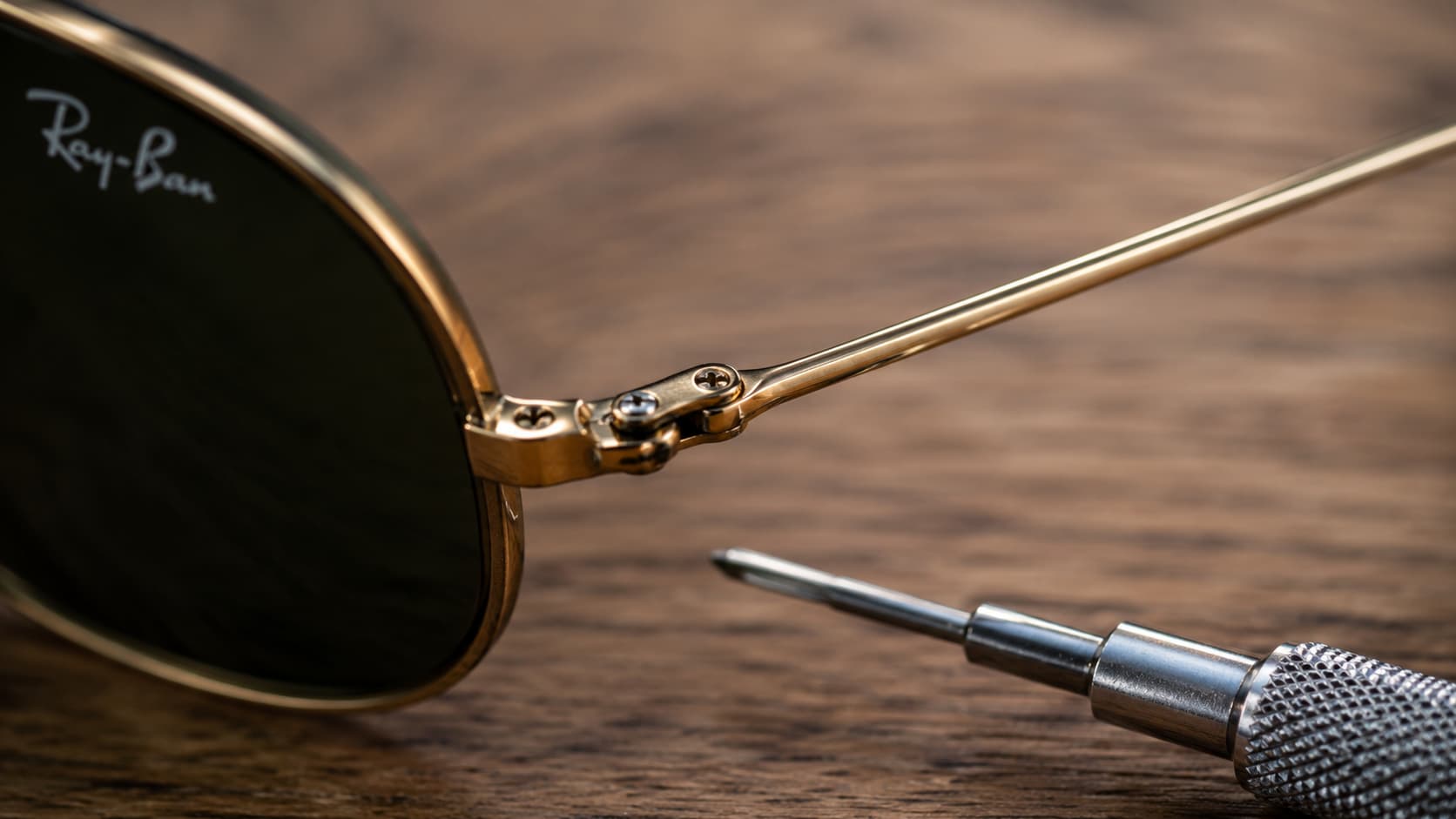
A loose hinge almost always comes down to one tiny screw that has worked itself out over time, and tightening it with a small eyeglass screwdriver usually solves the problem in under a minute. These screwdriver sets are cheap, widely available, and small enough to keep in a junk drawer for exactly this purpose.
Tightening a hinge involves holding the frame steady and turning the screw clockwise in short, gentle turns — overtightening can strip the tiny threads or crack the plastic around the screw hole. A screw that keeps loosening no matter how many times it’s tightened usually needs a small drop of clear nail polish or eyeglass-specific thread lock on the threads before the final tightening, which holds it in place. Missing screws are easy to replace, since most hardware and optical stores sell small assortment kits with the common sizes used in eyewear.
Spring hinges, which let the arms flex outward a bit before snapping back, are a different story. A spring hinge that feels loose or doesn’t snap back usually means the spring mechanism itself is worn out and needs professional replacement rather than a simple screw tightening.
Dirt, sunscreen, and salt residue can also build up inside a hinge, making a joint feel loose or stiff even when nothing is mechanically wrong — worth ruling out before assuming the screw is the problem. A soft brush (an old toothbrush works fine) and a little rubbing alcohol clears out most buildup. Most frames also use one of two hinge styles: simple barrel hinges, which are just a screwed joint with no spring, and spring hinges, which have that extra bit of give. Barrel hinges are the ones a home screwdriver fix works best on, since there’s no internal mechanism to wear out.
Signs Your Hinge Needs Professional Repair
- The arm wobbles side to side even after the screw is fully tightened
- There’s a visible crack in the plastic or metal around the hinge
- The spring mechanism doesn’t click or snap back into place
- The screw hole is stripped and won’t hold a screw anymore
Can You Fix a Broken Sunglasses Frame?
Whether a broken frame can be fixed depends entirely on the material and where the break happened, and a clean break in the right spot can often be repaired, while a shattered or bent metal frame usually cannot. Sunglasses frames are generally made from one of three materials, and each behaves differently when damaged.
Acetate frames, the thick plastic ones common in fashion sunglasses, can sometimes be repaired with a specialized plastic adhesive (super glue is too brittle and often fails) if the break is clean and the two pieces fit back together snugly. TR-90 and other nylon-based plastics are flexible and resist snapping in the first place, but once they do crack, they’re very difficult to glue because the material resists adhesives. Metal frames can sometimes be bent back into shape by an optician using proper tools, but a snapped metal temple or bridge usually needs to be soldered by a professional, since a home fix rarely holds up.
| Frame Material | Common Break | Fixable at Home? | Typical Repair Cost vs. New Pair |
|---|---|---|---|
| Acetate (thick plastic) | Clean crack or split | Sometimes, with the right glue | Low — a small fraction of replacement cost |
| TR-90 / Nylon blends | Stress crack | Rarely — hard to bond | Often not repairable |
| Metal | Bent temple or bridge | Bending: sometimes. Snapped: no | Low to moderate |
| Metal | Snapped hinge arm | No, needs soldering | Moderate, varies by optician |
Gluing a plastic frame works best when the pieces are clamped together tightly while the adhesive cures (a rubber band or small clip works well), with the glasses left unworn until the glue has fully set, which can take up to 24 hours depending on the product.
Frames also become more break-prone with age, even without any single dramatic incident. Constant UV exposure and heat — think of glasses left on a car dashboard or a beach towel in direct sun — slowly dry out and stiffen acetate and other plastics, making them more likely to snap under stress that a newer, more flexible frame would have absorbed. This is one reason older sunglasses tend to break “out of nowhere” even with careful handling; the material had already been weakening for a long time before the actual crack appeared.
Why Did a Lens Pop Out, and How Do You Put It Back In?
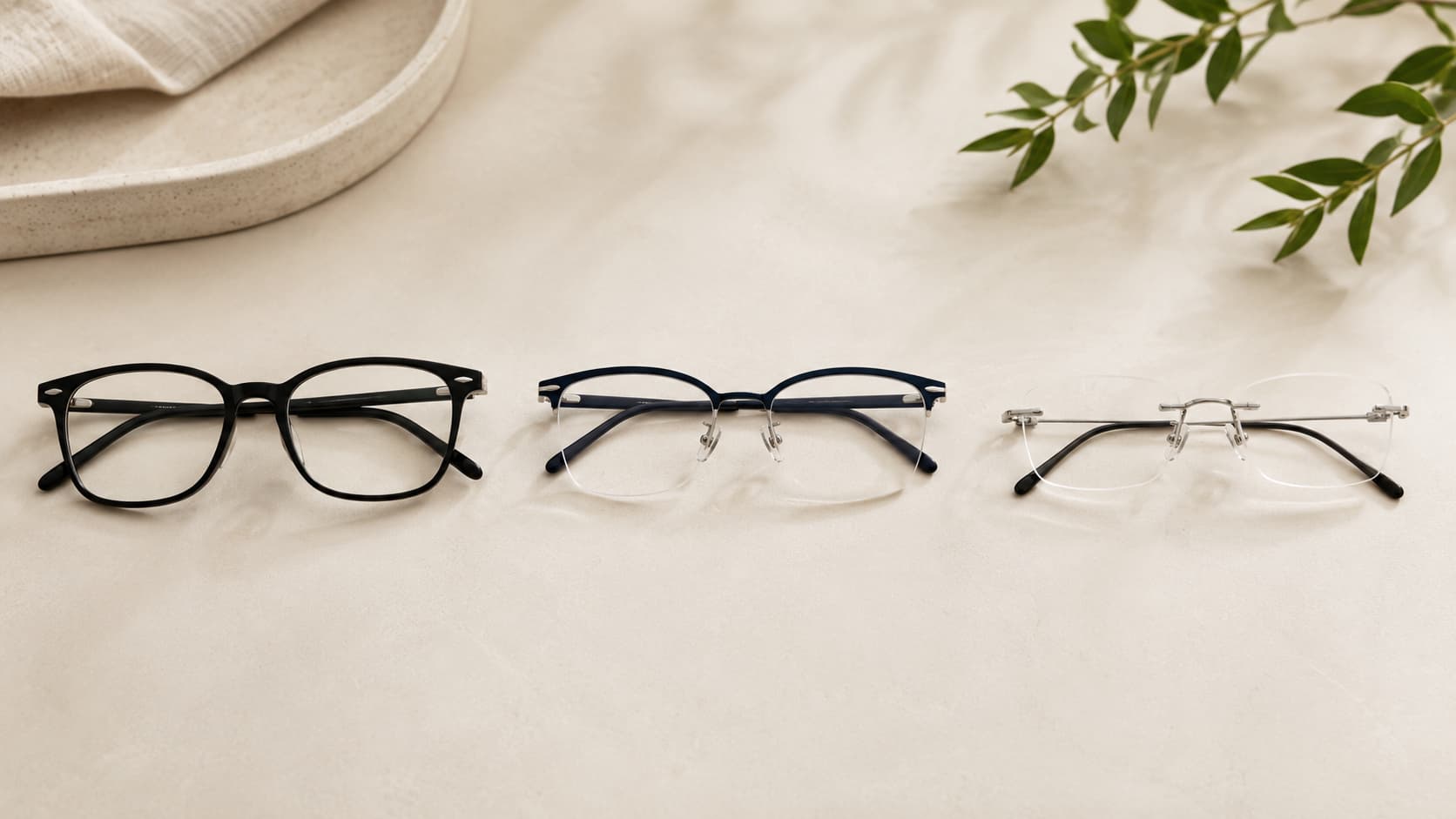
A lens popping out almost always means it’s simply worked loose from whatever holds it in place, and the fix depends on whether the sunglasses have a full frame around the lens or a rimless/semi-rimless design. Full-rim frames grip the lens in a groove that runs around its entire edge, while rimless and semi-rimless styles rely on a small screw, a nylon cord, or a thin wire to hold the lens against the frame, and each type comes loose for a different reason.
For full-rim frames, the lens usually just needs to be lined up with the groove and pressed firmly back into place, starting at one edge and working around. A frame too rigid to stretch enough for the lens to seat properly usually softens with a few seconds of gentle warmth from a hair dryer on low heat, making the plastic more pliable.
Rimless and semi-rimless frames are a bit more involved, since the lens is usually held by a tiny screw threaded through a hole in the lens itself, or by a nylon cord running along the lens edge under tension. A backed-out screw can be re-threaded and tightened the same way as a hinge screw, though the hole in the lens is delicate and can crack if forced. A stretched or snapped nylon cord isn’t something to re-tension at home — the cord needs replacing, a quick, inexpensive fix for most opticians but fiddly to get right without the proper small tools.
Quick tip: A popped-out lens is worth noting for orientation before it’s removed fully — lenses are often curved to match one specific side of the frame, and putting one in backward can make it impossible to seat correctly.
How Do You Fix Sunglasses That Won’t Sit Straight?
Sunglasses that sit crooked are almost always bent slightly out of shape, and gently bending them back — either by hand or with a hair dryer to soften plastic frames first — usually straightens them out. Cold plastic is more prone to cracking under bending, so warming acetate or TR-90 frames with a hair dryer for 20-30 seconds on low heat makes the material more flexible before any adjustment.
Metal frames can be bent back into alignment without heat, but it takes a gentler touch since metal can weaken or snap if bent too far or too many times. A crooked fit caused by one arm sitting longer than the other is sometimes a loose screw on one side rather than a bent frame at all, so checking the hinges first can save an unnecessary adjustment.
Laying the sunglasses face-down on a flat table with both arms folded out is a simple way to spot exactly where the problem is: a lens or arm sitting noticeably higher than the other pinpoints the bent spot, narrowing the adjustment to that one area instead of guesswork. An optician can also do this kind of adjustment for free or for a small fee in just a couple of minutes, often the safer route for anyone unsure about doing it themselves.
How Do You Fix a Loose Nose Pad on Sunglasses?
Loose nose pads either need tightening if they’re screwed on, or replacing if they’re glued or clipped, and both are quick fixes that don’t require professional tools. Screwed-on nose pads (common on metal frames) can be tightened the same way as hinges, with a small eyeglass screwdriver, while clip-on silicone nose pads simply pop off and a fresh pair pops on, sold cheaply in multi-packs at pharmacies and optical shops.
Some frames, especially plastic ones, have the nose pads built directly into the frame material rather than as separate pieces. If that built-in pad wears down or breaks, it typically can’t be replaced and instead needs an optician to add adhesive pads on top, or the frame needs replacing altogether.
Nose pads are usually made from silicone, acetate, or a rubbery blend, and itching or redness where the pads touch skin often traces back to the metal stems holding the pads (sometimes nickel-based) rather than the pad material itself. Switching to hypoallergenic silicone pads, widely sold at pharmacies, usually clears this up. The thin metal arms holding the pads are worth checking separately from the pads themselves, since these can bend out of alignment on their own, throwing off the fit even when the pads are in perfectly good condition.
When Should You Replace Sunglasses Instead of Repairing Them?
Replacing sunglasses makes more sense than repairing them when the lens is scratched across the direct line of sight, the frame has multiple breaks, or the repair cost would run close to what a new pair costs. A single loose hinge or a scuffed edge is worth fixing every time, but sunglasses that have been through several rounds of repairs are often signaling it’s time for a new pair.
A useful rule of thumb: small, quick fixes like a hinge tightening or a nose pad swap are almost always worth doing regardless of the sunglasses’ original price, since the cost is minor and the skill or time involved is small. Repair costs vary a lot by brand, material, and optician, but once a fix — a full lens replacement, a soldered frame repair — starts approaching a significant chunk of what a similar new pair would cost, replacing usually makes more financial sense, especially since a repaired frame doesn’t come with any guarantee against future issues.
There’s also a safety angle worth considering. Scratches deep enough to catch a fingernail can bend light unpredictably, which matters more than it might seem for driving or being out in bright glare, since the eyes end up straining to compensate. A frame that’s been glued back together multiple times is also more likely to fail again, sometimes at an inconvenient moment like mid-hike or on a bright beach day. A favorite pair with sentimental value is often worth a call to a professional optical repair shop, which can sometimes work wonders even on frames that look beyond saving.
Frequently Asked Questions
Can toothpaste really fix scratched sunglasses?
Toothpaste has very mild abrasive properties that can smooth out shallow, surface-level scratches on plastic lenses, but it won’t do anything for deep scratches and can dull the anti-glare or UV coating if used too aggressively or too often.
Why do my sunglasses keep falling apart at the hinge?
Hinges loosen naturally over time from the repeated opening and closing motion, and heat (like leaving sunglasses on a car dashboard) can also soften the plastic around the screw, making it easier for the screw to work loose.
Is it safe to use super glue on sunglasses frames?
Regular super glue tends to dry brittle and can crack again under the flexing that sunglasses go through daily, so a flexible, plastic-specific adhesive designed for eyewear repair usually holds up much better.
Can an optician fix sunglasses that aren’t from their store?
Most opticians will adjust, tighten, or do small repairs on any brand of sunglasses, often for free or a small fee, since it takes only a few minutes and builds goodwill with potential future customers.
Why do rimless sunglasses lose their lenses more often than full-frame ones?
Rimless and semi-rimless frames rely on a small screw or nylon cord under tension to hold the lens in place instead of a full groove around the edge, so any loosening of that single point is enough for the lens to come free, which is why these styles need a bit more routine hardware checking than full-rim frames.
How long do sunglasses usually last before needing repairs?
With regular use and reasonable care, most sunglasses show their first signs of wear — a loose hinge or minor scratch — somewhere between one and three years, though quality of materials and how carefully they’re stored make a big difference.
Conclusion
Most sunglasses problems come down to just a handful of fixable issues: a loose screw, a shallow scratch, a slightly bent frame, a lens that’s worked loose, or a worn nose pad, and most of these can be handled with basic tools and a little patience. The real judgment call is knowing when a repair is genuinely worth it versus when the damage — a deep scratch across the line of sight, a frame cracked in multiple places, or a spring hinge that’s given out — means it’s time to retire the pair. Keeping a tiny screwdriver kit on hand and catching small issues early remains the simplest way to make any pair of sunglasses last as long as possible.