The 1960s changed jewelry more than almost any decade before it. In just ten years, style went from ladylike pearls and gloves to giant plastic rings, peace-sign pendants, and necklaces shaped like circles and hexagons. This happened because the whole world was changing fast — space travel, new music, civil rights marches, and a younger generation that wanted accessories to say something instead of just sitting quietly around a neck. Jewelry from this era still shows up in fashion today because it was daring in a way that feels fresh even now.
What Made 1960s Jewelry Different?
The short answer is bold shapes and cheap new materials replaced quiet elegance and precious stones. Where the 1950s favored polished pearls, matching sets, and understated sparkle, the 1960s pushed jewelry toward big, graphic statements that could be seen from across a room.
At the start of the decade, women were still dressing conservatively for the most part, pairing gloves and neat little hats with a single, restrained strand of pearls. That look didn’t survive the sixties. By the time the decade closed, outfits had turned loud and playful, full of color blocking and a looser, more relaxed attitude toward getting dressed. Jewelry followed the exact same arc, moving from something an older relative might have worn to something that looked like it belonged on a psychedelic concert poster.
Part of this shift came from new plastics and metal-forming techniques that let designers make jewelry bigger and cheaper without needing rare gemstones. Part of it came from a generation that simply refused to dress like their parents.
Mod Jewelry: Bold Geometric Style
Mod jewelry solved a simple design problem — how to match jewelry to clean, geometric clothing — with sleek metal shapes and a minimalist look instead of fussy detail.
This style of jewelry leaned on smooth surfaces and strong, simple outlines, often made from plastic or other man-made materials that kept prices low without sacrificing visual impact. That pairing of affordability and boldness matched the design movement taking shape in London, where figures like Mary Quant and Biba were rewriting what fashionable clothing could look like, and where models Twiggy and Jean Shrimpton turned up on nearly every magazine cover of the era.
The shapes themselves borrowed from an older era but pushed it further. Designers leaned on strong geometric forms — circles, diamonds, spirals, and hexagons — in a way that echoed the Art Deco jewelry of forty years earlier, just rendered in bolder, less delicate proportions. A single ring or pendant might be shaped like a perfect circle with a bold cutout in the middle, or a necklace might be made of interlocking metal links that looked almost architectural.
Mod jewelry wasn’t trying to sparkle quietly. It was trying to be looked at.
Op Art and Pop Art Jewelry
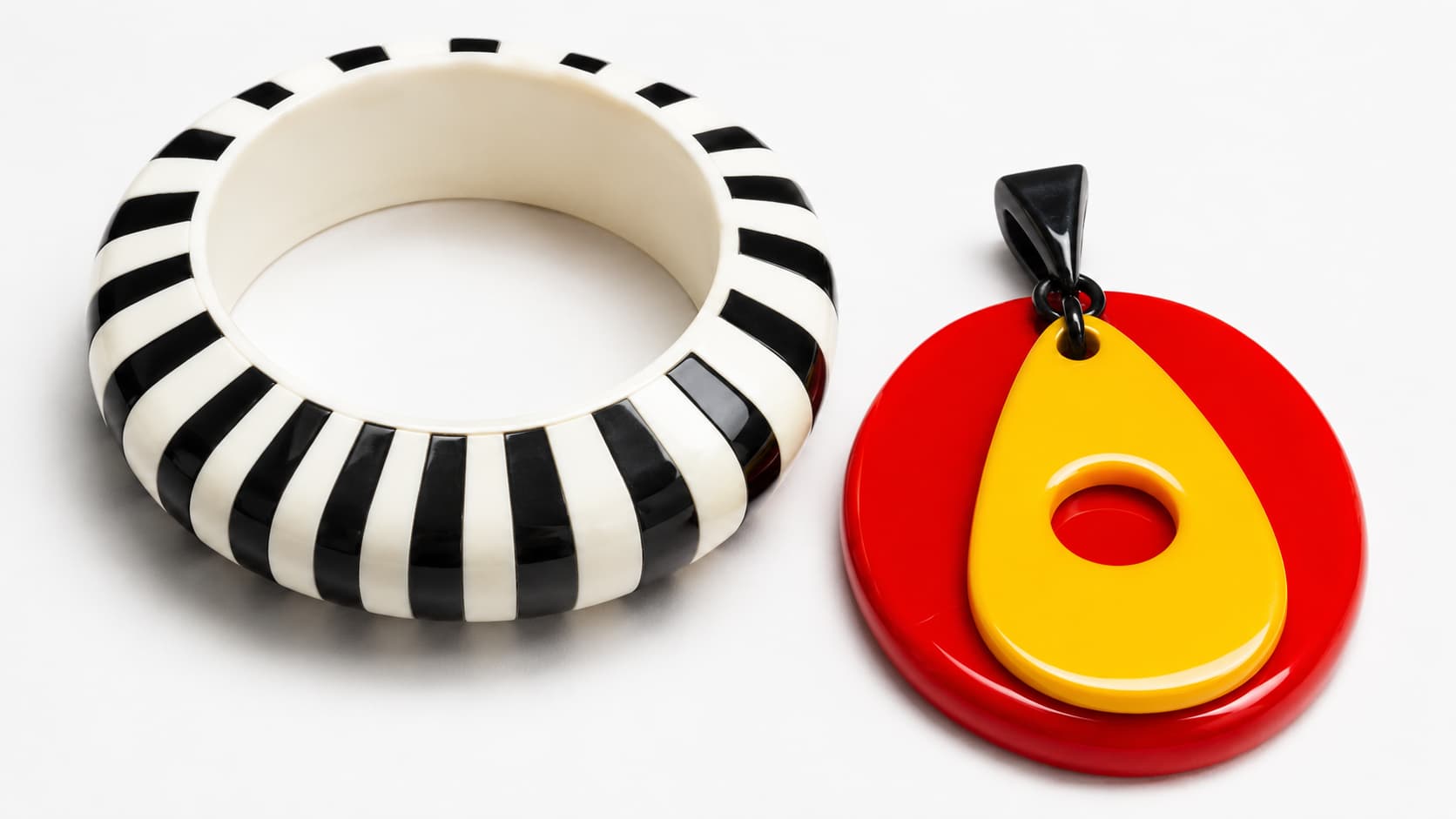
Op Art jewelry used black-and-white patterns and optical tricks to make simple accessories look like they were moving. Designers built pieces almost entirely in black and white, arranging the two colors into stripes, grids, and repeating shapes specifically so the eye would struggle to read them as flat. A bracelet with stripes or a checkerboard pendant could genuinely seem to shift or pulse with the smallest movement of the wrist.
Pop Art jewelry took the opposite approach, trading illusion for color and everyday imagery. Rather than referencing fine art traditions, this style pulled from ordinary, mass-produced culture and rendered it in loud primary shades. Red, yellow, and blue dominated, often mixed together in combinations that would have looked jarring or cheap by 1950s standards but read as fresh and confident by 1960s ones.
Identifying Op Art and Pop Art Jewelry
- Sharp black-and-white geometric patterns
- Bright primary colors used together (red, yellow, blue)
- Flat, graphic shapes rather than realistic details
- Materials that look glossy or almost plastic, even when made of metal
Plastic and Lucite Jewelry
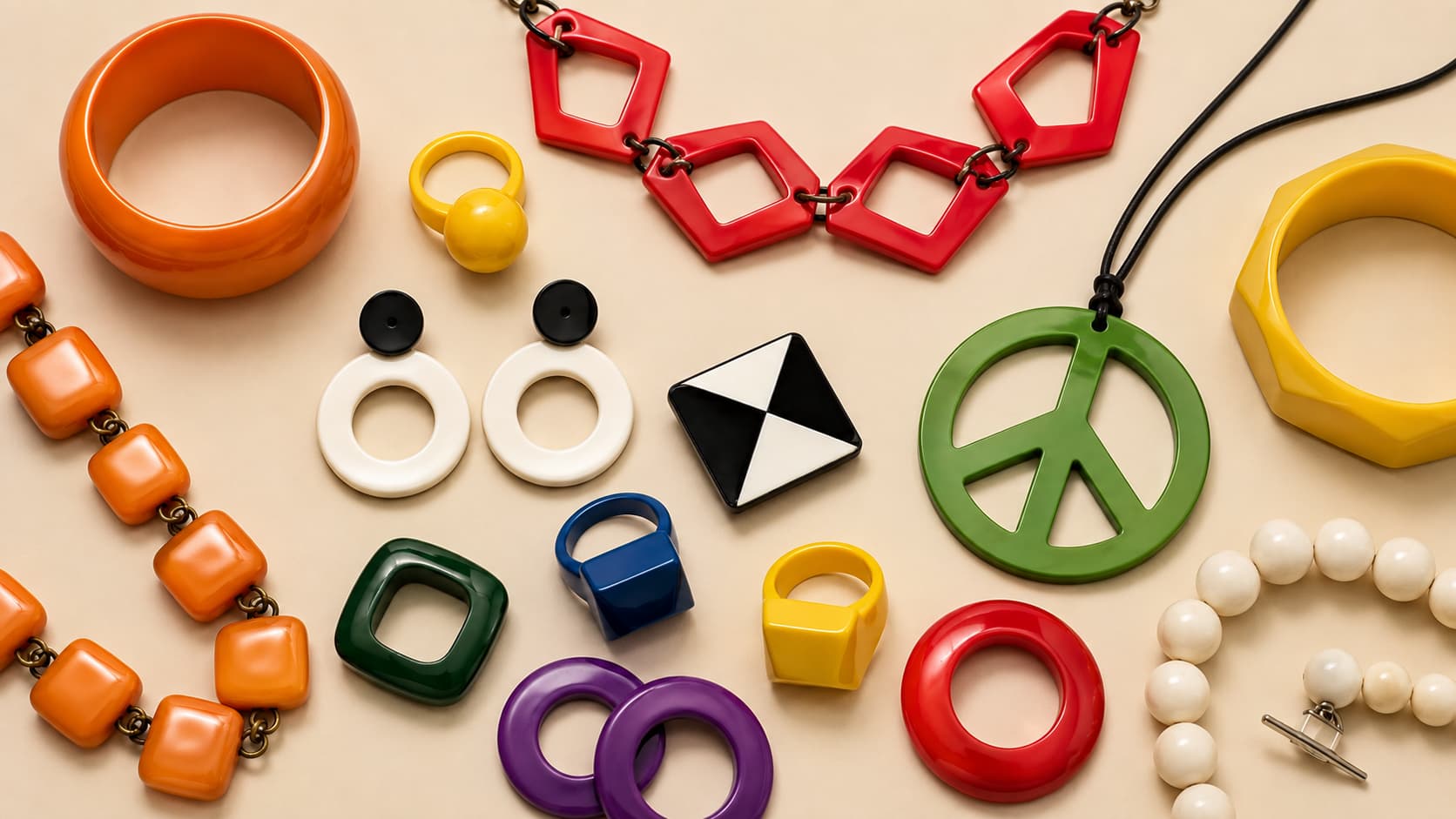
Plastic jewelry mattered in the 1960s because it let designers build oversized, colorful pieces that would have been far too expensive in gold or gemstones. This wasn’t seen as a downgrade — it was seen as modern.
Plastics themselves weren’t new; materials like Bakelite and Catalin had already existed for decades. What changed in the sixties was the manufacturing technology behind them, which suddenly made it possible to produce brighter colors and more elaborate shapes on a much larger scale. One designer became especially closely tied to this shift: Kenneth Jay Lane built a career on oversized plastic pieces studded with rhinestones, and the look caught on with major names, including Elizabeth Taylor and Audrey Hepburn. Even the era’s biggest model got in on it — Twiggy appeared in photographs during 1967 dressed head to toe in plastic jewelry.
Beyond plastic itself, designers also worked with resin, vinyl, and a rigid clear plastic called Perspex, since all three could be manufactured quickly and sold cheaply. Paper, PVC, Lucite, and leather rounded out the list of materials that let ordinary shoppers own something bold and eye-catching without paying for real gold.
1960s Space Age Jewelry
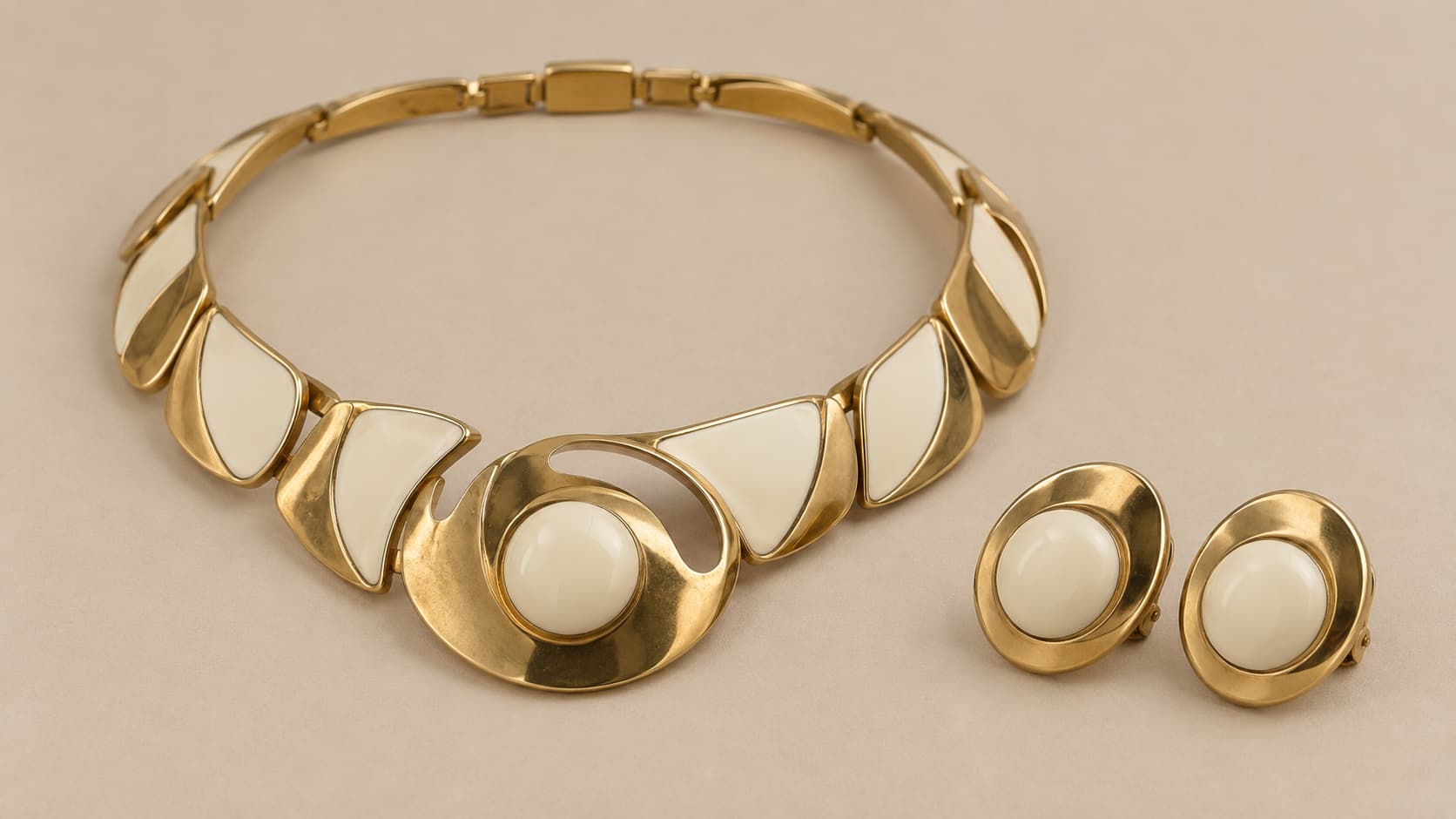
Space Age jewelry drew its inspiration directly from the excitement around rocket launches and moon missions happening throughout the decade. Fascination with space exploration bled into fashion more broadly during this period, and jewelry designers picked up on that same energy, translating rockets and orbit paths into wearable metal.
Designers leaned into smooth, futuristic metal forms — polished silver discs, orb-shaped pendants, and rings that looked like they belonged on a spacecraft control panel rather than a hand. This wasn’t just a coincidence of timing. The decade that put a man on the moon also wanted its accessories to look like they came from the future.
British jeweler Andrew Grima became the face of this shift in high jewelry, though his approach ran in almost the opposite direction from smooth, machine-like Space Age design. He built a reputation on rough, organic textures instead — surfaces that looked hammered, pitted, and irregular, closer to a moon rock or a piece of coral than to polished metal. His client list eventually included Queen Elizabeth II, Princess Margaret, and Jacqueline Kennedy Onassis, and he later received a Royal Warrant permitting his firm to describe itself as a supplier to the Queen.
Grima’s rough-edged style pointed to something bigger happening across 1960s jewelry as a whole: designers stopped insisting that a piece look perfectly balanced. A ring or brooch no longer needed even, matching sides to be considered beautiful. Irregular, off-center compositions — a stone placed deliberately off to one side, a shape that didn’t mirror itself — became the more fashionable choice, standing in direct contrast to the neat, symmetrical geometry that had defined Art Deco jewelry decades earlier.
Hippie Jewelry and Symbols
Hippie jewelry used cheap, natural, or symbolic materials to express beliefs about peace, love, and rejecting mainstream culture, rather than to show off wealth. This was the biggest philosophical shift jewelry saw in the decade — pieces stopped being about status and started being about identity and message.
The most recognizable symbol of the whole movement started life somewhere unexpected: an anti-nuclear rally. British artist Gerald Holtom designed the peace sign in 1958 for a British campaign against nuclear weapons, and within a decade the symbol had crossed the Atlantic and been adopted by American protest culture, eventually landing on necklaces and choker pendants everywhere. Most of these pendants were made cheaply, out of wood or clay, though people who wanted a more personal or lasting version often chose silver instead.
Other symbols carried similar spiritual weight. The ankh, an ancient Egyptian symbol representing life, appealed to a generation looking for meaning outside of mainstream religion, and its loop-topped cross shape worked naturally as a pendant in brass, copper, or silver. The Om symbol followed a similar path into Western jewelry as counterculture interest in Hindu, Buddhist, and Jain traditions grew, a shift that picked up noticeable momentum after the Beatles traveled to study with Maharishi Mahesh Yogi in 1968.
Alongside symbolic pendants, strands of beads — often called love beads — became a defining look, along with layered necklaces and flower-shaped charms that matched the “flower power” slogans of the era.
Traditional Jewelry in the 1960s
Not every woman in the 1960s traded her pearls for plastic rings and peace signs. Classic, refined jewelry stayed popular among people who preferred a more traditional look throughout the decade.
Plenty of women kept wearing the kinds of pieces that had defined the previous decade — pearls, gently textured gold, and rhinestone-set costume jewelry — even as younger buyers chased louder trends. High-end jewelers responded to that same audience by leaning into warmer, more tactile materials. Instead of setting faceted stones into cool platinum or white gold, many fine jewelers shifted toward yellow gold with a hammered or brushed surface, paired with colored gemstones and abstract, nature-inspired shapes. Turquoise and coral became especially fashionable choices for this warmer, more organic style, usually shaped into smooth cabochons rather than faceted cuts, and often set alongside classic round brilliant diamonds.
No single person represented this classic side of the decade better than Jacqueline Kennedy. As First Lady, she avoided anything flashy — her jewelry stayed deliberately quiet, and even her brooches were understated rather than showy. Her signature look needed almost nothing beyond a strand or two of pearls layered at the neck, and that restraint became a style statement in its own right, proving that quiet elegance could carry just as much influence as the loudest countercultural trends happening at the very same time.
Her later jewelry also showed how top jewelers were reworking tradition rather than abandoning it. She owned a pair of gold chandelier earrings from David Webb, set with cabochon-cut emeralds and rubies, ringed by brilliant-cut diamonds, and finished with a small pearl drop — a piece dramatic enough that she wore it to both a Spanish bullfight and an evening at the Metropolitan Opera. Meanwhile, at Tiffany & Co., designer Jean Schlumberger was building his own legacy through bold use of color and enamel. Tiffany gave him a rare honor: permission to sign his own pieces, something the house had never allowed before. One of his most famous designs, an enamel bangle bracelet introduced in 1962, remains part of Tiffany’s collection to this day.
This dual identity is part of what makes the decade so distinctive in jewelry history — several very different jewelry worlds existed side by side: bold mass-produced counterculture pieces, sculptural avant-garde designs from jewelers like Grima, and quietly refined fine jewelry from names like Webb and Schlumberger.
Statement Earrings, Bold Bangles, and Charm Bracelets
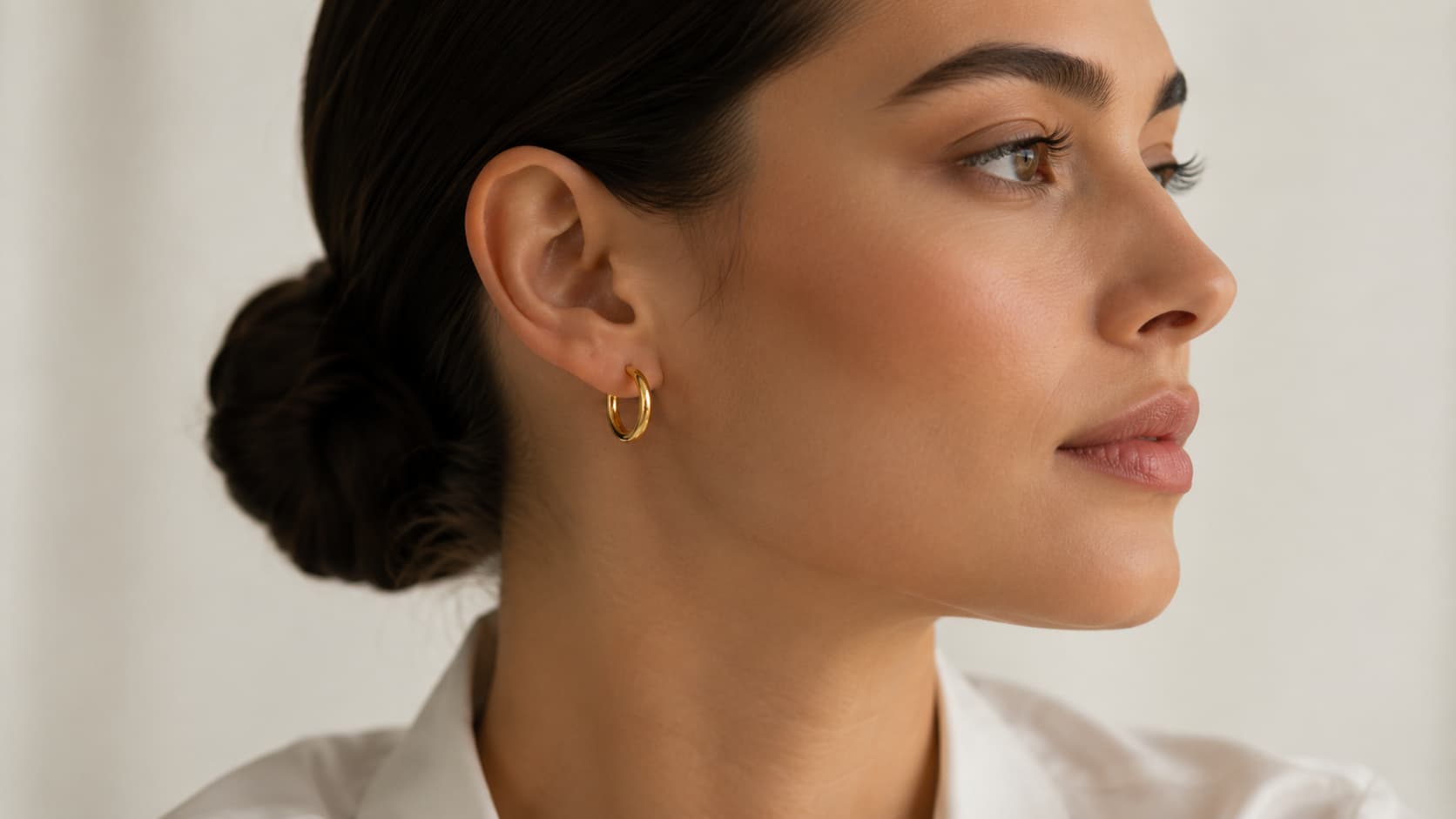
Hair got shorter in the 1960s, and jewelry adjusted to fill the space that was left behind. As short cuts and thick headbands became the norm, the neck and ears were suddenly far more visible than they’d been in years, and earrings grew accordingly — bigger, longer, and impossible to overlook.
Arms got busier too. Women stacked wide, colorful bangles in combinations that clashed on purpose, or wore rows of thin bangles running from wrist to elbow. Because these pieces were often made from inexpensive materials, building a whole armful of them was suddenly within reach for people who could never have afforded that much gold.
Charm bracelets tell a different kind of story — one about milestones rather than passing trends. By this point in the century, a charm bracelet had become something close to a coming-of-age gift, handed to a young girl for a birthday or graduation and then slowly built up with new charms marking each meaningful moment that followed. Later in the decade, that personal, memory-driven idea merged with the era’s fascination with symbolism, and zodiac pendants and coin-shaped medallions became a popular addition to costume charm bracelets specifically.
1960s Men’s Jewelry Trends
Men’s jewelry in the 1960s stayed mostly practical at the start of the decade, centered on cufflinks and tie bars, but even these small pieces picked up the era’s love of color and bold shape by the mid-1960s. Instead of plain metal discs, cufflinks began appearing set with colored stones like turquoise and ruby inside detailed gold mountings, and their shapes grew sharper and more geometric. Established jewelry houses noticed the shift too — both Tiffany & Co. and Bulgari released their own cufflink lines built around this same bolder, more decorative sensibility.
By the second half of the decade, men’s jewelry started breaking away from formal accessories entirely. As long hair, medallions, and beaded necklaces became part of the counterculture look worn by bands and their fans alike, jewelry stopped being divided so strictly along gender lines. A man in 1969 might just as easily be wearing a peace-sign pendant on a leather cord as a pair of gold cufflinks to the office — a genuine shift from the far more rigid rules of a decade earlier.
| Jewelry Style | Common Materials | Best Known For |
|---|---|---|
| Mod | Sleek metal, plastic | Minimal, geometric shapes |
| Op Art | Black-and-white metal, enamel | Optical illusion patterns |
| Pop Art | Painted metal, resin | Bright primary colors |
| Space Age | Polished silver, chrome-like metal | Futuristic, orb and disc shapes |
| Hippie | Wood, clay, silver, beads | Peace signs and spiritual symbols |
| Traditional | Yellow gold, turquoise, coral, pearls | Classic, refined elegance |
Frequently Asked Questions
What is the most iconic piece of 1960s jewelry?
The peace sign pendant is generally considered the most recognizable symbol to come out of 1960s jewelry, since it captured the era’s counterculture spirit and is still instantly linked to the decade today.
Why was plastic jewelry considered fashionable in the 1960s?
New plastic manufacturing techniques let designers create oversized, colorful, and dramatic pieces at a much lower cost than gold or gemstones, and designers like Kenneth Jay Lane made plastic jewelry genuinely glamorous by pairing it with rhinestones and bold design.
Did people still wear fine jewelry with real gemstones in the 1960s?
Yes. Many people continued wearing textured yellow gold with turquoise, coral, and diamonds throughout the decade, existing alongside — rather than being replaced by — the plastic and countercultural styles that got most of the attention.
What is the difference between Mod and Hippie jewelry from the 1960s?
Mod jewelry focused on sleek, minimal, geometric shapes tied to fashion trends coming out of London, while hippie jewelry used natural or symbolic materials like wood, clay, and beads to express spiritual beliefs and political messages such as peace and anti-war sentiment.
Why did earrings get so big in the 1960s?
Shorter hairstyles and headbands left ears more exposed than in previous decades, so earrings grew larger and more dramatic to fill that visual space and become a statement on their own.
The Takeaway
1960s jewelry tells the story of a decade that couldn’t sit still. Mod and Op Art brought sharp geometry and optical tricks to accessories, Space Age design chased the excitement of rocket launches, plastic and Lucite made bold statement pieces affordable to nearly anyone, and peace signs, ankhs, and beads turned jewelry into a way of announcing personal belief. At the same time, classic yellow gold, turquoise, and pearls proved that elegance never fully went out of style, even during the loudest decade fashion had ever seen. What ties it all together is confidence — 1960s jewelry was never meant to be quiet, and that’s exactly why so much of it still looks exciting more than sixty years later.