Chopard is one of the few watch brands left that still makes nearly everything itself, from the diamonds it sets to the movements ticking inside its cases. That matters because so much of the watch industry today is built on outsourcing, and a brand that controls its own supply chain tends to control its own quality too. Chopard has been doing this since 1860, first as a small pocket-watch workshop in the Swiss Jura, and today as a family-run house that makes everything from playful diamond sport watches to some of the most technically certified mechanical movements in Switzerland. Picking the “best” Chopard watches really means understanding which collection fits which kind of person, because the brand’s range is unusually wide for one company.
Chopard’s History and How Its Watches Are Made
Chopard stands out because it is a genuine manufacture, meaning it builds its own watch movements and jewelry pieces rather than buying parts from outside suppliers. That level of control is rare. Most watch brands, even well-known luxury ones, rely on movements made by third-party specialists. Chopard builds a large share of its own calibers at its manufacture in Fleurier, in the Neuchâtel region of Switzerland, and does its jewelry and non-L.U.C. watch assembly at its headquarters in Geneva.
The brand was founded in 1860 by Louis-Ulysse Chopard, a 24-year-old watchmaker from the village of Sonvilier. He built a reputation making precise pocket chronometers, and his watches eventually reached the court of Tsar Nicholas II of Russia. After his death in 1915, the company passed to his son and grandson, and in 1963 it was sold to Karl Scheufele, a German jeweler from Pforzheim. The Scheufele family still owns and runs Chopard today, with siblings Karl-Friedrich and Caroline Scheufele splitting the business: he oversees watchmaking, she leads jewelry and design. That family structure is part of why Chopard still feels like a workshop rather than a corporate brand, even though it now produces tens of thousands of watches a year.
In practice, Chopard actually runs three manufacturing sites rather than one. The headquarters in Meyrin, on the outskirts of Geneva, handles jewelry-making, including an in-house gold foundry, the assembly of non-L.U.C. watches, and the business side of the house. In Fleurier, there is the Chopard Manufacture itself, where L.U.C movements are designed and finished by hand, plus a separate nearby facility called Fleurier Ebauches, which produces movements on a larger, more industrial scale for collections like the Mille Miglia and Alpine Eagle. The Fleurier site also houses the L.U.CEUM, a small museum dedicated to the history of fine watchmaking, which gives a sense of how seriously the brand treats this side of the business even though its jewelry and Happy Sport lines get more mainstream attention.
Chopard Happy Sport
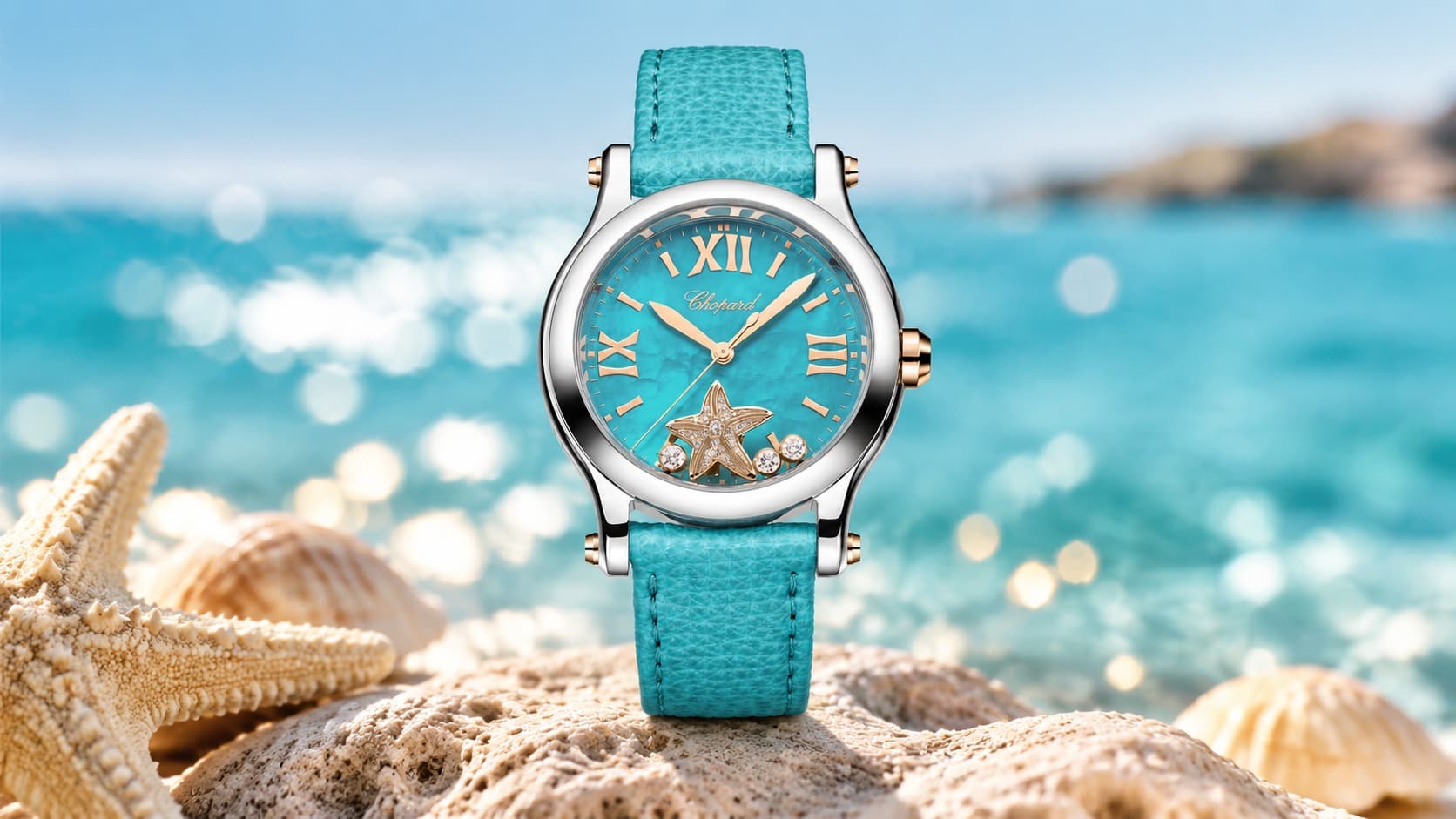
The Happy Sport is best known for its free-moving diamonds that drift between two layers of sapphire crystal above the dial. Caroline Scheufele designed it in 1993 as a watch she could wear “at the gym, in the office or for a dinner in town,” and it became the first watch in the industry to pair stainless steel with diamonds. Before that, diamonds were treated as something reserved for formal gold jewelry, not everyday steel sports watches.
She built it on a floating-diamond concept her parents had introduced years earlier, reworking it into something more casual and wearable by sandwiching the stones between two layers of sapphire crystal instead of sealing them loose inside a closed case. Since that 1993 debut, the Happy Sport has appeared in more than a thousand variations, with case sizes generally running from around 25mm to 36mm, in steel, two-tone, or rose gold, and in both quartz and automatic movements. Current retail prices for new models span roughly $7,000 to more than $20,000, depending on size, metal, and diamond-setting.
The floating-diamond concept is Chopard’s signature trick, and it genuinely cannot be replicated by other brands without infringing on Chopard’s patented construction.
In 2021, Chopard marked the watch’s roots with a pair of limited reissues called Happy Sport “The First,” built to resemble the original 1993 design closely, right down to the cabochon-cut sapphires set into the crown and lugs. One version was limited to 1,993 pieces, a nod to the launch year, while a second, more heavily set with a diamond bezel and a textured mother-of-pearl dial, was limited to 788 pieces, a number Caroline Scheufele has described as personally lucky. The reissues show that, despite constant updates over the decades, the core idea behind the watch has barely changed since Scheufele first sketched it.
Chopard Happy Diamonds
Happy Diamonds is the collection that came before the Happy Sport, and it is still sold today as its own distinct line rather than a discontinued precursor. Chopard launched the first Happy Diamonds watch in 1976, a cushion-shaped gold case for men set with 30 diamonds that moved freely inside a sealed sapphire-crystal window. The idea reportedly came from a comment by Karl Scheufele’s wife, who looked at an early prototype and remarked that the diamonds seemed “happier when they are free,” which became the name and the whole design philosophy behind the piece.
Construction is what separates the two collections most clearly. On a Happy Diamonds watch, the diamonds sit loose inside the case itself, enclosed by a solid gold or diamond-set bezel, which gives the collection a denser, more traditional jewelry look. The Happy Sport, by contrast, sandwiches its diamonds between two flat sapphire crystal layers mounted above the dial, which is part of why that watch reads as sportier and more wearable day to day. Chopard still sells Happy Diamonds today under names like Happy Diamonds Icons and Happy Diamonds Joaillerie, generally in gold rather than steel, with case sizes around 25mm to 32mm. Current prices for new pieces run from roughly $12,000 up past $40,000 for the most heavily jeweled Joaillerie versions, putting the collection a step above Happy Sport in both material and price.
Chopard Alpine Eagle
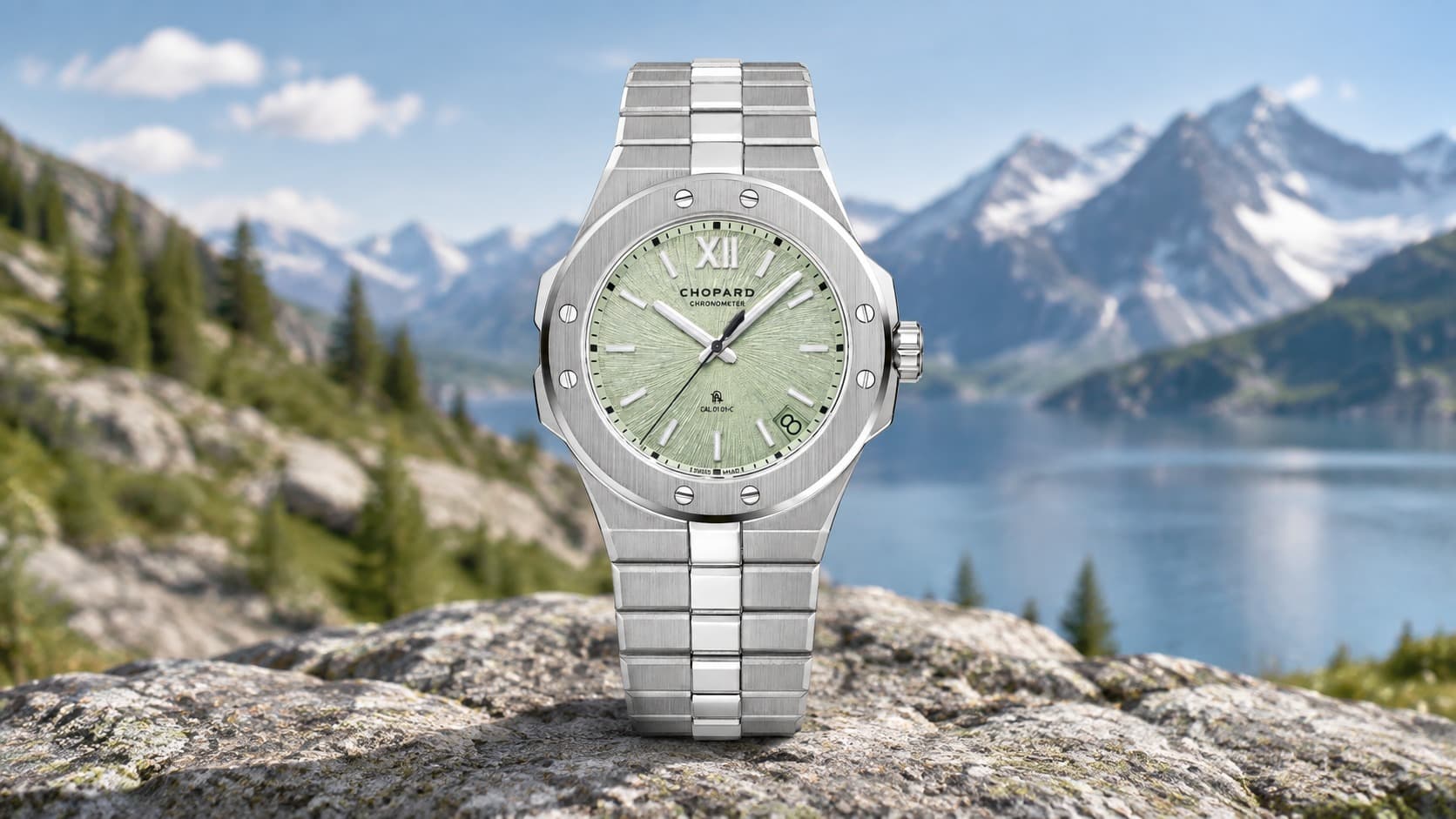
The Alpine Eagle is Chopard’s answer to the integrated steel sports watch category made famous by brands like Audemars Piguet and Patek Philippe. It launched in 2019 as a reinterpretation of the brand’s 1980 St. Moritz model, and it was Karl-Friedrich Scheufele’s long-held conviction that a sporty, premium steel watch could succeed for Chopard the way it had for its rivals.
What separates the Alpine Eagle from a typical steel sports watch is the material itself. Chopard spent four years developing Lucent Steel A223, a proprietary alloy that launched in 2019 with 70% recycled content and now contains at least 80%, with a goal of reaching 90% by 2025. The alloy is also around 50% harder than standard stainless steel and naturally hypoallergenic. The case design includes a textured dial pattern Chopard calls “eagle iris,” meant to resemble the look of an eagle’s eye up close. The collection has grown to include time-and-date models, a chronograph, a high-frequency movement, and even a flying tourbillon, with case sizes ranging from a compact 33mm up to a bold 44mm chronograph. Prices start around $10,000 for entry steel models and climb into six figures for the flying tourbillon versions, which sell for roughly $145,000.
Chopard Alpine Eagle Price by Model
| Model | Approx. Size | Approx. Price (USD) |
|---|---|---|
| Alpine Eagle 33 | 33mm | $9,900–$13,500 |
| Alpine Eagle 36 | 36mm | $13,400–$19,000 |
| Alpine Eagle 41 | 41mm | $13,200–$56,000+ |
| Alpine Eagle XL Chrono | 44mm | $20,000–$23,200 |
| Alpine Eagle 41 Flying Tourbillon | 41mm | ~$145,500 |
Exact prices vary by retailer, dial color, and metal combination.
The collection also carries Chopard’s environmental commitments more visibly than any other line. Since 2013, Chopard has run a sustainability program it calls the Journey to Sustainable Luxury, and since July 2018, every gram of gold the company uses across its watches and jewelry has been ethically sourced, either through certified small-scale mines or recycled through traceable refineries. Karl-Friedrich Scheufele also founded the Eagle Wings Foundation, which works on Alpine wildlife conservation, including efforts to reintroduce the white-tailed eagle to parts of its natural habitat, and Chopard has directed proceeds from certain Alpine Eagle models toward that work. Chopard treats these commitments as central to the collection’s identity, talking about recycled steel and ethical gold almost as often as it talks about design.
Chopard Mille Miglia
The Mille Miglia collection exists because Chopard has sponsored Italy’s Mille Miglia vintage car rally since 1988, making 2025 the brand’s 38th consecutive year as the race’s official timekeeper and world sponsor. Enzo Ferrari once called the event “the most beautiful race in the world,” and Chopard’s watches borrow directly from that motorsport world: tachymeter scales for calculating speed, rubber straps textured like racing tires, and dial details that echo vintage dashboard gauges.
The line includes the GTS Power Control, which shows power reserve the way a car’s gauge shows fuel, and the Classic Chronograph, which leans into a more vintage racing-driver look with perforated calfskin straps resembling driving gloves. Chopard also releases limited editions tied to each year’s race, some honoring historical drivers like Sir Stirling Moss. Pricing for the current Mille Miglia range runs from roughly $7,600 for limited chronograph editions up to around $11,000 for the more decorated chronometer-certified pieces, with some rose gold and specialty versions priced higher.
That race history explains several of the watches’ design details. The original Mille Miglia ran on public roads between Brescia and Rome from 1927 until 1957, when two fatal crashes during that year’s race led the Italian government to ban racing on open roads for good. It was revived twenty years later, in 1977, as a regularity rally called the Mille Miglia Storica, open only to car models that had competed in the original race, and it still follows roughly the same Brescia-to-Rome-and-back route today. Chopard’s watches reference that history directly: the red arrow seen on most Mille Miglia dials is a nod to the markers once used along the race route, and the brand has a tradition of presenting each competing driver with a numbered Race Edition watch engraved with their car’s entry number.
Chopard L.U.C
L.U.C watches are where Chopard proves it can compete with the most respected names in traditional Swiss watchmaking. The initials stand for Louis-Ulysse Chopard, a direct tribute to the brand’s founder, and the collection was born out of Karl-Friedrich Scheufele’s desire to turn Chopard into a true manufacture again, decades after it had drifted from its pocket-watch-making roots.
In 1996, Chopard opened its manufacture in Fleurier and introduced its first in-house caliber, the L.U.C 1.96, the following year. That movement earned both COSC chronometer certification and the Poinçon de Genève, or Geneva Seal, at the same time, a combination still considered rare in the watch industry even today. The Geneva Seal is a strict quality hallmark controlled by law in the canton of Geneva, and it judges the entire finished watch, not just the movement, checking for specific hand-finishing techniques like Côtes de Genève striping, beveled edges, and polished screw heads. Chopard remains one of only a handful of Geneva-based houses, alongside names like Vacheron Constantin, Roger Dubuis, and Cartier, that still put watches through this certification today. L.U.C watches now include everything from simple three-hand models to minute repeaters, flying tourbillons, and perpetual calendars, with prices starting in the low five figures and rising sharply for the most complicated pieces.
Chopard also developed its own house technology for the line, called Quattro, which uses four mainspring barrels arranged in two stacked pairs instead of the usual single barrel, giving several L.U.C calibers power reserves stretching well beyond the usual two or three days, in some cases up to nine days. In 2001, Chopard co-founded the Fondation Qualité Fleurier with fellow Fleurier-based watchmakers Parmigiani Fleurier and Bovet, along with movement maker Vaucher, creating an additional regional certification that some L.U.C pieces carry on top of COSC and the Geneva Seal. The scale here stays deliberately small: the Fleurier manufacture produces roughly 4,000 L.U.C watches a year, a fraction of the output from Fleurier Ebauches, which turns out tens of thousands of simpler movements annually for the rest of Chopard’s watch collections.
Frequently Asked Questions
Is Chopard considered a top-tier luxury watch brand?
Yes. Chopard sits among the recognized high-end Swiss watchmakers because it designs, produces, and finishes its own movements at its Fleurier manufacture, a level of vertical control that many well-known luxury brands do not have. Its L.U.C collection in particular carries certifications, like the Geneva Seal, that are reserved for a small number of serious watchmaking houses.
What is the most famous Chopard watch?
The Happy Sport is generally considered Chopard’s signature piece, since it introduced the idea of free-floating diamonds inside a steel sports watch in 1993 and remains one of the most recognized women’s watches in the industry. The Alpine Eagle has become the brand’s most talked-about model in recent years for men’s and unisex steel sports watches.
Who owns Chopard?
Chopard has been privately owned by the Scheufele family since 1963, when Karl Scheufele bought the company from the Chopard family’s descendants. His children, Karl-Friedrich and Caroline Scheufele, now run the company together, with Karl-Friedrich overseeing watchmaking and Caroline leading jewelry and creative direction.
What does “L.U.C” mean on a Chopard watch?
L.U.C stands for Louis-Ulysse Chopard, the company’s founder. Chopard uses the initials to name its high-end mechanical watch collection, made entirely at its own manufacture in Fleurier, Switzerland, as a tribute to the man who started the brand in 1860.
Are Chopard watches a good investment?
Chopard watches are generally bought and worn for their design, craftsmanship, and certifications rather than for resale value, and like most watches, they are not guaranteed to increase in price over time. Limited editions tied to events like the Mille Miglia race, or highly certified L.U.C pieces, tend to hold interest among collectors more than mass-produced quartz models, but anyone buying a watch purely as a financial investment should treat that as a secondary motive at best.
The Bottom Line
Chopard’s range ultimately splits into two separate strengths working side by side: playful, colorful jewelry-watches like the Happy Sport and Happy Diamonds on one side, and serious, certified mechanical watchmaking through L.U.C on the other, with the Alpine Eagle and Mille Miglia bridging the two as modern sports watches with real technical substance behind them. A shopper drawn to personality and sparkle tends to land on the Happy Sport or Happy Diamonds. Someone after a daily steel watch with genuine engineering inside it gravitates toward the Alpine Eagle. And anyone drawn to classic Swiss watchmaking at its most rigorous, backed by the Geneva Seal, finds that in the L.U.C line. Chopard’s real strength is that it has kept all three of those identities alive under one family-run roof for more than 160 years.