A dark patch stretching across the middle of an oval or pear-shaped diamond, almost like a little ribbon, is known in the jewelry world as the bow tie effect. It shows up in nearly every diamond that isn’t round, yet it rarely gets explained clearly before a shopper is standing at the jewelry counter, certificate in hand, wondering if something is wrong with the stone. Understanding why it happens, and when it actually matters, turns a confusing shadow into a normal part of how elongated diamonds behave.
What Is the Bow Tie Effect?
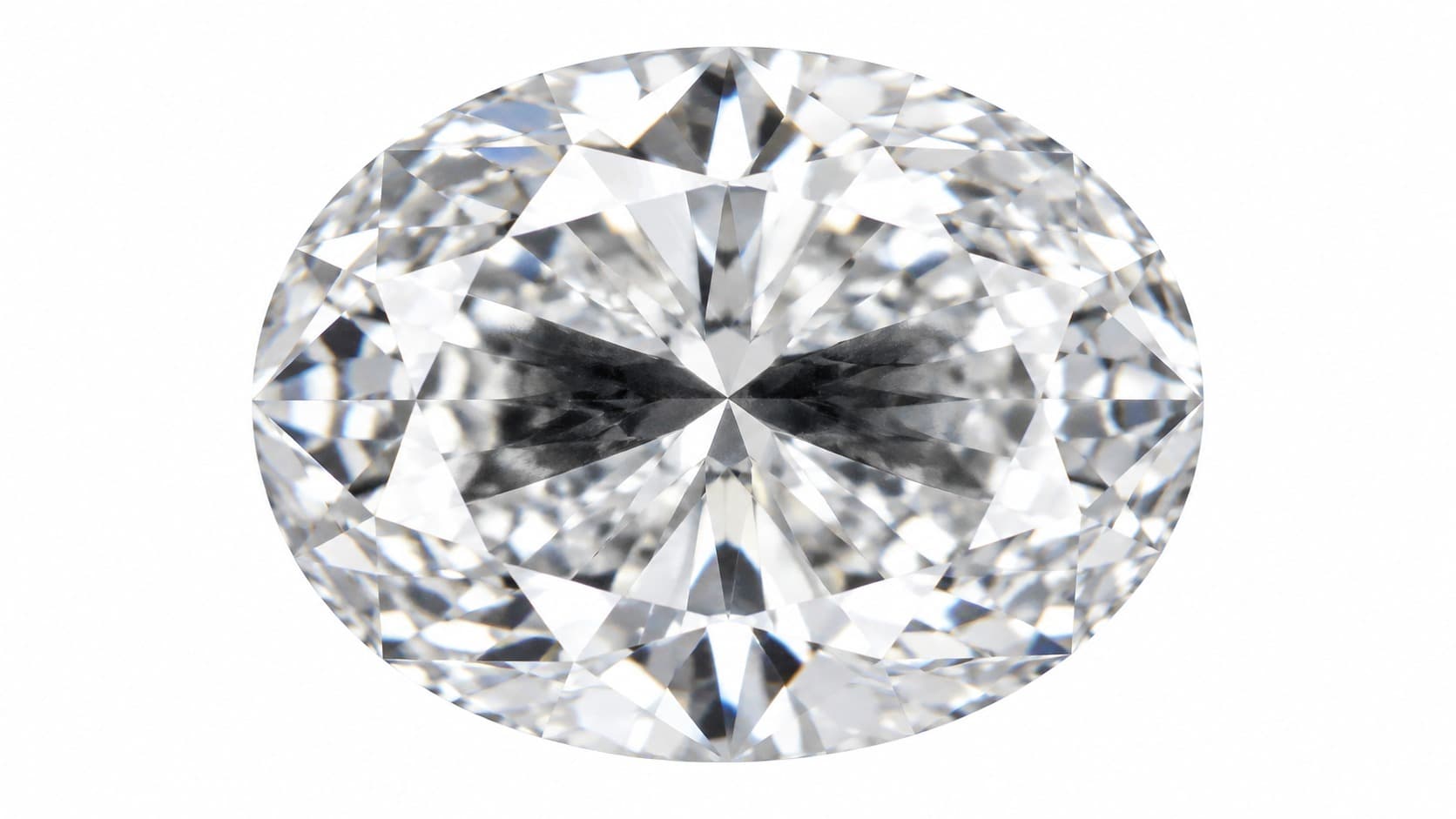
The bow tie effect is a dark shadow that sits across the center of certain diamond shapes, usually resembling a bow tie or a small ribbon of darkness. It appears most often in oval, pear, marquise, and sometimes radiant or heart-shaped diamonds, since these shapes are longer than they are wide.
Viewed from directly above, an oval diamond rarely sparkles evenly across its whole surface. Instead, two darker triangle shapes often meet in the middle, forming the classic bow tie look. It isn’t a crack, a flaw, or dirt trapped inside the stone. It’s an optical effect, meaning it comes down to how light behaves inside the diamond rather than any damage to the stone itself.
Nearly every elongated diamond shows some degree of bow tie. The real question isn’t whether it’s there, but how dark and distracting it looks.
Why Does the Bow Tie Effect Happen?
The bow tie effect happens because light gets blocked instead of bouncing back out through the top of the diamond. In round diamonds, the facets, meaning the small flat surfaces cut into the stone, are arranged symmetrically all the way around, so light bounces back out evenly from every direction. Elongated shapes don’t share that same symmetry, so in the center of the stone, some facets end up angled in a way that sends light sideways or downward instead of straight back up toward the viewer. That missing light is what appears as a shadow.
A few specific factors influence how dark or light that shadow becomes: facet alignment, meaning how precisely the angled surfaces on the diamond line up with each other; cut proportions, including the depth, length-to-width ratio, and overall shape of the stone; viewing angle, since the way a diamond is tilted changes what’s visible; and the light source, as bright, direct lighting tends to make the bow tie more obvious than soft, diffused light.
A surprisingly personal element also plays into the effect. When someone looks down at a diamond, their own head and shoulders block part of the light that would otherwise reach the stone, and that shadow reflects back up through the center facets. A change in distance, angle, or room lighting can noticeably soften a bow tie that looked heavy a moment earlier. This is part of why photographs alone can be misleading, and why a diamond that photographs dark isn’t always dark in person.
Diamond Shapes Prone to the Bow Tie Effect
Elongated diamond shapes show the bow tie effect, while symmetrical round and square shapes almost never do.
| Shape | Bow Tie Likelihood |
|---|---|
| Oval | Very common |
| Marquise | Very common |
| Pear | Common |
| Radiant | Sometimes |
| Heart | Sometimes |
| Round brilliant | Rare |
| Princess (square) | Rare |
| Cushion | Rare |
Round brilliants and cushion cuts rarely show a bow tie because their facet patterns repeat evenly in a full circle, leaving no long central stretch where light can get blocked. Elongated shapes lack that symmetry, which is why the term comes up mainly around ovals, marquises, and pears.
The oval cut’s history connects directly to this pattern. Its modern, brilliant-style faceting was developed in 1957 by Russian-born diamond cutter Lazare Kaplan, who adapted the round brilliant’s light-return principles to an elongated outline. That innovation is a major reason well-cut modern ovals sparkle as much as they do, even though the bow tie has never been fully engineered away.
Is the Bow Tie Effect a Flaw?
The bow tie effect is not considered a flaw or a defect in diamond grading. It doesn’t appear on a diamond’s certificate, and grading labs such as GIA don’t assign it a formal grade the way they do with clarity or color. It’s treated as a natural characteristic of elongated cuts rather than a problem with a stone’s quality.
Even so, a bow tie can still shape how a diamond is perceived. A subtle, soft bow tie often adds depth and a sense of character, almost giving the stone its own personality. A harsh, heavy bow tie that stays dark regardless of angle can make a diamond look dull or lopsided, even when its carat weight, color, and clarity are excellent on paper. Because of this gap between what’s written on a certificate and what’s actually visible, examining any elongated diamond in person, or through a detailed video, remains an important step before purchase.
A diamond with a favorable bow tie is typically visible but soft rather than pitch black, shifts or lightens as the stone is tilted under light, covers only a small portion of the center, and still allows strong sparkle and brightness around it. A problem bow tie, by contrast, stays dark from nearly every angle, covers a large portion of the diamond’s face, leaves that area noticeably dimmer than the rest of the stone, and often appears alongside poor overall symmetry or an unusual length-to-width ratio.
How Cut Quality Changes the Bow Tie
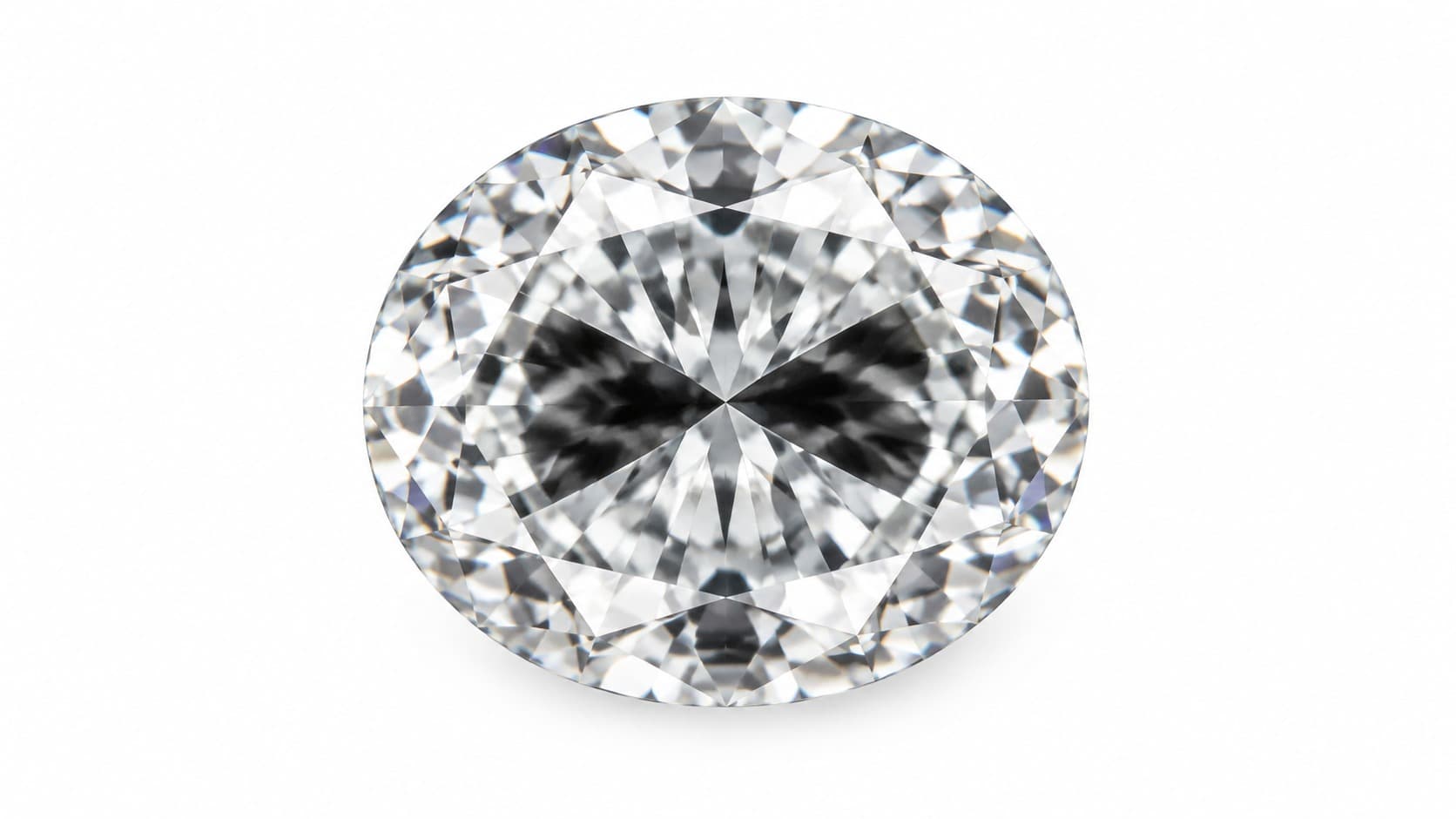
Cut quality has a major influence on how visible the bow tie effect is. A diamond cut with precise, well-balanced facets and good proportions will almost always show a softer, less noticeable bow tie than one cut carelessly or too shallow. Skilled cutters pay close attention to how light travels through the stone and adjust facet angles specifically to tame the shadow as much as possible.
Two measurements matter most. Depth percentage, meaning how tall the diamond is relative to its width, is the first: ovals cut too shallow, generally under about 57%, tend to show much darker bow ties, while a depth somewhere around 57% to 63% tends to strike a better balance between brightness and a muted shadow. The second is the length-to-width ratio, found by dividing a stone’s length by its width. A ratio of roughly 1.30 to 1.50 is generally considered the sweet spot for ovals, since stones stretching much past 1.50 tend to develop a more pronounced bow tie as the center facets grow longer and steeper. Marquise cuts follow a similar principle at a different range, typically landing closer to 1.75 to 2.25, since the shape itself is naturally narrower.
Cutters have also experimented with the facet pattern itself to counter the effect. One notable example is the split-facet cutting method developed by diamond cutter Basil Watermeyer in the 1980s, which breaks up the wide central facets on ovals and marquises into smaller, differently angled ones. Interrupting that one broad center facet, where light tends to escape, spreads the shadow out instead of letting it pool into a single solid dark shape. Cut quality alone still can’t erase the bow tie entirely, since it comes from the basic geometry of elongated shapes, but adjustments like these explain why some ovals look noticeably livelier than others at a similar price point.
How to Check a Diamond’s Bow Tie Before Buying
The most reliable way to judge a bow tie is to examine the actual diamond rather than relying on paper specs. Since certificates don’t grade bow tie severity, photos, videos, and in-person viewing carry far more weight than any number on a report.
Viewing the stone from directly above, the angle most people see day to day, and tilting it gently under a few different light sources tends to reveal the most. A dark area that shrinks, lightens, or disappears as the diamond moves points to a milder bow tie, while comparing the stone against a few others of the same shape and similar size helps put its severity in context. When in-person viewing isn’t possible, requesting a video of the diamond rotating under natural light serves as a reasonable substitute. A diamond that keeps a strong, unmoving shadow across multiple lighting conditions generally carries a more noticeable bow tie than one that only shows a faint shadow at certain angles.
Does Ring Setting Affect the Bow Tie Effect?
A ring setting cannot remove a bow tie, but it can change how noticeable it appears day to day. Since the bow tie belongs to the diamond itself, no setting alters the stone’s optics directly, though the way a ring frames and lights the center stone does affect how the eye reads it.
A halo setting, where a ring of smaller diamonds surrounds the center stone, is a common choice for this reason. The extra sparkle around the edges draws attention outward and gives the center stone more surrounding brightness to contrast against, which can make a moderate bow tie feel less dominant without changing the diamond underneath it. Side stones along the band, such as tapered baguettes beside a marquise or oval, work similarly by adding movement and light around the center rather than leaving it to stand alone. A plain solitaire setting has the opposite effect: with nothing else nearby to draw the eye, any bow tie in the center stone becomes the most prominent feature.
Prong placement plays a smaller but real role as well. Prongs positioned near the ends of an elongated stone, rather than along its sides, keep the metal away from the areas where the bow tie already sits, preventing the shadow from being visually reinforced by a dark prong nearby. None of this replaces choosing a well-cut diamond in the first place, though it becomes relevant once the same stone is being compared across a few different setting styles.
Frequently Asked Questions
Can a bow tie effect be completely avoided in an oval diamond?
Not entirely. Because the bow tie comes from the basic shape and facet structure of elongated cuts, nearly every oval diamond shows at least a faint version of it. Careful cutting, good depth percentage, and a balanced length-to-width ratio can make it subtle, but eliminating it completely is very difficult.
Does the bow tie effect lower a diamond’s value?
It can, though typically only when severe. A soft, barely noticeable bow tie usually has little to no impact on value, while a dark, dominant one can make a diamond less desirable and sometimes less expensive, even when its carat weight and clarity are strong.
Is the bow tie effect the same as a diamond inclusion?
No. An inclusion is an actual internal flaw, such as a tiny crystal or feather trapped inside the stone. The bow tie effect is purely optical, caused by how light bounces around inside the diamond’s shape, and has nothing to do with internal flaws.
Do colored gemstones show a bow tie effect too?
They can. The same optical principle applies to other elongated, faceted gemstones, including moissanite and certain colored stones cut in oval, pear, or marquise shapes, since the effect depends on shape and faceting rather than the specific mineral.
Why don’t round diamonds have a bow tie?
Round diamonds are cut with facets arranged symmetrically in a full circle, so light reflects back out evenly from every direction. There’s no elongated center where light gets trapped or blocked, which is why the bow tie effect rarely, if ever, appears in round stones.
Does a lab-grown diamond have a different bow tie than a natural one?
No. The bow tie effect is determined entirely by cut quality and proportions, not by whether a diamond grew in the earth or was created in a lab. A lab-grown and a natural oval diamond with the same length-to-width ratio and depth percentage show essentially the same bow tie behavior, since growth method has no bearing on facet angles or how light travels through the finished stone.
The Bottom Line
The bow tie effect is a natural result of how light moves through an elongated diamond shape, not a sign of poor quality or a hidden defect. What actually matters is severity: a soft, shifting shadow adds personality to a stone, while a dark, fixed one can drag down its overall sparkle regardless of carat weight or clarity grade. Since certificates don’t capture this detail, viewing the diamond itself under real light, tilted from a few angles, remains the most reliable way to judge whether a particular stone’s bow tie adds character or becomes a distraction.