Most people assume “colorless” means a diamond is see-through, and a diamond with “color” means it looks yellow at first glance. Neither is quite right, and that mix-up is exactly why the color grade printed on a diamond’s certificate confuses so many shoppers. The truth is that almost every white diamond has at least a trace of color in it, and the entire grading system exists to measure how much of that trace is there, in steps so small most of them are invisible to anyone except a trained grader working under special lighting.
What Is Diamond Color?
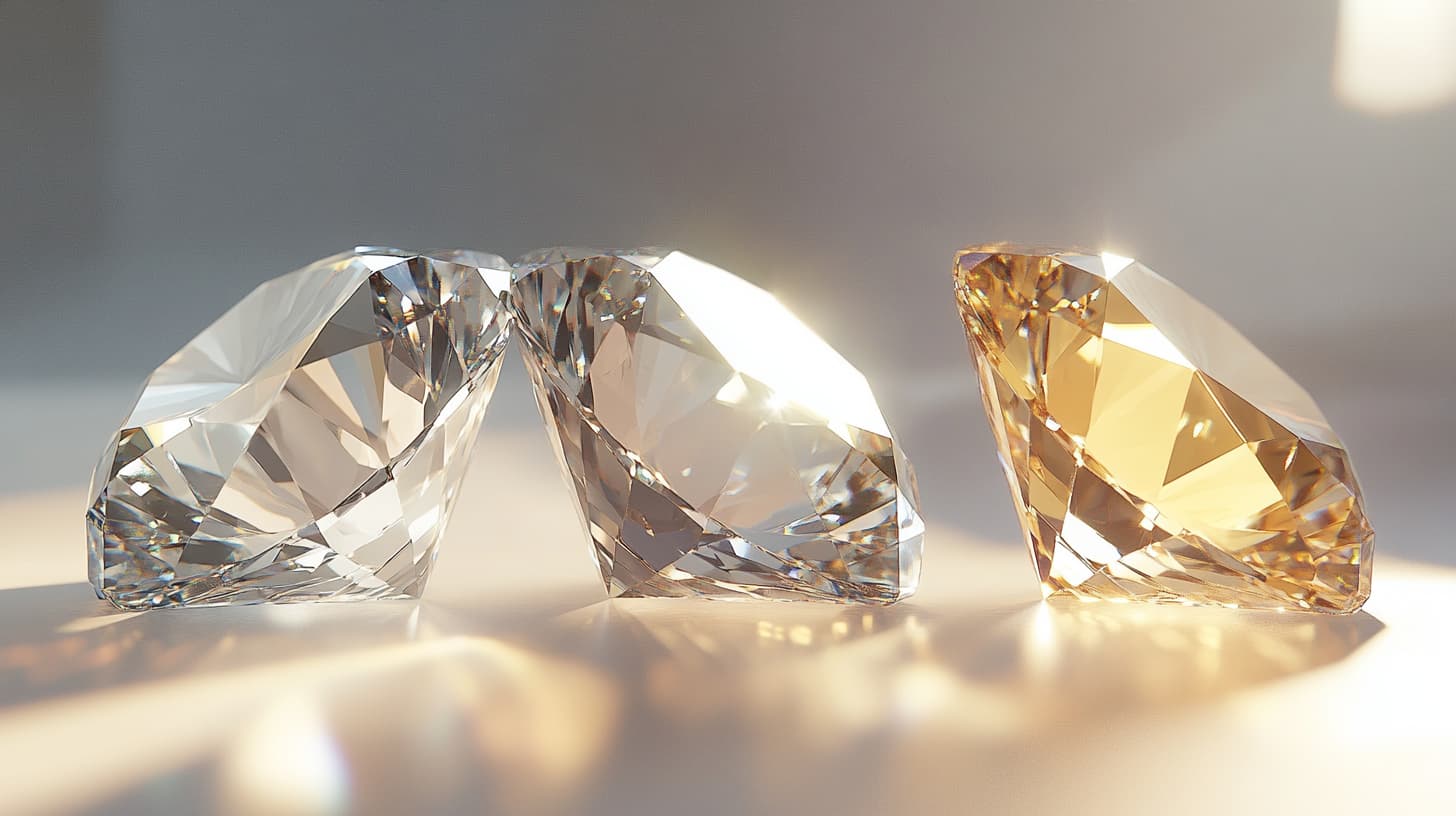
Diamond color measures how much yellow or brown tint is trapped inside an otherwise “white” diamond, not the flashes of rainbow light you see when it sparkles. When a jeweler talks about a stone’s “color,” they mean that underlying tint, not the flashy light show on top. That sparkle is a totally separate thing called fire and brilliance, driven mostly by the cut.
The tint itself comes from tiny traces of nitrogen trapped in the diamond’s crystal structure back when it formed, deep underground, over a billion years ago. More nitrogen generally means more visible yellow. A diamond with almost none of it reads as icy and clear, while one with more looks progressively warmer, like a glass of water with a drop of tea in it. Yellow is by far the most common tint, but not the only one; some diamonds trend brown instead, from natural structural distortions in the crystal, and a smaller number lean gray. The D-to-Z scale accounts for all of these tints within the normal color range for white diamonds. Diamonds with strong, obvious color, like vivid yellow, pink, or blue stones, sit outside that range entirely and are graded on a completely different “fancy color” scale, which works almost the opposite way: more color usually means more value, not less.
There’s an old piece of trade slang worth knowing here, too. Jewelers sometimes call warmer, K-through-Z diamonds “Cape” stones, a name that traces back to South Africa’s Cape Province, where large deposits of these yellowish diamonds were first mined in the 1860s. The name stuck around long after the location stopped mattering, and today it just means a diamond with a soft, noticeable yellow warmth rather than one from any particular mine.
Understanding the GIA Color Scale
The color scale runs from D at the top to Z at the bottom, and less color always means a higher grade. A diamond graded D shows essentially no tint at all, while one graded Z carries an obvious warm, yellowish-brown cast. Everything in between sits somewhere on that gradual slide. This scale was built by the Gemological Institute of America (GIA), and it’s the system nearly every jeweler in the world uses today, even ones who aren’t using GIA’s own lab.
You might wonder why the scale starts at D instead of A. That wasn’t random. Before GIA built this system, the jewelry trade used a mess of competing methods to describe color: some sellers used letters like A, B, and C without any agreed-upon meaning, others used plain numbers, and some just used vague marketing phrases that meant different things to different people. GIA wanted a fresh start that couldn’t be confused with any of those older, sloppier systems, so it picked a letter nobody else was using for diamonds: D.
Credit for the system usually goes to Richard T. Liddicoat, who became GIA’s president in 1952 and rolled out the D-to-Z scale, along with a matching clarity scale, in 1953. At the time it was built mainly as a teaching tool for GIA’s own students, a way to grade practice diamonds consistently in class. It worked so well that jewelers outside the classroom started asking GIA to grade their diamonds too, and that demand is what eventually turned it into the worldwide standard it is today.
Grading itself isn’t done just by eyeballing a diamond and guessing. Trained graders compare each stone against a set of reference diamonds with already-confirmed grades, all under carefully controlled lighting conditions built for consistency. Graders look at the diamond from the side and face-down, not through the top, because tint hides behind all the sparkle when you look at a diamond the normal way you’d wear it.
The Five Diamond Color Ranges
The 23 letter grades group into five broader categories, and knowing which bucket a diamond falls into tells you almost everything you need to know before you even look at the exact letter.
| Range | Grades | What You’ll Actually See |
|---|---|---|
| Colorless | D, E, F | No visible tint at all, even to a trained eye in most lighting |
| Near-Colorless | G, H, I, J | Looks white to almost everyone; faint warmth only visible to experts |
| Faint | K, L, M | A slight, often attractive warmth, especially noticeable in larger stones |
| Very Light | N, O, P, Q, R | Color starts to be visible to an untrained eye, especially in bigger diamonds |
| Light | S through Z | Distinctly yellow or brown, but still not intense enough to count as a “fancy color” diamond |
It’s worth remembering that each letter covers a small range of color rather than one fixed shade, so two diamonds carrying the same grade can still differ from each other very slightly, in a way only a trained grader would ever pick up on.
Older European dealers, especially before GIA’s scale caught on internationally, used their own set of names instead of letters, and you’ll still occasionally hear them today. “River” and “Top Wesselton” roughly lined up with today’s colorless range, “Wesselton” and “Crystal” with near-colorless, and “Cape” with the warmer end of the scale. These terms were never perfectly standardized between dealers, which is part of why the GIA letter system eventually replaced them everywhere.
What Does Each Color Grade Look Like?
The honest answer is: for most grades, almost nothing to the naked eye. This is the part that surprises people the most once they understand it, because color grade differences at the top of the scale are genuinely tiny.
- D, E, F (Colorless): These are the rarest and most expensive of the white diamonds. A jeweler comparing a D to an F side by side under a loupe and special lighting can tell them apart. You, glancing at a ring on someone’s hand, almost certainly cannot.
- G, H, I, J (Near-Colorless): This is where most fine jewelry diamonds actually land, because they look essentially white once mounted in a ring, especially with any metal setting around them. Many jewelers consider this range the best mix of appearance and value.
- K, L, M (Faint): A gentle warmth starts to show, more so in larger diamonds since there’s simply more diamond for light to pass through. Plenty of buyers like this warmer look, particularly in vintage-inspired designs.
- N through R (Very Light): Color becomes noticeable without any special equipment, especially in diamonds over one carat.
- S through Z (Light): Clearly yellow or brown toned. Still classified as white diamonds by grading standards, just at the far warm end of that spectrum.
A helpful way to think about it: color differences matter most side-by-side, under bright light, in a bigger stone. A single mounted diamond, seen on its own, hides small color differences extremely well.
Does Diamond Size Affect Color?
Yes, and this is one of the most practical things to understand before buying. A bigger diamond has more material for light to travel through, so any tint gets more visible the larger the stone gets. A half-carat diamond graded J might look perfectly white, while a three-carat diamond graded J can show a noticeably warmer tone, simply because there’s more diamond for the eye to see through.
This is why jewelers often recommend stepping up a color grade or two as carat weight increases. If you’re buying something small, like stud earrings under half a carat, a lower color grade can still look completely white and save real money. If you’re buying a large center stone for a ring, spending a bit more to move up the color scale tends to make a bigger visual difference.
Does Metal Setting Affect Diamond Color?
Yes, quite a lot actually. The metal surrounding a diamond changes how noticeable its color grade appears, sometimes dramatically.
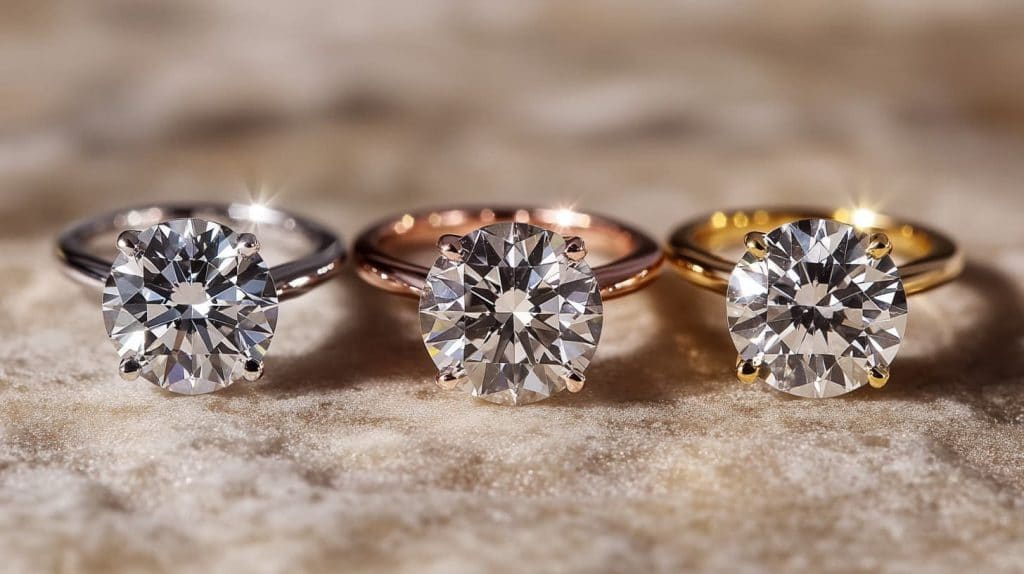
- Platinum and white gold show off a diamond’s true color, since the bright white metal doesn’t hide any warmth. If you’re set on platinum or white gold, sticking closer to D-F or G-H grades keeps the stone looking crisp against the metal.
- Yellow gold and rose gold actually work in your favor if you want to save money. Warm-toned metal reflects its own color back into the diamond, masking faint yellow tones in the stone itself. A J or K grade diamond can look bright and white when set in yellow gold, even though the same stone might look slightly warm in a platinum setting.
This is genuinely one of the best-kept secrets in diamond shopping: choosing a warmer metal lets you buy a lower, less expensive color grade without any visible compromise.
Does Fluorescence Affect Diamond Color?
Sometimes, yes. Roughly a third of diamonds glow faintly under ultraviolet light, and that glow, usually blue, can visually cancel out a little yellow tint in near-colorless to faint diamonds (roughly G through M), making them look a touch whiter than their letter grade suggests. In already-colorless D-F diamonds, though, strong fluorescence occasionally has the opposite effect, giving the stone a slightly hazy look in bright daylight. The overall impact depends heavily on where a diamond sits on the color scale to begin with, working in a warmer stone’s favor far more often than it works against a colorless one.
How Color Grade Affects Diamond Price
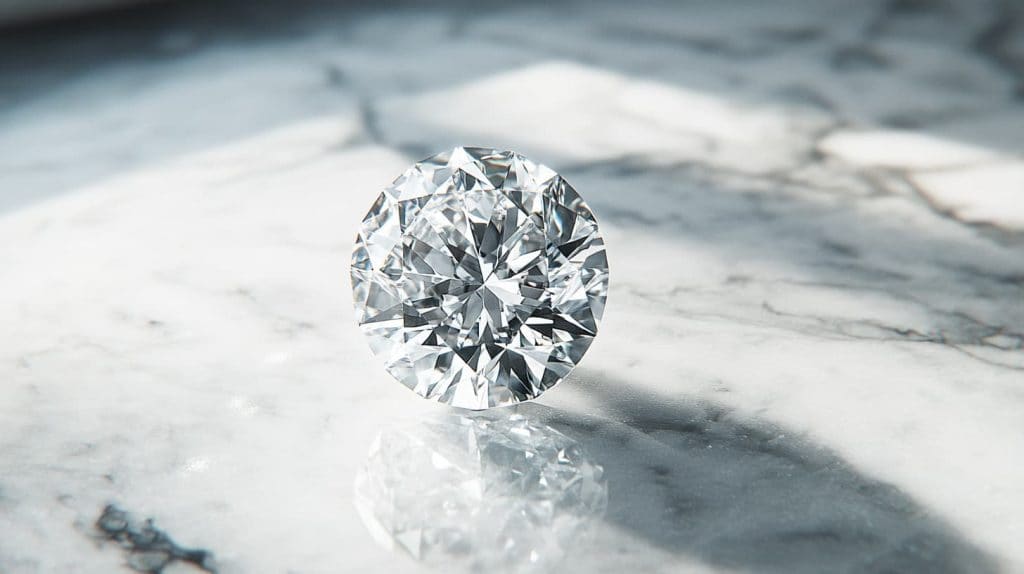
Color is one of the biggest price levers among the 4Cs, right alongside carat weight. Because truly colorless diamonds (D-F) are rare, they carry a real premium simply for their scarcity, not because they necessarily look more beautiful to an untrained eye. Moving down just a few letters, say from F to I, can lower the price noticeably while the visual difference to most people remains close to unnoticeable once the stone is set.
This is why many jewelers and gemologists actually recommend the near-colorless range (G-J) as the smartest place to shop. You get a stone that reads as bright white in person, at a meaningfully lower price than the colorless range, with the savings often better spent improving the diamond’s cut instead, since cut has the single biggest impact on how much a diamond actually sparkles.
Do Lab-Grown Diamonds Have Color Grades?
Yes. Lab-grown diamonds go through the exact same D-to-Z grading process as natural ones, because chemically and optically they’re essentially the same material. A lab-grown diamond graded H will look the same as a natural diamond graded H, since the grading measures the same physical property of light absorption in both cases, regardless of how the stone was formed.
Frequently Asked Questions
What is the best diamond color grade to buy?
There isn’t one single “best” grade for everyone, but G through I is widely considered the sweet spot for most buyers, since these grades look white to the naked eye once set, especially in a ring, while costing noticeably less than the colorless D-F range.
Can you tell diamond color grade just by looking at a diamond?
Not reliably, especially within the D-J range. Differences between neighboring grades are subtle enough that even jewelers use masterstones and controlled lighting to tell them apart accurately, so casual observation is not a dependable way to judge color.
Is a higher color grade always better?
Not necessarily. A higher grade means less color, which some buyers value for a crisp, icy look, but plenty of people genuinely prefer the subtle warmth of K-M range diamonds, especially in vintage or antique-style settings, so it comes down to personal taste as much as objective quality.
Why do some diamonds look yellow even with a good color grade?
This usually comes down to size or setting rather than a grading error. Larger diamonds show tint more visibly than small ones at the same grade, and diamonds set in white metal show their natural color more honestly than those set in yellow or rose gold, which can visually mask warmth.
Does color grade matter more than clarity?
For most buyers, color has a bigger effect on how a diamond looks at a glance, since a warm tint is something anyone can notice, while clarity flaws are often invisible without magnification. That said, both matter: a common approach is to prioritize a solid near-colorless grade (G-J) and a clarity grade that’s eye-clean (no flaws visible without a loupe), rather than maxing out either one individually.
Does color grade affect how much a diamond sparkles?
Not directly. Sparkle, technically called brilliance and fire, is controlled mainly by how well a diamond is cut, not by its color grade. A diamond with a lower color grade but an excellent cut can still sparkle beautifully; color affects the diamond’s tint, not its light performance.
Conclusion
Understanding diamond color really comes down to one core idea: it measures the absence of tint, and every grade from D to Z simply marks how close a stone gets to that colorless ideal. For most buyers, the near-colorless range delivers a diamond that looks completely white once it’s set, at a price well below the rarest colorless grades, and pairing your color choice with the right metal and carat size matters just as much as the letter on the certificate. Once you know that, reading a diamond grading report stops being confusing and starts being genuinely useful.