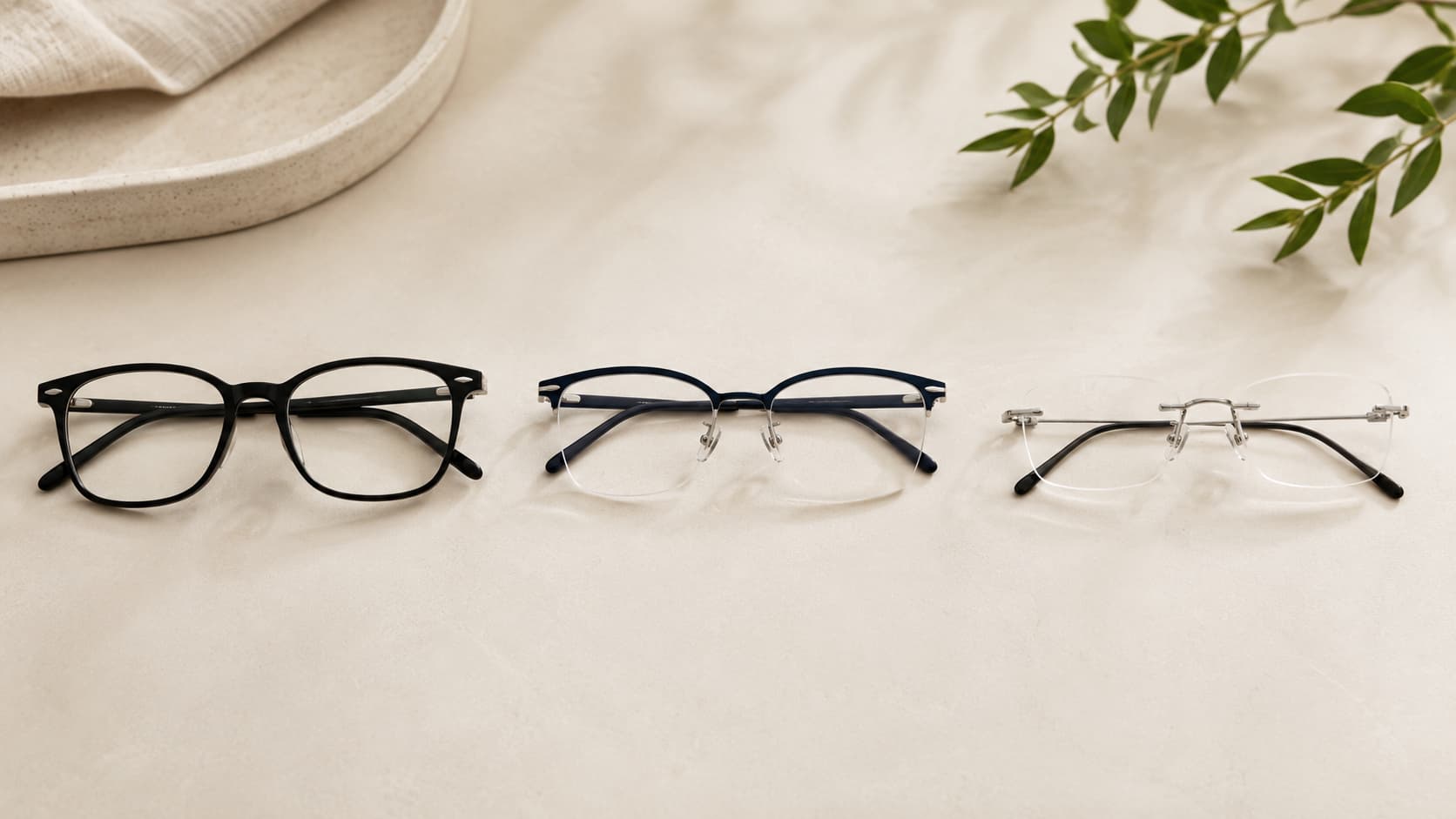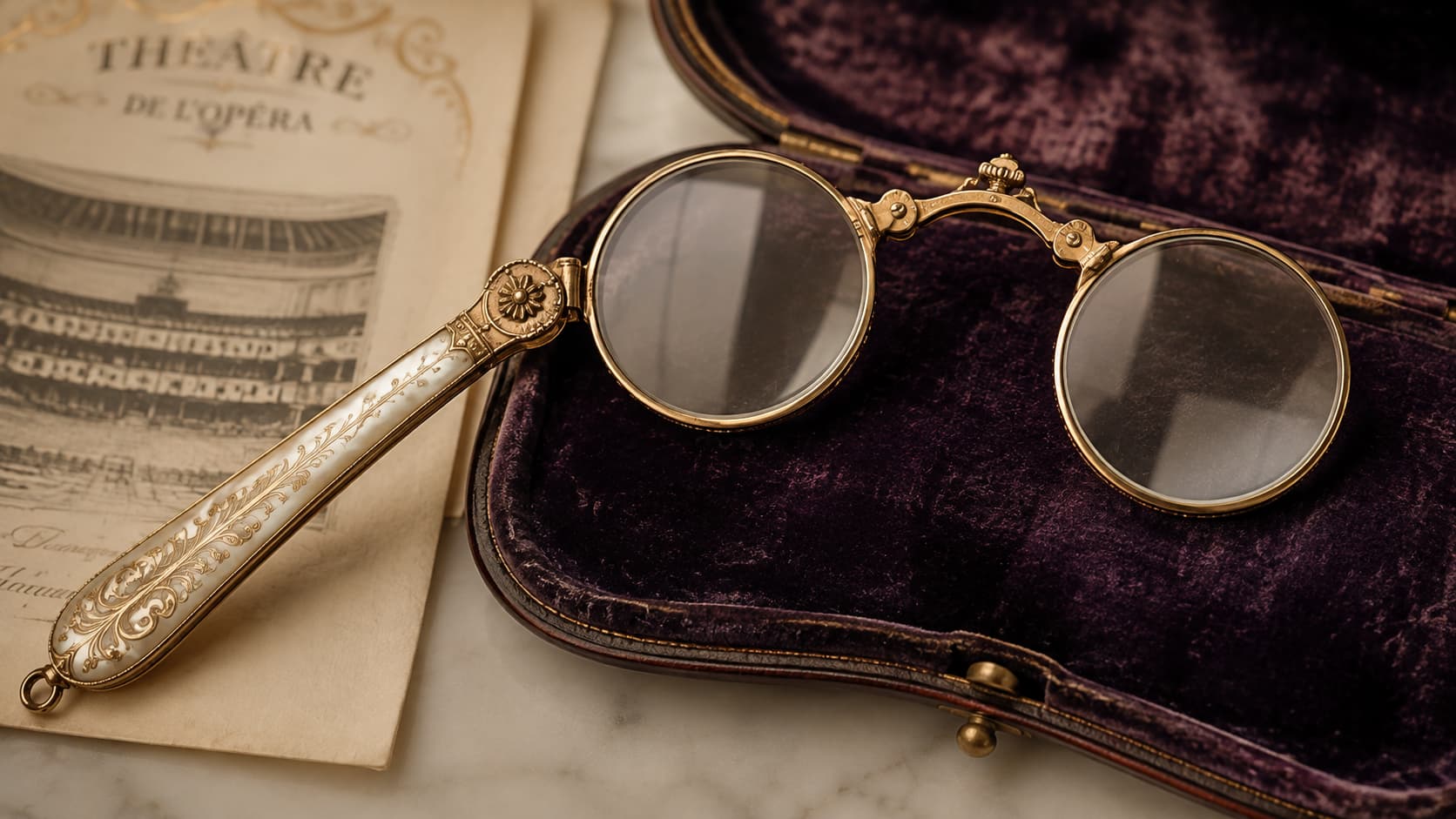
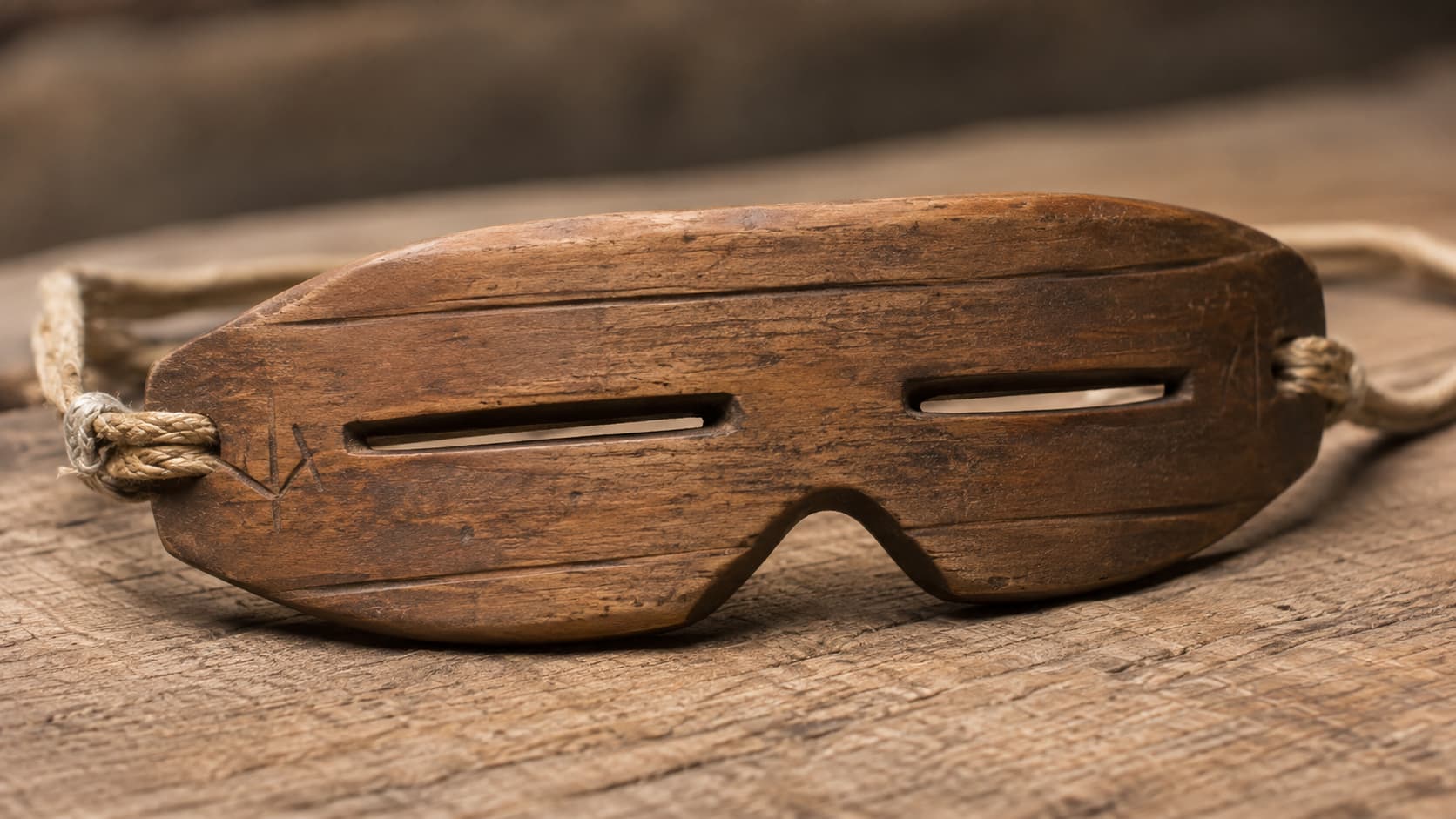
Long before anyone dreamed up polarized lenses or UV coatings, people living in the Arctic had already solved one of the toughest problems in eyewear: how to see clearly across miles of blinding white snow without damaging the eyes. Their answer was a simple, carved piece of bone, antler, wood, or ivory with a thin slit cut across it. It looked nothing like modern sunglasses, yet it worked on the same basic idea — block out most of the light, let just enough through to see. That invention, still made and worn today, is the Inuit snow goggle.
What Are Inuit Snow Goggles?
Inuit snow goggles, often called iggaak (also spelled ilgaak or igguag depending on the dialect), are a curved piece of material carved to fit snugly against the face, with a narrow horizontal slit for each eye instead of an open lens. Carvers drew on whatever sturdy material was on hand — antler, musk-ox horn, bone, wood, or ivory — and the finished piece did the same job a pair of sunglasses does today, cutting the glare bouncing off snow and ice before it could damage the wearer’s eyes.
The design is beautifully low-tech. Rather than filtering light through glass, the goggles simply block almost all of it, leaving only a sliver open for the eye to peek through. Getting the slit dimensions right was a balancing act — cut too generously and the wearer stayed exposed to harmful UV rays, cut too tightly and they could barely see where they were going. Some pairs were even blackened on the inside with soot or charcoal, which cut down on stray reflections bouncing around inside the goggle itself.
The slit works like a keyhole cut on purpose. Less light gets in overall, but what does get in is sharp enough to navigate by.
Why Did the Inuit Need Snow Goggles?
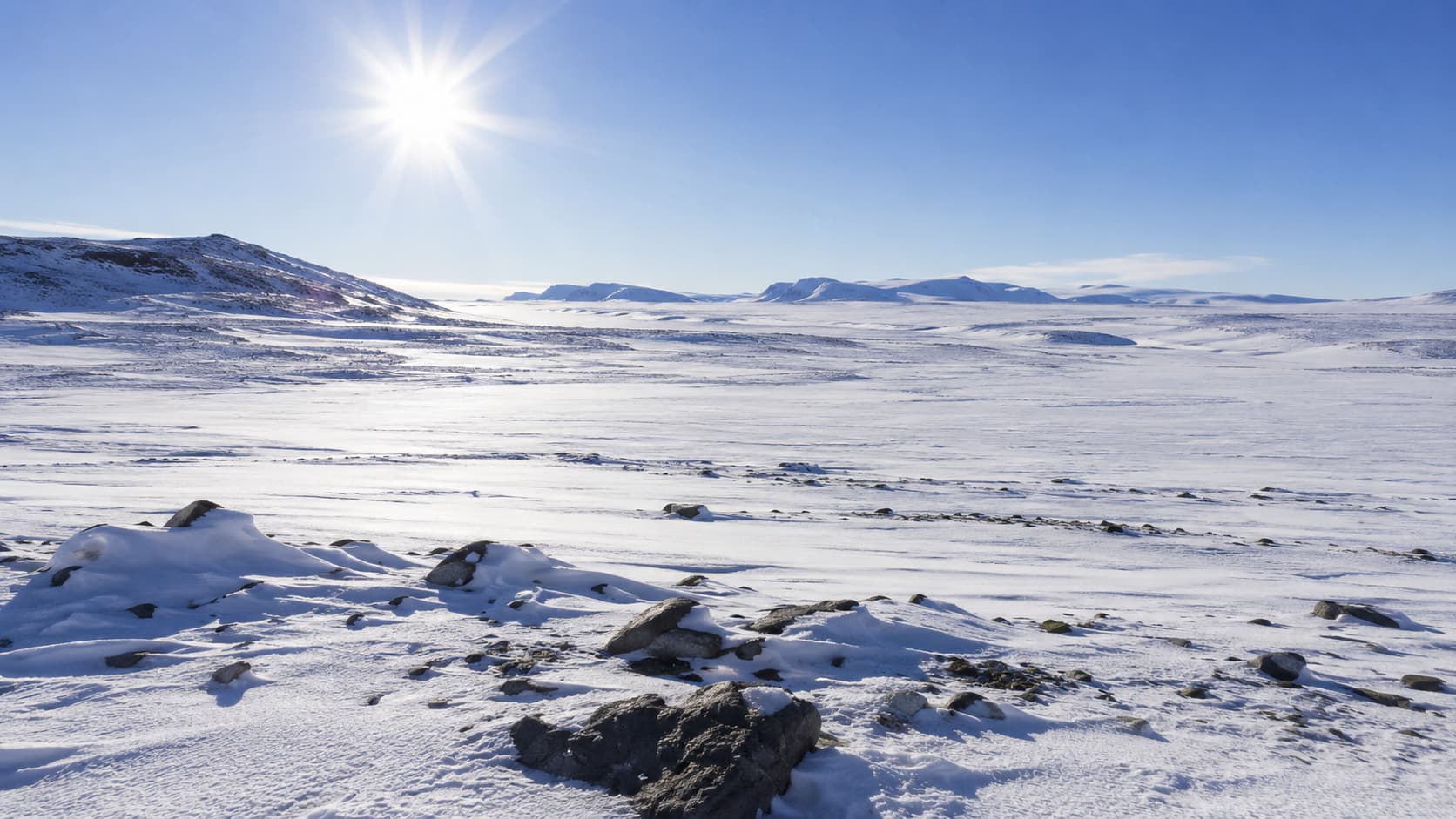
Snow goggles exist because bright snow can genuinely injure the eyes, not just cause discomfort. Fresh snow bounces back an enormous amount of sunlight, and without protection, that reflected glare can burn the surface of the eye in a matter of minutes.
Snow reflects sunlight back upward far more effectively than most surfaces do. Because snow-covered terrain has a high albedo, meaning it bounces back most of the radiation that hits it, freshly fallen snow can send back roughly 90 percent of the sunlight striking it. Combine that with the thin, clean Arctic air that does little to filter ultraviolet rays, and eyes are hit with far more UV exposure than they’d get almost anywhere else on the planet. For people who spent entire days hunting, fishing, or traveling across open ice, losing clear vision wasn’t a minor inconvenience — it could mean not finding your way back, or not finding the animal you were tracking in the first place.
What Is Snow Blindness, and Why Is It So Painful?
Snow blindness is essentially a sunburn on the clear front surface of the eye, called the cornea, caused by too much UV exposure reflecting off snow or ice. It’s medically known as photokeratitis, and while it usually heals on its own, it hurts a lot while it lasts.
Photokeratitis is temporary, painful eye damage caused by exposure to ultraviolet light — most often the sun, but also sunlight reflected off snow, ice, water, or sand. The tricky part is that it doesn’t show up right away. A person usually won’t notice anything wrong for half an hour to as long as twelve hours after the damaging exposure occurred, and once symptoms do arrive they tend to include pain in both eyes, sensitivity to light, blurred vision, and excessive tearing. That delay meant a hunter could spend a whole clear day out on the ice feeling fine, only to wake up later with eyes that felt like they were full of sand, unable to see properly for a day or two. Fortunately, the damage is usually temporary and the eyes heal on their own, but repeated, unprotected exposure over a lifetime can cause lasting harm, which is exactly why generations of Arctic peoples treated eye protection as essential survival gear, not an accessory.
When Were Snow Goggles Invented?
Snow goggles are not a recent invention — they’re one of the oldest known forms of purpose-built eyewear in human history, dating back thousands of years. Researchers estimate the earliest snow goggles were created roughly 2,000 years ago by the ancestors of the Inuit, and some evidence suggests the idea may stretch back even further, closer to 4,000 years, to the earliest Arctic settlements. That means people were engineering UV-blocking eyewear thousands of years before anyone had ever heard the word “sunglasses.”
Archaeologists have found goggles preserved in old settlement sites across the Arctic. A carved ivory pair meant for hunting or travel on the spring ice turned up during excavation of an early Inuit dwelling on Baffin Island, and it now sits in a museum collection as one of the clearest physical links to that early period. Their survival for so many centuries says a lot about both the durability of the materials used and how central these goggles were to everyday Arctic life.
How Does the Slit Design Work?
The genius of snow goggles isn’t in fancy chemistry — it’s in geometry. Cutting the opening down to a thin line does two things at once: it narrows how much of the surrounding world the wearer can see, and it sharply cuts the dose of ultraviolet light striking the eyes, while still leaving enough of a gap to see through clearly.
Inuit snow goggles work on this same trade-off: the narrower the slit, the less peripheral vision the wearer keeps, but the more effectively that slit screens out the ultraviolet radiation trying to reach the eyes. Carvers had to strike a careful balance when shaping that opening. Cut it too narrow, and the wearer strains their eyes trying to see through it. Cut it too wide, and too much glare gets through, defeating the purpose entirely. Getting that slit width right, tailored to the individual wearer’s face and eyes, was a skill passed down through generations of craftspeople.
Some goggle-makers took the design a step further for extra protection:
- Blackened interiors — soot or charcoal rubbed on the inside surface reduced glare bouncing around inside the goggle before it reached the eye.
- Custom-fitted curves — the goggles were carved to sit snugly against the cheekbones and brow, sealing out extra light from the sides.
- Sinew cords — a strap made from caribou sinew or similar material held the goggles firmly in place during travel or hunting.
There’s also a neat side effect to this design that goes beyond just blocking light. Because the narrow slit focuses light the way a pinhole camera does, it can actually sharpen vision, making far-off objects look clearer. An anthropologist working with Yupik communities discovered this firsthand after eye surgery had left her vision blurry in one eye — the moment she held a pair of traditional Yupik goggles up to that eye, her vision snapped back into focus. So the slit wasn’t only protecting eyes from glare; in bright, glary conditions, it could genuinely help people see farther and sharper, which was no small advantage when scanning the horizon for animals or hazards on the ice.
What Materials Were Snow Goggles Made From?
Traditional snow goggles were made from whatever durable natural materials were available in the local environment, since trees and other resources were scarce across much of the Arctic. Caribou antler, bone, driftwood, and walrus ivory were among the most common choices for the earliest goggles. Whale baleen, the flexible, comb-like material found in a whale’s mouth, was another material some communities carved into goggles. Coastal communities near tree lines sometimes used wood or even bark instead. One documented pair, called deiizhii, was sewn from birch bark with a leather strap by the Gwich’in people of the upper Yukon River, where birch trees were plentiful.
The choice of material often depended on geography as much as tradition. Coastal and hunting communities with regular access to walrus or caribou used ivory, antler, or bone, while inland groups near forested areas leaned on wood and bark. Either way, the goal stayed the same: a rigid, face-hugging shell with a narrow slit for the eyes.
Did Different Arctic Communities Have Different Names for Them?
Yes — because the Inuit and Yupik peoples span an enormous stretch of the Arctic, from Siberia through Alaska, Canada, and Greenland, the goggles go by several different names depending on the region and dialect. In the Kivalliq dialect the word ilgaak is used, while the North Baffin dialect uses iggaak; in Central Yupik the goggles are called nigaugek, in Cup’ig they’re igguag, and in Siberian Yupik the word is iyegaatek. Interestingly, several of these same words are also used today to refer to modern sunglasses, which shows just how directly the old technology is connected to the new in the minds of the people who use both.
Are Snow Goggles Still Used Today?
Yes, though far less often than in the past, since manufactured sunglasses and ski goggles are now widely available across the Arctic. Traditional snow goggles haven’t disappeared, though — they’re still hand-carved by Inuit artists today, both for practical use on the land and as cultural and artistic pieces.
More than 100 pairs of Inuit snow goggles are held in the Canadian Museum of History’s collection alone, and contemporary carvers continue to produce new ones using the same traditional methods as their ancestors. Beyond their practical role, snow goggles carry real cultural weight. Making a pair well was a skill that elders taught to younger generations, so the craft doubled as a way of keeping knowledge and tradition alive within a community. Many pairs were also personalized with unique carved markings and patterns, meaning no two were ever quite identical.
The core idea behind snow goggles has also outlived the goggles themselves. The narrow-slit, side-shielded approach to blocking glare shows up in the design logic behind modern wraparound ski and mountaineering eyewear, which limits stray light from the sides in much the same spirit as a hand-carved slit did centuries ago. It’s a good reminder that “old” and “outdated” aren’t the same thing — sometimes an ancient solution just gets translated into new materials.
How Snow Goggles Compare to Modern Sunglasses
| Feature | Inuit Snow Goggles | Modern Sunglasses |
|---|---|---|
| Light-blocking method | Narrow slit limits how much light reaches the eye | Tinted or polarized lens filters specific light wavelengths |
| Materials | Bone, antler, ivory, wood, bark | Glass, plastic, polycarbonate |
| Field of vision | Narrow, limited to the slit | Wide, full lens area |
| UV protection | Physical blocking, highly effective | Chemical UV coatings, highly effective |
| Fit | Hand-carved to an individual’s face | Mass-produced, adjustable frames |
| Origin | Arctic Indigenous innovation, ~2,000–4,000 years old | Developed from tinted lenses in the 18th–20th centuries |
The two approaches solve the same problem in almost opposite ways. Sunglasses let a wide field of light in and then filter it chemically through the lens. Snow goggles take the more direct route, physically blocking most of the light from ever reaching the eye at all. Both work, but the trade-off with snow goggles is a narrower field of view in exchange for extremely effective, low-tech UV protection.
Frequently Asked Questions
Are Inuit snow goggles the same as ski goggles?
Not exactly. Ski goggles use a wide, curved lens to protect the whole eye area from wind, cold, and light, while traditional Inuit snow goggles use a narrow slit instead of a lens to physically limit how much light reaches the eye. Both aim to prevent glare-related eye damage, but they use very different methods to do it.
Can carved snow goggles actually block UV rays as well as sunglasses?
Yes, quite effectively. The narrow slit works entirely by physically restricting the opening rather than filtering light through a tinted lens, and some sources estimate a well-carved slit can block somewhere in the range of 90 to 95 percent of reflected light — squarely in the same ballpark as good-quality modern sunglasses, even without any chemical coating involved.
What does snow blindness feel like?
People often describe it as feeling like glass in the eye or a handful of sand under the eyelid. It typically comes with redness, heavy tearing, and strong sensitivity to light, and symptoms usually show up hours after the actual UV exposure happened rather than right away.
Why were the slits made so narrow instead of just using a dark material?
A narrow slit does two jobs at once: it cuts down the sheer amount of light reaching the eye, and it limits the angle of light entering, which reduces glare more effectively than a simple dark filter would. Carvers had to balance the slit’s width carefully, since too narrow a gap strains the eyes, while too wide a gap lets too much glare through.
Can snow goggles actually improve eyesight, not just protect it?
In certain situations, yes. Restricting light to a narrow slit increases depth of field and reduces the size of the image landing on the retina, which sharpens vision and improves contrast, especially in flat, featureless white-out conditions. This is the same “pinhole effect” used in old pinhole cameras, and it’s why some wearers, including people with mild vision problems, have found that looking through a traditional pair of goggles brings distant objects into sharper focus.
Is it legal to buy old ivory or antler snow goggles today?
It depends heavily on the material, the item’s age, and the buyer’s or seller’s location, so this is genuinely a case of checking current rules rather than assuming. U.S. federal law carves out protection specifically for Alaska Native communities, allowing them to hunt walrus for subsistence and to turn the ivory into authentic handicrafts they can legally sell. Antler, bone, and wood goggles fall outside ivory regulations entirely and are generally straightforward to buy, sell, and own. Because ivory laws vary by country and even by U.S. state, and because they’ve continued to change in recent years, anyone buying or selling an ivory piece should check current federal and local rules first rather than relying on old information.
Would traditional snow goggles meet today’s sunglasses safety standards?
Not by the same measurement, but they solve the underlying problem in their own way. Modern sunglasses are usually rated by how much of the UV spectrum they block, with UV400-rated lenses filtering close to 100 percent of UV rays up to 400 nanometers. Traditional snow goggles were never tested against that specific scale, but the physical slit design achieves a similar practical result by drastically cutting the total amount of light, UV included, that reaches the eye. The trade-off is field of view: sunglasses allow a full view of the surroundings through a filtered lens, while snow goggles trade a wider view for a narrower, highly controlled one.
Who still makes traditional snow goggles today?
Inuit artisans across Nunavut, northern Canada, Alaska, and Greenland continue to hand-carve snow goggles using traditional materials and techniques passed down through their families. They’re made both for practical wear on the land and as cultural pieces that preserve a craft going back thousands of years.
Conclusion
Inuit snow goggles are proof that good design doesn’t need advanced materials to work — it needs a sharp understanding of the problem being solved. By narrowing what the eye lets in, Arctic carvers protected generations of hunters and travelers from a painful, disabling condition using nothing more than bone, antler, and a steady hand. Thousands of years later, sunglasses solve the same problem with glass and coatings instead of a slit, but the core idea traced back to iggaak remains exactly the same: control the light before it reaches the eye.