Sunglasses feel like a fairly modern invention, the kind of thing associated with movie stars in the 1950s or beachgoers today. But the idea of covering the eyes to block out harsh light is thousands of years old, and it started nowhere near a beach at all. It began in the freezing Arctic, long before anyone had ever seen a pair of glass lenses, and it grew through ancient China, Roman gladiator arenas, and Venetian canals before finally becoming the plastic-framed accessory that hit the American boardwalk in 1929. The full origin story reframes what sunglasses actually are: not an invention built to look good, but one built because bright light can genuinely cause harm.
What Was the Very First Pair of Sunglasses?
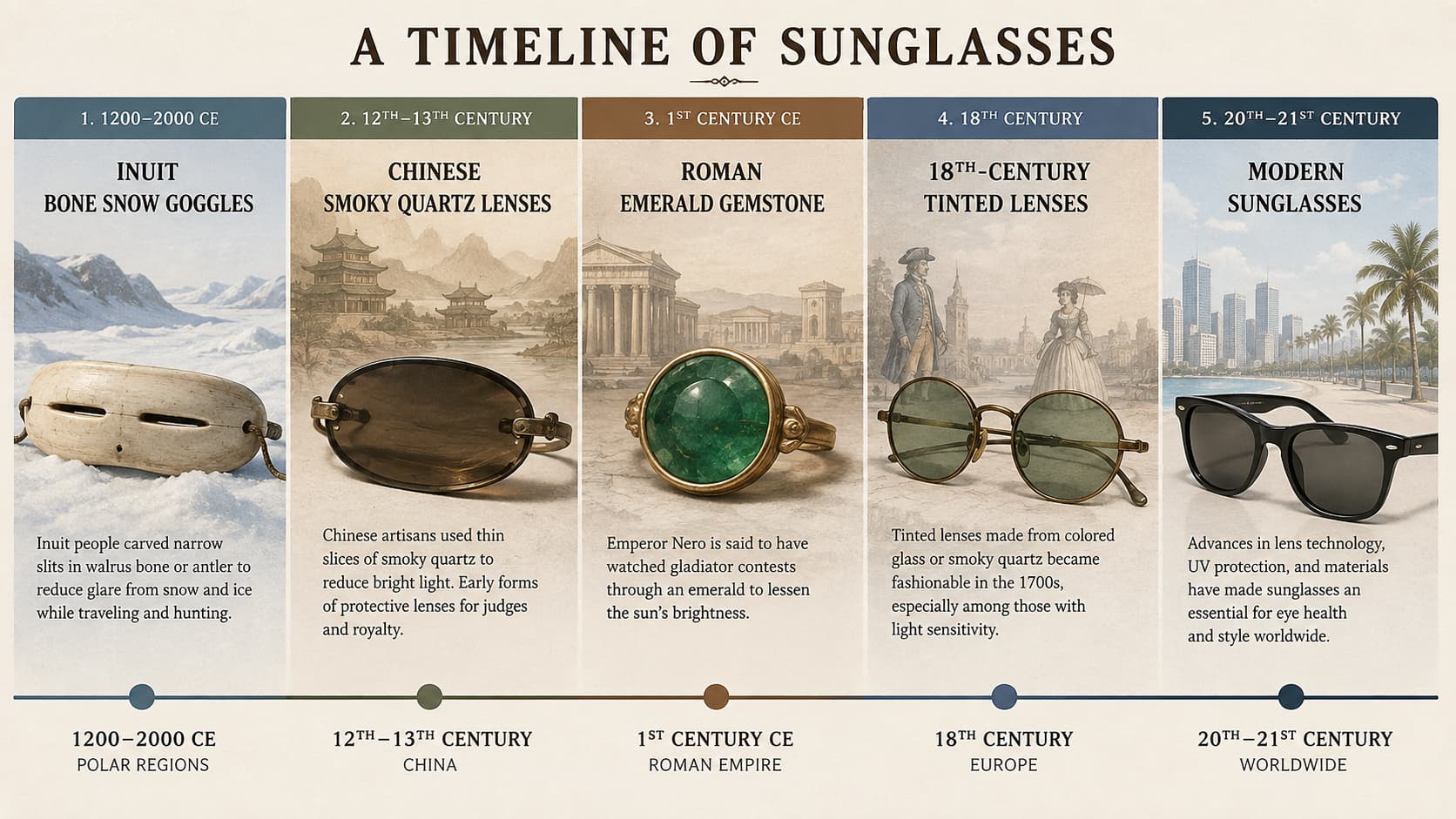
The very first eye protection from sunlight wasn’t glasses at all — it was a pair of carved goggles made by Inuit people in the Arctic roughly 2,000 years ago. They weren’t tinted or transparent like modern lenses; they were solid pieces of bone, wood, walrus ivory, or antler with a thin slit cut across the front.
These goggles are usually called snow goggles, and they solved a very real, very painful problem. In the Arctic, sunlight bouncing off snow and ice is intense enough to burn the surface of the eye, a condition called snow blindness. It functions much like a sunburn on the eyeball, and it’s agonizing. Inuit craftspeople figured out that a narrow slit cut into a piece of solid material, worn snug against the face, still allowed enough vision to hunt or travel while blocking almost all of the blinding glare.
Some designs were rubbed with soot or charcoal on the outside surface. That extra layer of black absorbed even more reflected light before it ever reached the eye.
The design was remarkably consistent across a huge stretch of the Arctic, made by Inuit and Yupik communities from Alaska all the way to Canada and Greenland. Craftspeople carved the slit down to just 1 to 3 millimeters wide, then shaped the inside of the goggles to curve snugly against the wearer’s face, with a groove cut out for the nose so almost no stray light could sneak in around the edges. One well-documented specimen, a wooden pair fitted with a leather strap, entered the historical record when explorer Sir William Parry returned from his third Arctic expedition in 1823 carrying it back to Britain. That artifact is still preserved in a museum collection today, giving historians a physical example to study rather than just written descriptions.
Modern scientists have actually tested these goggles using photometric equipment, and the results back up what Inuit communities knew for centuries: narrowing the field of vision to a slit dramatically cuts down glare and even sharpens focus a little, similar to how squinting works. In the most literal sense, the first sunglasses weren’t about fashion or sun protection from heat — they were a survival tool.
Were the Chinese the First to Use Tinted Lenses?
Yes — China gets credit for the first known use of a see-through tinted lens over the eyes, using flat sheets of smoky quartz sometime during the Song Dynasty, around the 12th century. This is the earliest known example of something that actually resembles a modern lens.
Smoky quartz is a naturally brownish-gray, semi-transparent crystal, and Chinese craftspeople learned to cut it into thin, flat panes that could be held or mounted in front of the eyes. These lenses were known as Ai Tai, a name that roughly translates to “dark clouds covering the sun,” which is a pretty good description of what wearing one would have felt like. Unlike Inuit snow goggles, these quartz lenses let a decent amount of light through while dimming the overall glare, much closer to what a modern sunglass lens does. Historical accounts describe these lenses being expensive enough that owning a pair signaled real wealth, on the level of owning a horse.
Historians generally believe, however, that Chinese judges wore smoky quartz lenses in courtrooms for a completely different reason than sun protection. The tint helped hide their eyes and facial expressions while questioning witnesses, so their reactions couldn’t be read during a case. That detail means one of the earliest “sunglasses” in history wasn’t really about the sun at all — it was about privacy and control in a legal setting.
Did the Romans Have Sunglasses Too?
Not exactly, but there’s one famous story that gets brought up constantly: the Roman Emperor Nero reportedly watched gladiator fights through polished, translucent gemstones, possibly emeralds, held up to his eyes. This comes from the writings of Pliny the Elder, a Roman historian.
Nobody knows for certain why Nero did this, and the story is often repeated without much context. Some historians think the green gemstone may have reduced glare from the sun while he watched events in the arena. Others think it was more about vanity, or about using a polished, reflective surface to view the action from a distance, similar to a small mirror. Either way, it wasn’t a manufactured product or a widespread practice — it was one wealthy, powerful individual doing something unusual, and it never became any kind of standard.
Who Made the First Tinted Glasses for Eyesight?
In the mid-1700s, a London optician named James Ayscough started making glasses with green and blue-tinted lenses, but he wasn’t trying to block sunlight at all — he believed the color of the tint could actually help correct certain vision problems.
Ayscough’s glasses were considered a medical tool rather than a fashion item or a sun-blocking product. Tinted lenses in this era were mostly associated with people who had weak or light-sensitive eyes, and they carried something of a stigma because of that association. It would take well over a century before tinted eyewear started shaking off that “medical device” reputation and being seen as something ordinary people might wear outdoors just because it was comfortable.
Later in the 18th century, gondoliers in Venice, Italy, were wearing tinted glasses to cut down on the intense glare bouncing off the water in the canals. These became known as Goldoni glasses, named after the playwright Carlo Goldoni, who was known to wear them and helped popularize the style. Because they were specifically designed to block sunlight rather than treat an eye condition, some historians actually argue these Venetian glasses have a stronger claim to being the “first true sunglasses” than Ayscough’s medical lenses.
The “medical tool” reputation stuck around for a surprisingly long time. In the early 1800s, doctors began prescribing tinted lenses, sometimes called therapeutic lenses, to patients suffering from syphilis, since the disease could cause severe sensitivity to light as one of its symptoms. For much of the 1700s and early 1800s, someone spotted in tinted glasses was more likely assumed to have an eye condition than to be dressed stylishly or on vacation.
When Did Sunglasses Actually Become a Mass-Produced Product?
The first mass-produced, affordable sunglasses hit the market in 1929, when an entrepreneur named Sam Foster began selling them on the boardwalk in Atlantic City, New Jersey, under the name Foster Grant.
Foster and his business partner, Bill Grant, had actually founded their company a decade earlier to manufacture women’s hair combs and accessories out of celluloid, an early type of plastic. When a shift toward shorter hairstyles in the 1920s crushed demand for combs, Foster looked for a new use for the same material and machinery. He started selling celluloid sunglass frames at a Woolworth’s store right on the Atlantic City boardwalk, marketing them straight to sunbathers and tourists rather than through an optometrist’s office, which was how tinted lenses had traditionally been sold. It wasn’t until 1934, five years after that first boardwalk sale, that Foster Grant became the first American company to adopt injection molding, a manufacturing leap that let it produce sunglasses far faster than by hand.
This mattered enormously because, before 1929, tinted lenses generally had to be custom-made through an eye doctor. Foster Grant turned sunglasses into something anyone could grab off a shelf for a few dollars. Within a decade, Hollywood had taken notice — actresses began wearing large sunglasses partly to hide their eyes, which were often red and irritated from the powerful arc lamps used on film sets at the time. By the end of the 1930s, sunglasses had gone from a niche medical item to a genuine consumer craze, with millions of pairs sold across the United States. In fact, by 1939, Life magazine had officially declared sunglasses a nationwide fad, reporting that roughly 20 million pairs had been sold in the U.S. in just that one decade.
How Did Sunglasses Go From Useful to Fashionable?
Sunglasses became a true fashion symbol in the decades right after Foster Grant’s boardwalk debut, driven mostly by Hollywood glamour and military technology from World War II.
Once movie stars started wearing sunglasses regularly in the 1930s, the association between shades and celebrity status was locked in. Decades later, in 1965, Foster Grant leaned into that connection with its now-famous advertising campaign asking “Who’s That Behind Those Foster Grants?”, which put oversized frames on the faces of stars like Raquel Welch and Peter Sellers and became one of the most recognized ad slogans of the 20th century. At the same time, the U.S. military was developing its own sun-protection technology for pilots. Bausch & Lomb created aviator-style sunglasses for the Army Air Corps specifically to cut glare at high altitude, a style that eventually crossed over into everyday civilian fashion and is still one of the most recognizable shapes in eyewear today.
The other major technical leap came from Edwin Land, founder of Polaroid, who invented polarized lenses in the 1930s. Polarization doesn’t just darken the overall view — it specifically blocks the kind of horizontal glare that bounces off flat surfaces like water, snow, or a car hood, which is why polarized lenses are still considered the gold standard for driving and outdoor sports.
Sunglasses went on to mirror pop culture closely, with a distinct look taking over nearly every decade that followed.
- 1930s — Simple round frames and the first aviator styles, worn by early film stars
- 1940s — Bold, colorful frames, some shaped like flowers or other playful designs
- 1950s — Cat-eye frames, made iconic by stars like Audrey Hepburn and Marilyn Monroe
- 1960s — Oversized square frames in bright colors, worn by men and women alike
- 1970s — Large, round, lightly tinted lenses with a laid-back, bohemian feel
- 1980s — Aviators surge back into the mainstream, largely thanks to the movie Top Gun
- 1990s — A shift toward small, narrow frames favored by celebrities of the era
| Era | Development | Main Purpose |
|---|---|---|
| ~2,000 years ago | Inuit snow goggles (bone, ivory, wood) | Preventing snow blindness |
| 1st century AD | Nero’s polished gemstones | Uncertain — possibly glare reduction |
| 12th century | Chinese smoky quartz lenses | Concealing expressions in court, some glare reduction |
| 1752 | James Ayscough’s tinted lenses | Believed vision correction |
| Late 1700s | Venetian Goldoni glasses | Blocking canal glare |
| 1929 | Foster Grant mass production | Affordable sun protection for the public |
| 1936 | Polaroid’s polarized lenses | Reducing reflected glare |
Frequently Asked Questions
Did Inuit snow goggles actually work?
Yes. Modern testing has confirmed that the narrow slit design genuinely reduces the amount of reflected sunlight reaching the eye, and it can even sharpen focus slightly by narrowing the field of vision, much like squinting does.
Were early sunglasses meant to block UV rays?
No. None of the earliest forms of eye protection, from Inuit goggles to Chinese quartz lenses to Ayscough’s tinted glasses, were designed with ultraviolet radiation in mind, since UV rays weren’t scientifically understood yet. They were built to reduce visible glare and brightness, not the invisible rays that cause long-term eye damage.
When did sunglasses start blocking UV light specifically?
Meaningful UV protection didn’t become a standard feature until research in the 1970s and 1980s proved that a lens being dark doesn’t automatically mean it blocks UV rays. This eventually led to labeling standards like UV400, which is now the benchmark most quality sunglasses are measured against.
Who is credited with inventing the first mass-produced sunglasses?
Sam Foster, through his company Foster Grant, is widely credited with this in 1929. He wasn’t the first person to create tinted eyewear, but he was the first to make sunglasses cheap, plastic, and available to ordinary shoppers rather than something custom-made through a doctor.
Why did Chinese judges wear smoky quartz lenses?
Historical accounts suggest it wasn’t primarily about the sun — the tinted quartz helped hide a judge’s eyes and facial expressions from witnesses during questioning, giving away less about their reaction to testimony.
Conclusion
The story of sunglasses isn’t really one invention — it’s a chain of separate solutions to separate problems that eventually merged into a single everyday object. Inuit communities solved snow blindness with slitted bone and antler. Chinese court officials found a use for tinted quartz that had nothing to do with weather. An English optician tried to fix eyesight with colored glass. And it took a hair-accessory manufacturer named Sam Foster, working out of a New Jersey boardwalk, to finally turn all of that into something cheap enough and stylish enough for the general public to wear. Modern sunglasses still carry a trace of all of that history — protection, status, medicine, and fashion, layered on top of each other over roughly two thousand years.