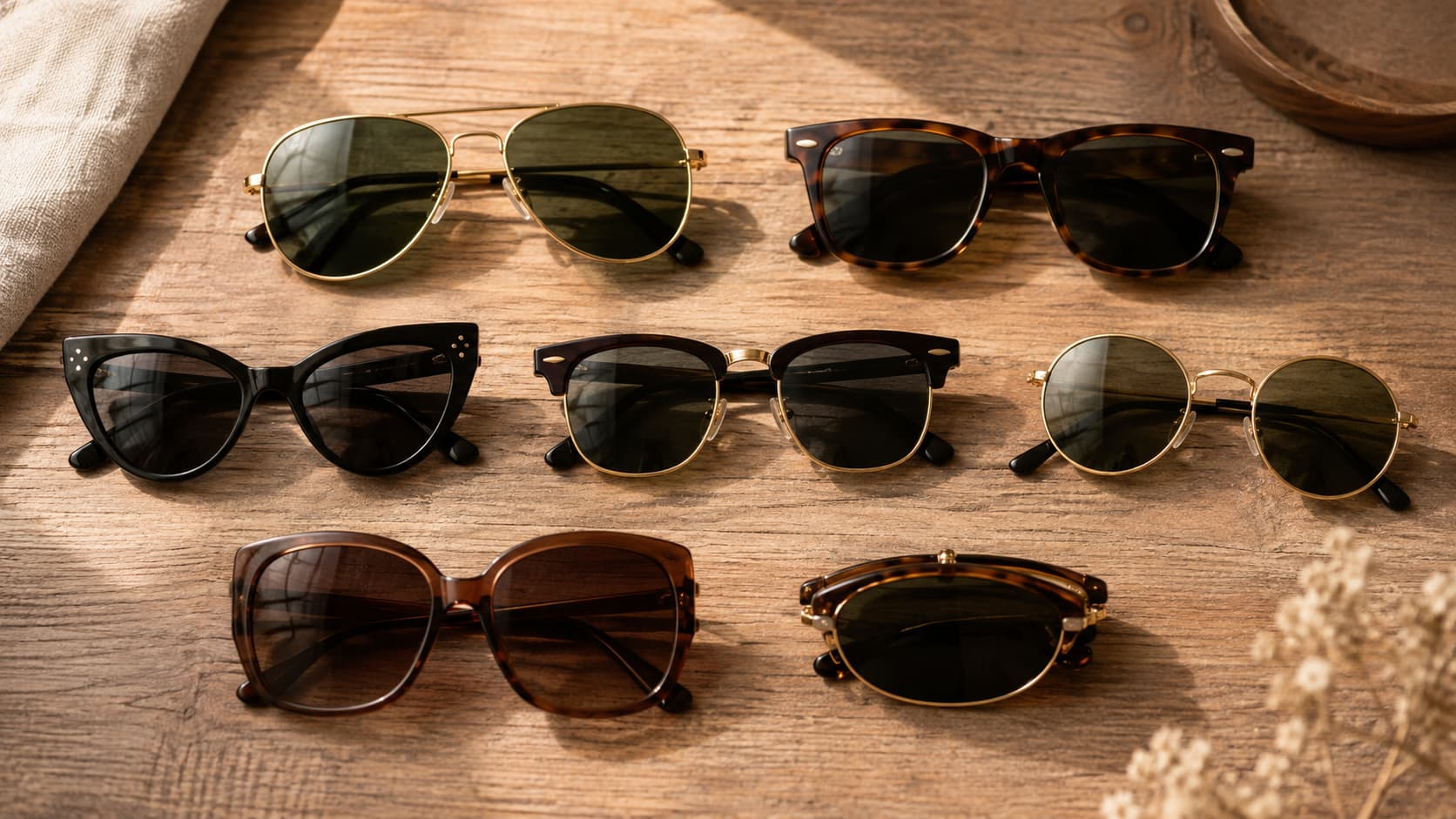
Most sunglasses shapes that still look stylish today started somewhere unexpected: a military cockpit, a lonely optician’s window in New York, or a Beatles film set. The shapes now considered timeless — the teardrop lens, the thick black square, the swept-up cat’s eye — weren’t dreamed up by trend forecasters. They were solutions to real problems, worn first by pilots, inventors, and outsiders, long before they became style statements. Understanding where these shapes came from explains why they still look right today, decades after they were first sketched on a drafting table.
The History of Aviator Sunglasses
Aviator sunglasses exist because pilots kept getting sick from the glare at high altitude, not because anyone was trying to invent a fashion trend. The teardrop lens shape and thin metal frame were built for one job: covering as much of the eye as possible while staying light enough to wear for hours.
The story starts in the late 1920s, when U.S. Army Air Corps officer John Macready asked the optical company Bausch & Lomb for help. Pilots flying at extreme altitudes were suffering headaches and even altitude sickness, and Macready suspected the blinding glare of the sky was partly to blame. Bausch & Lomb’s engineers spent years experimenting before landing on a prototype in 1936: a plastic-framed pair with green-tinted glass lenses large enough to shield the entire eye socket, with almost no gap at the top, bottom, or sides. A metal-framed version followed in 1937, and it was patented and sold to the public under a new name, Ray-Ban, a nod to the glasses’ job of “banning” harmful rays.
The design might have stayed a piece of flight equipment if it hadn’t been photographed on famous faces. General Douglas MacArthur wore his pair wading ashore in the Philippines during World War II, and the image was printed in newspapers everywhere. Decades later, the shape’s link to daring pilots was cemented on-screen when Tom Cruise wore Ray-Ban Aviators throughout the 1986 film “Top Gun,” a movie built around the exact fighter-pilot world the sunglasses were originally designed for. That mix of military toughness and movie-star glamour is still the whole appeal of an Aviator today.
The technology kept evolving even after the shape was locked in. The earliest lenses were a neutral gray-green tint designed to cut glare without distorting colors, useful for a pilot trying to read instrument panels accurately. Wartime research pushed things further, leading to gradient lenses with a darker coating on top and a lighter, uncoated strip at the bottom, so pilots could still see their cockpit controls clearly while the sky above stayed shaded. When the sunglasses first went on public sale in the late 1930s, they cost about six dollars, which was a notable price at the time for what was essentially safety equipment.
Aviators were never designed to flatter a face. They were designed to solve a medical problem for pilots — the fact that they happen to suit almost everyone is a happy accident.
The History of Wayfarer Sunglasses
The Wayfarer’s thick, trapezoid-shaped plastic frame looks nothing like the metal Aviator that came before it, and that was the entire point. Bausch & Lomb wanted a design that felt modern and bold rather than military.
Designer Raymond Stegeman, who worked for Bausch & Lomb, filed the patent for the Wayfarer in 1952. Rather than metal and glass, it used molded plastic, a manufacturing technique that was still new at the time, which let the frame have sharper angles and a wider, more dramatic look than anything else on the market. Early advertising aimed the style squarely at men, but it was Hollywood that decided the frame’s fate. When James Dean wore a pair in the 1955 film “Rebel Without a Cause,” and later Audrey Hepburn and Bob Dylan adopted the look, the Wayfarer became one of the defining shapes of mid-century cool.
That popularity didn’t last forever. By the 1970s, sales had slipped so badly that Ray-Ban’s parent company considered discontinuing the style altogether. Instead, in the early 1980s, they struck product placement deals to get Wayfarers into movies and television, and the frame appeared on-screen dozens of times a year through the mid-1980s. Sales rebounded into the millions, and the shape has stayed in continuous production ever since, making it arguably the most copied sunglasses silhouette in the world.
The frame itself has changed more than most people realize. The original 1950s version was built from acetate and had a subtle upward curve at the corners, closer in spirit to a cat-eye than the perfectly square shape people picture today. In the early 2000s, Ray-Ban reworked the design using injection-molded plastic instead of acetate and squared off the corners, creating the cleaner, more angular silhouette that most modern Wayfarers and their countless imitators now use.
The History of Cat-Eye Sunglasses
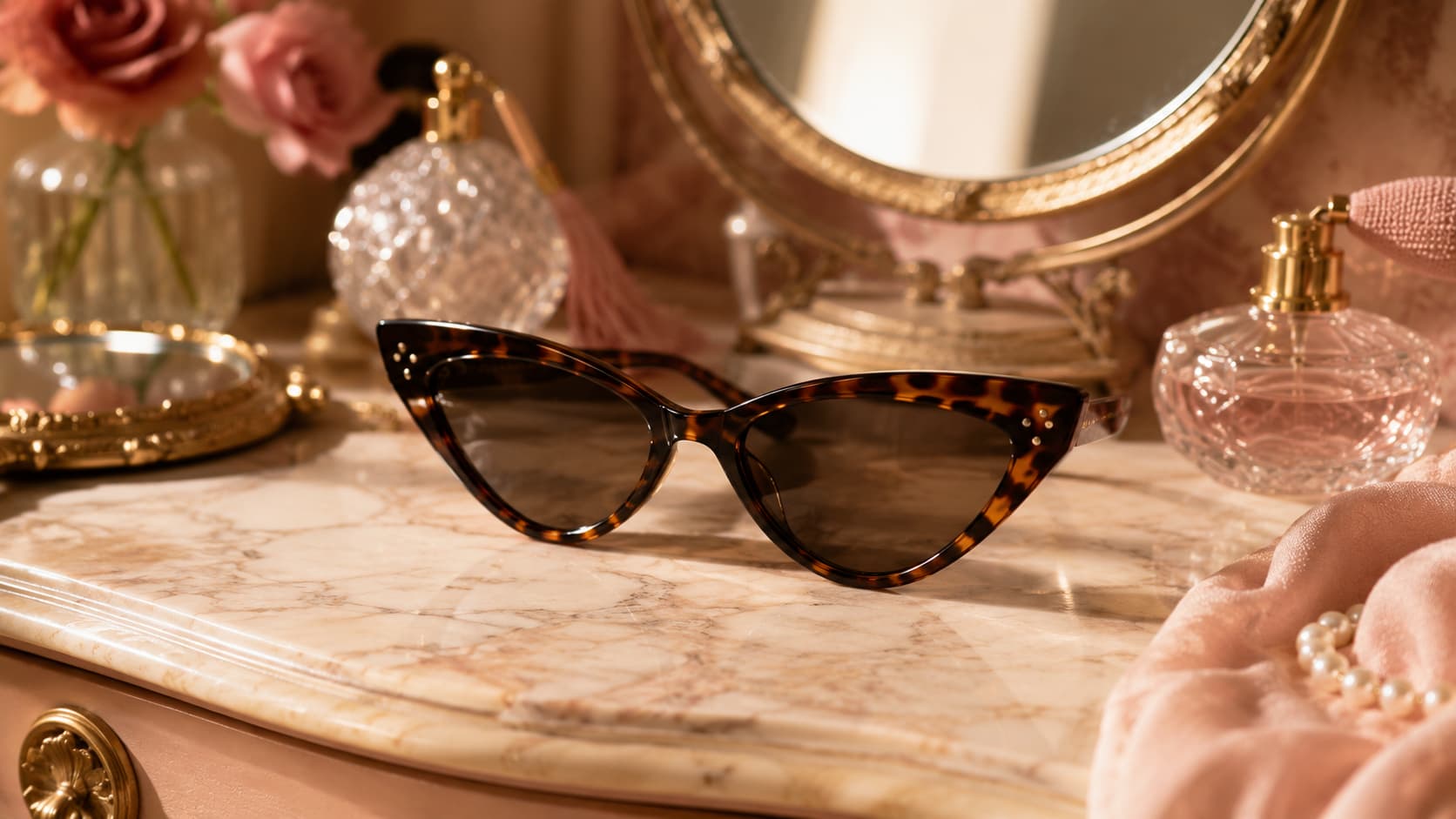
The upswept, pointed corners of cat-eye sunglasses trace back to one specific complaint: a woman named Altina Schinasi walked past an optician’s window in New York and was bored by the identical, rounded, unisex frames on display.
Schinasi was a sculptor and window dresser, not an eyewear engineer, and she based her new design on the dramatic masks worn during Venetian Carnival. She called her creation the “Harlequin” frame, after the character from Italian theater, developing the design in the late 1920s and patenting it in the years that followed. Opticians weren’t interested at first, so she partnered directly with a boutique to get the frames made and sold. By 1939, Vogue and Time magazines had both praised the design, and it slowly caught on with stylish women looking for something less clinical than standard spectacles.
The shape got a boost from fashion itself in the years that followed. Christian Dior’s famous “New Look” of 1947, with its nipped waist and full skirt, paired naturally with the upswept frame, and in 1952 the American Optical company released its own lower-cost cat-eye line designed by fashion designer Claire McCardell, believed to be the first eyewear collection ever created by a clothing designer. That helped push the shape out of boutiques and into everyday department stores.
The shape really exploded in the 1950s, when it became narrower and more pointed, and stars like Marilyn Monroe wore it on screen. It reached even greater fame in the 1960s once Audrey Hepburn wore an oversized version in “Breakfast at Tiffany’s.” Because Schinasi built the frame specifically to be feminine and expressive at a time when eyewear had almost no personality at all, the cat-eye is still shorthand for playful glamour nearly a century later.
The History of Browline and Clubmaster Glasses
Browline frames use a thick band of plastic or acetate across the top, paired with a thin metal rim around the bottom of the lens, so the design draws attention to the eyebrows the same way real eyebrows draw attention to the eyes. That contrast between bold and delicate is what gives the style its serious, intellectual look.
The frame was invented in 1947 by Jack Rohrbach, a vice president at the eyewear company Shuron, and released under the name “Ronsir.” It let wearers mix and match parts, choosing different colors for the top brow and the bottom rim, which was unusual for the time. Browlines became hugely popular through the 1950s and into the 1960s, at one point accounting for roughly half of all eyeglasses sold in the United States. Civil rights leader Malcolm X and U.S. President Lyndon B. Johnson were both frequently photographed wearing the style, which cemented its reputation as the eyewear of serious, thoughtful people.
The style faded in the 1970s as looser, more colorful plastic frames took over, but it came roaring back as sunglasses in the 1980s after actor Bruce Willis wore tinted Ronsirs on the television show “Moonlighting.” Ray-Ban capitalized on the renewed interest by launching its own sunglass version in 1986, calling it the Clubmaster, and that name is now used almost interchangeably with “browline” even though Clubmaster is technically just Ray-Ban’s version of the older design.
The History of Round Sunglasses
Round sunglasses, sometimes nicknamed “teashades” because the tinted lenses resembled the color of steeped tea, are one of the oldest lens shapes in eyewear history, but their modern fame is tied almost entirely to one musician.
Circular wire frames had existed for decades, associated with round “Windsor” style spectacles worn earlier in the century. John Lennon wore thick, dark horn-rimmed glasses in the early Beatles years, similar to the look of 1950s rock and roll performers, but he switched to round wire frames publicly in 1966 while filming the movie “How I Won the War.” The shift was more than cosmetic. The round lenses stood in deliberate contrast to the sharp-angled “Beatlemania” frames that had defined the band’s earlier image, and Lennon kept wearing round glasses, often in tinted versions, for the rest of his life. The look became tangled up with the peace movement and 1960s counterculture, worn by fellow musicians like Mick Jagger and Janis Joplin as the decade went on.
Because Lennon never really abandoned the shape, round sunglasses avoided becoming a one-decade fad. They keep resurfacing with each generation of musicians and artists who want to signal the same free-spirited, anti-establishment attitude Lennon originally represented.
The style’s connection to Lennon still drives real demand decades later. A pair of his round sunglasses, made by the British eyewear brand Oliver Goldsmith, sold at a Sotheby’s auction for well over £100,000 in 2019, a price that reflects how closely this specific frame shape is tied to one person’s identity rather than to a decade or a designer.
The History of Oversized Sunglasses
Oversized sunglasses grew popular for a very practical reason: they let one of the most photographed women in the world walk down a street without being immediately recognized.
Jacqueline Kennedy Onassis began wearing large, round-to-oval sunglasses with dark lenses in the late 1960s, favoring pairs from French designers such as François Pinton and Nina Ricci, and continued the habit through the 1970s. As a former First Lady who was followed constantly by photographers, the oversized shape gave her genuine practical cover for her eyes and part of her face, while also looking effortlessly chic in every photo taken of her. Her frames were typically plastic, in black or tortoiseshell, which made the look easy for other brands to copy at a fraction of the cost.
The style caught on with women who had nothing to do with politics or paparazzi, simply because it looked glamorous and self-assured. By the 1970s, oversized sunglasses in round, octagonal, and square shapes had become a mainstream fashion statement rather than a security measure, worn by everyday people who wanted a slice of that same old-Hollywood mystery. The style has never fully disappeared since, resurfacing every decade or so whenever fashion swings back toward maximalism.
The History of the Persol 649
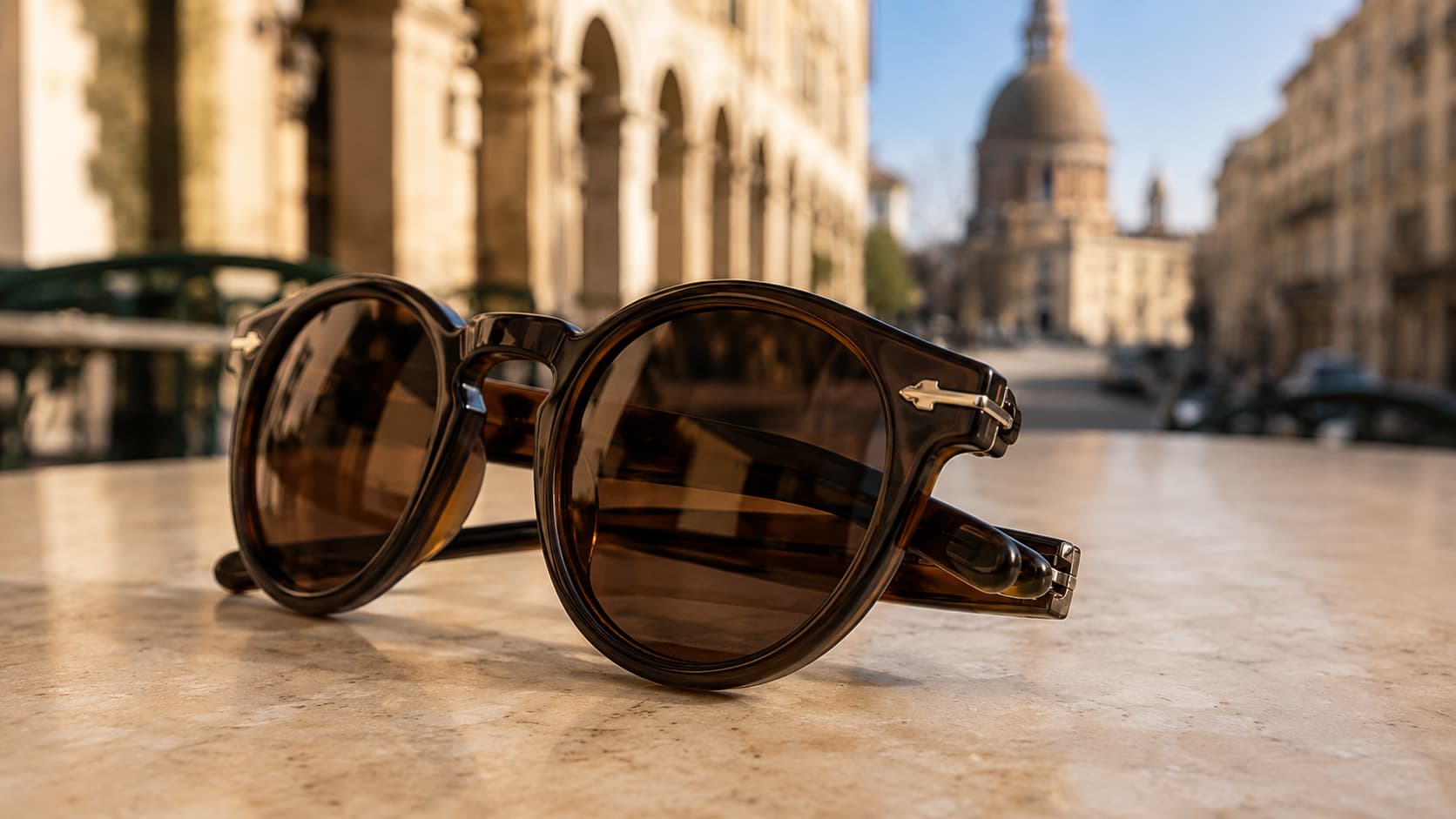
The Persol 649’s rounded, wraparound shape and distinctive arrow-shaped hinge weren’t created for movie stars at all. They were built to stop dust and glare from bothering the tram drivers of Turin, Italy, on their daily routes.
Persol was founded in Turin in 1917 by Giuseppe Ratti, an optician who initially made protective eyewear for pilots and race car drivers. In 1957, the company designed the 649, named after the number of the tram line its earliest wearers drove, with oversized lenses to block dust and a flexible temple system called Meflecto that let the frame adjust to different head shapes without pinching. Those same features, including a signature metal arrow decorating each hinge, are still used on the model today, largely unchanged from the original.
The frame’s leap into fashion came through film. Italian actor Marcello Mastroianni wore the 649 in the 1961 comedy “Divorce Italian Style,” and the style became linked with a specific kind of relaxed, expensive-looking Italian elegance. Its biggest fame boost, though, came from a close relative rather than the 649 itself: a folding version called the 714, which Steve McQueen wore in the 1968 film “The Thomas Crown Affair.” Persol had engineered the 714 as the first folding sunglasses ever produced, a genuinely difficult manufacturing feat that required extra construction steps just so the frame could collapse flat.
Comparing the Seven Iconic Styles
| Style | Decade Introduced | Original Purpose | Most Associated With |
|---|---|---|---|
| Aviator | 1936–1937 | Military pilot eye protection | General Douglas MacArthur, Top Gun |
| Wayfarer | 1952 | Bold, modern alternative to metal frames | James Dean, Bob Dylan |
| Cat-Eye | 1930s (peaked 1950s–60s) | Feminine, expressive eyewear | Marilyn Monroe, Audrey Hepburn |
| Browline / Clubmaster | 1947 (sunglass version 1986) | Customizable, intellectual-looking frames | Malcolm X, LBJ |
| Round / Teashades | 1960s | Counterculture and artistic identity | John Lennon |
| Oversized | Late 1960s | Privacy and glamour for public figures | Jacqueline Kennedy Onassis |
| Persol 649 | 1957 | Protecting tram drivers from dust and glare | Marcello Mastroianni, Steve McQueen |
Frequently Asked Questions
Which sunglasses style is the oldest?
The Aviator has the earliest documented origin among today’s major styles, with its prototype built in 1936 for military pilots, though the cat-eye’s earlier version, the Harlequin frame, was patented by Altina Schinasi in the 1930s as well. Browline frames followed in 1947, and the Persol 649 and Wayfarer arrived within a few years of each other, in 1957 and 1952.
Why do so many iconic sunglasses styles come from Ray-Ban?
Ray-Ban’s parent company, Bausch & Lomb, was one of the few large American optical manufacturers actively developing new eyewear technology and materials in the mid-20th century, including molded plastic and improved metal alloys. That gave the brand a head start on producing several distinct, patentable shapes decades before most competitors had the resources to do the same. Persol followed a similar path in Italy, using its own hinge and frame innovations to create a style just as recognizable.
Are Wayfarers and Clubmasters really different frame styles?
Yes. The Wayfarer is a solid plastic frame with a wide, trapezoid shape, while the Clubmaster is Ray-Ban’s sunglass version of the older browline design, which combines a thick plastic top with a thin metal bottom rim. They’re often confused because both became famous through 1980s product placement, but their construction and silhouette are distinct.
Why did oversized sunglasses become so popular in the 1960s and 70s?
Part of it was practical, since larger lenses gave public figures like Jacqueline Kennedy Onassis genuine visual privacy from photographers, and part of it was simply the era’s love of bold, dramatic accessories. Once the look was associated with her glamour, it spread quickly into mainstream fashion.
Do any of these historic styles still get worn for their original purpose?
Aviators are still issued to and worn by military and commercial pilots today because the wide lens coverage genuinely reduces glare at altitude. The Persol 649 also keeps its original dust-blocking, flexible-hinge design almost unchanged, even though it’s now bought for style rather than tram driving. The other styles, including the Wayfarer, cat-eye, browline, round frame, and oversized shapes, have moved almost entirely into fashion, even though some retain useful features like UV protection from modern lens technology.
Conclusion
Each of these shapes survived for a reason that has little to do with trends. The Aviator solved a real problem for pilots, the Wayfarer proved that plastic could look as sharp as metal, the cat-eye gave women a frame with personality, the browline made eyewear look intelligent, the round frame became a symbol worn by one of the most influential musicians of his generation, the oversized frame turned privacy into glamour, and the Persol 649 showed that a design built for tram drivers could become a byword for Italian elegance. What ties them together is that none were built to chase a passing trend — each was built to solve a specific problem for a specific person, and the wider public simply adopted the solution.