A signet ring looks like a simple band with a flat, engraved top, but it used to do a job that no other piece of jewelry could do: it proved who its wearer was. Long before signatures on paper carried legal weight, a person pressed their ring into warm wax or soft clay to seal a letter, a contract, or a royal order, and that mark alone told everyone the document was real. Today the ring has lost its job as a legal tool, but it has kept its meaning as a symbol of identity, family, and personal style, which is exactly why it has survived thousands of years while so many other ancient objects have not.
Signet Ring Definition and Design
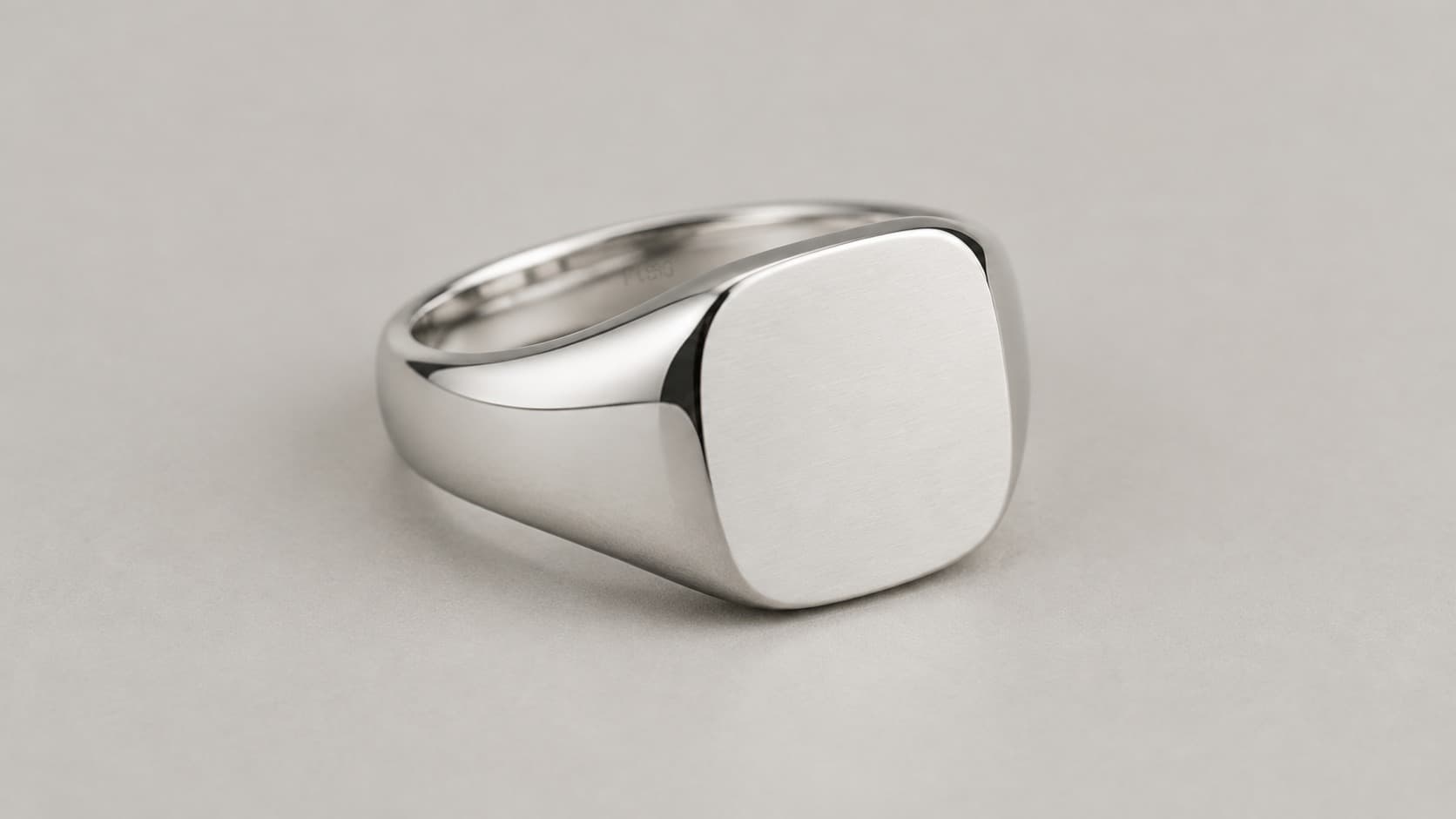
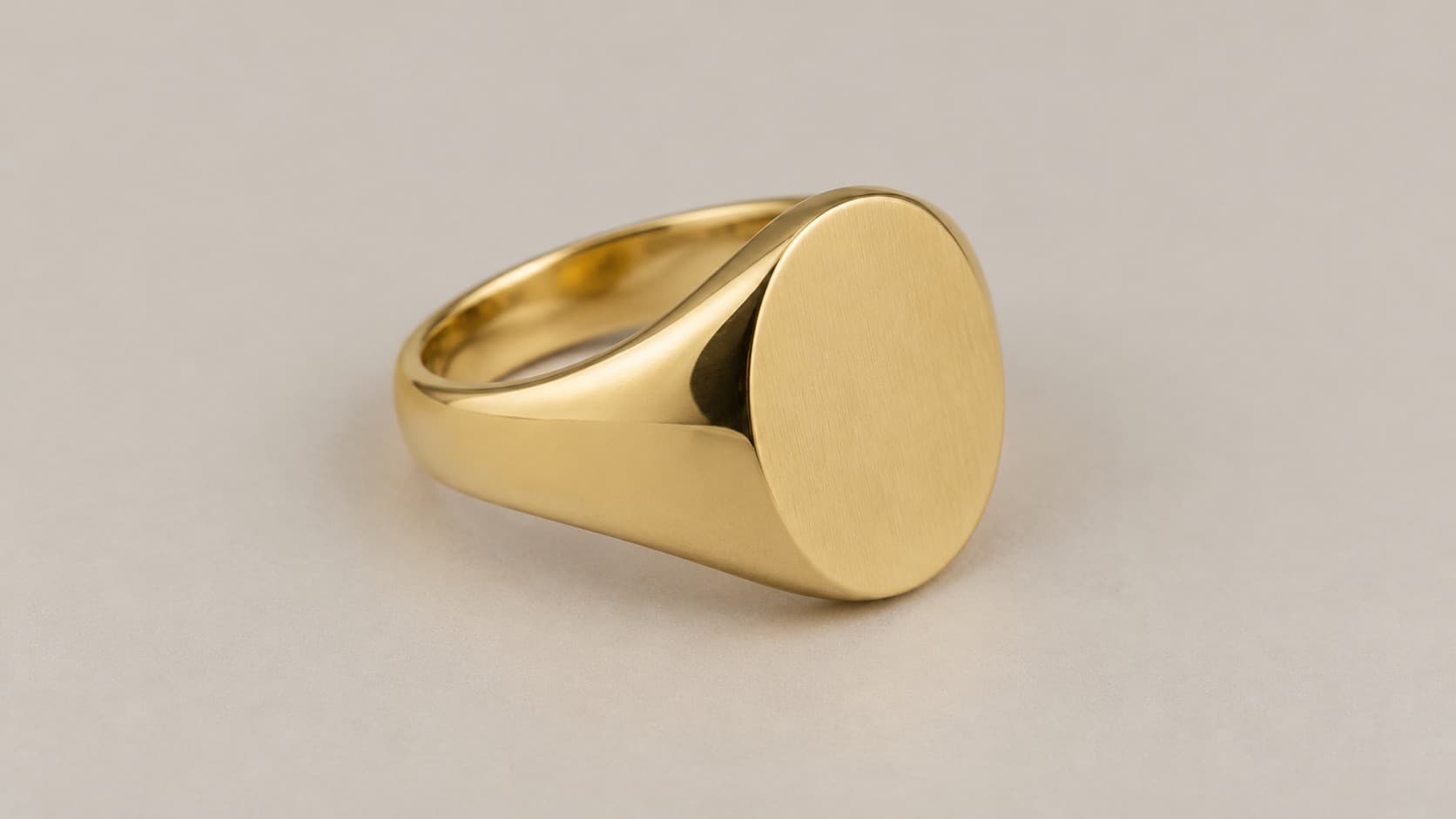
A signet ring is a ring with a flat or slightly raised face, called the bezel, that carries an engraved design such as initials, a family crest, or a symbol. The word “signet” comes from the Latin signum, meaning “sign” or “mark,” and that root reveals the ring’s original purpose: it was built to leave a mark, not just to look good. These rings are also called “seal rings,” the same piece of jewelry described by its job rather than its name.
The engraving on a true signet ring is traditionally cut as an intaglio, meaning the design is carved into the metal rather than raised above it. That groove is what allowed the ring to press a crisp, readable image into hot wax. On an antique signet ring, the letters or crest often appear backward, almost mirror-flipped. That was intentional. A reversed design on the ring produces a correctly readable impression once it is pressed into the wax, the same way a rubber stamp works.
Not every signet-style ring is cut this way today. Many modern pieces use a raised, right-reading design purely for decoration, since most buyers never intend to seal a letter with theirs. Both versions are considered signet rings, but only the reversed intaglio style can actually function as a seal.
The History of Signet Rings
Signet rings started in ancient Mesopotamia around 3500 BC as cylindrical stone seals, long before anyone wore them as rings at all. People in ancient Mesopotamia used small carved cylindrical seals, worn on a cord around the neck or wrist, to roll unique designs into wet clay tablets. This was one of the earliest forms of a personal signature in human history, since most people at the time could not read or write, and a carved symbol was a far more reliable way to prove authorship than a name scrawled by hand.
Ancient Egypt turned that idea into the ring shape recognized today. Egyptians attached the seal directly onto a ring, creating what is considered the first true signet ring, around 2000 BC. Pharaohs and high officials wore these rings as marks of authority, often carved from hardstone or a glazed ceramic called faience, and some bore the names of gods written in hieroglyphics. The scarab beetle was an especially popular design on Egyptian signets, since it represented rebirth and renewal in Egyptian belief.
The Greeks and Romans expanded the tradition further. By around 600 BC the ancient Greeks had adopted the signet ring and turned it into a genuine art form, and Roman citizens, especially wealthy ones, used signets to seal letters and legal documents in wax to protect them from tampering and prove they were genuine. Breaking someone’s seal without permission was treated as a serious offense in Roman society, since it was the equivalent of forging a signature or opening someone’s locked mail.
By the Victorian era, the signet ring had shifted again, becoming a fashion staple for well-dressed gentlemen rather than a strictly functional tool. This period saw a broader revival of Renaissance-style jewelry, and the signet ring fit neatly into that trend, valued as much for its historic character as for anything it could still legally do.
How Signet Rings Were Used to Sign Documents
Signet rings moved from personal items to official legal instruments during the Middle Ages, when kings required them for government business. By the 14th century, important legal documents in England needed a signet ring’s wax impression to count as valid, and King Edward II went further by declaring that all official government paperwork had to carry the seal of the king’s own signet ring. This made owning a signet ring a visible marker of rank. A ring bearing a crest usually meant its owner belonged to a noble or influential family, since commoners rarely held the kind of authority that required a personal seal.
By the 16th century, the style most people picture today, a ring bearing a family crest or coat of arms cut deep enough for a clean wax impression, had become genuinely fashionable rather than purely functional. Some rings from this era even had a rotating bezel, letting the wearer spin the engraved face toward their palm when not in use, both to protect the design from wear and to keep the crest private between uses.
The tradition of an official signet carrying real legal authority survived longest in the Catholic Church. The Pope has worn a ceremonial signet called the Ring of the Fisherman since around the 13th century, engraved with an image representing Saint Peter casting his net. Historically, this ring was used to seal papal documents, and tradition holds that it is rendered unusable after a pope’s death, specifically so that no one could forge official documents in his name during the transition to a new pope. It remains one of the clearest surviving examples of the signet ring’s original purpose: proof of identity that nobody else could fake.
Why Signet Rings Stopped Being Used as Seals
Signet rings stopped working as legal seals once handwritten signatures and standardized paperwork became the accepted way to prove identity. Two inventions pushed this change along: the portable desk seal stamp of the 18th century, which let people stamp documents without needing an engraved ring at all, and the spread of widespread literacy in the 19th century, which made a handwritten signature a faster and equally trustworthy way to sign something. Once a signature on paper carried the same legal weight as a wax seal, the ring’s practical job disappeared.
What didn’t disappear was the emotional weight of the object. Families kept passing signet rings down through generations, not because anyone still needed to seal a letter, but because the ring had become a physical link to ancestors, a small piece of metal that carried a name, a crest, or an initial that meant something to the people who had worn it before.
What Does a Family Crest Mean on a Signet Ring?
A family crest on a signet ring represents a specific family’s identity, history, or achievements, and it is legally tied to that family in countries with heraldic traditions like the United Kingdom. A crest is not simply a decorative logo. In heraldic countries, crests and coats of arms are formally registered and belong to a specific family line, meaning another family’s crest cannot legally be used, however appealing the design.
A family without a registered crest is not shut out of the tradition. Plenty of people choose to have a monogram, a set of initials, or a meaningful symbol engraved instead, and some families start an entirely new tradition from scratch, choosing a design and treating it as their own going forward. In the United Kingdom, it has also become a modern custom in some families to gift a signet ring to a child around their 21st birthday, starting a personal tradition even where no inherited crest exists.
The ring has also found a new audience well outside old aristocratic families. Younger buyers have driven a visible revival of signet rings in recent years, often choosing a single engraved initial or a small personal symbol rather than a crest, which has turned a once narrowly inherited tradition into something closer to a modern style staple.
A signet ring doesn’t need centuries of family history to carry meaning. A ring engraved today, worn for decades, becomes exactly the kind of heirloom a great-grandchild will ask about someday.
Which Finger Should a Signet Ring Go On?
The traditional placement for a signet ring is the little finger, or pinky, of the left hand, though plenty of people today wear them elsewhere. This custom comes from the ring’s original job: wearing the seal on the smallest finger of the non-dominant hand kept it out of the way during everyday tasks, while still letting the wearer turn their hand over quickly to press the ring into wax whenever a document needed sealing.
Left-handed people traditionally reversed this and wore the ring on the right pinky instead, since the goal was always to keep the seal on the hand used less for writing and other work. Winston Churchill, who was left-handed, is often cited as an example of someone who wore his signet on his right hand for exactly this reason.
No modern rule forces one finger over another, and placement today varies by taste and occasion:
- Pinky finger – the most traditional and historically accurate placement, especially for an inherited family crest.
- Ring finger – a common modern choice, though some wearers avoid it to keep that finger free for a wedding or engagement ring.
- Middle finger – a bolder, more visible placement that works well with a larger ring face.
- Index finger – historically associated with authority and leadership, and a striking option for a statement piece.
Regardless of placement, jewelers generally recommend precise sizing rather than a snug or loose fit, since a signet ring sits differently on the hand than a standard band and needs to stay level to display its engraving clearly.
What Metal Is Best for a Signet Ring?
Gold has been the traditional metal for signet rings throughout most of their history, prized for both its status and its resistance to tarnish. Yellow gold remains the classic choice, especially for crest or heraldic designs, because the warm tone has always been associated with the aristocratic roots of the tradition. Rose gold and white gold are modern variations that keep the same shape while offering a different look.
Sterling silver has become a popular, more affordable alternative in recent decades, offering the same style without the cost of solid gold. Silver takes engraving just as well as gold and develops its own character over time, though it does require more frequent polishing to prevent tarnish, which is worth weighing for anyone wanting a low-maintenance piece.
The shape of the bezel also varies. Oval and round faces are the most traditional, closely matching the shapes used on historic wax seals, while modern designs include square, cushion, and even hexagonal bezels for a signet with less of a strictly classic look.
| Metal | Typical Look | Maintenance |
|---|---|---|
| Yellow gold | Classic, warm tone, closest to historic tradition | Low; resists tarnish well |
| White gold | Bright, modern, often rhodium-plated | Moderate; plating may need occasional re-coating |
| Rose gold | Warm pink tone, contemporary twist | Low; resists tarnish well |
| Sterling silver | Bright white, affordable | Higher; needs regular polishing to prevent tarnish |
Engraving quality is worth paying attention to as well. A design cut by hand, directly into solid metal, tends to hold its sharpness longer than a shallow, machine-stamped version, which matters most for a ring meant to be passed down or still seal wax cleanly decades from now.
How to Clean and Maintain a Signet Ring
Signet rings need regular cleaning and occasional professional attention because the flat engraved surface collects dirt, skin oils, and soap residue more easily than a smooth band. A soft-bristled brush, mild soap, and warm water are usually enough for routine cleaning at home. Working the brush gently into the engraved lines, where buildup tends to hide, followed by a thorough rinse and a soft cloth to dry, keeps the design crisp.
Harsh chemicals, chlorine, and abrasive cleaners are best avoided, since these can dull the metal’s finish or, in the case of engraved stone bezels, damage the surface of the stone itself. A ring with an inset gemstone rather than metal engraving is worth checking against that stone’s specific care needs, since some softer stones are more sensitive to heat and chemical exposure than hard metal is.
Because the engraving is the whole point of the ring, deep scratches or significant wear to the design are worth taking to a professional jeweler. A skilled engraver can often re-cut worn lines to restore crispness, which matters most for family crests that need to stay legible for the next person who inherits the ring. For a ring carrying real sentimental or financial value, keeping a record of its appraisal is also worthwhile, since a one-of-a-kind engraved heirloom can be harder to replace or document than a mass-produced piece if it’s ever lost.
Frequently Asked Questions
Do signet rings have to have a family crest?
No. While crests and coats of arms are the historic standard, most signet rings sold today are engraved with initials, monograms, or personal symbols instead. A crest only applies when a family has a formally registered one, which is mainly relevant in countries with active heraldic traditions.
Can women wear signet rings?
Yes. Signet rings were historically worn mostly by men because titles and crests were passed down through male family lines in many cultures, but women have worn them throughout history too, and the style has become widely popular across genders today.
Is a signet ring the same as a class ring or a pinky ring?
Not exactly. A pinky ring simply refers to any ring worn on the little finger, and a signet ring happens to traditionally sit there, but not every pinky ring is a signet. A signet ring is specifically defined by its flat, engraved bezel, regardless of which finger it ends up on.
Can a signet ring still be used to seal wax today?
Yes, as long as the design is cut as a proper intaglio engraving rather than a raised or printed pattern. Many jewelers can still engrave a ring this way on request, and wax sealing kits are widely available for anyone wanting to use a ring the way it was originally intended.
How can someone tell if a signet ring is real gold or silver?
A hallmark stamp on the inside of the band usually settles the question, with numbers indicating karat weight for gold or a sterling stamp for silver. If no mark is visible, a jeweler can test the metal directly.
The Bottom Line
Signet rings have outlived their original purpose by centuries, yet they remain one of the most meaningful pieces of jewelry a person can own. What began as a practical tool for sealing wax in ancient Mesopotamia became a marker of noble rank in medieval Europe, and today it survives as something more personal: a ring that carries initials, a crest, or a symbol chosen specifically to represent the person wearing it. Whether a ring arrives with generations of history behind it or begins a brand new tradition with a fresh design, the engraving on the bezel still does what it always did: marking the ring, and the hand wearing it, as unmistakably its owner’s.