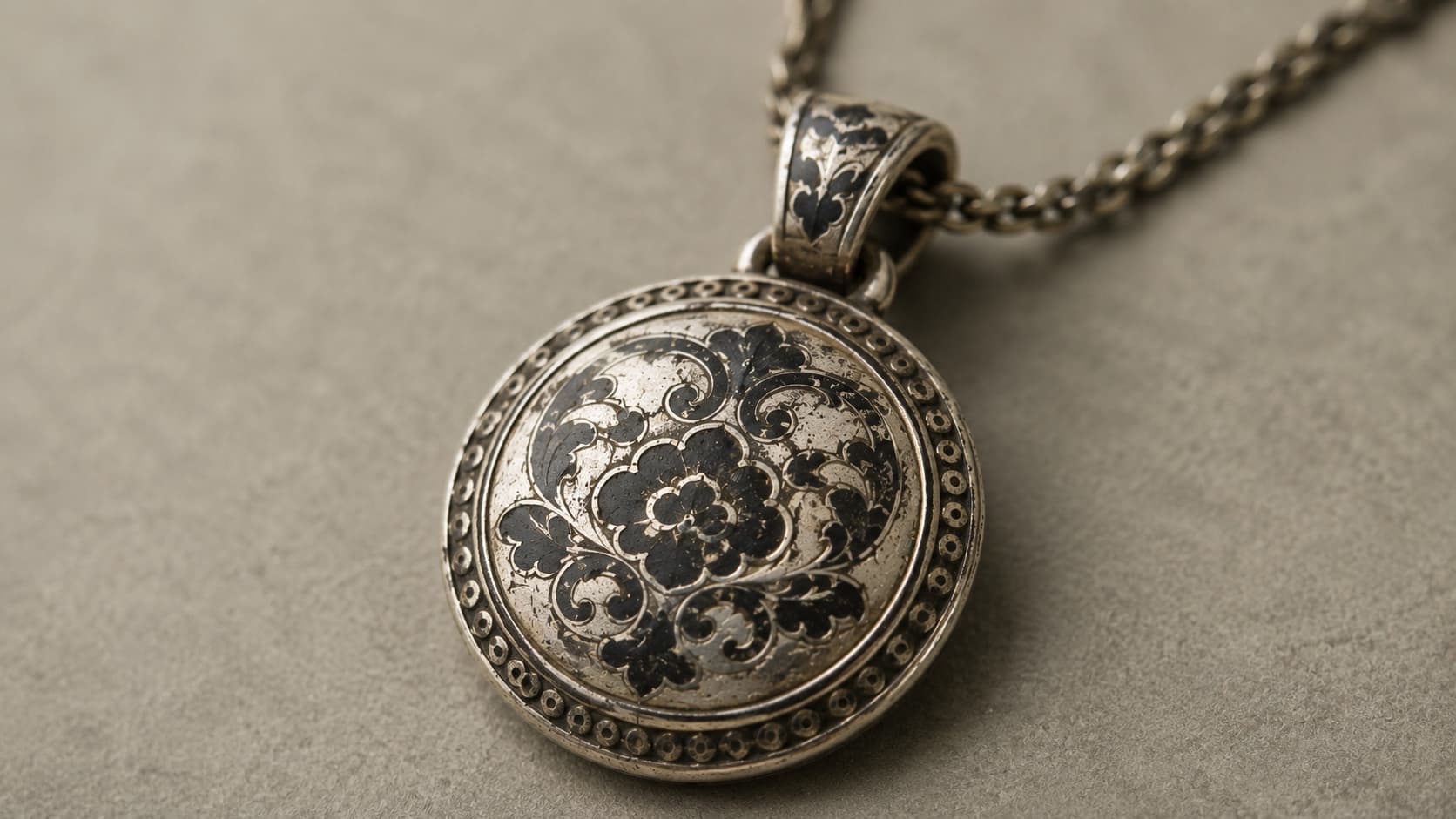
A dark, inky-black design on an old silver ring, spoon, or box is usually the mark of niello. It’s one of the oldest decorating techniques in metalworking, and it’s the reason so many antique silver pieces have that sharp, almost drawn-on look. Understanding what niello actually is helps explain why these pieces have survived for centuries without the black fading or flaking away, and why the technique still shows up in jewelry and silverware today.
What Is Niello?
Niello is a black metal mixture that gets melted into engraved lines cut into silver or gold. It’s usually made from silver, copper, and lead mixed with sulfur, which turns the whole blend jet black once it’s heated. A jeweler cuts a design into the metal first, then packs the niello powder into those cuts and heats the piece until the niello melts and fuses into place.
Once it cools, the surface gets filed and polished smooth, so the black design sits flush with the shiny metal around it. This is different from paint or enamel. Enamel is a kind of glass that sits on top of a surface, while niello is a metal alloy that actually bonds into the metal underneath it. That’s part of why niello holds up so well over hundreds of years — it isn’t just sitting on the surface, it’s locked into it.
As a rule, niello fuses reliably to silver and gold, but it won’t take hold on base metals like copper, brass, or nickel silver — one reason the technique has stayed closely tied to fine silverwork rather than everyday costume pieces.
Where Did Niello Come From?
Niello’s earliest confirmed use dates back to the late Bronze Age, roughly 1500 to 1200 BCE, in the ancient Near East. Archaeologists have traced early examples to the region around modern-day Syria, Mesopotamia, and Anatolia, with the port city of Byblos often mentioned as an early hub for the craft.
From there, the technique spread outward along trade routes. Egyptian and Mycenaean Greek metalworkers picked it up, and it later became well known among the Romans. The Roman writer Pliny the Elder even described a niello recipe in his book Natural History in the first century CE, which tells us the technique was already common and respected by that point.
After the fall of the Roman Empire, niello work continued through the Byzantine Empire and spread across medieval Europe, including into Anglo-Saxon England. A famous example is a ring belonging to King Æthelwulf of Wessex, who ruled in the 800s, which is now kept in the British Museum and still shows niello decoration today. Another well-known Anglo-Saxon piece, the 9th-century Fuller Brooch, also relies on niello to outline its figures, showing how far the technique had traveled from its Near Eastern origins by that point.
Niello also turns up in one of the richest archaeological finds in England: the Sutton Hoo ship burial, dated to the early 7th century. Gold and garnet fittings from that burial, including a belt buckle, use niello-filled details as part of their decoration, which tells historians that the technique was already valued by wealthy patrons in early medieval Britain, long before it became widespread across Europe in later centuries.
How Is Niello Made?
Making niello starts with melting metal and sulfur together to create a dark, brittle alloy that gets ground into a fine powder. The classic mix uses silver, copper, and lead, though the exact ratio has changed a lot depending on the century and country making it. Lead became a common addition sometime in the early medieval period because it made the melted niello flow more smoothly, which let jewelers fill in more detailed and complicated designs. The process itself follows a consistent sequence:
- Engrave the design into a piece of silver or gold using a sharp tool, cutting grooves deep enough to hold the niello.
- Prepare the niello powder by grinding the black metal-sulfur alloy into a fine grain.
- Pack the powder into the engraved grooves.
- Heat the piece until the niello melts and flows into every line of the design.
- Cool, then file and polish the surface so the black niello sits flat and even with the surrounding metal.
Because this takes real skill and a steady hand with heat, niello work has always been considered a specialty within metalworking rather than something every silversmith learned to do. It’s also worth noting that heating lead and sulfur together gives off fumes that are genuinely hazardous to breathe, which is one reason niello is traditionally made by trained metalworkers in ventilated workshops rather than something to try casually at home.
The exact recipe has shifted quite a bit across history, which is part of what makes niello such an interesting material to study. Pliny the Elder’s 1st-century version only used silver and copper melted with sulfur, with no lead at all, and it needed a fairly hot flame to apply. The 12th-century monk Theophilus Presbyter wrote down a clearer formula: roughly twice as much silver as copper, with a smaller portion of lead stirred in at the end. Historians disagree on exactly when lead first entered niello recipes, with some tracing it back to the early medieval period and others placing it closer to the 10th or 11th century, but its effect is well documented: it lowered the melting point of the mixture, letting goldsmiths apply it as a smoother liquid instead of a stiff paste, and lead-based niello eventually became the standard almost everywhere.
Niello Around the World
Niello didn’t stay in one place or one culture — it kept reappearing in different countries over the centuries, each adding its own style. In 15th-century Florence, Italy, the goldsmith Maso Finiguerra became famous for his niello work, and the technique is even credited with helping inspire modern printmaking. Goldsmiths would sometimes take an impression of a niello design in sulfur or on paper before filling it in, and that recording process is thought to have influenced the early development of engraved prints.
Russia developed one of the best-known niello traditions in Europe, centered on the city of Tula, where local goldsmiths revived and refined the craft in the late 1700s. Niello silver from Tula became a recognized regional specialty from that point on and is still associated with the city today. Long before that, the technique was already flourishing further east. Silverwork from the Sasanian Empire in Persia, which ruled from the 3rd to 7th centuries CE, used niello to pick out hunting scenes, animals, and courtly figures on silver bowls and plates, some of which survive in major museum collections today.
Thailand built one of the most enduring niello traditions anywhere in the world, known locally as khrueang thom. The craft took root in the city of Nakhon Si Thammarat in the south of the country, most likely arriving through Persian or Portuguese traders during the Ayutthaya period several centuries ago, and it grew into a highly prized royal craft. Thai kings gifted nielloware to foreign dignitaries for generations, including pieces sent to European royalty and, more recently, to the Smithsonian Institution and the American government. That tradition is still alive today, though it has shrunk considerably, with only a small number of workshops in Nakhon Si Thammarat still practicing it by hand.
How to Tell If Niello Is Real
Real niello sits inside a carved or engraved recess, so it should look and feel flush with the metal around it rather than sitting on top. A gentle fingernail test across the surface often reveals the difference: painted or printed “niello-look” designs tend to feel slightly raised or uneven, while genuine niello feels smooth and level with the rest of the piece.
Another clue is wear patterns. Because niello is metal fused into metal, it wears down evenly over time along with the surrounding silver. Paint or lacquer imitations tend to chip, flake, or peel at the edges instead, especially around areas that get handled a lot, like the inside of a ring or the handle of a spoon. If a black design looks patchy or is missing in odd, uneven spots, that’s usually a sign it isn’t true niello.
It also helps to know what niello isn’t. Oxidized silver, sometimes called “blackened silver,” gets its dark color from a chemical reaction on the surface of the metal itself rather than from an inlaid alloy, so it tends to sit as a thin, even tone across the whole piece rather than as crisp, contained lines. True niello, by contrast, only appears inside the engraved design, with the surrounding silver left bright and polished, which is what creates that sharp black-and-silver contrast niello is known for.
Caring for Niello Jewelry and Silverware
Niello pieces don’t need much special care beyond normal, gentle silver care. A soft cloth and mild soapy water are usually enough to clean dust or tarnish off the surrounding silver without disturbing the niello itself, since it’s fused into the metal rather than sitting loosely on top.
It’s still smart to avoid harsh chemical cleaners, ultrasonic cleaners, and abrasive polishing cloths on niello pieces, especially older or antique ones. Aggressive polishing can slowly wear down the fine detail of the design over time, even though the niello itself is fused in. When in doubt, a light touch and a soft cloth will protect the piece far better than scrubbing.
Frequently Asked Questions
Is niello the same as enamel?
No. Niello is a metal alloy that fuses into engraved metal, while enamel is a type of glass that’s melted onto a surface. Niello has a metallic shine and is much harder and more durable than enamel, which has a glassier, softer look.
What metals does niello work best on?
Niello fuses reliably to silver and gold. It generally won’t bond to base metals like copper, brass, or nickel silver, which is why it’s traditionally associated with fine silver and gold pieces rather than costume jewelry.
Why is niello always black?
Niello turns black because of the sulfur in its recipe. When silver, copper, and lead are combined with sulfur and melted, the resulting metal sulfide compound naturally takes on a deep black color, which is what gives niello its signature look.
Is niello still used today?
Yes. Niello is still actively used in places like Russia and Thailand, where it remains part of regional silversmithing traditions, and individual jewelers and metalsmiths around the world continue to use it in modern pieces.
Does niello wear off over time?
Genuine niello is very durable because it’s fused into the metal rather than sitting on top of it, so it holds up well to normal wear over many years. It can still wear down gradually with heavy polishing or rough handling, which is why gentle cleaning is recommended.
Does niello make a piece more valuable?
Niello decoration can add value to antique or vintage silver, especially when the work is intricate, well-preserved, and tied to a known regional tradition like Tula or Nakhon Si Thammarat nielloware. That said, value depends more on the overall age, condition, craftsmanship, and rarity of a piece than on the presence of niello alone, so it’s just one factor among several rather than an automatic price boost.
Conclusion
Niello has managed to stay relevant for roughly 3,500 years, which says a lot about how well the technique actually works. It survived because fusing black metal directly into engraved silver creates a design that doesn’t chip, fade, or peel the way paint does, and that durability is exactly why so many ancient and antique niello pieces still look sharp today. From a Byzantine ring to a piece of Tula silver to a modern niello pendant, the same basic idea runs through all of it: cut a design into metal, then lock in the contrast permanently.