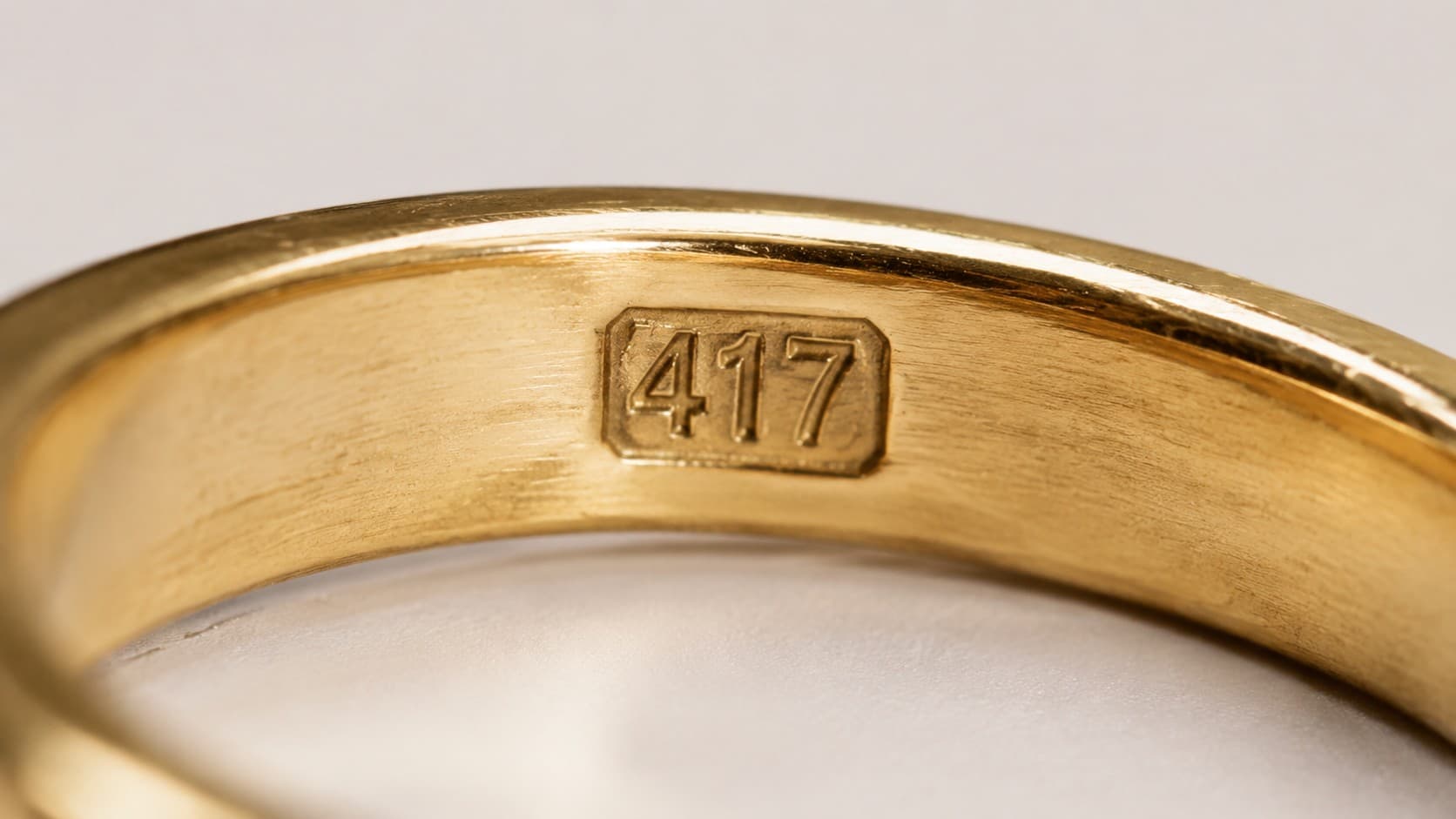
A tiny number stamped inside a gold ring or near a chain’s clasp can look like a secret code, but 417 is one of the most useful pieces of information stamped on any piece of jewelry. It states exactly how much real gold is inside, hints at how the piece will hold up to daily wear, and places it on the price scale relative to other gold jewelry.
What Does 417 Stamp Mean on Gold Jewelry?
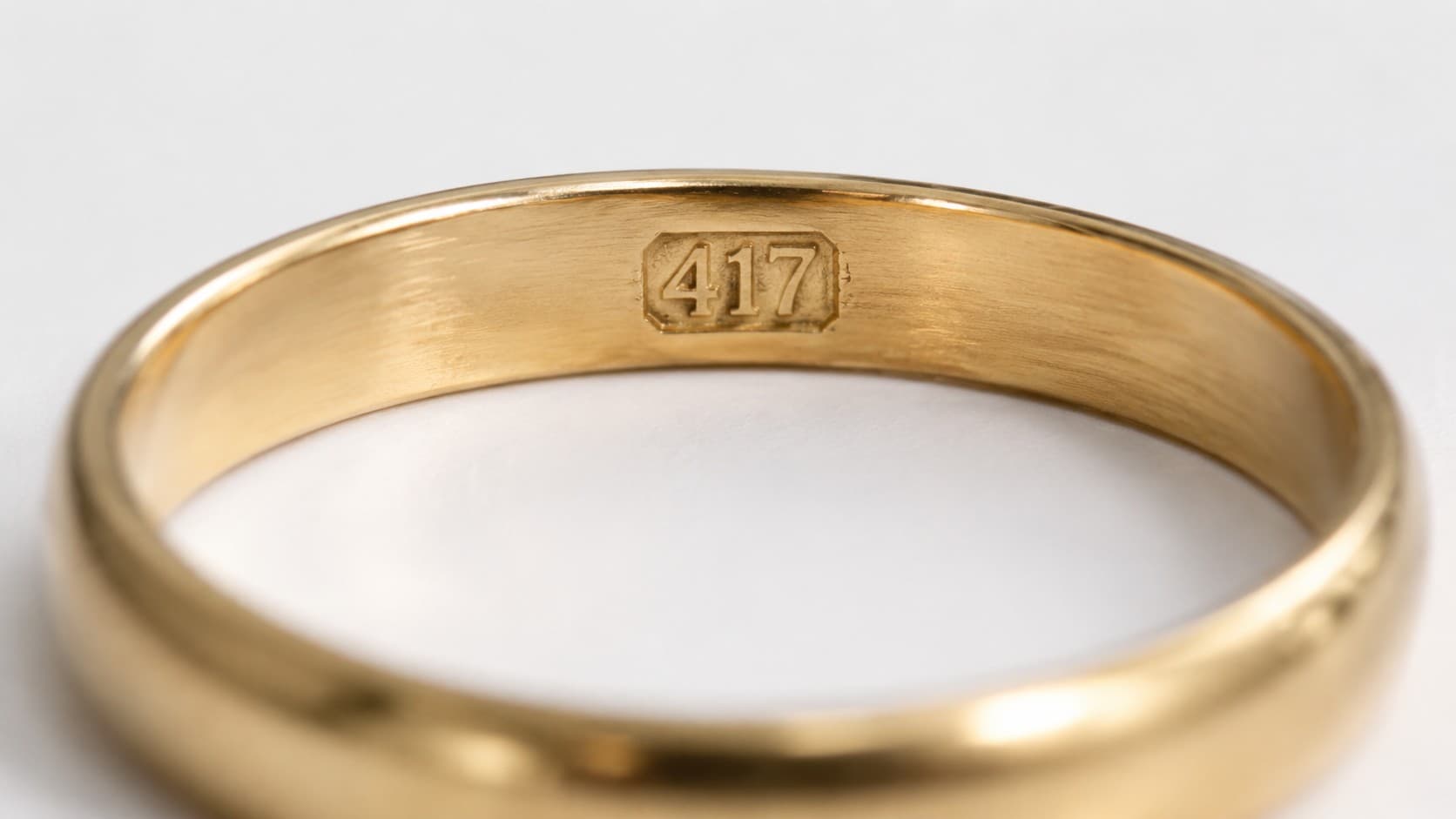
A 417 stamp means the piece is 10 karat gold, made of 41.7% pure gold and 58.3% other metals. The number comes from a system called millesimal fineness, which measures gold purity out of 1,000 parts instead of out of 24 karats. So 417 out of 1,000 parts pure gold works out to the same thing as saying “10 karat.”
This system is popular in Europe and increasingly common on jewelry sold worldwide, because it uses a straightforward percentage instead of the karat scale, which can be confusing without a conversion chart. Under the millesimal system, pure 24 karat gold is stamped 999 (or sometimes 999.9), 18 karat gold is stamped 750, and 14 karat gold is stamped 585. Following that same pattern, 10 karat gold lands at 417. It’s just math: 10 divided by 24, multiplied by 1,000, rounds to 417.
The word “millesimal” comes from the Latin word for “thousand,” which is exactly what the system measures things against. Assay offices, the official bodies that test and certify metal purity, adopted this system because it removes any guesswork. A karat number alone doesn’t convey the precise percentage without a known conversion, while a fineness number like 417 states the exact gold content directly.
Is 417 the Same as 10K Gold?
Yes, 417 and 10K describe the exact same gold content. They are simply two different labeling systems for the same alloy. A piece stamped “417” and a piece stamped “10K” both contain 41.7% pure gold, mixed with 58.3% other metals like copper, silver, or zinc.
Which label appears often depends on where the piece was made. American manufacturers usually stamp jewelry with the karat system, producing marks like “10K” or “10KT.” European and Asian manufacturers more often use the fineness system, so their pieces show “417” instead. Some jewelry carries both stamps side by side. Occasionally a piece shows “416” or “10K P,” where the P stands for plumb, meaning the gold content is precisely 10 out of 24 parts with no rounding down.
Why Isn’t 10K Gold Pure Gold?
Pure gold is too soft to survive everyday wear, so manufacturers mix it with stronger metals to make it durable. On its own, 24 karat gold bends, scratches, and dents from ordinary contact. That softness works fine for a coin sitting in a vault, but it becomes a problem for a ring that knocks against doorknobs and keyboards throughout the day.
To solve this, jewelers blend pure gold with harder metals such as copper, silver, zinc, and sometimes nickel or palladium. The exact blend also determines the final color: more copper pushes the metal toward rose gold, while silver and palladium shift it toward a paler, whiter shade. Because 10 karat gold has the highest percentage of these added metals compared to 14K, 18K, or 24K gold, it ends up as the hardest and most scratch-resistant option among common gold purities.
The recipe changes depending on the color a jeweler is aiming for. A 10K yellow gold mix combines silver and copper in proportions that vary by manufacturer, balanced to keep a warm, familiar gold tone. A 10K white gold mix swaps in nickel, palladium, or zinc to cancel out gold’s natural yellow color, which is also why white gold jewelry is usually finished with a rhodium plating for extra shine. A 10K rose gold mix pushes copper content higher than any other version, often making up close to 40% of the alloy, since copper is what gives rose gold its pink blush.
Lower purity in gold jewelry doesn’t mean lower quality. It’s a deliberate trade-off, sacrificing a portion of pure gold content in exchange for a piece that survives years of daily bumps and scrapes.
Is 417 Gold Real Gold?
Yes, 417 gold is genuine, solid gold all the way through, not a plating or a coating. This point causes confusion because 41.7% can sound low enough to seem fake. But a 417 stamp is a legal declaration of gold content, not a warning sign. It is entirely different from gold-plated or gold-filled jewelry, where only a thin outer layer contains gold and the core is a base metal.
Because it’s solid gold throughout, a 417 piece keeps its gold content even after decades of scratching or wear, since there’s no plating to wear through. That’s also why 10K jewelry can be melted down or refined for its scrap gold value, something that isn’t possible with gold-plated items, which contain barely any actual gold at all.
By law in most countries, a purity stamp like 417 can’t stand alone. It has to appear next to a manufacturer’s trademark, a separate small mark identifying which company made the piece. This pairing exists so that if a stamp ever turns out to be inaccurate, regulators can trace the piece back to whoever produced it. A purity number floating on its own with no maker’s mark nearby is one of the signs jewelers look for when checking whether a stamp might be counterfeit.
Is 417 Gold Durable and Worth It?
417 gold is legitimate, durable jewelry, but it sits at the lower end of the fine gold purity scale. In the United States, the National Stamping Act sets the tolerance for any piece stamped “10K”: its actual gold content can’t fall more than three parts per thousand below the stated fineness, or seven parts per thousand if the piece includes solder. In practice, that means a stamped 10K piece should test out to roughly 41.4% gold at minimum, close to the full 41.7%.
Hallmarking rules in Europe vary by country rather than following a single EU-wide law. Nations such as France, Ireland, and Spain require gold jewelry to be tested and stamped by an official assay office before it can be sold, and a hallmark reading 417 in those countries must meet or exceed that fineness with no shortfall allowed. Other countries, including Germany and Luxembourg, don’t require pre-market hallmarking at all, though the stamped number still has to be accurate under general consumer protection law.
Standards vary further outside Europe. China’s domestic gold market runs largely on much higher purities, commonly 999 or 990, so 10K gold is uncommon there in the first place. Japan sets a comparatively high bar for what can be labeled “gold” in its domestic retail market as well, which keeps 10K largely out of Japanese jewelry counters too. That leaves 10K gold as more of a fixture in markets like the United States, where it has long served as a practical, affordable entry point into solid gold jewelry, even without a strict legal floor forcing it to exist.
Whether 417 gold counts as good quality depends on its intended use, and the comparison against other common purities makes the trade-off clear:
| Stamp | Karat | Pure Gold % | Best For |
|---|---|---|---|
| 417 | 10K | 41.7% | Everyday rings, chains, class rings |
| 585 | 14K | 58.5% | Balanced everyday and dress jewelry |
| 750 | 18K | 75.0% | Fine jewelry, engagement rings |
| 999 | 24K | 99.9% | Bars, coins, investment gold |
For a ring worn every day, the extra durability of 417 gold can matter more than a higher percentage of pure gold. For a special-occasion piece meant to show off a rich, warm gold color, a higher karat like 14K or 18K tends to look and feel more luxurious.
How to Verify a 417 Gold Stamp
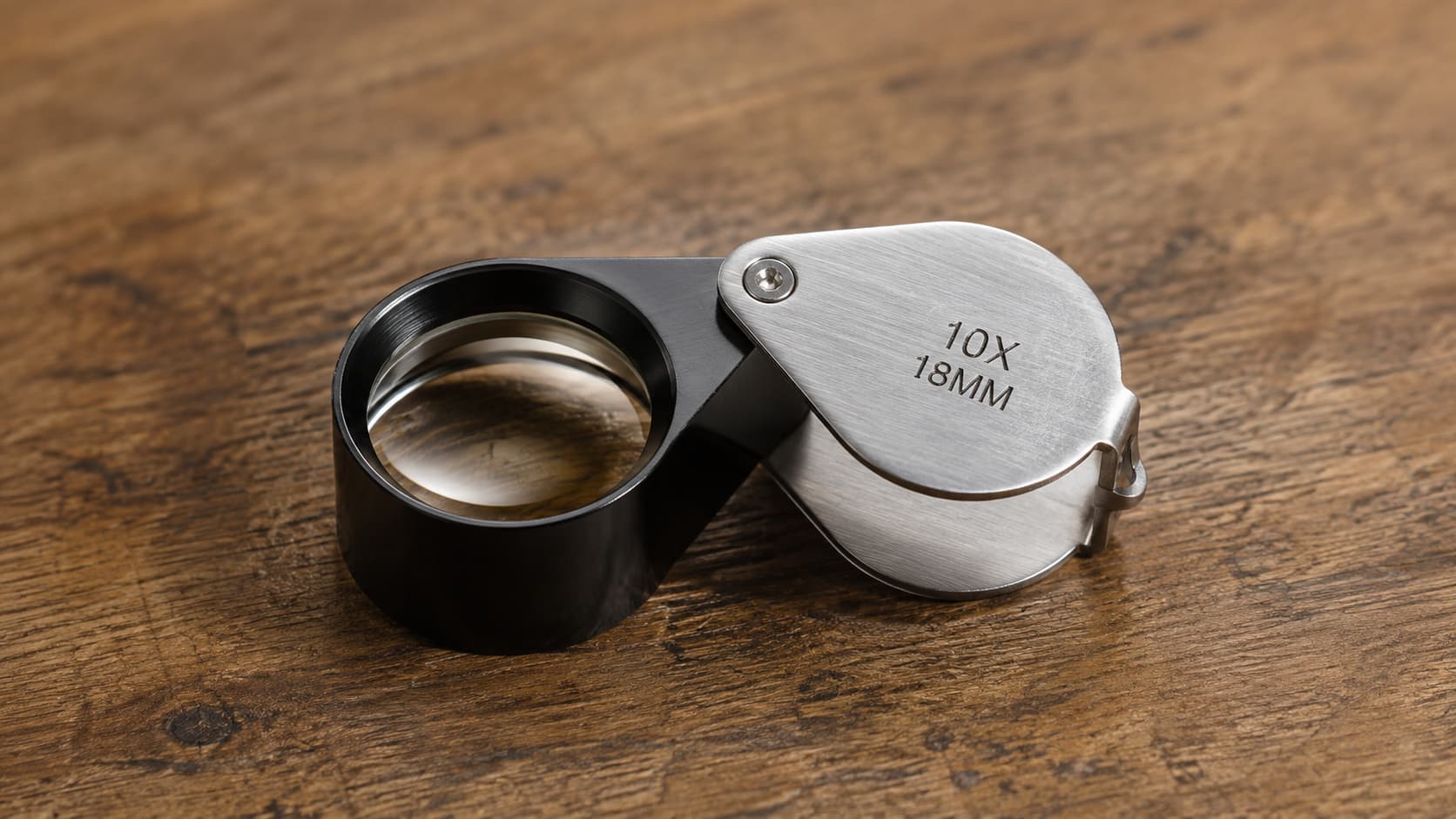
A genuine 417 stamp is crisp, evenly pressed, and placed in a predictable spot: inside the band on a ring, near the clasp or a soldered tag on a necklace or bracelet, and on the post or back of an earring. A blurry, uneven, or oddly placed stamp is a warning sign, and so is a stamp missing the manufacturer’s trademark that’s supposed to sit right beside it.
A simple magnet test offers a quick first check. Real gold, at any karat, is not magnetic, so a piece that clings strongly to a magnet raises doubt about the claimed purity. This test isn’t conclusive on its own, though, since some non-magnetic fake metals exist. Greater certainty comes from a jeweler’s acid test or an XRF scanner, which reads the exact metal composition within seconds without damaging the piece. A professional appraisal remains the most reliable route for a major purchase or an inherited piece with an unclear history.
How to Clean and Care for 417 Gold Jewelry
Mild soap, warm water, and a soft cloth clean 417 gold jewelry effectively without wearing down the metal. Because 10K gold contains a higher percentage of other metals, it tarnishes or shifts color slightly more than higher-karat gold over time, particularly with frequent exposure to lotions, perfume, chlorine, or sweat.
A soft-bristled toothbrush helps work soap into detailed areas like filigree or prongs, and thorough drying afterward prevents water spots. Storing the piece separately from other jewelry, ideally in a soft pouch or a lined box, prevents scratches from harder gemstones or metal edges. A dull piece that doesn’t respond to regular home cleaning can be professionally polished by a jeweler without removing meaningful amounts of gold from the surface.
Chlorine deserves special caution with 10K gold specifically. Because the alloy contains a higher share of metals like copper and silver, chlorine reacts with those metals more aggressively than it would with a higher-karat piece, sometimes weakening the metal’s structure or causing pitting over time. Removing 417 gold jewelry before swimming in a chlorinated pool or using household cleaning products is a simple habit that extends how long the piece looks and holds up.
Frequently Asked Questions
Does 417 mean fake gold?
No, 417 does not mean fake gold. It means the piece is 10 karat gold, containing 41.7% real, pure gold mixed with other metals for strength. It is genuine solid gold, just less concentrated than 14K, 18K, or 24K pieces.
Can 417 gold turn skin green?
It’s possible, depending on the specific alloy and an individual’s skin chemistry. Because 10K gold has a higher percentage of metals like copper mixed in, it carries a slightly higher chance of causing skin discoloration or irritation than higher-karat gold, particularly for sensitive skin.
Is 417 gold worth buying?
417 gold suits anyone wanting an affordable, durable piece for daily wear. It costs less than 14K or 18K gold because it contains less pure gold, and its added hardness makes it a practical choice for rings, chains, and bracelets subject to constant wear.
What’s the difference between 417 and 375 gold?
The difference is pure gold content: 417 is 10 karat gold at 41.7% pure gold, while 375 is 9 karat gold at 37.5% pure gold. Both are legitimate purity levels, but 375 is common in the United Kingdom and contains slightly less gold than 417.
Can a ring stamped 417 be resized?
Yes, jewelers resize 417 gold rings using standard resizing tools and techniques, since it’s a workable solid gold alloy. Its added hardness makes resizing slightly more demanding than with a softer, higher-karat ring, though any experienced jeweler can handle it.
Conclusion
The 417 stamp packs in a surprising amount of information: it confirms the piece is genuine solid gold, states it as 41.7% pure, and signals that it was built to survive daily wear rather than sit in a display case. From a chain to a class ring to a family heirloom, that number explains exactly what the piece is made of, how it compares to other gold purities, and what it takes to keep it looking its best for years to come.