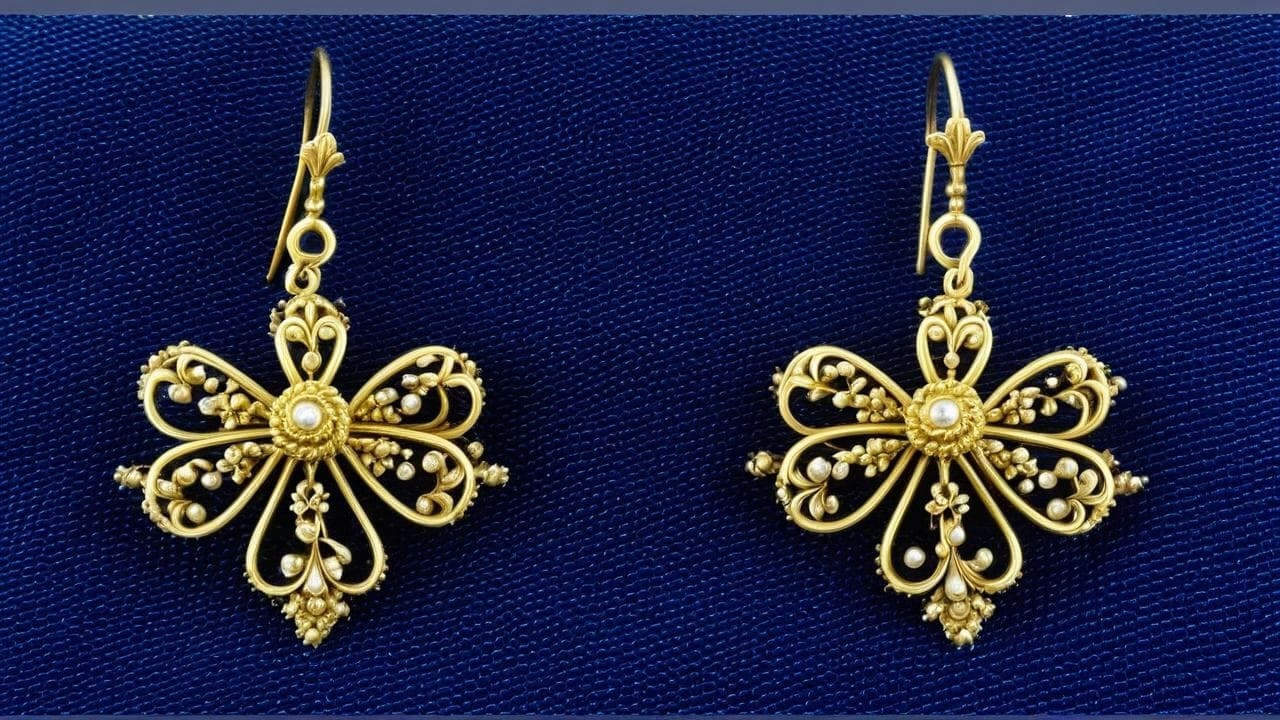
Cannetille represents one of jewelry history’s most extraordinary achievements - a specialized technique that emerged during the early 19th century to address Europe’s post-Napoleonic gold scarcity. This French method transforms minimal precious metal into elaborate, three-dimensional ornaments using exceptionally fine gold or silver wires. Unlike flat filigree work, cannetille creates raised sculptural elements including rosettes, beehives, and pyramids that appear substantial while remaining remarkably lightweight. The technique flourished between 1815-1840 during the Georgian era, when craftspeople created impressive pieces using threads as fine as human hair. Today, authentic cannetille pieces rank among the most sought-after antique jewelry, prized for their technical complexity and rarity.
What is Cannetille Jewelry?
Cannetille transforms thin precious metal wires into stunning three-dimensional jewelry through intricate coiling and layering techniques. This method creates pieces that look substantial and expensive while using surprisingly little actual gold or silver, making it perfect for the metal-scarce period following Europe’s Napoleonic Wars.
- The name comes from French cannetille, which traces back through Italian cannutiglia to the Arabic word qannūṭ, meaning “small tube.” English speakers pronounce it “can-eh-TEEL,” though you’ll sometimes hear “kan-eh-TEEL” as well. This etymology makes sense when you see the technique’s focus on creating tiny tubular coils and dimensional wire elements.
- Jewelers start with gold or silver wire that’s incredibly thin - between 0.25mm to 0.4mm in diameter, which is about as thick as a single strand of fine human hair. They draw the metal through progressively smaller holes to achieve this fineness, requiring frequent heating (called annealing) to keep the wire workable and prevent it from becoming brittle and breaking.
- The magic happens when craftspeople shape these hair-thin wires into signature patterns. They create tight spiral coils that look like miniature beehives, form delicate scrollwork that resembles plant tendrils, craft spider-like rosettes with radiating wire “legs,” and build small pyramids and cone shapes. Each element is carefully soldered in place using different temperature solders to avoid melting previous work.
- Two main construction methods define authentic cannetille work. Thread cannetille uses the finest wires throughout the entire piece, creating extremely lightweight jewelry that seems to defy physics - a large brooch might weigh less than a modern lightweight ring. Plate cannetille starts with a thin sheet metal base and adds the decorative wire elements on top, providing more structural support for larger pieces like necklaces or bracelets.
- Small gold spheres called granulation often accent cannetille work, with some spheres measuring just 0.14mm across - smaller than many grains of sand. These tiny balls require precise temperature control during attachment, as they’ll either fail to stick or completely melt if the heat isn’t exactly right.
- The technique emerged because Europe faced severe precious metal shortages after the Napoleonic Wars ended in 1815. Gold became so expensive that jewelers needed creative ways to make impressive pieces using minimal materials. Cannetille solved this problem perfectly - a necklace that looked like it contained substantial gold might actually use just a fraction of what solid construction would require.
- Master craftspeople needed 3-5 years to learn cannetille properly, and even then, they worked much more slowly than with other techniques. A simple pair of earrings might take 12-22 hours to complete, while an elaborate necklace could require 96 hours or more of concentrated work. This time investment, combined with the specialized skills required, made cannetille jewelry expensive even when using minimal precious metal.
- The art died out almost completely by 1840 when gold discoveries in California and Australia made precious metals abundant again. Once jewelers could afford to use solid gold construction, they abandoned the labor-intensive cannetille method. Today, very few craftspeople possess the skills to create authentic cannetille, making original Georgian pieces irreplaceable artifacts of this brief but brilliant period in jewelry history.
What makes cannetille truly remarkable is how it turned limitation into innovation. During its peak years in the 1820s and 1830s, this technique allowed jewelers to create pieces that satisfied wealthy customers’ desire for impressive jewelry while working within the harsh economic realities of post-war Europe. A cannetille parure (matching jewelry set) could provide all the visual impact of solid gold construction while using perhaps one-tenth the actual metal. This ingenious solution to scarcity created some of the most technically sophisticated jewelry ever made, with construction so complex that modern jewelers often struggle to repair damaged pieces, let alone create new ones using period-accurate methods.
The History of Cannetille: Why This Jewelry Art Disappeared
Cannetille’s story begins well before its famous Georgian peak, with roots stretching back to ancient metalworking traditions and military decorative arts. The technique evolved from practical necessity during one of Europe’s most economically turbulent periods, reaching extraordinary heights of artistry before vanishing almost overnight when economic conditions changed.
- Ancient precedents for wire-based jewelry appear in archaeological finds from Egypt, Greece, and Rome, where craftspeople used gold threads for decorative purposes. However, these early techniques focused primarily on flat applications rather than the three-dimensional sculptural approach that would define true cannetille work centuries later.
- Military embroidery provided the direct inspiration for cannetille’s development. European armies used elaborate gold and silver thread work to decorate uniforms, particularly for officers and ceremonial guards. This passementerie - ornate military trimming - featured many of the same coiling and spiraling techniques that jewelers would later adapt for personal ornaments.
- Catherine the Great’s silver toilet service, created between 1740-1750, shows some of the earliest jewelry applications of proto-cannetille techniques. This Chinese-made set features delicate spider web patterns and raised circular elements that demonstrate the transition from flat wire work to dimensional construction, though it lacks the extreme fineness of later Georgian pieces.
- The Napoleonic Wars (1803-1815) created the economic crisis that made cannetille not just possible but necessary. These conflicts drained European treasuries and disrupted trade routes that supplied precious metals. Gold became so scarce and expensive that traditional solid jewelry construction became financially impossible for all but the wealthiest customers.
- Post-war recovery periods differed significantly across Europe, affecting when and how cannetille appeared in different regions. England began producing cannetille jewelry around 1815-1820, taking advantage of its relatively stable economy and established goldsmithing traditions. France, devastated by war and political upheaval, didn’t embrace the technique until the mid-1820s as the monarchy stabilized under Louis XVIII and Charles X.
- The technique spread rapidly through European jewelry centers once established. Portuguese craftspeople developed their own regional style using higher gold content (19.2 karat) and incorporating turquoise stones. Dutch jewelers integrated religious motifs and folk tradition elements. Central European workshops in areas like Bohemia combined cannetille with locally available garnets and other regional gemstones.
- Peak production occurred between 1825-1835, when European workshops had perfected their techniques and economic conditions still favored minimal-metal construction. During this decade, cannetille appeared in royal collections, wealthy merchant families’ jewelry boxes, and even middle-class aspirational pieces that mimicked aristocratic styles using this cost-effective method.
- The California Gold Rush beginning in 1848, followed by Australian gold discoveries in the 1850s, flooded European markets with precious metal and eliminated the scarcity that made cannetille economically attractive. Jewelers could suddenly afford to return to solid construction methods, which produced more durable pieces and required less specialized labor.
- Changing fashion preferences also contributed to cannetille’s decline. The early Victorian era brought new aesthetic ideals that favored archaeological revival styles, elaborate gemstone settings, and more substantial-looking jewelry. The delicate, ethereal quality of cannetille began to seem outdated compared to the bold, historically-inspired pieces that became fashionable.
- Machine production capabilities emerged during the 1840s-1850s, offering jewelers faster ways to create decorative elements. Stamping, die-cutting, and early mass production techniques could produce ornate jewelry more quickly and cheaply than hand-formed cannetille, making the traditional craft economically obsolete.
- Regional production continued sporadically after the main period ended. Portuguese workshops maintained cannetille traditions well into the 20th century, with documented pieces created as late as 1984. These later pieces often mixed traditional techniques with modern materials and construction methods, creating hybrid styles that reflected changing times while preserving ancestral skills.
The rapid rise and fall of cannetille reflects how dramatically economic and technological changes can affect artistic traditions. What began as an ingenious solution to metal scarcity became a symbol of extraordinary craftsmanship, only to disappear when the original problem no longer existed. This brief flowering created a distinct chapter in jewelry history - one where limitation sparked innovation and scarcity produced some of the most technically sophisticated ornaments ever created. The technique’s disappearance was so complete that by 1900, many jewelers had no idea how authentic Georgian cannetille was made, contributing to the mystery and value that surrounds these pieces today.
How Cannetille is Made: Step-by-Step Georgian Techniques
Creating cannetille jewelry demands a level of precision and patience that few modern craftspeople can imagine. The process transforms precious metal from thick wire stock into hair-thin threads, then shapes these delicate materials into complex three-dimensional sculptures using techniques that require years to master.
- Wire preparation begins with solid gold or silver rods about 1mm in diameter, which craftspeople must reduce to the final working thickness of 0.25-0.4mm through a labor-intensive drawing process. They use a drawplate - a steel tool with graduated holes - pulling the metal through progressively smaller openings while maintaining consistent tension to avoid breaking the increasingly fragile wire.
- Annealing becomes critical during wire preparation because repeated drawing work-hardens the metal, making it brittle and prone to snapping. Craftspeople must heat the wire to specific temperatures (around 1200°F for gold) at regular intervals, then allow controlled cooling to restore malleability. This heating and cooling cycle might be repeated 15-20 times to achieve the final wire gauge.
- Tool requirements for cannetille work far exceed typical jewelry making needs. Essential implements include round-nose pliers for forming perfect circles, chain-nose pliers for gripping without marking, flat-nose pliers for angular work, and bent-nose pliers for reaching into tight spaces. Specialized mandrels in various sizes create consistent coil diameters, while micro-shear flush cutters ensure clean wire ends that solder properly.
- Coiling techniques form the heart of cannetille’s visual appeal. Craftspeople wrap wire around mandrels to create tight, spring-like spirals, then carefully remove and shape these coils into beehive forms, rosettes, and scroll patterns. The wire tension must remain perfectly consistent - too loose and the coils look sloppy, too tight and the wire breaks or creates uneven spacing.
- Rosette formation requires wrapping wire in expanding spirals, starting from a tight center point and gradually increasing the diameter while maintaining even spacing between wraps. The craftsperson must calculate the total wire length needed before beginning, as joining additional wire mid-rosette creates weak points that often fail during soldering or wear.
- Pyramid and cone construction involves creating wire frameworks, then filling these armatures with additional coiled elements. The base structure provides stability while the decorative fill work creates the visual texture and dimensional depth. Each layer must be planned carefully since accessing interior elements becomes impossible once outer layers are soldered in place.
- Granulation work adds textural contrast through tiny gold spheres as small as 0.14mm diameter. Creating these spheres requires heating small gold fragments until surface tension forms them into perfect balls, then sorting by size and storing carefully since they’re easily lost. Attaching granulation demands precise temperature control - the heat must be high enough to fuse the spheres but low enough to avoid melting them completely.
- Multi-stage soldering represents cannetille’s most challenging technical aspect. Craftspeople use hard solder (melting at about 1450°F) for initial structural joints, medium solder (1390°F) for secondary connections, and easy solder (1325°F) for final detail work. Each subsequent soldering operation must use lower-temperature solder to avoid melting previous joints.
- Assembly sequences require careful planning since some areas become inaccessible once other elements are attached. Experienced craftspeople create detailed mental maps of their soldering sequence, identifying which joints need completion before others can begin. Mistakes at this stage often require dismantling significant portions of completed work.
- Quality control during construction involves constant checking for proper wire tension, clean solder joints, and structural integrity. Cannetille’s delicate nature means that problems caught early can usually be fixed, while issues discovered late in the process might require starting over completely.
- Time investments vary dramatically based on piece complexity and craftsperson skill level. Simple items like basic rings require 12-22 hours of concentrated work, while moderate pieces such as elaborate brooches need 28-48 hours. Complex items like ornate necklaces demand 48-96 hours of effort, with master craftspeople working 2-3 times faster than apprentices.
- Finishing work includes careful cleaning to remove flux residues, polishing to achieve proper surface luster, and final inspection for structural soundness. The cleaning process must be gentle enough to avoid damaging delicate wire work while thorough enough to remove all soldering traces that would tarnish over time.
The extraordinary skill requirements explain why cannetille masters commanded premium prices for their work and why the technique died out so completely when economic conditions changed. Modern jewelers often express amazement at Georgian craftspeople’s abilities, noting that contemporary tools and techniques still struggle to match the precision and durability achieved by 19th-century artisans working with far more primitive equipment. This technical mastery, combined with the artistic vision required to design complex three-dimensional compositions, places cannetille among the highest achievements in decorative metalworking history.
Types of Cannetille Jewelry: English vs French Styles
Regional preferences and historical periods created distinct variations in cannetille work, with each area developing characteristic motifs, construction methods, and aesthetic approaches that help modern collectors identify pieces and trace their origins. The differences reflect local tastes, available materials, and cultural influences that shaped jewelry design during the technique’s peak years.
- Georgian English cannetille (1815-1830) favored architectural and geometric elements that reflected the period’s neoclassical aesthetic influences. English craftspeople specialized in creating pyramids, cones, and structured forms with mathematical precision, often incorporating these elements into rigid compositional arrangements that emphasized symmetry and order rather than organic flowing designs.
- English pieces frequently incorporated rubies set in closed-back settings specifically designed to enhance their appearance under candlelight, which was the primary lighting in wealthy homes during this period. These garnets and rubies were often table-cut or rose-cut rather than the brilliant cuts that became popular later, creating a softer, more diffused light reflection that complemented cannetille’s delicate wire work.
- French cannetille emphasized naturalistic and romantic motifs that aligned with the Romantic movement’s aesthetic philosophy, which celebrated emotion, nature, and individual expression over rigid classical forms. French craftspeople excelled at creating flowing vine patterns, delicate leaf forms, and organic spirals that seemed to grow naturally rather than being mechanically constructed.
- French workshops maintained superior hallmarking practices compared to other regions, consistently stamping their pieces with maker’s marks, gold content indicators, and often date codes that allow precise dating today. This documentation makes French cannetille particularly valuable to collectors who can establish clear provenance and authenticity through official markings.
- Portuguese cannetille developed unique characteristics including consistently higher gold content, typically using 19.2-karat gold marked as “800” rather than the lower karat weights common elsewhere. Portuguese pieces also featured extensive use of turquoise cabochons, often in elaborate clusters that created striking color contrasts against the yellow gold wire work.
- Portuguese production continued far longer than other regions, with documented authentic pieces created as late as 1984, though these later examples often mixed traditional techniques with modern materials and construction methods. This extended timeline means collectors must be particularly careful when evaluating Portuguese pieces, as 20th-century examples lack the historical significance of true Georgian work.
- Dutch cannetille integrated religious symbolism and folk tradition elements, particularly cross pendants and motifs related to traditional costume jewelry worn in various regional celebrations. Dutch pieces often appeared as part of larger traditional dress ensembles, serving both decorative and cultural identity functions within specific communities.
- Central European variations incorporated locally available gemstones, particularly the famous Bohemian garnets from Turnau (now in the Czech Republic), along with turquoise and opals that reflected the region’s position along historical trade routes. These pieces often combined cannetille techniques with other regional specialties like garnet cluster work and enamel decoration.
- German states produced cannetille that reflected the period’s philosophical movements, particularly the ideas of figures like Goethe and Novalis who celebrated authentic historical traditions over contemporary industrial developments. This intellectual influence created pieces with deliberate archaeological references and historical motif revivals.
- Early Victorian evolution (post-1837) saw cannetille techniques adapting to new fashion preferences, often combining with micro-mosaic work, shell cameos, and Greek key patterns that reflected the period’s archaeological revival enthusiasm. These hybrid pieces maintained cannetille’s technical precision while incorporating the bolder, more substantial aesthetic that Victorian tastes demanded.
- Construction quality variations emerged based on intended market and regional capabilities. Thread cannetille represented the finest and most expensive category, using hair-thin wires throughout and creating extremely lightweight pieces that seemed to defy their substantial appearance. Plate cannetille served middle-market customers, using sheet metal bases with applied wire decoration that reduced labor costs while maintaining visual appeal.
- Motif combinations varied significantly between regions and periods. English pieces might combine pyramids with geometric coil work in rigid patterns, while French examples integrated flowing scrollwork with naturalistic granulation arrangements. Portuguese pieces often featured repetitive turquoise clusters with surrounding wire halos, creating distinctive color and texture combinations.
- Size preferences reflected both practical and aesthetic considerations. English cannetille often appeared in substantial parures (matching sets) designed for formal court presentation, while French pieces included more intimate items like delicate brooches and hair ornaments suited to salon society. Portuguese examples ranged from substantial regional costume pieces to delicate personal ornaments.
These stylistic variations create a rich taxonomy that helps collectors, dealers, and historians trace cannetille’s development across Europe during its brief but brilliant flowering. The differences also explain why certain regional styles command higher prices today - English and French pieces generally bring premium prices due to their superior documentation and association with major historical events, while Portuguese and Central European examples offer collectors opportunities to acquire authentic period pieces at more accessible price points. The diversity within cannetille work demonstrates how a single technical innovation could be adapted to serve vastly different cultural needs and aesthetic preferences across the complex social landscape of early 19th-century Europe.
Cannetille vs Other Wire Jewelry: How to Tell Them Apart
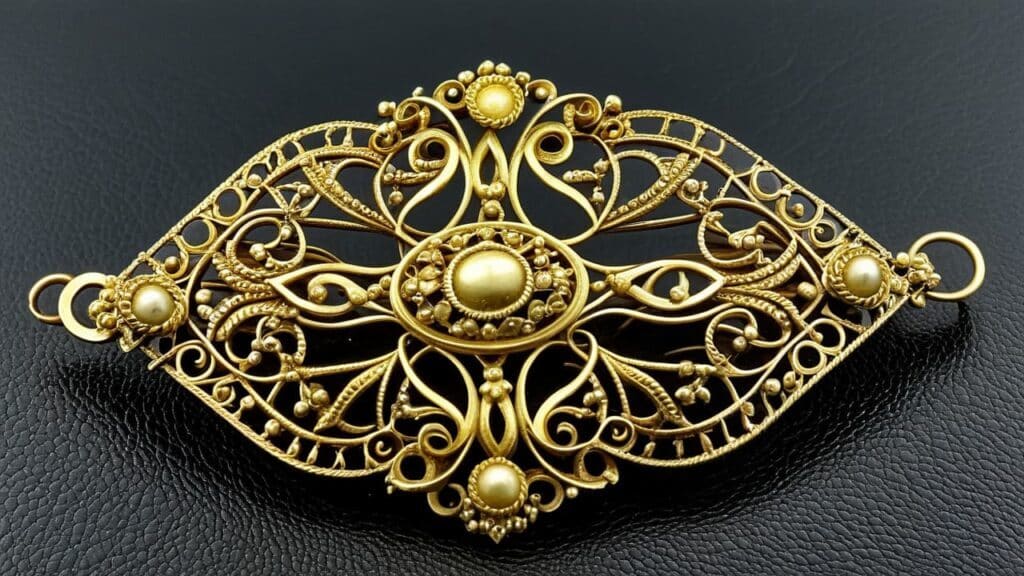
Distinguishing cannetille from related metalworking techniques prevents costly collecting mistakes and helps appreciate the unique characteristics that make authentic pieces so valuable. While several methods share superficial similarities with cannetille, each has distinct construction approaches, visual qualities, and historical contexts that trained observers can identify.
- Filigree work represents the technique most commonly confused with cannetille, but fundamental construction differences separate these methods clearly. Filigree creates primarily flat, two-dimensional patterns using fine wires that form lace-like designs, while cannetille builds three-dimensional sculptural elements that project significantly from base surfaces. Filigree wires typically remain in single planes even when forming enclosed spaces, whereas cannetille deliberately layers multiple wire levels to achieve depth and shadow effects.
- Visual depth assessment provides reliable differentiation between filigree and cannetille when examining pieces directly. Filigree patterns appear consistent when viewed from different angles, maintaining their flat character regardless of lighting direction. Cannetille pieces change dramatically as viewing angles shift, with raised elements creating varying shadow patterns and background details appearing and disappearing behind foreground structures.
- Granulation technique frequently appears within cannetille pieces but represents an entirely different skill set with ancient origins tracing to Etruscan and Roman periods. Granulation focuses on applying tiny gold spheres to surfaces through specialized soldering that avoids traditional flux materials. When granulation appears in cannetille work, it serves as accent decoration rather than the primary construction method.
- Modern wire jewelry differs fundamentally in design philosophy, material properties, and construction goals from historical cannetille. Contemporary wire work emphasizes artistic expression using readily available materials, often incorporating non-precious metals, colored wires, and unconventional forms that would have been impossible or economically impractical during the 1820s-1830s period.
- Machine production capabilities create superficially similar appearances through die-stamping, casting, and mechanical forming processes that can mimic cannetille’s dimensional qualities. However, machine-made pieces lack the subtle irregularities and organic flow patterns that hand construction naturally creates, displaying instead the mathematical precision and perfect repeatability of mechanical production.
- Repoussé and chasing techniques produce raised metalwork through hammering from reverse sides and surface detailing, creating dimensional effects that might resemble cannetille from distance. Close examination reveals fundamental differences - repoussé work shows hammer marks and surface displacement patterns, while cannetille displays wire construction evidence and soldering joints throughout.
- Casting methods can reproduce cannetille appearances but fail detailed technical examination through porosity evidence, flow marks from molten metal, and uniform material density that differs from genuine wire construction. Cast reproductions also lack the material conservation evidence that authentic pieces display, showing consistent metal distribution rather than the economical construction logic of original work.
- Electroforming represents a modern technique capable of creating extremely lightweight dimensional jewelry that mimics cannetille’s weight characteristics. However, electroformed pieces display different surface textures, lack proper soldering joint evidence, and often show contemporary material compositions that didn’t exist during the Georgian period.
- Ottoman and Middle Eastern wire work traditions share some technical similarities with European cannetille but developed different aesthetic approaches and construction priorities. These regional techniques often emphasize different motif types, use alternative metal alloys, and integrate cultural symbols that help distinguish them from European Georgian production.
- Victorian archaeological revival jewelry incorporated cannetille-inspired elements but combined them with other techniques like micro-mosaic, enamel work, and machine-produced components. These hybrid pieces might include authentic cannetille sections alongside contemporary additions, requiring careful analysis to determine which elements represent original Georgian work.
- Contemporary studio jewelry sometimes attempts cannetille recreation but rarely achieves period-accurate results due to different economic pressures, available tools, and artistic goals. Modern craftspeople working in cannetille styles typically emphasize personal expression over historical accuracy, creating pieces that honor the tradition while clearly reflecting contemporary sensibilities.
- Repair and restoration work can complicate technique identification when period pieces receive later additions or modifications. Victorian-era repairs might add non-cannetille elements to damaged Georgian pieces, while modern restoration attempts sometimes introduce contemporary materials and construction methods that create confusing mixed evidence.
- Regional variation boundaries sometimes blur technique distinctions, as craftspeople in different areas adapted cannetille methods to local traditions and preferences. Portuguese cannetille, for example, incorporates construction approaches that differ significantly from English examples while remaining authentically within the cannetille tradition.
- Documentation challenges arise when auction catalogs, dealer descriptions, or previous attributions incorrectly identify piece techniques. These attribution errors can persist for decades, creating false market expectations and complicating accurate identification for future collectors and researchers.
- Price differential analysis reveals how technique identification affects market values, as authentic cannetille commands significantly higher prices than filigree, modern wire work, or machine-made alternatives. Proper identification protects collectors from overpaying for similar-appearing but less valuable techniques while ensuring appropriate appreciation for genuine Georgian craftsmanship.
The complexity of distinguishing cannetille from related techniques reflects both the sophistication of period craftsmanship and the challenges facing modern collectors in an increasingly sophisticated reproduction market. Successful identification requires combining visual analysis, technical knowledge, historical context, and often professional consultation to reach reliable conclusions. The investment in proper authentication proves worthwhile given the significant value differences between authentic cannetille and superficially similar alternatives.
How to Identify Real Cannetille Jewelry
Distinguishing genuine Georgian cannetille from modern reproductions requires careful examination of construction details, materials, and craftsmanship characteristics that reflect the specific tools, techniques, and economic conditions of the early 19th century. Contemporary reproductions can fool even experienced dealers, making systematic authentication knowledge essential for collectors.
- Authentic cannetille displays three-dimensional raised elements that create genuine depth and shadow play when viewed from different angles. The wire work builds up in multiple layers, with background elements clearly separated from foreground details. Modern reproductions often lack this dimensional quality, appearing flatter despite attempts to mimic the raised appearance through surface texturing or shallow embossing.
- Wire quality provides crucial authentication evidence, as genuine Georgian pieces show subtle irregularities consistent with hand-drawn wire production. Authentic wire displays slight variations in thickness, occasional tiny surface marks from drawplate passage, and the soft, slightly rounded profile created by period tools. Machine-drawn modern wire appears perfectly uniform with sharp, precise edges that never existed in the 1820s-1830s.
- Hand-formed coils in authentic pieces show tiny imperfections that prove human craftsmanship - slightly uneven spacing between wraps, minor variations in coil diameter, and organic flow patterns that skilled hands naturally create. Machine-made reproductions display mechanical precision with perfectly uniform spacing and mathematically exact proportions that would have been impossible for period craftspeople to achieve consistently.
- Soldering quality differs dramatically between authentic and reproduction pieces. Georgian craftspeople used flux materials and techniques that left characteristic microscopic traces visible under magnification, while their multi-stage soldering approach created subtle color variations in joint areas as different temperature solders aged differently over 200 years.
- Surface patina development on authentic pieces reflects two centuries of wear, storage, and environmental exposure. Genuine patina appears in protected areas like wire intersections and behind raised elements, while high-contact surfaces show natural polishing from handling. Artificial aging on reproductions often appears too uniform or shows modern chemical treatments that create unnatural color patterns.
- Hallmarking patterns contradict many collector expectations, as most authentic Georgian cannetille carries no maker’s marks or official stamps. Gold assaying wasn’t consistently enforced until much later in the 19th century, making unmarked pieces completely normal for the 1820s-1830s period. Modern reproductions sometimes include fake period-style marks that actually prove recent manufacture.
- Gemstone characteristics reflect period cutting and setting techniques that modern reproduction makers often overlook. Authentic pieces feature rose-cuts, table-cuts, and irregular cabochons that show hand-polishing marks under magnification. The stones sit in closed-back settings designed for candlelight enhancement, often with thin foil backing that creates specific optical effects impossible to replicate with modern lighting expectations.
- Weight relationships provide reliable authentication clues, as authentic cannetille achieves remarkable lightness relative to visual mass - precisely the economic goal during gold scarcity periods. Reproduction pieces often feel heavier because modern makers don’t understand or replicate the extreme material conservation that drove original construction methods.
- Construction logic reflects period economic constraints that reproduction makers rarely consider. Authentic pieces show evidence of material conservation - wire joints positioned to minimize waste, reuse of gold fragments in granulation work, and structural compromises that genuine craftspeople made to stretch expensive materials as far as possible.
- Tool marks from period equipment remain visible under careful examination, including drawplate scratches on wire surfaces, mandrel impressions in coiled elements, and file marks from finishing work using 19th-century tools. Modern reproductions show contemporary tool marks that experienced authenticators can distinguish through comparative analysis.
- Reproduction source identification has become critical as high-quality fakes from Turkey and the UK challenge even expert authenticators. Turkish reproductions often feature slightly different gold alloy colors and construction sequences that differ from European period practices. UK reproductions sometimes achieve better visual accuracy but fail technical examination through modern materials and tool evidence.
- Condition factors affect authentication since genuine pieces show 200 years of natural aging, repair evidence, and period storage effects. Original pieces might have period repair work visible through different solder types or replacement elements that used contemporary materials. Reproductions lack this historical layering, appearing artificially pristine or showing modern aging techniques.
- Documentation gaps actually support authenticity in many cases, as period record-keeping was minimal for personal jewelry. The absence of original boxes, certificates, or detailed provenance often indicates genuine age, since comprehensive documentation systems didn’t exist during cannetille’s peak production years.
- Regional construction characteristics help narrow attribution possibilities, as English pieces display different structural approaches than French or Portuguese examples. English work shows more mechanical precision, French pieces emphasize artistic flow, and Portuguese examples feature distinctive turquoise integration patterns that proved difficult for reproduction makers to replicate accurately.
- Price reality checks provide authentication context, as genuine Georgian cannetille commands substantial prices reflecting its rarity and craftsmanship complexity. Pieces offered significantly below market rates should trigger authentication concerns, though occasional estate discoveries and uninformed sellers do create legitimate bargain opportunities.
The authentication challenge continues evolving as reproduction techniques improve and more sophisticated fakes enter the market. Even established auction houses occasionally mistake high-quality reproductions for authentic pieces, emphasizing the importance of consulting recognized experts when significant investments are involved. The most reliable authentication approach combines multiple evidence types rather than relying on any single factor, since skilled forgers increasingly understand individual authentication criteria and design their reproductions accordingly.
Famous Cannetille Collections: Museums and Notable Pieces
The institutional preservation of exceptional cannetille pieces provides crucial reference points for collectors, scholars, and enthusiasts seeking to understand the technique’s highest achievements and historical significance. These museum collections and documented sales records establish benchmarks for quality assessment while preserving examples that might otherwise disappear into private collections.
- The Victoria & Albert Museum houses one of the world’s most comprehensive jewelry collections with over 3,000 pieces spanning from Bronze Age artifacts to contemporary works, including significant cannetille examples within their European decorative arts holdings. Their Georgian jewelry section features documented cannetille pieces that serve as authentication references and demonstrate the technique’s integration within broader period jewelry traditions.
- The Hermitage in St. Petersburg preserves crucial early evidence through Catherine the Great’s silver toilet service created between 1740-1750, which displays proto-cannetille decorations that predate the technique’s Georgian flowering. This Chinese-manufactured set shows delicate spider web patterns and raised circular elements that demonstrate cannetille’s developmental transition from flat embroidery applications to three-dimensional jewelry construction.
- The Metropolitan Museum of Art features cannetille pieces within their comprehensive jewelry galleries, alongside the renowned Donna Schneier Collection of contemporary jewelry that provides important historical context for understanding how traditional techniques influenced modern artistic development. Their European decorative arts department maintains study collections that researchers can access for comparative analysis.
- Museum of Fine Arts, Boston contains significant American collections that include cannetille pieces acquired by wealthy American families during European grand tours of the 19th century, providing documentation of how the technique crossed cultural boundaries and influenced American collecting patterns during the technique’s peak period.
- The British Museum’s extensive jewelry holdings include cannetille examples that demonstrate English regional characteristics and construction preferences, offering comparative material that helps distinguish authentic English work from continental European variations and later reproductions attempting to mimic British styles.
- Notable auction records establish market benchmarks while documenting exceptional pieces that have appeared in public sales. Heritage Auctions has handled numerous significant cannetille lots, with their detailed catalog descriptions and final prices providing valuable market data for collectors and researchers tracking price trends and authentication standards.
- Antiques Roadshow appraisal documentation creates accessible reference material through their televised evaluations of privately owned pieces. A particularly notable Georgian amethyst cannetille suite was appraised at $8,000-$12,000, with the expert noting the piece’s convertible elements that allowed multiple wearing configurations - a sophisticated feature typical of high-quality period work.
- Sotheby’s and Christie’s auction records demonstrate the international market’s recognition of cannetille’s importance through their jewelry department sales that regularly feature exceptional examples. These auction house catalogs provide detailed professional descriptions, condition assessments, and provenance information that supports authentication efforts for similar pieces.
- Private collection documentation occasionally surfaces through estate sales, insurance claims, or scholarly research that reveals remarkable pieces previously unknown to the broader collecting community. These discoveries sometimes reshape understanding of regional variations or construction techniques when pieces display previously undocumented characteristics.
- Royal collection references appear in historical inventories and insurance records, though many pieces remain in private hands or have been lost through historical upheavals. The few documented royal cannetille pieces provide evidence of the technique’s status among the highest social levels during its peak popularity.
- Dealer archive documentation from established firms like Lang Antiques, S.J. Phillips, and other prominent antique jewelry specialists creates valuable research resources through their decades of handling significant pieces. These professional records often include detailed condition reports, restoration histories, and provenance research that supports broader scholarly understanding.
- Insurance claim records occasionally document exceptional pieces that have been lost to theft, damage, or other circumstances, providing detailed descriptions and valuations that help establish market parameters. These unfortunate losses also highlight the irreplaceable nature of authentic cannetille and the importance of proper preservation efforts.
- Exhibition catalogs from major museum shows occasionally feature cannetille pieces within broader presentations of Georgian decorative arts, providing scholarly analysis and high-quality photography that serves reference purposes. These publications often include essays by recognized experts that advance technical understanding and historical context.
- Scholarly publication documentation appears in academic journals, auction house research publications, and specialized collecting guides that analyze specific pieces or regional variations. This literature creates cumulative knowledge that supports authentication efforts and market development for serious collectors.
- Photography archives maintained by museums, auction houses, and specialized dealers preserve visual records of pieces that might otherwise be forgotten or misidentified. High-resolution images captured under controlled conditions provide authentication references that help identify reproductions or alterations to original pieces.
- Price record databases maintained by auction houses and market research services track cannetille sales over time, revealing trends that reflect changing collector preferences, authentication challenges, and broader market conditions affecting luxury collectibles. These records show significant appreciation in values for documented authentic pieces.
- Regional collection surveys conducted by museums and cultural institutions occasionally identify previously unknown cannetille pieces in local collections, contributing to broader understanding of geographic distribution patterns and regional characteristics that help distinguish authentic examples from various production centers.
The preservation of exceptional cannetille pieces through institutional collections and documented sales creates an invaluable resource for understanding this remarkable technique’s achievements and significance. These reference collections become increasingly important as authentic pieces become rarer and authentication challenges grow more complex. The combination of museum preservation, scholarly documentation, and market records provides the foundation for continued appreciation and study of cannetille’s brief but brilliant contribution to jewelry history, ensuring that future generations can study and appreciate these extraordinary examples of human craftsmanship and artistic achievement.
How to Care for Cannetille Jewelry: Cleaning and Storage
Cannetille’s exceptional delicacy demands specialized preservation approaches that differ significantly from standard jewelry maintenance, as the technique’s hair-thin wires and three-dimensional construction create vulnerability points that can suffer irreversible damage from conventional cleaning and storage methods. Proper care extends these precious pieces’ lifespan while maintaining their historical integrity and collector value.
- Gentle cleaning represents the safest maintenance approach, using lukewarm water mixed with a few drops of mild dish soap to remove surface dirt and oils accumulated through handling. A soft-bristled toothbrush can reach into wire crevices, but pressure must remain extremely light to avoid bending or breaking delicate elements. The cleaning motion should follow wire directions rather than working against natural curves and spirals.
- Water exposure limitations require careful attention since many Georgian pieces contain foiled gemstones with backing materials that dissolve when moisture penetrates closed settings. These foil backings enhance stone brilliance under candlelight but become permanently damaged when wet, causing stones to lose their reflective properties and appear dull or cloudy afterward.
- Drying procedures must ensure complete moisture removal from all wire intersections and hidden spaces where water can collect and cause corrosion over time. Gentle air circulation works better than heat application, which can cause thermal expansion that stresses solder joints or loosens stone settings. Placing pieces on absorbent towels allows gravity drainage while preventing direct contact damage.
- Chemical avoidance proves critical since household cleaners, jewelry solutions, and even some professional treatments can damage cannetille’s delicate construction. Ultrasonic cleaners create vibrations that can fatigue wire joints and dislodge granulation elements. Steam cleaning introduces moisture into areas impossible to dry thoroughly. Acid-based cleaners attack solder joints and can dissolve foil backings instantly.
- Storage requirements demand individual attention for each piece to prevent tangling, scratching, and pressure damage that occurs when multiple jewelry items contact each other. Soft fabric pouches provide protection while allowing air circulation that prevents moisture accumulation. Acid-free tissue paper can wrap particularly delicate elements, though direct contact with bare metal should be avoided.
- Position considerations during storage prevent stress concentration on vulnerable areas like extended wire elements, protruding rosettes, and connection points between different construction sections. Flat storage distributes weight evenly, while vertical hanging can create stress points that gradually weaken over time. Support padding should contact sturdy areas rather than delicate projections.
- Temperature and humidity control affects long-term preservation since metal expansion and contraction cycles can gradually loosen joints and settings. Stable conditions between 65-70°F with 45-55% relative humidity provide optimal preservation environments. Extreme fluctuations cause more damage than consistently higher or lower levels within reasonable ranges.
- Handling protocols minimize mechanical stress through proper grip techniques and movement patterns. Supporting pieces from sturdy structural areas rather than grabbing projecting elements prevents bending damage. Two-handed handling distributes forces and reduces accidental dropping risks. Clean hands prevent oil transfer that attracts dirt and creates cleaning challenges.
- Professional intervention becomes necessary when pieces show loose stones, bent wire work, missing elements, or structural instability that risks further damage through normal wear. Early professional attention often prevents minor problems from becoming major restoration projects that significantly affect value and authenticity.
- Inspection schedules help identify developing problems before they cause irreversible damage. Monthly visual examination can spot loose elements, developing cracks, or tarnish patterns that indicate moisture exposure. Annual professional inspection by qualified antique jewelry specialists provides expert assessment of structural integrity and preservation needs.
- Restoration philosophy decisions affect both preservation and value considerations, as historically inappropriate repairs can diminish authenticity and collector desirability. Period-appropriate restoration techniques using compatible materials maintain historical integrity, while modern convenience improvements might enhance durability at the expense of authenticity.
- Documentation maintenance includes photographing pieces before and after any restoration work, maintaining records of professional services performed, and preserving any historical information about previous ownership or repairs. This documentation supports authentication efforts and helps future caretakers provide appropriate care.
- Insurance considerations require updated appraisals that reflect current market values and condition assessments, since cannetille values have increased significantly as pieces become rarer. Professional appraisals should note specific condition factors that affect value and include recommendations for appropriate insurance coverage levels.
- Travel precautions become essential when transporting cannetille pieces to appraisers, dealers, or social events. Rigid containers with custom padding prevent movement damage during transport. Climate-controlled vehicles avoid temperature extremes that cause metal expansion problems. Security considerations reflect these pieces’ high values and replacement impossibility.
- Wearing guidelines help balance enjoyment with preservation needs, as cannetille pieces can be worn occasionally with proper precautions. Avoiding contact with clothing fabrics that might snag wire elements, preventing chemical exposure from perfumes or lotions applied to nearby skin areas, and removing pieces before activities that risk impact damage all contribute to long-term preservation.
The investment in proper cannetille care pays dividends through maintained condition, preserved value, and extended enjoyment of these remarkable historical artifacts. Given the irreplaceable nature of authentic Georgian cannetille and the impossibility of recreating damaged elements using period-accurate techniques, preventive care represents the most cost-effective approach to long-term ownership. Professional conservation guidance proves worthwhile for valuable pieces, as the specialized knowledge required for optimal cannetille preservation exceeds typical jewelry care expertise.
Collecting Cannetille Jewelry: Investment Guide and Prices
The cannetille market combines historical significance, extreme rarity, and technical mastery into one of the most specialized segments of antique jewelry collecting, where prices reflect both artistic achievement and the impossibility of replacement when pieces are lost or damaged. Market dynamics favor knowledgeable collectors who can navigate authentication challenges while recognizing quality differences that dramatically affect values.
- Current market values span an enormous range based on authenticity, condition, provenance, and construction quality, with simple authentic pieces starting around $175 for damaged examples while exceptional museum-quality parures can exceed $46,000. The average price for cannetille earrings approaches $4,400, though this reflects significant variation between reproductions misidentified as authentic and genuine Georgian pieces with clear documentation.
- Authentication costs represent a necessary investment that often pays for itself through avoided mistakes, as professional evaluation by recognized experts typically costs $150-300 but prevents purchasing expensive reproductions that have fooled even experienced dealers. The expense becomes minimal compared to potential losses from buying fake pieces at authentic prices.
- Rarity factors create supply constraints that support long-term value appreciation, since cannetille production lasted only about 25 years and no contemporary craftspeople possess the skills necessary for authentic recreation. Each lost or damaged piece permanently reduces the available supply, while collector interest continues growing as more people discover this remarkable technique.
- Regional preference patterns affect pricing structures, with English and French pieces commanding premium values due to superior historical documentation, association with important historical events, and generally higher construction quality. Portuguese examples offer entry-level opportunities for collectors building knowledge before investing in top-tier pieces, while Central European variations provide specialized collecting niches.
- Construction quality distinctions significantly impact values, as thread cannetille pieces using the finest wire throughout command higher prices than plate cannetille examples with sheet metal foundations. Complete original parures with fitted cases represent the ultimate collecting category, often bringing multiples of individual piece values when sold as intact sets.
- Condition assessment requires understanding how different types of damage affect values and restoration possibilities. Missing granulation elements might reduce value by 15-20% but can sometimes be restored by skilled specialists. Bent or broken wire work creates more serious problems, potentially reducing values by 40-60% depending on location and repair feasibility. Stone replacement with period-inappropriate cuts destroys authenticity and can reduce values by 75% or more.
- Market timing considerations reflect seasonal patterns and economic cycles that affect luxury collectibles generally, with spring auction seasons typically producing higher prices than fall sales. Economic uncertainty can create buying opportunities as some collectors liquidate positions, while periods of confidence drive competitive bidding that establishes new price records.
- Source identification helps collectors find pieces at various price points while avoiding problem areas where reproductions concentrate. Established auction houses like Heritage Auctions, Sotheby’s, and Christie’s provide authentication guarantees but command market premiums. Specialized dealers like Lang Antiques offer expertise and return policies. Estate sales occasionally yield discoveries but require strong authentication skills.
- Documentation value adds significantly to pieces that include original receipts, insurance appraisals, family history, or previous auction records. A well-documented piece might bring 20-30% more than identical examples without provenance, since buyers gain confidence in authenticity and historical significance through verifiable information.
- Investment performance data remains limited due to the specialized market size, but quality pieces have generally appreciated faster than inflation over recent decades. The combination of fixed supply, growing awareness, and increasing reproduction quality that drives collectors toward authenticated examples creates favorable long-term dynamics for genuine pieces.
- Storage and insurance requirements affect ownership costs and should be factored into acquisition decisions. Professional storage for valuable collections might cost $200-500 annually per significant piece, while specialized insurance coverage typically runs 1-2% of appraised value per year. These ongoing expenses favor collectors who actively enjoy their pieces rather than purely speculative buyers.
- Liquidity considerations vary dramatically by piece quality and market conditions, as exceptional examples with clear documentation can sell relatively quickly through appropriate channels, while problem pieces or those without authentication might prove difficult to market at fair prices. Building relationships with reputable dealers provides eventual exit strategies for collectors.
- Tax implications affect both acquisition and disposal strategies, with collectibles receiving different treatment than financial investments under most tax codes. Professional tax advice becomes important for significant collections, particularly regarding estate planning and charitable donation possibilities that might provide advantages over direct sales.
- Authentication evolution continues as reproduction techniques improve, making pieces that once seemed obviously genuine now questionable without professional evaluation. This trend favors early authentication investment and building collections through sources that provide authentication guarantees or return policies for pieces that later prove problematic.
- Portfolio approach strategies suggest diversifying across different regions, construction types, and price points rather than concentrating in single categories, since market preferences can shift and individual pieces face condition risks that total loss represents. Spreading investment across multiple authentic pieces reduces individual item dependence while maintaining exposure to the segment’s overall appreciation potential.
- Exit strategy planning should begin at acquisition time, since the specialized knowledge required for optimal marketing often exceeds typical collector expertise. Establishing relationships with qualified dealers, understanding auction house consignment requirements, and maintaining proper documentation supports eventual liquidity when collection goals change or estate planning needs arise.
The cannetille collecting market rewards knowledge, patience, and careful authentication while punishing hasty decisions and inadequate research. Success requires understanding both the artistic and technical aspects that create value, along with market dynamics that affect pricing and liquidity. Given the technique’s historical importance and permanent scarcity, quality pieces represent both cultural preservation opportunities and potentially sound long-term investments for collectors who approach the market with appropriate expertise and realistic expectations.
Contemporary Cannetille: Modern Artists and Methods
The revival of cannetille techniques faces enormous challenges since the specialized knowledge died out so completely by 1850 that even detailed examination of original pieces cannot fully reveal the craftspeople’s working methods and trade secrets. Contemporary artists attempting this work must essentially rediscover lost techniques while adapting them to modern materials, tools, and aesthetic expectations.
- Traditional skill transmission broke down completely when the last Georgian cannetille masters retired or died without passing their knowledge to apprentices, since economic changes made the technique commercially obsolete by 1840. Unlike other historical crafts that maintained continuous practice in isolated regions, cannetille disappeared so thoroughly that no unbroken lineage connects modern practitioners to original masters.
- Contemporary wire artists working in related techniques rarely attempt true cannetille recreation due to the extreme technical demands and economic impracticality of authentic methods. Modern wire jewelry emphasizes artistic expression, efficient production, and contemporary aesthetics rather than historical accuracy, creating pieces that honor cannetille’s spirit while clearly reflecting 21st-century sensibilities and capabilities.
- Research challenges limit modern revival efforts since Georgian craftspeople left no written instructions, technical manuals, or detailed documentation about their methods. Contemporary researchers must deduce techniques through careful examination of original pieces, metallurgical analysis of period materials, and experimental reconstruction that often fails to match authentic results.
- Tool availability issues complicate accurate recreation attempts, as many specialized implements used by Georgian craftspeople no longer exist or have been modified for modern production efficiency. Period drawplates, mandrels, and soldering equipment possessed characteristics that affected final results in ways that modern equivalents cannot perfectly replicate.
- Material differences between Georgian and contemporary supplies affect both working properties and final appearance, since historical gold alloys, flux compositions, and wire drawing techniques created materials with subtly different characteristics. Modern materials might achieve similar visual results but lack the specific properties that enabled period construction methods.
- Educational initiatives at institutions like the Jewelry Arts Institute and specialized workshops through organizations like Metalwerx occasionally offer courses in historical wire techniques, though these typically focus on general principles rather than attempting complete cannetille recreation. Students learn fundamental skills that could theoretically support cannetille work but rarely achieve the precision levels that original pieces demonstrate.
- Studio jeweler approaches to cannetille-inspired work emphasize personal artistic interpretation over historical accuracy, creating pieces that capture the technique’s delicate aesthetic while incorporating contemporary design elements, alternative materials, and modern construction methods that would have been impossible or economically unfeasible during the Georgian period.
- Conservation specialist knowledge represents the closest modern equivalent to original cannetille expertise, as professionals restoring damaged pieces must understand construction methods sufficiently to perform repairs. However, even expert conservators typically focus on stabilizing existing work rather than creating new elements using period-accurate techniques.
- Academic research projects occasionally attempt cannetille reconstruction as part of broader studies into historical craft techniques, with universities and museums supporting experimental archaeology that tries to recreate period methods. These projects provide valuable insights but rarely achieve the quality levels or production efficiency that made original cannetille commercially viable.
- Experimental recreation efforts by dedicated craftspeople sometimes produce remarkable results through years of trial and error, though these individuals typically work as hobbyists or artists rather than commercial producers. Their achievements demonstrate that cannetille recreation remains theoretically possible but requires investments of time and effort that exceed practical commercial limits.
- Documentation projects focus on recording and analyzing original pieces to preserve technical knowledge before more examples are lost to damage or private collections. High-resolution photography, microscopic analysis, and detailed construction diagrams create archives that future researchers might use to attempt more complete technique recreation.
- Hybrid approaches combine elements of cannetille with contemporary techniques to create pieces that evoke historical aesthetics while remaining practical for modern production and wear. These compromises might use modern tools to achieve similar visual effects or incorporate cannetille-inspired elements within otherwise contemporary construction methods.
- Cultural preservation arguments support continued cannetille research as part of broader efforts to maintain traditional craft knowledge, even when complete recreation proves impossible. These initiatives treat cannetille as intangible cultural heritage that deserves documentation and study regardless of commercial applications.
- International interest in cannetille revival appears occasionally in countries with strong jewelry-making traditions, particularly Portugal, where cannetille production continued longer than elsewhere. However, even these efforts typically produce approximations rather than achieving the technical precision and aesthetic refinement of Georgian masters.
- Technology applications might eventually support cannetille revival through computer-controlled tools, precision temperature management, and materials analysis that could recreate period conditions more accurately than manual attempts. However, such approaches would fundamentally alter the technique’s character by removing the human skill element that defined original work.
- Market demand for authentic cannetille recreation remains limited since collectors generally prefer original pieces over modern recreations, while contemporary jewelry buyers typically favor current styles over historical reproductions. This economic reality provides little incentive for the major investments required to master authentic techniques.
The fundamental challenge facing cannetille revival lies not just in technical complexity but in the economic and social conditions that made the original technique possible. Georgian cannetille emerged from specific historical circumstances - metal scarcity, available skilled labor, wealthy customers willing to pay premium prices for handwork, and aesthetic preferences that valued delicate craftsmanship over durability concerns. Modern conditions favor different priorities, making authentic cannetille revival more of an academic exercise than a practical restoration of living craft tradition. While individual artists may achieve remarkable approximations of cannetille effects, the complete technique essentially remains frozen in history, preserved only through the precious surviving examples that continue to amaze viewers with their technical sophistication and artistic achievement.
Conclusion
Cannetille stands as one of jewelry history’s most remarkable achievements, representing the perfect convergence of economic necessity, technical mastery, and artistic vision during a brief but extraordinary period in early 19th-century Europe. Born from the post-Napoleonic gold scarcity, this technique transformed limitation into innovation, enabling craftspeople to create jewelry of breathtaking complexity using minimal precious materials. The hair-thin wires, three-dimensional sculptures, and intricate granulation work required skills that took years to master and demanded patience that modern production methods cannot replicate. Each authentic piece represents not just personal adornment but a testament to human ingenuity in the face of adversity.
The technique’s rapid disappearance by 1840 makes surviving examples irreplaceable cultural artifacts that preserve knowledge of sophisticated metalworking methods now lost to time. Today’s collectors and museums serve as guardians of this heritage, maintaining pieces that demonstrate technical achievements many contemporary jewelers struggle to understand, let alone recreate. The authentication challenges posed by modern reproductions underscore both the technique’s historical importance and the specialized knowledge required to distinguish genuine Georgian work from contemporary imitations. As these pieces become increasingly rare, their value extends beyond monetary considerations to encompass their role as tangible links to a vanished world of extraordinary craftsmanship.
The enduring fascination with cannetille reflects humanity’s appreciation for technical excellence and artistic innovation, particularly when achieved under challenging circumstances. These delicate wire sculptures continue inspiring contemporary artists while serving as benchmarks for what human skill can accomplish when necessity drives creativity. For collectors, historians, and jewelry enthusiasts, cannetille represents the pinnacle of wire-working artistry - a brief flowering of genius that transformed economic constraint into lasting beauty. As we preserve and study these remarkable pieces, we honor both their creators’ exceptional abilities and the historical moment that made such extraordinary innovation possible.