Walk into any room full of cowboy hats and boots, and sooner or later a bolo tie will show up: a thin cord looped around the neck, held together by a chunky silver clasp instead of a knot. It is one of the few pieces of American neckwear with an actual origin story, an official state title, and a design that has barely changed in eighty years. It looks nothing like a regular necktie, yet it fills the exact same spot on a shirt collar, which is part of why the accessory keeps drawing curiosity.
What Is a Bolo Tie?
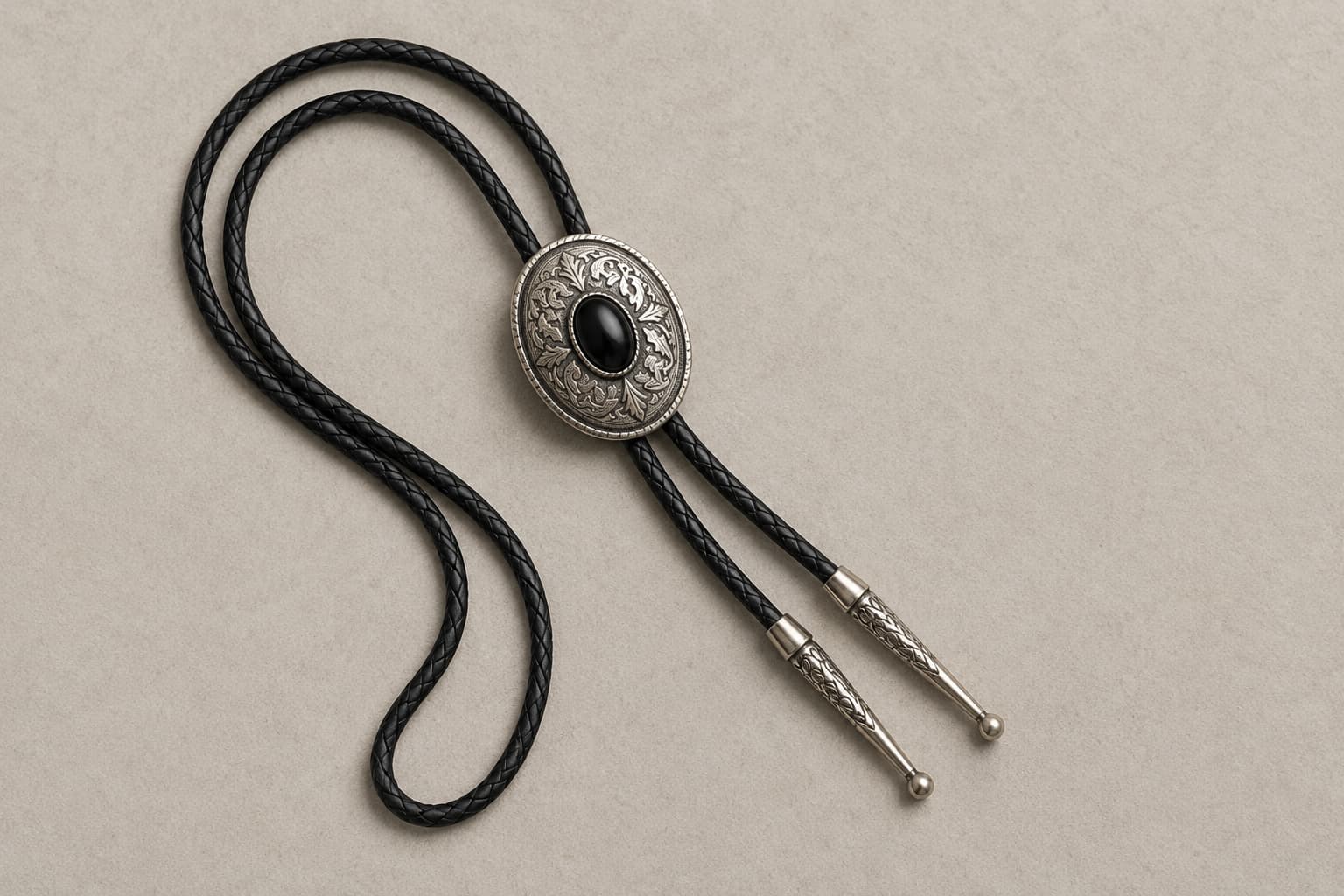
A bolo tie is a necktie made from a cord or braided leather string that hangs down the front of a shirt, held in place by a decorative clasp called a slide. Instead of a knot like a traditional necktie, the cord slips through the slide and pushes up toward the collar to tighten it. The two loose ends of the cord usually end in metal caps called aglets, similar to the plastic tips on shoelaces.
The slide is the star of the show. It can be a flat piece of engraved silver, a chunk of turquoise, a carved wooden shape, or almost anything flat enough to rest against the chest. Because the slide is the main decoration, bolo ties are often treated more like jewelry than like clothing, and collectors buy them the same way people collect pins or cufflinks.
The History Behind the Bolo Tie
Most accounts trace the modern bolo tie to Arizona silversmith Victor Cedarstaff in the late 1940s. The often-repeated version of events has him on horseback when a gust of wind sent his hat flying; rather than lose the ornamental silver hatband, he looped it around his neck instead, and a friend’s remark that it looked like a necktie apparently stuck. Cedarstaff refined the idea from there and eventually patented his own version of the sliding clasp.
That is the popular legend, but the deeper roots run further back. Some historians argue the bolo tie is really a North American pioneer creation dating back to somewhere between 1866 and 1886, long before Cedarstaff came along. Silverwork on cord neckties also has long-standing ties to Native American craftsmanship in the Southwest — slides and cord tips made of silver have been part of Hopi, Navajo, and Zuni metalworking traditions since the mid-20th century. Cedarstaff’s story is the one most often repeated, but the bolo tie’s look and construction grew out of a much longer tradition of Southwestern metalwork.
By the 1950s, Western movies and TV shows put bolo ties on screen constantly, and the style spread far beyond ranch country, becoming shorthand for a relaxed, rugged alternative to the stiff business suit tie.
The name itself may come from South America. Some historians connect “bola” to the boleadora, a hunting tool used by Argentine gauchos, made of braided leather cords with weighted balls tied to the ends and thrown to trip up cattle. A bolo tie is obviously not a hunting weapon, but the resemblance in shape — a cord with weighted tips — is thought to be where the “bola” name came from, even as the accessory itself developed independently in the American Southwest.
Bolo Tie as a State Symbol

Arizona, New Mexico, and Texas have all named the bolo tie their official state neckwear. Arizona made it official first, on April 22, 1971, when Governor Jack Williams signed it into law. New Mexico passed a non-binding measure in 1987 and later made it fully official in 2007 under Governor Bill Richardson, and Texas named the bolo tie its official state tie that same year.
Arizona’s push for the title began as a grassroots effort rather than a top-down decision. Television anchor Bill Close and a small group of fellow enthusiasts set out in 1966 to get the accessory recognized as a state emblem, a cause that picked up some public visibility that October when Arizona Highways Magazine devoted several pages to Southwestern jewelry, bolo ties included. Momentum built further in 1969, when Governor Williams proclaimed the first week of March “Bolo Tie Week,” and the law finally passed two years later.
A silver bolo tie set with turquoise, Arizona’s official state gemstone, is generally considered the classic, “correct” version of the accessory — though bolo ties come in far more materials and styles than that.
Understanding Bolo Tie Parts
A bolo tie has three main parts, each with its own job: the cord, the slide, and the tips.
- Cord – The string that goes around the neck, usually round leather or braided cord.
- Slide – The decorative clasp the cord passes through; sliding it up or down loosens or tightens the tie.
- Tips (aglets) – The metal caps on the two loose ends of the cord, which stop it from fraying and add a bit of extra shine.
Some bolo ties also include a small clip or catch inside the slide that locks it in place at a chosen height, so it does not slip back down on its own.
How Is a Bolo Tie Worn?
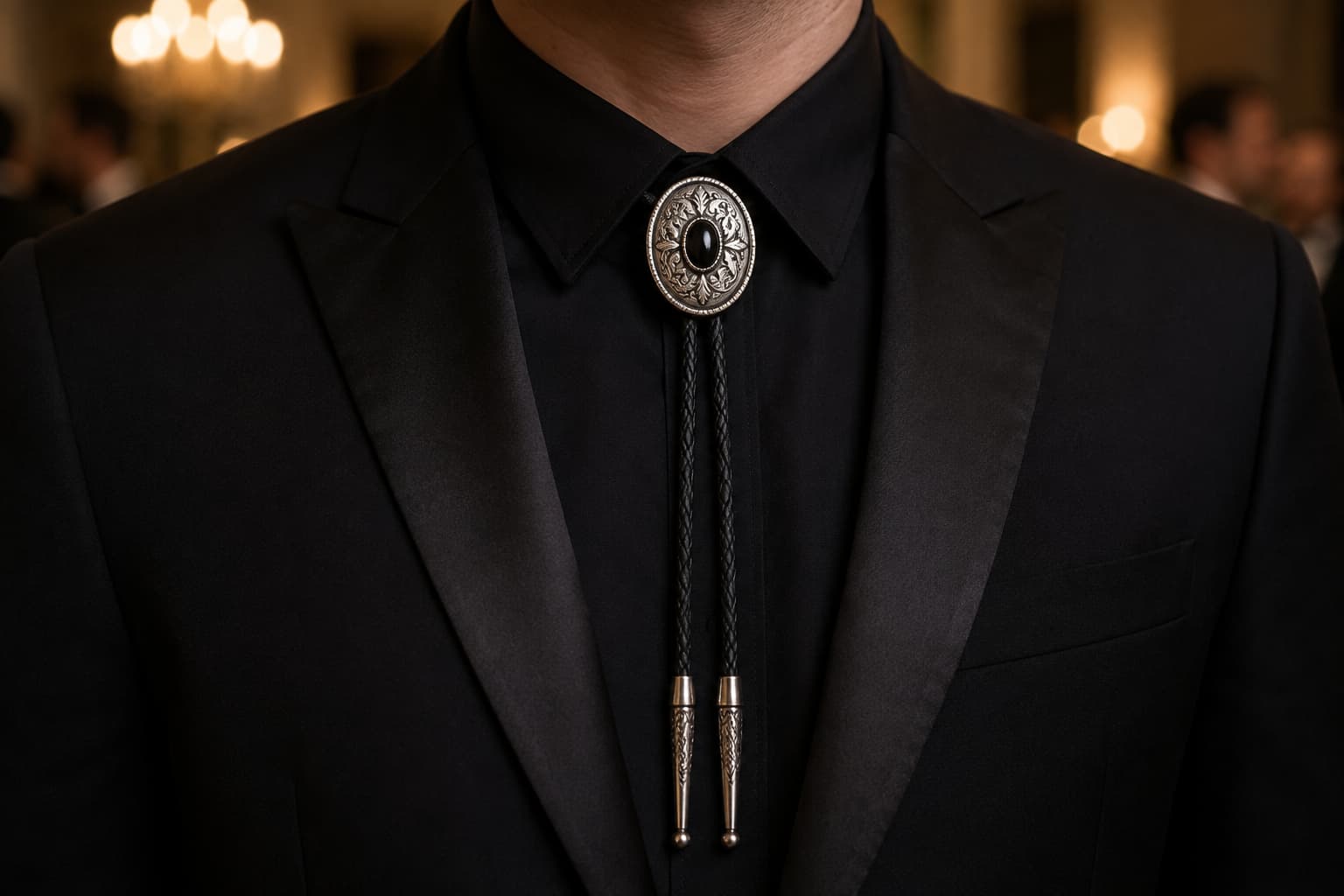
A bolo tie is worn around the shirt collar just like a necktie, with the slide sitting where a tie knot would normally sit. It goes on by draping the cord around the neck, then sliding the clasp up until it feels snug but not tight against the throat. The two tipped ends of the cord hang down evenly on either side of the slide.
Bolo ties pair naturally with Western-style shirts, blazers, and even some modern suits for a less formal look than a traditional tie. Because the slide can be swapped for different designs on some models, one cord can be dressed up or down depending on which clasp is attached to it.
Length matters more than most people expect. A cord that is too long lets the slide sit low on the chest instead of near the collar, which tends to look sloppy rather than stylish. Most bolo ties are made to hang a few inches below the collarbone, so the slide sits roughly where a tie knot would, and the two tipped ends fall evenly rather than crossing over each other.
Who Popularized the Bolo Tie?
The bolo tie has been worn by a wide mix of country singers, actors, politicians, and musicians since the mid-20th century, which is a big part of why it never fully disappeared from American fashion. Arizona Senator Barry Goldwater wore one throughout his 1964 presidential campaign, tying the accessory directly to his home state, and Ronald Reagan was known to wear bolo ties as well. Country and rock musicians embraced it just as strongly: Johnny Cash, Willie Nelson, and Roy Orbison were all associated with the look, and it later showed up in films like Butch Cassidy and the Sundance Kid, worn by Robert Redford.
The accessory has kept resurfacing with newer generations of performers. Nick Jonas wore a designer bolo tie to the 2019 Billboard Music Awards, Lizzo wore one to the 2020 Grammy Awards, and Post Malone has worn them on award show red carpets as well. That mix of old Western roots and modern red-carpet appearances shows how a piece of regional workwear can turn into a lasting fashion statement.
What Length Should a Bolo Tie Be?
Most adult bolo ties fall between 36 and 42 inches of cord length, measured end to end, not counting the metal tips. A 36-inch cord tends to work well for shorter to average frames, while a 42 to 44-inch “extra-long” cord suits taller wearers or anyone who prefers the tips to hang lower on the chest. There is no single official standard, but this range covers what most makers and retailers treat as normal.
The simplest way to find the right size is to measure rather than guess. A soft tape measure or a piece of string, wrapped around the neck the way the cord would sit and extended down to about 3 to 4 inches below the sternum — roughly where the bottom of a necktie knot would land — gives a close match. For a bolo tie meant to be worn under a jacket, measuring again with the jacket on is worthwhile, since the tips usually look best staying just above the lapel line rather than disappearing underneath it.
| Height range | Typical cord length |
|---|---|
| Under 5’4” | 34–36 inches |
| 5’4” to 5’9” | 36–38 inches |
| 5’10” to 6’1” | 38–40 inches |
| Over 6’1” | 40–44 inches |
These figures are an approximate guide rather than an official standard, built from the general 36-to-44-inch range makers commonly use rather than a single published chart. Because the slide moves freely along the cord, it can be adjusted higher or lower on any given day, and a shorter overall cord simply leaves less room to slide it down for a looser, more relaxed look.
How to Clean and Store a Bolo Tie
Wiping the bolo tie down with a soft, dry cloth after each wear removes sweat, skin oils, and everyday dirt before they have a chance to settle into the metal or leather. This one habit does more to keep a bolo tie looking good long-term than any deep cleaning, since most of the damage to cords and slides comes from grime building up slowly over repeated wears rather than from any single event.
The cord and the slide need slightly different treatment. Leather cords should be kept away from direct sunlight and excess moisture, since both cause leather to dry out, stiffen, and eventually crack; conditioning the leather every few months with a proper leather conditioner keeps it flexible. Silver slides and tips can be polished with a soft, non-abrasive cloth — a dedicated silver-polishing cloth works well — to remove tarnish, but any stone set into the slide, such as turquoise, coral, or onyx, should only be wiped with a slightly damp cloth, never soaked or scrubbed, since household cleaners and excess water can dull or damage porous stones.
A few habits help avoid damage before it starts. Applying perfume, cologne, hairspray, and sunscreen before putting on the bolo tie, rather than after, keeps those products from degrading the cord and dulling the slide’s finish over time. When not being worn, the bolo tie stores best flat or hanging in a cool, dry place out of direct sunlight, ideally with the slide pushed up so the loop sits smaller than neck size, which keeps the cord from developing a permanent bend or stretch over time.
Frequently Asked Questions
Is a bolo tie the same as a bola tie?
Yes, “bolo tie” and “bola tie” refer to the exact same accessory. “Bola” is the earlier and more official term, especially in Arizona state law, while “bolo” became the more common spelling in everyday use over time.
What materials are bolo ties usually made from?
The cord is typically braided leather or another cord material, the slide is often silver, and the decorative piece on the slide can be turquoise, coral, wood, or another stone or metal. Tips on the cord ends are usually metal as well.
Can women wear bolo ties?
Yes, bolo ties are not limited to men. Because the design is really just a decorative cord and clasp, it works as a unisex accessory and has been styled by women for decades, especially within Western and Southwestern fashion.
Are bolo ties considered formal wear?
Generally no. Bolo ties are considered semi-formal to casual, though a well-made silver-and-turquoise bolo can hold its own at more dressed-up Western events, like ranch weddings or award ceremonies with a Southwestern theme.
Why is the bolo tie associated with Arizona specifically?
The bolo tie’s design has strong roots in Southwestern silversmithing traditions, and Arizona was the first state to make it an official symbol, doing so in 1971 after a multi-year campaign by bolo tie enthusiasts. That history is why Arizona is still seen as the accessory’s spiritual home, even though New Mexico and Texas later adopted it too.
How long should a bolo tie cord be?
Most bolo ties run 36 to 42 inches long, and the right length mostly comes down to height and how low the slide and tips are meant to sit. Measuring from the neck down to about 3 to 4 inches below the sternum produces a close match in most cases.
Can a bolo tie get wet?
A quick splash is unlikely to ruin most bolo ties, but they are not meant to get soaked. Water can dry out and stiffen a leather cord over time, and moisture trapped against a silver slide or a porous stone like turquoise can dull the finish, so removing it before swimming, showering, or heavy rain is the safer choice.
Conclusion
The bolo tie survived nearly eight decades without losing its core design: a cord, a clasp, and two metal tips, dressed up with whatever silver or stone the wearer likes best. It grew out of genuine Southwestern silversmithing traditions long before Victor Cedarstaff’s famous windblown-hat story turned it into a commercial product, and that mixed history is exactly why three states eventually gave it official status. Getting the fit right is mostly a matter of measuring from the neck to a few inches below the sternum, and keeping it looking good long-term comes down to a quick wipe after each wear and keeping the leather out of the sun. Whether it is viewed as Western fashion or as a small piece of wearable jewelry, the bolo tie’s staying power comes from how little it asks of the wearer and how much personality it lets the slide express.