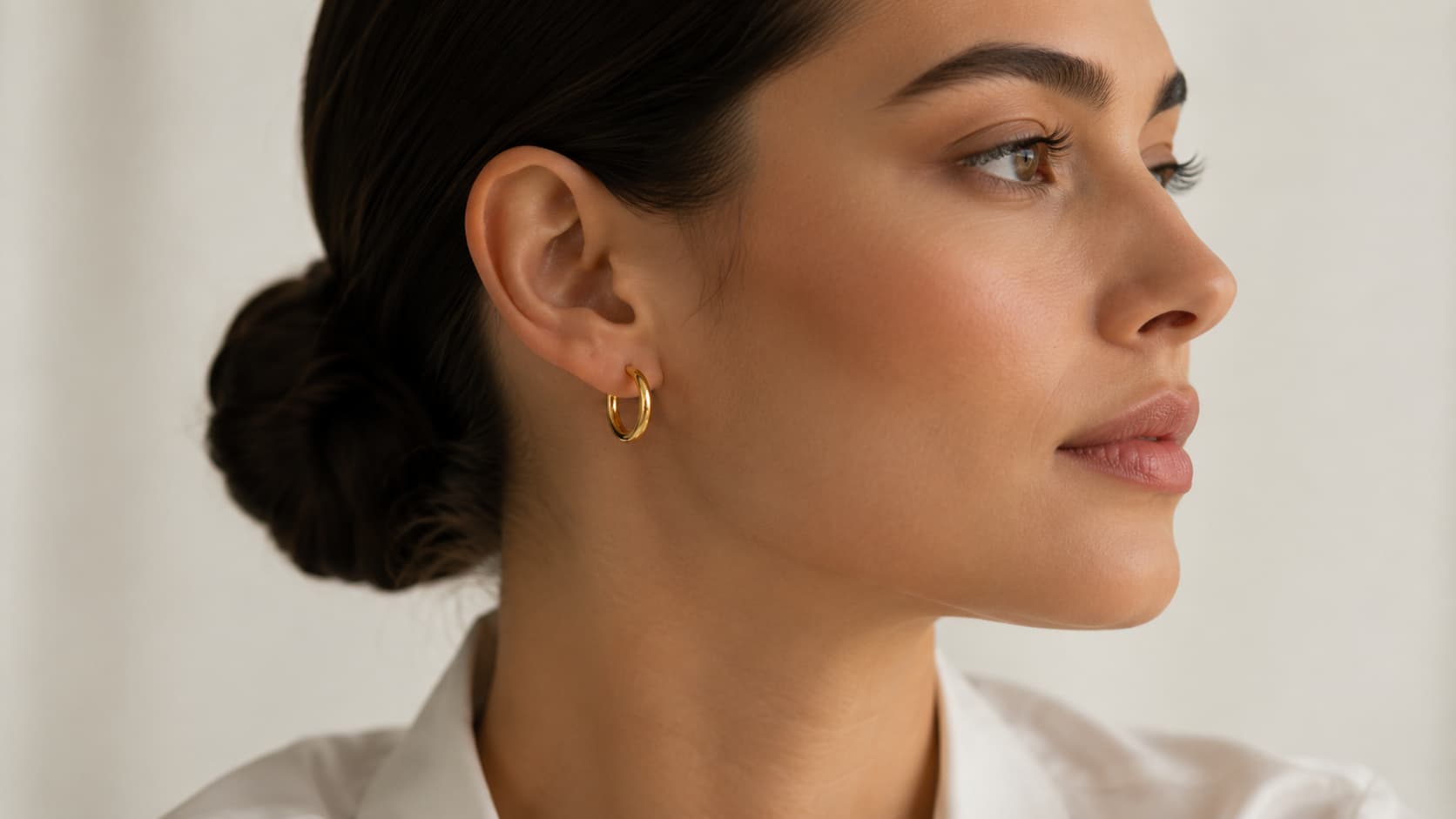
Stud earrings are one of the simplest pieces of jewelry a person can own, but that simplicity hides a surprising amount of detail. A single small stone or shape sitting close to the earlobe has to deal with post thickness, backing type, metal purity, and piercing health all at once, and getting any of those wrong is usually the reason a “simple” earring ends up itchy, loose, or lost in a bedsheet. Those small mechanical choices, more than the design on the front, are what decide whether a pair gets worn for years or ends up sitting in a drawer.
What Are Stud Earrings?
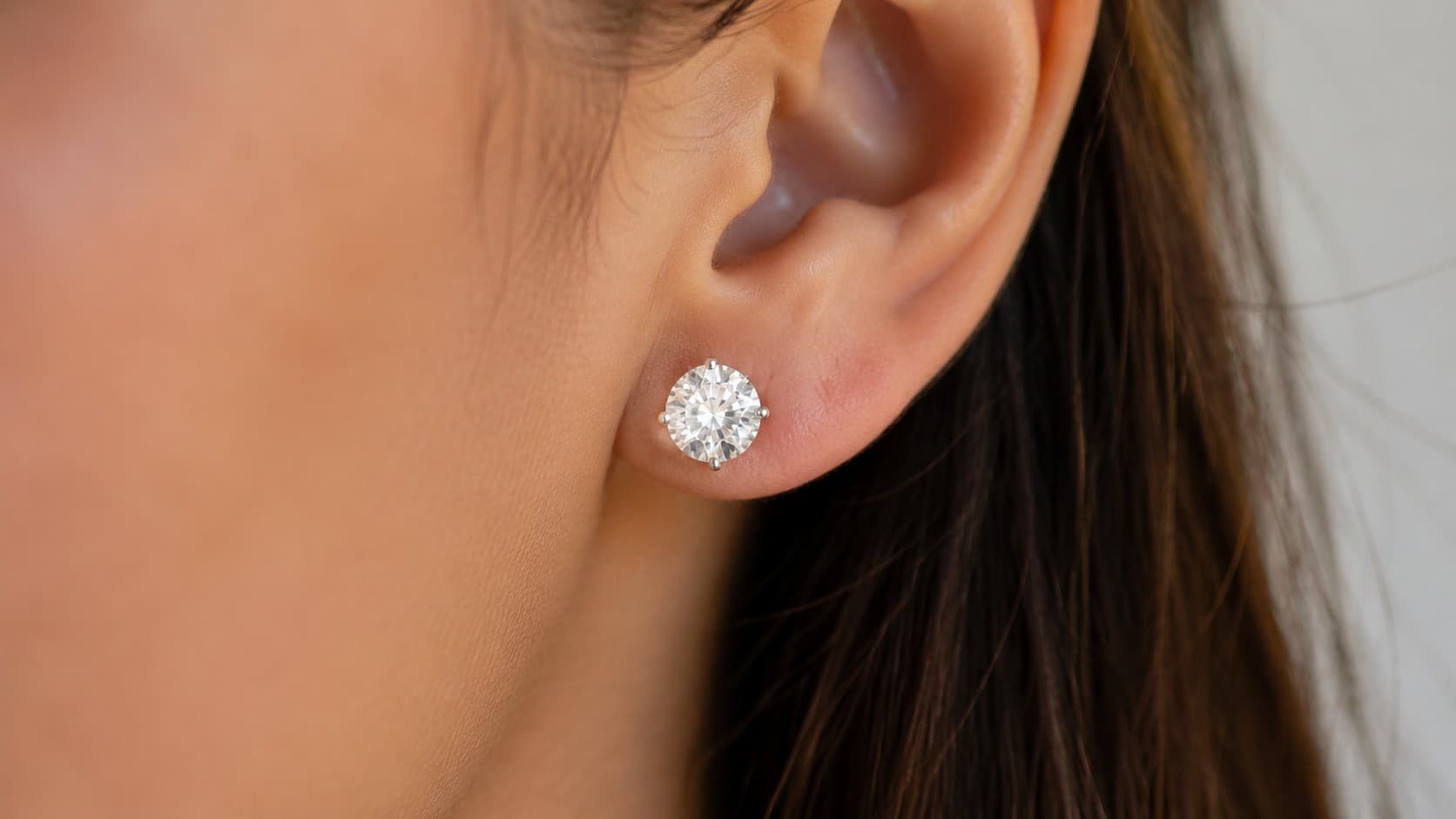
A stud earring is a piece of jewelry that sits flat against the earlobe, held in place by a thin post that goes through the piercing and locks with a small backing. Unlike hoops or dangles, studs don’t swing or hang. The decorative part, whether it’s a diamond, a pearl, or a simple metal ball, stays fixed right against the ear.
The word “stud” comes from the way the earring is built: a short post sticking straight out from the back of the design, like a stud on a piece of leather. That post is the working part of the earring. Everything else, the gemstone, the shape, the finish, is really just decoration sitting on top of it. Studs are popular precisely because that structure is so stable. There’s no chain link to snap and no hoop to catch on a scarf, which is part of why they’re often recommended as a first pair of earrings for new piercings.
Their low-profile shape also makes studs the easiest earring to combine with other pieces. Because they sit flat and don’t move, several pairs can be worn at once along the same ear without clashing or tangling, which is why studs are the go-to choice for anyone building up multiple piercings along the lobe or cartilage. A single dangling earring can only really be worn one at a time in the same spot, but three or four tiny studs can sit side by side and still look intentional.
The History of Stud Earrings
Stud-style earrings are almost as old as jewelry itself. Archaeologists have found earrings, including simple flat designs worn close to the ear, in graves and tombs from Mesopotamia and Egypt dating back roughly 4,500 years, long before anyone had a word for “jewelry” the way it’s used today. In these early societies, a pair of gold studs wasn’t just decoration. It signaled wealth and rank, and pharaohs and nobles were sometimes buried wearing them as a mark of status carried into the next life.
The basic idea barely changed for thousands of years: a small ornament fixed close to the ear, worn by both men and women depending on the culture and the period. What did change over time was the hardware behind the ear. The screw backs, push backs, and locking clutches used today are a much newer invention, tied to the rise of mass jewelry manufacturing over the last century or so, which made it possible to produce a consistent, secure backing cheaply enough for everyday earrings instead of one-off pieces made entirely by hand. The broader story of how adornment itself began, stretching back even further than earrings alone, spans nearly the whole of human history.
The Parts of a Stud Earring
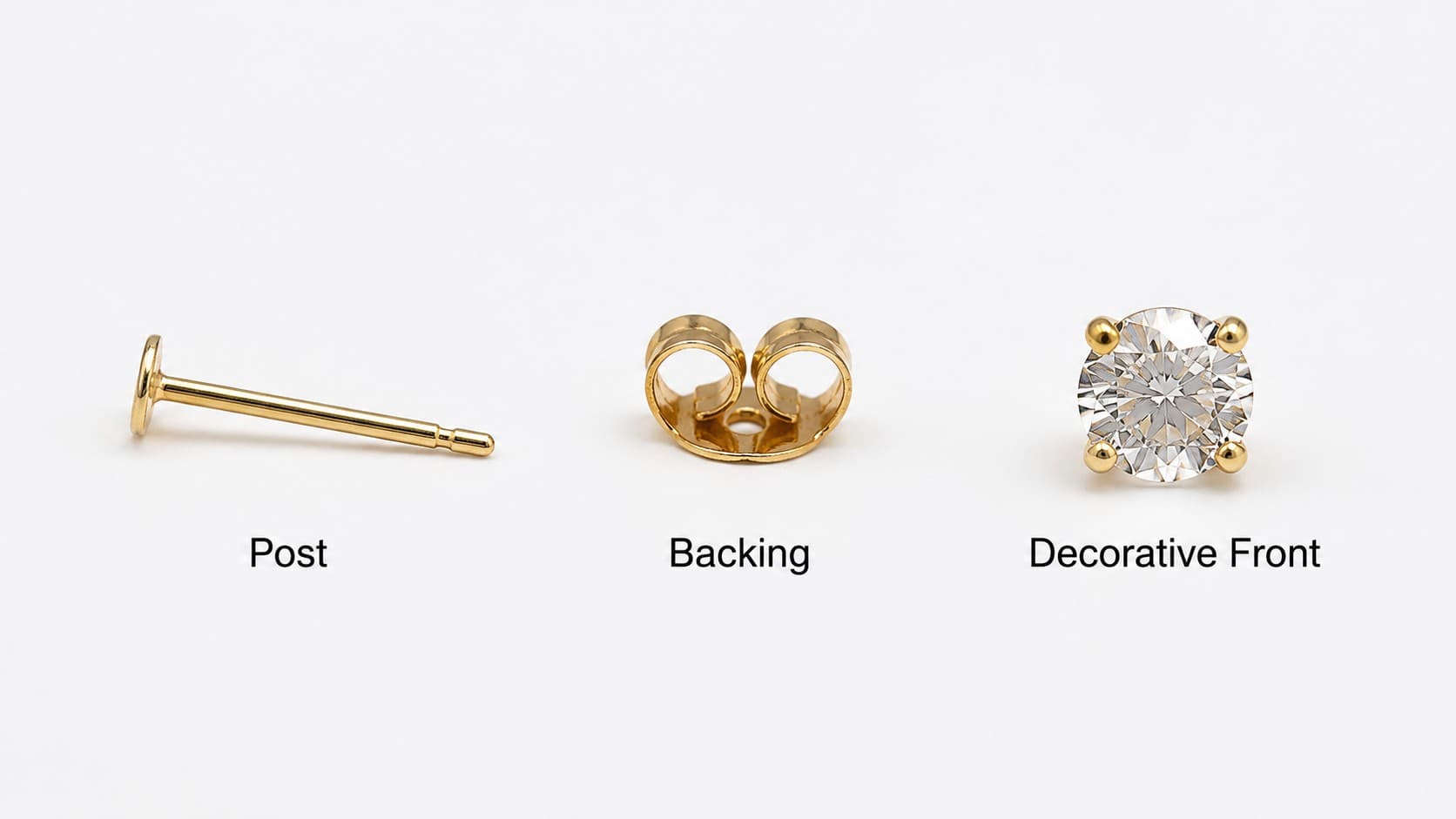
Every stud earring is made of the same three basic parts, even though the materials and shapes change from pair to pair: the head, the post, and the backing.
- The head (or front): the visible part, which can be a gemstone, a pearl, a metal shape, or a cluster of small stones.
- The post: the thin pin that passes through the piercing. It’s usually 10 to 12 millimeters long and made from the same metal as the head, or from a hypoallergenic metal for comfort.
- The backing: the small piece that clips or screws onto the post from behind the ear to hold the earring in place.
A stud earring is only as comfortable as its weakest part. A beautiful diamond mounted on a scratchy or ill-fitting post will still be uncomfortable to wear all day.
The head and the post aren’t always the same metal. Many fine jewelry studs use a gold or platinum head for looks, but pair it with a post made from a tougher, more hypoallergenic metal, since the post takes all the daily contact with skin and the wear from being inserted and removed. This is normal and doesn’t make the earring less “real,” but it does mean a listing described as “gold earrings” doesn’t always guarantee a gold post, which matters for anyone shopping specifically for sensitive skin.
What Post Thickness Do Stud Earrings Use?
Most stud earrings use a 20-gauge post, which measures about 0.8 millimeters thick. Gauge numbers work backward from what might be expected: the smaller the number, the thicker the post. So an 18-gauge post, at roughly 1.0 millimeters, is actually thicker than a 20-gauge one.
For everyday lobe piercings, 20-gauge is the industry standard and fits the vast majority of ears comfortably, whether the piercing was done with a piercing gun or a needle. Some piercing studios use 18-gauge needles instead, because the slightly thicker hole heals with less risk of the jewelry tearing through the skin. A piercing done professionally with a needle often feels more secure with an 18-gauge post than with the thinner 20-gauge size. Cartilage piercings, like the helix or tragus, often use 16 or 18-gauge jewelry because that part of the ear is tougher and needs a slightly sturdier post.
The safest way to check an unknown gauge is to measure the post of an earring already worn comfortably, using a small ruler or caliper rather than guessing. A post that’s noticeably thinner than a piercing’s healed size will feel loose and may shift around during the day, while one that’s too thick can be hard to insert and put pressure on skin that isn’t used to it. This matters most with new piercings, since jewelry swapped too early to a different gauge is one of the more common causes of slow healing or irritation.
Types of Stud Earring Backings
Earring backings are the small pieces that hold a stud in place, and the best type depends on activity level and skin sensitivity. The four most common styles differ mainly in how securely they hold the post in place.
| Backing Type | How It Works | Best For |
|---|---|---|
| Push (friction) back | Slides on and grips the post with pressure | Everyday wear, easy on and off |
| Screw back | Twists onto a threaded post | Valuable studs, active kids, less risk of loss |
| Locking (secure) back | Clicks into a locked position | Babies, toddlers, or anyone worried about earrings falling out |
| La Pousette / adjustable | Uses a sliding disc to control tightness | Stretched or loose piercings |
Push backs are by far the most common because they’re quick to use and inexpensive to make. Screw backs and locking backs trade some convenience for extra security, which matters a lot more when the earring itself is valuable or when it’s being worn by someone who moves around a lot, like a young child.
One detail people often miss is that the backing is frequently made from a different, cheaper metal than the earring itself, even on fine jewelry. A stud can be solid gold while its backing is plated brass or contains trace nickel, and since the backing sits directly against the back of the earlobe, it can cause irritation even when the visible front of the earring never touches skin. For anyone who has reacted to earrings in the past without figuring out why, the backing is worth checking before assuming the earring itself is to blame.
Best Metals for Stud Earrings
Stud earrings are most commonly made from gold, sterling silver, platinum, titanium, or surgical stainless steel, and the right choice depends mostly on skin sensitivity and budget. Solid 14k or 18k gold and platinum are the most hypoallergenic precious-metal options because they contain very little or no nickel, which is the metal most often responsible for ear irritation. Sterling silver is affordable and attractive but can tarnish over time and occasionally irritate very sensitive skin.
Titanium and surgical stainless steel have become popular for everyday studs because they’re extremely hard, resist scratching, and are naturally hypoallergenic. These metals are also frequently used for the posts of otherwise decorative earrings, so a gold-look stud might actually have a titanium post underneath for comfort. Anyone with a history of reactions to earrings, redness, itching, or a green mark on the skin, should confirm that both the head and the post are made from a nickel-free material, since manufacturers don’t always match the two.
Budget “gold” studs are usually gold-plated or gold-filled rather than solid gold, and the difference between those two terms is bigger than it sounds. Gold-plated jewelry has an extremely thin layer of gold, typically no more than a few microns thick, applied over a base metal, and that layer can wear off within a year or two of regular use. Gold-filled jewelry uses a much thicker, mechanically bonded layer that must legally make up at least 5 percent of the item’s total weight, so it holds its color for years rather than months. Neither is dishonest, but the distinction explains why two “gold” studs at very different prices can behave so differently over time.
White gold studs come with one more thing to plan for: most white gold is naturally a pale yellow and gets its bright white color from a thin rhodium plating layer. That plating wears down gradually with everyday contact, especially at a spot like the earlobe, and needs to be reapplied by a jeweler every year or two to keep its original shine. This isn’t a defect, just a normal part of owning white gold. Platinum and titanium, by contrast, keep their white color without any plating at all, making them the lower-maintenance option.
How Are Stud Earrings Sized?
Stud size usually refers to the diameter of the visible front, which typically ranges from about 3 millimeters for a subtle look to 8 millimeters or more for a statement piece. Smaller studs, in the 3 to 5 millimeter range, sit close to the ear and work well for everyday wear or for stacking multiple piercings. Larger studs, above 6 millimeters, are noticeable from across a room and tend to be saved for special occasions.
Post length matters just as much as the size of the front. A post that’s too short can be uncomfortable to fasten on a thicker earlobe, while one that’s too long may let the earring sit crooked or dangle slightly instead of staying flat. Checking the post length listed by a retailer is a useful habit when buying online, especially for anyone whose earlobes are on the thicker side.
Diamond and gemstone studs add another layer to sizing because they’re usually described by carat weight rather than millimeters. A common source of confusion is that this weight is often listed as “total carat weight,” meaning the combined weight of both earrings in the pair, not each one individually. A pair listed as 1 carat total weight typically has two stones of about 0.5 carats each, which will look noticeably smaller than a single 1-carat stone would in a ring. Checking whether a listing means total or per-stone weight avoids the disappointment of a pair arriving smaller than expected.
How to Clean Stud Earrings
Stud earrings need regular cleaning because they sit directly against skin, hair products, and lotion all day. A simple routine of wiping the earring with a soft cloth and mild soapy water every couple of weeks removes the buildup of oil and product that causes both tarnish and skin irritation.
Earrings with gemstones benefit from being removed before applying perfume, hairspray, or lotion, since these products can dull certain stones and cloud metal finishes over time. Storing studs separately from other jewelry, ideally in a lined box or a small pouch, keeps the posts from getting bent or scratched by bumping into other pieces. On a screw-back earring, checking every so often that the backing is still tightening smoothly prevents it from becoming loose or getting stuck.
Not every stone can be cleaned the same way, so it’s worth knowing which gemstones can safely go in an ultrasonic cleaner before reaching for one or a jewelry-store dip. Hard, durable stones like diamonds and sapphires generally hold up well to ultrasonic cleaning, but softer or more porous materials, including pearls, opals, turquoise, and emeralds, can crack, cloud, or lose their treatment under vibration or harsh chemicals. A soft, slightly damp cloth is the safer choice for those. Removing stud earrings before swimming is also a good habit, since chlorine and salt water can dull metal finishes and, over time, weaken glue-set stones.
Frequently Asked Questions
Can you sleep in stud earrings?
Small, simple studs with flat backs are generally considered the safest earrings to sleep in, since they don’t have moving parts that can catch on a pillow. Larger studs or ones with sharp edges are better removed at night to avoid pressing into the skin or getting tangled in hair.
Are stud earrings good for sensitive ears?
Yes, as long as both the post and the decorative front are made from a hypoallergenic metal like titanium, surgical steel, or solid 14k+ gold. Nickel is the most common cause of ear irritation, so checking the material before buying matters more than the style of the earring itself.
How long do stud earrings last?
Well-made studs in solid precious metals or titanium can last for decades with basic care, since the design has very few moving parts to wear out. The most common failure points are the backing losing its grip over time or a gemstone loosening in its setting, both of which are usually easy to repair.
What’s the difference between a stud earring and a barbell?
A traditional stud has a decorative front attached to a single post with a backing behind the ear, while a barbell has a bar with a ball or decorative end on both sides, often used in cartilage piercings. Barbells tend to feel more secure for piercings that get more movement, while studs are the standard choice for earlobes.
Can stud earrings be resized?
The front design of a stud generally can’t be resized, but the post length can sometimes be adjusted or swapped by a jeweler if it’s uncomfortable. This is more commonly done with gemstone studs than with cheaper fashion jewelry, where replacing the whole earring is usually simpler.
Conclusion
Stud earrings look simple, but the details, post gauge, backing type, metal, and size, are what decide whether a pair feels comfortable for years or ends up sitting in a drawer after a week. Matching the post material to the wearer’s skin, choosing a backing that fits daily activity, and keeping the pair clean does more for how often studs actually get worn than the design on the front ever will. Once those basics are right, a good pair of studs becomes one of the few pieces of jewelry that can be put on and simply forgotten about.