Girard-Perregaux is one of the oldest watch companies still making watches today, and it has quietly shaped some of the biggest ideas in modern watchmaking without ever becoming a household name like Rolex or Omega. That is part of its charm. The brand built its reputation on a strange-looking pocket watch with three gold bridges shaped like arrows, then went on to design and build its own steel luxury sports watch entirely in-house during the same wave that produced icons like the Royal Oak. Collectors and watch fans keep coming back to this small Swiss manufacturer for the same reasons the brand has survived for more than two centuries: real in-house engineering and a handful of genuinely original designs.
Why Girard-Perregaux Stands Out Among Swiss Watchmakers
Girard-Perregaux builds its own watch movements from scratch inside its own factory, which is rare even among luxury Swiss brands. Many watch companies buy movements, the “engine” inside a watch, from outside suppliers. Girard-Perregaux designs, makes, and assembles almost all of its own parts in La Chaux-de-Fonds, Switzerland, a small city known worldwide for watchmaking.
This matters because a brand that makes everything itself has full control over quality and design. It also means Girard-Perregaux can create unusual movements, like the famous three-bridge tourbillon, that other brands simply cannot copy exactly. The company is a founding member of the Fondation de la Haute Horlogerie, an organization that promotes fine, high-quality watchmaking, which reflects how seriously it treats the craft. Since 2022, Girard-Perregaux has also been independently owned and run by its own management team, after buying itself out from the French luxury group Kering, giving it more freedom to focus on watchmaking without answering to a giant fashion conglomerate.
How Girard-Perregaux Became a Watchmaking Legend
Girard-Perregaux traces its story back to 1791, when a 19-year-old watchmaker named Jean-François Bautte signed his first watch in Geneva. That makes the brand’s roots more than 230 years old, among the oldest continuously connected watchmaking lineages in the world.
The company as we know it by name began later, though. In 1852, a watchmaker named Constant Girard started his own workshop, and in 1856, after marrying Marie Perregaux, the pair combined their names to create Girard-Perregaux. In 1906, Girard-Perregaux bought out Bautte’s old company, which is why the brand counts 1791 as its true starting point rather than 1856.
The house’s defining moment came in 1889, when its tourbillon pocket watch featuring three parallel gold bridges won a gold medal at the Paris World’s Fair, a design so distinctive it still appears on Girard-Perregaux watches today.
The 20th century brought more milestones. Girard-Perregaux introduced self-winding Gyromatic movements in the 1950s and 1960s, and in 1971 it helped set the industry standard for quartz watch frequency at 32,768 Hz, a number still used inside quartz watches made by many different brands today. The brand survived the “quartz crisis” of the 1970s and 1980s, a period when cheap electronic watches from Japan nearly wiped out traditional Swiss watchmaking, by leaning into mechanical craftsmanship rather than abandoning it.
Girard-Perregaux’s Watch Collections
That history split Girard-Perregaux’s catalog into a handful of distinct families, each built around a different case shape or purpose rather than being a random assortment of models.
| Collection | Best known for | Typical case shape |
|---|---|---|
| Laureato | Steel luxury sports watch, integrated bracelet | Octagonal bezel on a round case |
| Three Gold Bridges / Bridges | The brand’s signature tourbillon architecture | Round or rectangular, skeletonized |
| 1966 | Classic dress watches and calendars | Round, slim |
| Vintage 1945 | Art Deco styling | Rectangular |
| Sea Hawk | Sporty dive watch | Round, oversized |
| Cat’s Eye | Women’s dress watches | Oval |
Girard-Perregaux Laureato: The Brand’s Most Famous Watch
The Laureato is Girard-Perregaux’s flagship watch, an integrated-bracelet steel sports watch first launched in 1975 with an octagonal bezel and a slim, in-house quartz movement. If someone only knows one Girard-Perregaux watch, it is almost always this one.
The Laureato arrived during a wave of “luxury sports watches” in the 1970s, following the Audemars Piguet Royal Oak from 1972 and appearing a year before the Patek Philippe Nautilus in 1976. What made the Laureato special was that Girard-Perregaux designed, engineered, and built it entirely in-house, including that early quartz movement, at a time when many rivals were still relying on outside suppliers. Its eight-sided bezel sitting on top of a round case became its signature look, paired with a textured “Clous de Paris” dial pattern that catches light in a distinctive way.
The Laureato went through several redesigns over the decades, including a switch to mechanical movements in 1995, before Girard-Perregaux relaunched it as its core modern collection in 2016. Today it comes in sizes ranging from around 34mm up to 42mm, in steel, titanium, and precious metals, with prices for a steel automatic model typically starting around $15,000 to $19,000 and climbing well past that for chronograph, skeleton, or gem-set versions. In 2025, the Laureato turned 50 years old, and Girard-Perregaux marked the anniversary with the Laureato Fifty, a two-tone steel-and-gold limited edition built around a brand-new movement called the GP4800.
Since 2021, the Laureato has also been the centerpiece of Girard-Perregaux’s collaboration with British car maker Aston Martin, a partnership that later extended to becoming the official watch partner of the Aston Martin Formula 1 team. The resulting limited-edition watches include a chronograph made from 904L steel, a grade more resistant to corrosion than the 316L steel most brands use, and a later version whose case incorporates titanium and carbon reclaimed from actual Formula 1 race cars. Several dials carry a textured green finish echoing details from Aston Martin’s own design history. It is an unusual pairing for a Swiss watchmaker with roots in the 1700s, but it shows how the Laureato platform flexes into different personalities without losing its bezel shape.
Why the Laureato Remains So Popular
The Laureato answers the question of what a “boring” old design can still teach modern watchmakers about restraint. Instead of chasing trends, Girard-Perregaux kept refining one shape for fifty years, which is exactly why serious collectors respect it. It sits in the same conversation as the Royal Oak and Nautilus but often costs less for a comparable steel sports watch, making it a common recommendation for someone who wants that “integrated bracelet” look without paying Audemars Piguet or Patek Philippe prices.
Tourbillon with Three Gold Bridges: The Watch That Built the Brand
This is the design that started everything, and it remains Girard-Perregaux’s most recognizable technical signature. The original pocket watch, patented in 1884 by Constant Girard, placed the tourbillon (a rotating cage that fights gravity’s pull on watch accuracy), the going train, and the barrel each under its own arrow-shaped gold bridge, arranged in a straight line.
That pocket watch won a gold medal at the 1889 Paris World’s Fair, and the three-bridge design became so tied to Girard-Perregaux’s identity that the brand still uses it more than 130 years later. Modern versions appear as wristwatches under names like the Bridges collection, the Vintage 1945 Tourbillon with Three Gold Bridges (which places the bridges inside a rectangular Art Deco-style case), and the Tourbillon with Three Flying Bridges, where the bridges appear to float without visible support. These are genuine high-complication watches, often produced in limited numbers, and prices typically run from the tens of thousands of dollars into six figures depending on materials and rarity.
The three-bridge design functions like a car maker’s signature grille shape, carried across every model for over a century. It is not just decoration; it identifies the brand at a glance.
Girard-Perregaux 1966 Collection: Classic Dress Watches
The 1966 collection covers Girard-Perregaux’s round, traditional dress watches, named after the year the brand introduced its first high-frequency automatic movement. These watches favor clean dials, thin cases, and classic complications over sporty styling.
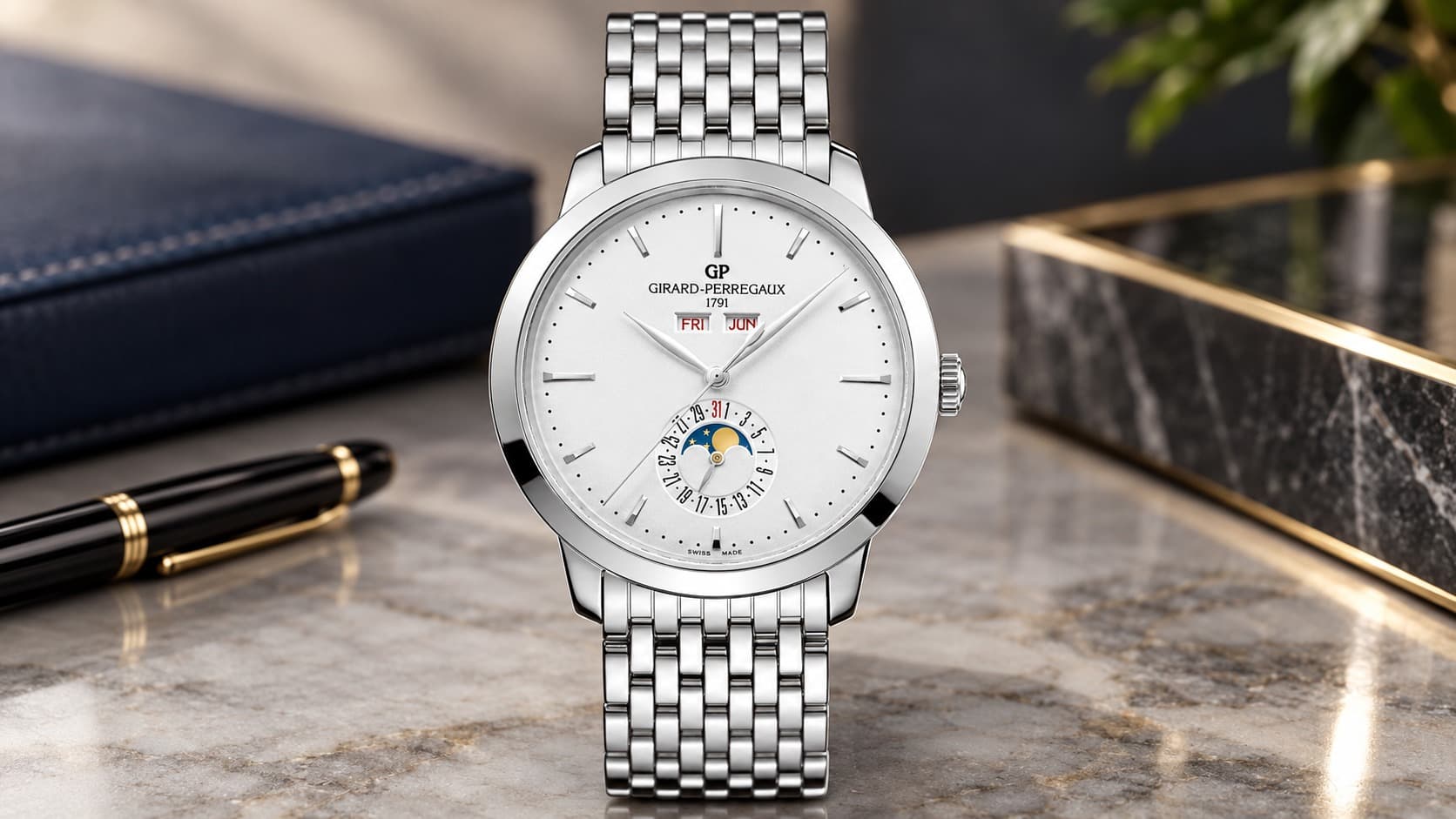
Within the 1966 lineup, buyers will find simple three-hand watches, full calendar models that show the date, day, and month together, and chronographs for timing events. Girard-Perregaux introduced the 1966 Full Calendar and 1966 Chronograph in 2012, and the brand has continued to describe the line as one of its “grand classics.” For someone who wants a Girard-Perregaux watch that looks at home under a suit jacket rather than at the gym, the 1966 collection is the natural starting point, generally priced lower than the brand’s tourbillon pieces.
Because the 1966 case is thin and understated, it also tends to be where Girard-Perregaux places quieter technical details rather than showy complications. A full calendar or a moonphase display fits comfortably into the round case without crowding the dial, which keeps the collection feeling like a traditional dress watch even when the mechanics underneath are fairly advanced.
Sea Hawk and Cat’s Eye: The Brand’s Sport and Women’s Lines
Not every Girard-Perregaux watch is a dress piece or a tourbillon showcase. The Sea Hawk is the brand’s dedicated dive watch, an oversized 44mm sports model rated to 1,000 meters of water resistance, built to handle serious underwater use rather than just poolside wear. It runs on Girard-Perregaux’s in-house GP03300 automatic movement family, the same engine used across several modern collections, giving it roughly a two-day power reserve.
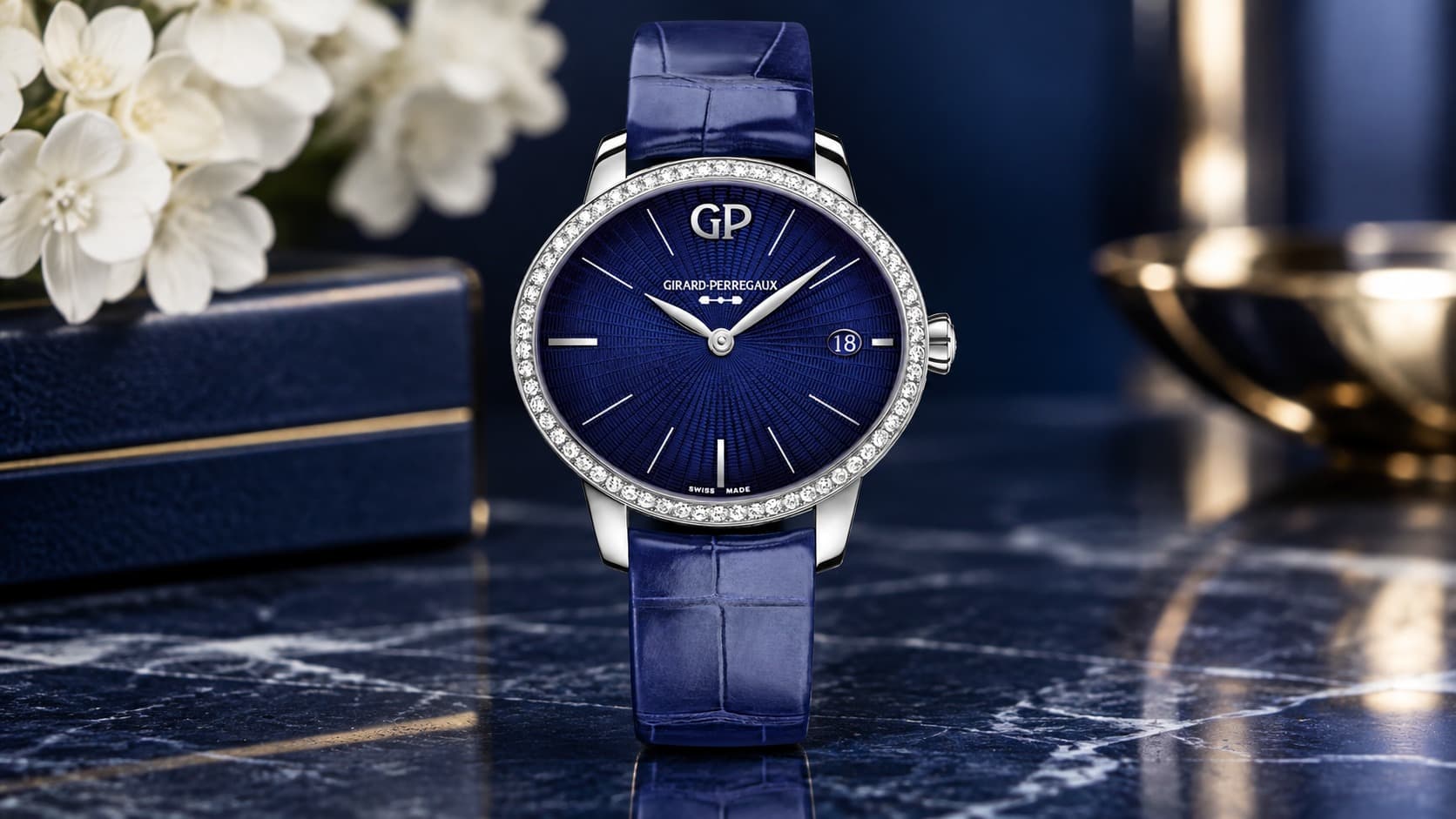
On the opposite end of the lineup sits Cat’s Eye, Girard-Perregaux’s women’s collection introduced in 2004 and built around an oval case shape rather than the round or octagonal cases seen elsewhere in the range. Cat’s Eye models range from simple time-and-date watches to versions with moonphase displays, diamond-set bezels, and mother-of-pearl dials, all still powered by mechanical movements rather than quartz. Together, the Sea Hawk and Cat’s Eye show that Girard-Perregaux’s identity is not limited to the Laureato or the Three Bridges tourbillon; the brand has maintained dedicated sport and women’s lines for decades alongside its more famous pieces.
Vintage 1945: Girard-Perregaux’s Rectangular Watch
The Vintage 1945 takes its rectangular case shape from a Girard-Perregaux watch originally made in 1945, giving the modern collection a distinctly Art Deco personality that stands apart from round watches. Its stepped, geometric case corners are the collection’s most identifiable feature.
Vintage 1945 watches come with a range of movements, from straightforward automatic calibers to the brand’s showpiece Tourbillon with Three Gold Bridges squeezed into the rectangular case. Because the shape is unusual, this collection tends to appeal to buyers who already own round watches and want something visually different, rather than a first Girard-Perregaux purchase.
Buying a Girard-Perregaux: What to Know First
Buying new through an authorized Girard-Perregaux retailer means paying full retail price, but it also comes with the brand’s full warranty and no guesswork about authenticity. Buying pre-owned, through a dealer or a private sale, can bring the price down noticeably, since Girard-Perregaux does not have the same waitlist culture or resale premium that pushes up prices on brands like Rolex or Patek Philippe. That price gap is actually part of the appeal for collectors: a five- or ten-year-old Laureato often costs a fraction of a new one, while still using the same in-house movement.
Because Girard-Perregaux builds its own movements rather than buying generic ones, convincing fakes are less common than with mass-market brands, but they do exist for the most famous pieces, especially the Laureato and the Three Gold Bridges watches. The most reliable way to confirm authenticity is to buy from an authorized dealer or a reputable pre-owned specialist, and to ask for the watch’s box, papers, and Certificate of Authenticity when available. A missing serial number, a movement that does not match the reference number, or a price that seems far too low for the model are all reasons to slow down and verify before paying.
For resale value, limited editions, the Three Gold Bridges family, and pieces tied to a well-known collaboration like Aston Martin tend to hold interest better than core, mass-produced references, simply because fewer of them exist. That said, Girard-Perregaux is not primarily a brand people buy expecting quick resale gains; most owners buy it because they want a genuinely independent, in-house watch without paying Royal Oak or Nautilus prices.
Frequently Asked Questions
Is Girard-Perregaux considered a luxury watch brand?
Yes, Girard-Perregaux is widely regarded as a genuine haute horlogerie brand, meaning it operates at the highest tier of fine Swiss watchmaking. It designs and manufactures nearly all of its own movements in-house, a standard that only a small number of Swiss watch companies meet, and it has held that status since the 1800s.
Who owns Girard-Perregaux now?
Girard-Perregaux is independently owned by its own management team through a company called Sowind Group. The French luxury conglomerate Kering held a majority stake starting in 2011 but sold the brand back to its management in a buyout completed in 2022.
What is the entry price for a Girard-Perregaux watch?
Prices generally start around $9,000 to $10,000 for a steel Laureato on the pre-owned market, while pre-owned 1966 and Vintage 1945 models tend to run lower, often in the $2,000 to $9,000 range depending on condition and complications. New steel Laureato models from authorized retailers typically start in the mid-teens of thousands of dollars. Complicated pieces like tourbillons and the Three Gold Bridges watches cost significantly more, often into six figures for rare or limited editions.
Is the Girard-Perregaux Laureato similar to the Audemars Piguet Royal Oak?
The two watches share a similar idea, a steel sports watch with an integrated bracelet, but they were designed independently and look different up close. The Royal Oak launched in 1972 with its octagonal bezel and exposed screws, while the Laureato followed in 1975 with its own octagonal-over-round bezel shape and different case proportions, developed entirely by Girard-Perregaux’s own team.
What does “in-house movement” mean, and why does it matter for Girard-Perregaux?
An in-house movement is a watch engine that a brand designs and builds itself, rather than buying a ready-made one from another company. It matters because it gives Girard-Perregaux full control over performance, design, and how rare or unique its watches can be, which is a major reason the brand is respected among collectors despite being less famous than some competitors.
Does Girard-Perregaux make watches for women?
Yes, Girard-Perregaux’s main women’s line is called Cat’s Eye, an oval-cased collection introduced in 2004 that ranges from simple mechanical time-and-date models to versions with diamonds, mother-of-pearl dials, and moonphase displays. Some Laureato sizes, particularly the smaller 34mm and 38mm cases, are also worn by women and marketed as unisex.
The Bottom Line
Girard-Perregaux’s story comes down to one idea repeated in different forms for over two centuries: build the whole watch yourself, and let a distinctive design carry the brand rather than a famous name alone. The three-bridge tourbillon proved that idea in 1889, the Laureato proved it again in 1975, and the brand’s continued independence since 2022 suggests it plans to keep proving it on its own terms. Across the modern lineup, that same philosophy plays out differently in each collection: the Laureato as a modern sports watch, the 1966 and Vintage 1945 as classic dress styling, and the Three Gold Bridges watches as the rare, high-complication pieces that started it all.