Every perfume bottle is covered in small print that most people never really look at: a string of letters like EDP or EDT, a tiny code stamped near the barcode, a list of ingredients that seems to be written in another language, and a little drawing of an open jar with a number inside it. None of that is filler. Each piece carries useful information, from how strong the scent will be to how old the bottle actually is to whether it contains something that could irritate sensitive skin. Understood correctly, a perfume label stops being a wall of confusing text and becomes a fast, reliable way to understand exactly what’s in a given bottle.
What Does EDP, EDT, and EDC Mean?
These letters indicate how much pure fragrance oil is mixed into the bottle, which is the single biggest factor in how strong and long-lasting a perfume will smell. Everything else about a scent — its notes, its brand, its price — sits on top of this basic number.
Fragrance is made by blending scented oil with alcohol and a little water. The more oil in that mix, the more powerful and longer-lasting the smell, and usually the higher the price too. Brands don’t all use identical percentages, but the general order, from lightest to strongest, stays consistent across the industry:
| Label | Typical Oil Concentration | How Long It Tends to Last |
|---|---|---|
| Eau Fraîche | 1–3% | 1–2 hours |
| Eau de Cologne (EDC) | 2–5% | 2–4 hours |
| Eau de Toilette (EDT) | 5–15% | 3–5 hours |
| Eau de Parfum (EDP) | 15–20% | 6–8 hours |
| Parfum / Extrait de Parfum | 20–30%+ | 8+ hours |
Brands don’t publish these percentages under any shared industry standard, so the exact cutoffs shift slightly from house to house, but the ranking order itself, from Cologne up through Extrait, holds steady across virtually every fragrance company. That also means an EDT will almost always be lighter than that same brand’s Eau de Parfum, even if the exact numbers differ from one company to the next. There’s no independent body checking that a bottle labeled EDP actually contains 18% oil rather than 14%; brands set their own recipes and simply use the label that fits the tradition closest.
Fewer letters after “Eau de” generally signals a lighter, faster-fading scent. Cologne fades fastest; Parfum lasts longest.
Other words often appear on bottles that aren’t part of this official ladder, like “Intense,” “Elixir,” “Absolu,” or “Extreme.” These are marketing names rather than regulated concentration terms, and different brands use them to mean different things, usually a slightly boosted version of an existing EDP with a bit more oil or a few added notes. There’s no rule saying an “Intense” has to be stronger than a regular EDP from a different brand, so the name alone isn’t something to rely on when comparing across brands. The actual concentration category printed on the box remains the more reliable measure of strength, and when that category isn’t listed, testing the scent directly on a paper strip is a better gauge than the marketing term itself.
Where Is the Batch Code and What Does It Reveal?
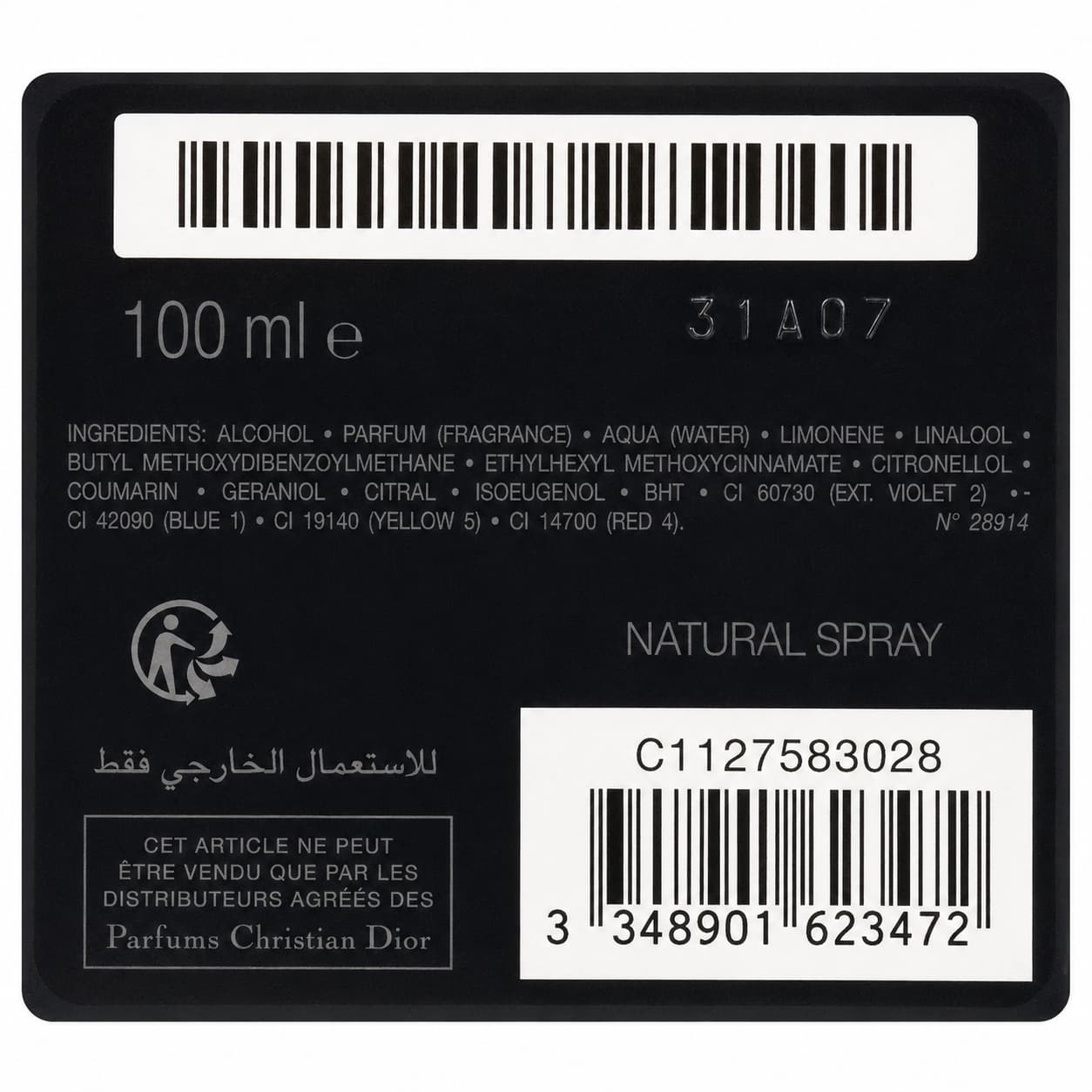
The batch code is a short string of letters and numbers, usually stamped or printed near the barcode, on the bottom of the bottle, or around the neck under the cap. It isn’t there to look official. It’s a manufacturing record that lets the factory trace exactly which production run a given bottle came from, and it’s the only reliable way to figure out how old a perfume actually is, since almost no fragrance brand prints a plain “made on” date anywhere on the packaging.
Each brand uses its own private system to build these codes, mixing letters for the factory or production line with numbers for the week, month, or year of manufacture. That means a code that works perfectly for one brand’s decoder tool won’t mean anything on a different brand’s bottle. Confirming the manufacturing date of a specific bottle reliably usually means going straight to that brand’s own customer service, since it holds the real key to its own coding system.
Checking this code becomes especially useful with secondhand fragrance, discount-retailer stock, or an older bottle inherited as a gift, since perfume does change over time. It won’t suddenly go “bad” the way food does, but the scent can drift, and the alcohol base can start to smell slightly different, especially once a bottle has been opened and exposed to air and light repeatedly.
Batch codes are also one of the simplest tools for spotting a counterfeit bottle. On genuine perfume, the code stamped on the bottle itself and the code printed on the outer box should always match exactly. A mismatch between the two, or a code that looks smudged, re-stamped, or oddly placed compared to how that brand normally prints it, is a real warning sign worth raising with the seller.
What Is the Little Open Jar Symbol With a Number Inside?
That small drawing of an open jar with a number like “12M” printed inside it is called the Period After Opening symbol, or PAO for short, and it indicates how many months the product is meant to stay in good condition once opened. The clock starts on the day the bottle is first used, not the day it was manufactured.
That small drop-off in shelf life doesn’t come from nowhere — it’s a formally defined symbol under EU cosmetics rules, showing a small open jar paired with a number of months, meant to mark how long a product stays good once someone actually opens it, as opposed to how long it lasts sealed. This symbol exists because cosmetics and fragrances only need to carry an exact “best before” date if their unopened shelf life is under 30 months. Since most perfumes are stable well beyond that, brands are allowed to skip a fixed expiry date and use the PAO symbol instead, which is a more honest way to communicate shelf life anyway, since a sealed bottle sitting in a dark cupboard ages very differently from one that’s opened and sprayed daily.
For perfume specifically, this number is usually generous, often somewhere between 12 and 24 months, because the alcohol base acts as a natural preservative. That’s different from something like a cream or lotion, where bacteria can grow much faster once air gets in.
In fact, plenty of perfumes skip the PAO symbol entirely, and that’s not an oversight. Products with a high enough alcohol content are typically exempt from PAO labeling altogether, since that much alcohol makes microbial growth unlikely in the first place. A bottle without the little open jar symbol hasn’t necessarily had it left off by mistake — it more likely means the formula was considered stable enough not to need one.
What Do the Ingredients on a Perfume Label Actually List?
Perfume ingredients lists usually show the alcohol base first, followed by water, and then the single word “Parfum” or “Fragrance,” which stands in for the entire scent blend rather than spelling out every individual note. After that, a handful of specific chemical names typically follow in Latin-style script, and those are the ones that matter most for anyone with sensitive skin.
Brands are allowed to hide the exact recipe of their fragrance blend behind the general term “Parfum” because a full scent formula can involve dozens of ingredients and represents years of work by a perfumer. Protecting that formula is treated similarly to protecting a recipe. However, regulators in places like the European Union require that certain specific ingredients known to commonly cause allergic skin reactions be pulled out and listed individually by name, even though they’re technically part of that same fragrance blend.
In the European Union, cosmetic law sets out a specific group of 26 fragrance ingredients that have to be named on the label whenever they’re present above a set concentration, precisely because they’re known to trigger allergic skin reactions in some people. Familiar names on that list include limonene (found in citrus peel), linalool (found in lavender), geraniol, coumarin, and eugenol, alongside a handful of less familiar chemical names. None of this makes a bottle unsafe or worth avoiding. Many of these allergens occur naturally in things like citrus peel, lavender, and rose oil. They’re listed simply so that people who already know they’re sensitive to one of them can check before buying. In 2026, the EU expanded this rule considerably, with the number of individually declarable allergens growing well past the original 26 to cover a much wider range of naturally occurring fragrance compounds.
Fragrance sold in the United States generally won’t carry this same level of detail. Current U.S. cosmetic rules don’t require brands to break out individual fragrance allergens the way the EU does, so a scent made up of a dozen different allergenic compounds can still legally appear on an American label as nothing more than the single word “Fragrance.” It’s a real difference in what can be learned just from reading the box, depending on where a bottle was sold.
When these allergens do appear, they’re written using standardized INCI names, which is why slightly unfamiliar spellings sometimes show up even for ingredients most people would recognize by their common name. Lemon oil’s main allergen shows up as “Limonene,” lavender’s as “Linalool,” and cinnamon-adjacent notes as “Cinnamal.” None of these names are trying to be confusing on purpose. INCI naming exists so that the same ingredient is labeled identically regardless of country or brand, which makes it far easier for someone with a known allergy to scan a new bottle and recognize the exact word they’ve been told to avoid.
What Do the Other Symbols and Numbers Mean?
Beyond the concentration name, batch code, and PAO symbol, a perfume box usually carries a handful of smaller marks: the net volume in milliliters or fluid ounces, a barcode, a country of origin, and sometimes tiny warning icons for flammability or eye irritation.
The volume, printed as something like “50ml / 1.7 fl oz,” indicates exactly how much liquid is inside, which matters because bottle shapes can be deceiving. A short, wide bottle and a tall, thin one can hold the exact same amount of perfume. The barcode itself doesn’t carry any secret information about age or authenticity; it’s simply a retail scanning code tied to that specific product and size, the same as on any item in a shop.
A small, stylized lowercase “e” sometimes appears right next to the volume, printed as something like “50 ml ℮”. That symbol isn’t a hedge or an admission that the fill amount is only a rough guess. It’s an EU compliance mark confirming the bottle was filled using measuring equipment and methods that meet the bloc’s official accuracy standards for volume and weight, essentially a quiet promise that the brand is filling bottles honestly and consistently across an entire production batch. It’s a quality mark rather than a warning of any kind.
Flammability warnings exist because perfume is mostly alcohol, which is genuinely flammable, so keeping bottles away from open flames or direct heat isn’t just a formality. Country of origin (“Made in France,” “Made in USA,” and so on) indicates where the fragrance was actually formulated and bottled, which can sometimes differ from where the brand itself is headquartered.
Frequently Asked Questions
Is Eau de Parfum always better than Eau de Toilette?
Not necessarily better, just different. Eau de Parfum contains more fragrance oil, so it tends to last longer on skin and project more strongly, which some people love and others find overwhelming in warm weather or enclosed spaces. Eau de Toilette is lighter and fades faster, which many people prefer for daytime or hot climates. Neither one is objectively the higher quality product; they’re built for different situations.
Can I tell how old my perfume is just by smelling it?
Sometimes, but not reliably. A perfume that’s gone past its best condition may smell slightly sour, flat, or different from how it smelled when new, especially around the top notes. But this isn’t a precise method, since some fragrances actually mellow in a pleasant way over time. Checking the batch code through the brand’s customer service is far more accurate than trusting your nose alone.
Does “Parfum” on the ingredient list mean the same thing as the word on the front of the box?
No, and this trips a lot of people up. “Parfum” on the front of the box next to the brand name tells you the concentration category (how strong the scent is). “Parfum” inside the ingredients list on the back is just the umbrella term for the entire fragrance blend itself, regardless of whether the bottle is labeled EDT, EDP, or actual Parfum concentration.
Why don’t all perfumes list a clear expiration date?
Because regulators generally only require a fixed expiration date on cosmetic products expected to last less than 30 months unopened, and most perfumes, thanks to their high alcohol content, easily last longer than that. Instead, brands are permitted to use the Period After Opening symbol to tell you how long the bottle stays in good shape once you actually start using it.
Is it safe to use perfume past the PAO number?
In most cases, yes, especially with fragrance specifically, since the alcohol base resists bacterial growth far better than water-based cosmetics do. The PAO number is a quality guideline rather than a hard safety cutoff. If the scent still smells like it should and the liquid looks clear rather than cloudy or discolored, it’s generally fine to keep using.
Conclusion
Reading a perfume label really comes down to four things: the letters after “Eau de” indicate the strength, the batch code reveals the age, the PAO jar symbol shows how long a bottle stays good once opened, and the ingredient list flags what might trigger a reaction on sensitive skin. None of it requires special training to understand, just knowing where to look and what each piece is actually for. That small print on the box, taken together, tells nearly everything worth knowing about a bottle before the cap is even opened.