On almost any perfume bottle, one word ends up doing all the work: “fragrance” or “parfum.” That single word can hide anywhere from a handful to over a hundred different ingredients, and most bottles never reveal what they actually are. Perfume makers guard their recipes the way chefs guard secret sauces, which makes sense for business but leaves anyone curious about what’s actually touching their skin without many answers. Understanding the basic building blocks of perfume — the oils, the alcohol, the lab-made molecules, and the stuff that makes a scent stick around all day, unfolding across top, heart, and base notes — turns fragrance shopping from a guessing game into something far more interesting.
Why Does the Label Just Say “Fragrance” or “Parfum”?
Perfume recipes count as trade secrets, so laws in most countries let companies list “fragrance” or “parfum” as one single ingredient instead of spelling out every chemical inside. A brand might use 50 to 200 different scent materials in one perfume, and legally they only have to write one word for all of them.
This rule exists because a perfume’s exact formula is basically its fingerprint — if a company had to publish the full recipe, a competitor could copy it almost exactly. Regulators do still require warnings for a specific list of ingredients known to commonly cause allergic reactions, so even a bottle that just says “parfum” will often list things like limonene or linalool separately underneath it. Outside of those flagged allergens, though, the rest of the formula usually stays a mystery to the customer.
What Are the Basic Parts of a Perfume?
Nearly every perfume, no matter how expensive or cheap, is built from three basic parts: a liquid to carry the scent, the scented oils and chemicals that make the smell, and fixatives that slow everything down so the perfume doesn’t disappear in ten minutes. Everything else is really just variation on those three jobs.
Alcohol: The Carrier
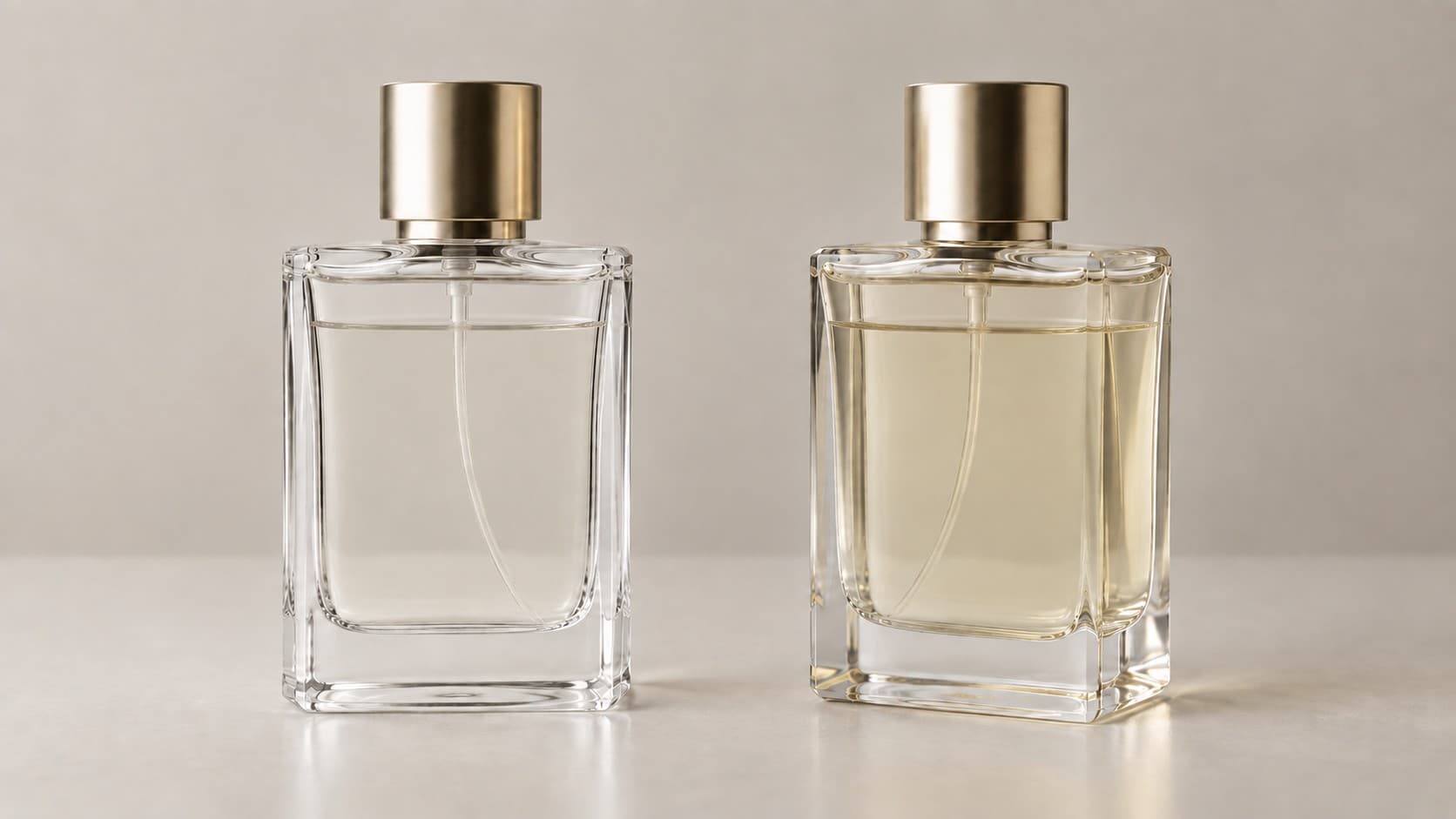
Alcohol is the clear liquid that makes up most of the volume in a bottle of perfume, and its job is to dissolve the scented oils and carry them onto the skin. Perfumers use a purified, high-grade ethanol rather than the kind found in drinks, because it needs to be extremely clean and free of unwanted odors of its own.
Once a perfume is sprayed, the alcohol evaporates first and fastest. That’s actually useful — it’s what carries the initial burst of scent outward right after application, before the slower, oilier ingredients take over. A small number of perfumes use oil instead of alcohol as the base, which is why “perfume oils” smell different and tend to sit closer to the skin.
Essential Oils and Absolutes: The Natural Ingredients
Essential oils and absolutes are scent materials pulled directly from real plants — flowers, bark, roots, peels, and resins. Absolutes rely on solvents instead of steam distillation, a gentler method that suits delicate blooms such as jasmine and rose, which would lose much of their character under heat and pressure.
Getting these natural materials is often slow and expensive. It can take thousands of rose blossoms to produce a single small vial of rose oil, which is part of why naturally-derived florals tend to push up the price of a perfume. Nature also doesn’t cooperate with consistency the way a lab does — a rose harvest from one year might smell slightly different from the next, depending on rain, soil, and heat.
Aroma Chemicals: The Synthetic Ingredients
Aroma chemicals are scent molecules made in a lab rather than pulled from a plant or animal. They aren’t a shortcut or a lesser version of “real” perfume — many modern scents that people love, including fresh “ocean” fragrances and soft musks, are only possible because chemists figured out how to build them from scratch.
Synthetic molecules let perfumers create smells that don’t exist anywhere in nature, keep costs down, and avoid draining rare natural resources like sandalwood trees or musk deer. They’re also far more consistent batch to batch than anything grown in a field. A well-made synthetic musk or amber note can smell just as rich and complex as something natural, sometimes more so, because a chemist can fine-tune it with precision that farming can’t match.
How Are Perfume Notes Organized Into Top, Heart, and Base?
A perfume isn’t one single smell — it’s built in three layers, called top, heart, and base notes, that reveal themselves one after another as the fragrance dries down on the skin. Top notes come through first, in the first few minutes, heart notes take over for the next several hours, and base notes are what’s still there long after the rest has faded. Perfumers often sketch this out as a triangle, or “note pyramid,” with the lightest ingredients at the top and the heaviest at the bottom.
This layering isn’t the perfumer applying ingredients one at a time — every note is mixed into the bottle together from the start. What changes over time is simply how fast each ingredient evaporates off the skin, since lighter molecules escape into the air quickly while heavier ones cling on for hours. That’s the whole reason a fragrance can smell noticeably different right after spraying than it does by the end of the day.
Top Notes
Top notes are the ingredients that come through first, in the first five to fifteen minutes after applying a perfume, built from small, light molecules that evaporate the fastest. Citrus oils like bergamot and lemon, light aldehydes, and fresh herbal notes are classic examples, since their job is to grab attention immediately.
Because top notes fade so quickly, they’re really more of a first impression than the scent that lingers for most of the day. A fragrance that smells incredible on a store tester and then feels “different” twenty minutes later isn’t going bad — the top notes are simply stepping aside so the next layer can take over.
Heart Notes (Middle Notes)
Heart notes, also called middle notes, emerge as the top notes fade, usually somewhere between fifteen minutes and an hour after application, and they form the fragrance’s main character for the next several hours. Florals like rose and jasmine, spices, and many fruit notes typically live in this layer.
Perfumers sometimes call this the “body” of the fragrance, since it’s the part most people associate with a perfume’s actual identity — the part most wearers would describe if asked what fragrance they had on.
Base Notes
Base notes are built from the heaviest, slowest-evaporating molecules in a perfume, and they’re usually what’s still noticeable hours after applying it, sometimes into the next day. Musk, sandalwood, vanilla, patchouli, and fixatives like Ambroxan and Iso E Super typically sit in this layer.
Base notes gradually blend with the fading heart notes as the hours pass, which is part of why a fragrance genuinely smells different by evening than it did right after application. That’s not nose fatigue or imagination — the actual mix of molecules reaching the nose keeps shifting throughout the day.
What Are Aldehydes in Perfume and Why Do They Matter?
Aldehydes are a family of aroma chemicals known for adding a sharp, sparkling, almost soapy-clean lift to the top of a perfume. They’re famous for one reason above all: Chanel No. 5, released in 1921, used a heavy dose of them and completely changed what perfume could smell like.
Before aldehydes became popular, most perfumes tried to smell like a specific flower or fruit. Aldehydes don’t smell like anything found in nature on their own — in small amounts they read as clean and fizzy, almost like the smell of freshly ironed laundry. Perfumers use them in tiny amounts even today to make a floral or citrus perfume feel brighter and more polished, rather than flat.
Dosage matters a lot with aldehydes, more than with most other ingredients. On their own, the lighter members of the family can smell genuinely unpleasant, almost like spoiled fruit, while the heavier ones lean into soap, wax, or even a metallic edge. That’s exactly why perfumers blend them in very small, carefully measured amounts rather than using them as a headline note — a little bit adds sparkle, but too much can tip a perfume from “polished” into “harsh” surprisingly fast.
What Is Musk and Where Does It Come From?
Musk is a warm, skin-like base note that perfumers use to add depth and to help a fragrance stick around longer. Its animal-derived origins have largely been phased out, and the vast majority of what’s labeled “musk” in a modern fragrance is built in a lab rather than harvested from a living creature.
The original source of musk was a gland from the musk deer, and harvesting it required killing the animal — which is exactly why the practice was banned or heavily restricted across most of the world decades ago. Modern “musk” in perfume is built from synthetic molecules like Galaxolide or Iso E Super, which recreate that same soft, warm, skin-close feeling without harming any animal. A “clean musk” body spray or a cozy, skin-hugging fragrance today is almost certainly built from lab-made musk chemicals rather than anything animal-derived.
Synthetic musk itself has gone through a few generations. The earliest lab-made musks, called nitro musks, worked well but turned out to build up in rivers and fatty tissue over time, which led Japan, the EU, and other regulators to ban or restrict several of them. The industry responded by developing polycyclic musks such as Galaxolide, first patented in 1965, which achieve a musk-like smell through a different molecular structure and largely replaced the older nitro musks by the 1990s. That’s the version of “musk” most likely present in perfumes and detergents on shelves today.
Common Perfume Ingredients and What They Actually Smell Like
Perfume marketing loves throwing around ingredient names, but most people have no idea what any of them actually smell like or where they come from. A handful of names show up constantly on perfume boxes and websites, each with its own origin and character.
| Ingredient | Type | What It Smells Like |
|---|---|---|
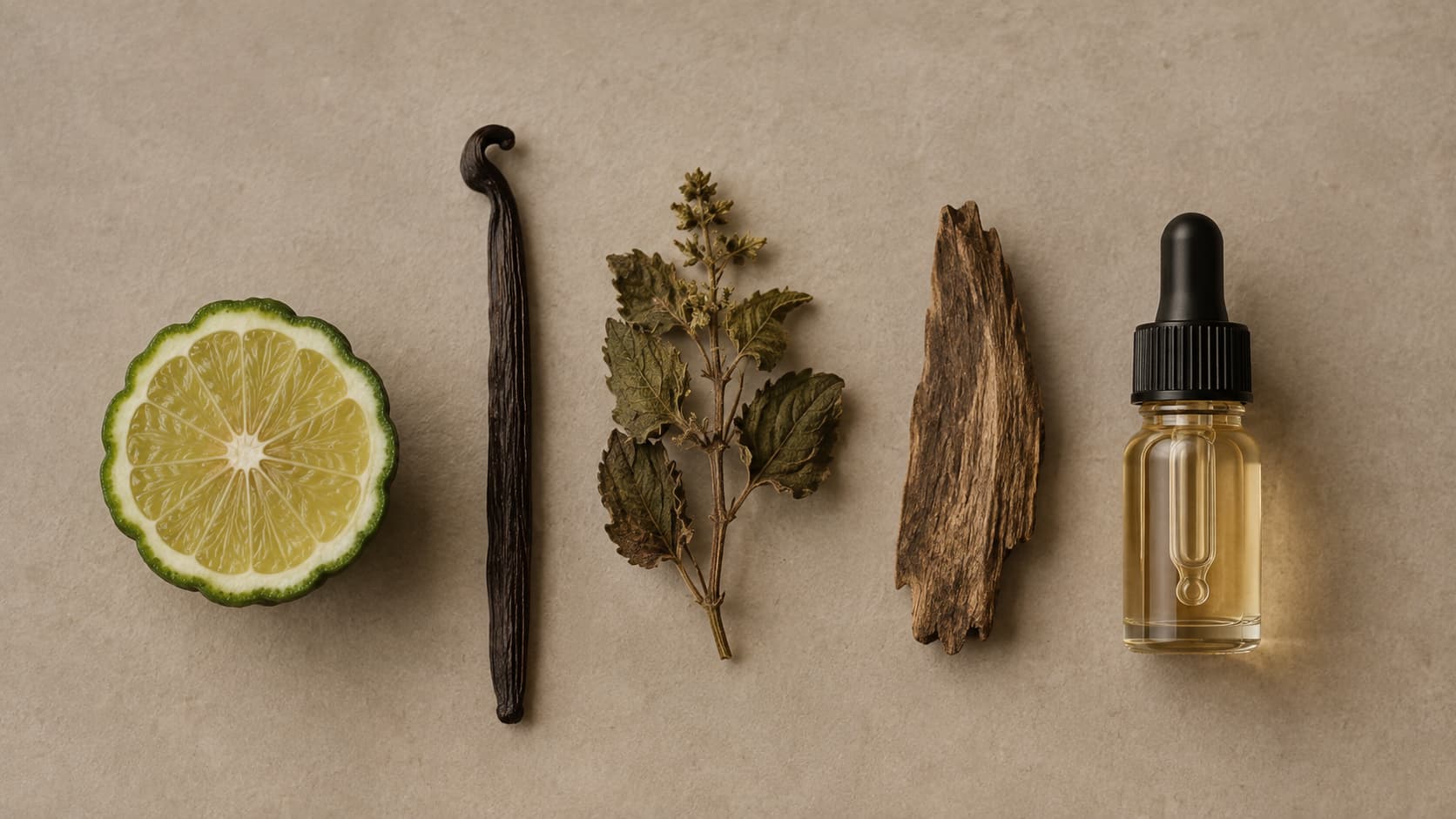
| Bergamot | Natural (citrus peel) | Bright, zesty, slightly floral citrus |
| Vanillin | Usually synthetic | Warm, sweet, classic vanilla |
| Patchouli | Natural (plant leaf) | Earthy, woody, a little smoky |
| Oud | Natural or synthetic | Deep, dark, woody, resinous |
| Iso E Super | Synthetic | Soft woody-amber, almost like skin |
| Ambroxan | Synthetic | Warm, woody-musky, mineral-like |
| Cashmeran | Synthetic | Cozy, musky, slightly spicy |
| Calone | Synthetic | Fresh, watery, “ocean breeze” |
| Coumarin | Natural or synthetic | Sweet hay, almond, vanilla-like |
| Linalool | Natural or synthetic | Soft floral, a bit like lavender |
Bergamot
Bergamot is a citrus fruit that’s too bitter to eat but smells fantastic, and it’s one of the most common opening notes in perfume history. Almost all of it grown for perfumery comes out of Italy, and its bright, tart edge has a way of playing nicely with whatever else is in the formula, which is a big part of why it turns up in such a wide range of scents.
Bergamot is one of the classic ingredients in cologne-style fragrances going back centuries, and it’s still a go-to whenever a perfumer wants a fresh, slightly sharp opening before the rest of the scent unfolds.
Its history with perfume runs deep. In 1709, Italian perfumer Johann Maria Farina had the idea of dissolving bergamot alongside other citrus oils into pure alcohol, something no one had done quite that way before, and the resulting scent became a hit with European royalty within just a few years. He named the fragrance after Cologne, the German city he’d settled in, which is where the entire “eau de cologne” category gets its name — so in a real sense, bergamot is the ingredient that kicked off the whole idea of a light, citrusy splash-on scent.
Vanilla and Vanillin
Vanilla brings warmth and sweetness, and it’s one of the most universally loved smells in perfumery. Real vanilla extract is expensive and limited, so most perfumes actually rely on vanillin, a synthetic compound that recreates vanilla’s warm sweetness far more cheaply and consistently than the real bean.
Vanilla shows up everywhere from cozy gourmand perfumes that smell like dessert to soft floral scents where it just rounds out sharper notes in the background.
Patchouli
Patchouli comes from the dried, fermented leaves of an Asian shrub, and it brings an earthy, woody, almost smoky depth to a fragrance. Perfumers reach for it specifically to lend a composition a sensual, grounded weight, and it’s held that role for decades without falling out of fashion.
It became especially associated with 1960s and 70s counterculture fashion, but today it shows up in everything from unisex woody scents to warm, spicy evening fragrances.
Oud (Agarwood)
Oud is a rich, resinous wood note that comes from agarwood trees after they’ve been infected by a specific type of mold, which triggers the tree to produce a dark, fragrant resin as a defense response. Genuine agarwood oud is one of the most expensive raw materials in the entire perfume industry, since only a small percentage of trees naturally produce enough resin to harvest.
Because true oud is so costly and limited, the vast majority of “oud” perfumes on shelves today use synthetic oud accords built to mimic that same deep, woody, slightly animalic character.
Iso E Super
Iso E Super is a synthetic woody-amber molecule that smells soft and almost like clean skin rather than a strong, obvious “note.” It became famous for being sheer and diffusive, meaning it spreads a gentle scent cloud around the wearer without smelling sharp or overpowering up close.
It shows up constantly in modern minimalist and “skin scent” perfumes, and perfumers often use it in surprisingly large amounts because of how smooth and non-intrusive it is.
The molecule was created at the fragrance company IFF in 1973, but it stayed a behind-the-scenes tool for decades before getting its own moment in the spotlight. Perfumer Geza Schoen eventually stripped a fragrance down to just this one molecule and released it as Molecule 01, betting that wearers would respond to its warm, skin-like quality even with no other ingredients blended in to support it. The gamble paid off and helped kick off a wider trend of stripped-down “skin scent” perfumes that lean on one or two standout synthetics instead of a long list of notes.
Ambroxan
Ambroxan is the synthetic molecule that has largely replaced ambergris in modern perfumery, giving fragrances a warm, woody, slightly mineral base note without relying on anything taken from a whale. It reads as smooth and skin-like rather than sweet or floral, which is why it’s become one of the most common base notes in both designer and niche perfumes today.
Firmenich chemists began hunting for a synthetic stand-in for ambergris back in the 1930s, and by 1950 the company had patented a process for producing ambroxide — one of the compounds behind ambergris’s scent — starting from sclareol, a substance found in clary sage. It took until 1977 for researchers at a different company, IFF, to pin down that ambroxide wasn’t just one ingredient among several responsible for that classic smell, but essentially the single molecule doing most of the work. That plant-based route meant perfumers no longer had to depend on rare, unpredictable whale-derived material to get that warm, ambery base. Ambroxan turned out to be so popular on its own that it got the same treatment as Iso E Super — Geza Schoen built Escentric Molecule 02 entirely around it, following up his single-ingredient Molecule 01.
Cashmeran
Cashmeran is a fully synthetic molecule built to capture the warm, soft, slightly fuzzy feeling of cashmere sweaters. Chemically it belongs to the aldehyde family, and on the skin it reads as a warm, oriental-leaning blend where spice, amber, and soft florals all show up at once rather than any single note dominating.
There’s no natural source for this smell at all — it exists purely because a chemist set out to bottle the idea of comfort and warmth, and it’s now a staple in cozy, sweater-weather fragrances.
Calone
Calone is the ingredient responsible for that “ocean breeze” or “fresh water” smell found in a lot of 1990s and early 2000s fragrances. Its briny, wet-air character comes through strongly, softened by a faint floral edge underneath, and it’s the reason an entire wave of water-themed fragrances was possible in the first place.
There’s no way to extract an “ocean smell” from actual seawater, so this entire category of fresh, aquatic fragrance only exists because of this one synthetic molecule.
Coumarin
Coumarin gives off a sweet, warm smell often compared to fresh-cut hay, almonds, or vanilla. It occurs naturally in tonka beans and a few other plants, but is also produced synthetically for consistency and safety reasons.
It’s one of the oldest synthetic perfume ingredients still in wide use today, and it’s a key part of the “fougère” fragrance family, a category built around a herbal, woody, slightly sweet combination that’s especially common in classic men’s colognes.
That entire fragrance family traces back to one perfume. Houbigant released Fougère Royale in 1882, and it’s widely credited as the moment perfumery shifted into its modern era, largely because coumarin was a lab-made material rather than anything pulled straight from a plant or animal. Ferns themselves don’t actually give off any scent, so Paul Parquet had nothing real to copy — he worked out a combination of lavender, oakmoss, and coumarin that felt fern-like anyway, and it’s the same combination perfumers keep returning to more than a century later.
Linalool
Linalool is a soft, slightly floral, slightly woody smell that shows up in an enormous number of fragrances, often in the background rather than as the star. It occurs naturally in lavender, coriander, and several other plants, and it’s also made synthetically at large scale.
Because it’s so common, linalool is one of the ingredients regulators require to be listed separately on labels when present above a certain amount, since a portion of people can develop skin sensitivity to it over time.
What Are Fixatives and Why Does a Perfume Need Them?
Fixatives are ingredients added specifically to slow down evaporation, which makes a perfume last longer on the skin instead of fading within the hour. Without them, even a beautifully blended perfume would smell wonderful for ten minutes and then vanish.
Historically, fixatives came from animal sources: ambergris, a waxy substance that forms in the digestive system of sperm whales and washes up on beaches after floating in the ocean for years, along with civet (from a gland of the civet cat) and castoreum (from beavers). All three were prized for their ability to make lighter, more fleeting scents last far longer on the skin, even though in their raw, undiluted form they smell more like a barnyard than a perfume counter.
Today almost all fixatives are synthetic, built from heavier, slower-evaporating molecules like certain musks and woody-amber compounds, which sidesteps the ethical and supply problems of the old animal-derived versions. Ambroxan is the best-known example — it does the job ambergris used to do without needing anything sourced from a whale. These heavier ingredients don’t just smell good on their own — their whole purpose is to “hold down” the lighter, more fleeting top notes so the fragrance develops in stages instead of disappearing all at once.
Why Do Some Perfume Ingredients Cause Allergic Reactions?
Certain perfume ingredients are more likely than others to irritate skin or trigger allergies, which is why regulators in places like the European Union require specific ones to be listed by name even when the rest of the formula stays hidden under “parfum.” Linalool, limonene, coumarin, and citral are common examples that show up on ingredient lists this way.
This doesn’t mean those ingredients are unusually dangerous — many of them occur naturally in everyday things like citrus peels and lavender. It simply means that, across a large population, a noticeable number of people react to them, so labeling rules were created to give people with sensitive skin or known allergies a way to check before buying. It’s estimated that somewhere between 1 and 3 percent of people have a genuine fragrance allergy, which sounds small until factoring in how many people wear scented products every day.
The list of ingredients that must be named on a label is also growing. For years, the EU required only 26 fragrance allergens to be individually listed. That changed with a 2023 regulation that tacked on dozens of newly flagged substances, pushing the total past 80, after a scientific safety review concluded the additional ingredients carried a real risk of triggering skin reactions. Companies have until mid-2026 to start applying the new rules to new products, so expect ingredient lists on perfumes and other scented cosmetics to get noticeably longer and more specific in the years ahead.
Frequently Asked Questions
Is synthetic perfume worse than natural perfume?
Not necessarily. Synthetic ingredients go through extensive safety testing before use, and many natural essential oils are actually more likely to cause skin irritation than their synthetic counterparts. “Natural” and “safe” aren’t the same thing, and “synthetic” doesn’t automatically mean harsh or harmful.
Why don’t perfume brands list every ingredient?
Laws in most countries allow “fragrance” or “parfum” to be listed as a single ingredient to protect a brand’s formula from being copied by competitors. Ingredients known to commonly cause allergic reactions are the main exception and usually still have to be listed by name.
What’s the difference between an essential oil and a fragrance oil?
An essential oil is extracted directly from a plant, while a fragrance oil is a blend that can include synthetic aroma chemicals designed to replicate or enhance a particular smell. Fragrance oils are generally more consistent and often more affordable than pure essential oils.
Does a higher price mean better or more natural ingredients?
Not always. Price is influenced by rare raw materials, brand marketing, packaging, and production costs, not purely by how “natural” the formula is. Some expensive perfumes lean heavily on synthetics, and some affordable ones use real essential oils.
Why do some perfumes smell different on different people?
Skin chemistry, body temperature, and even diet can affect how a perfume’s ingredients evaporate and blend on skin. That’s also why testing a perfume on the wrist, rather than just smelling it in the bottle, gives a much more accurate idea of how it will actually smell once worn.
Conclusion
A bottle of perfume looks simple, but it’s really a small chemistry project built from three working parts: a carrier to spread the scent, a mix of natural and synthetic materials to create the actual smell, and fixatives to make sure it doesn’t disappear in minutes — all timed to unfold in the top, heart, and base notes that make a fragrance change over the course of a day. Ingredients like bergamot, vanillin, and patchouli exist alongside lab-built molecules like Iso E Super, Ambroxan, and Cashmeran, and neither category is automatically better than the other — they simply do different jobs. A label that just says “fragrance” or “parfum” becomes far less mysterious with that framework in mind, even if the exact recipe stays a secret.